Project Updates

Tracks blockchain projects from inception to their latest updates and major milestones. By covering project financing, partnerships, and product upgrades, it helps investors stay informed about the latest industry trends and developments.

Circle Releases Arc Network Whitepaper: Can the New Economic Mechanism Drive It to Become the "Clearing Coordination Layer" for Institutional-Grade Stablecoin Payments?

Circle has released the whitepaper for its Arc Network, detailing plans for a new economic coordination layer using the proposed ARC token. Arc is a Layer 1 blockchain designed for enterprise-level stablecoin payments, featuring USDC as its native gas token, a high-performance consensus mechanism for instant transaction finality, and optional enterprise privacy features. Currently operating on a Proof-of-Authority (PoA) model, the network plans a future transition to a Proof-of-Stake (PoS) system. The ARC token is intended to serve as the network's native coordination asset, facilitating governance, enabling staking rewards, and managing fee mechanisms. User fees paid in stablecoins would be converted to ARC, with portions distributed as rewards and burned. The governance model will blend token-based voting with institutional oversight, especially for high-sensitivity matters like security and compliance. While positioning Arc as a potential settlement layer for institutional stablecoin payments, the whitepaper acknowledges challenges. These include the network's current centralization, the unfinished and potentially volatile ARC token economics, and the evolving global regulatory landscape for stablecoins. The development signals a broader industry trend where Web3 infrastructure competition is shifting from pure performance to factors like liquidity, compliance, and institutional-grade stability.

marsbit05/13 02:04

Circle Releases Arc Network Whitepaper: Can the New Economic Mechanism Drive It to Become the "Clearing Coordination Layer" for Institutional-Grade Stablecoin Payments?

marsbit05/13 02:04

Casper Network Publishes the Casper Manifest, a Multi-Year Roadmap to Power Regulated Real-World Assets and the Machine Economy

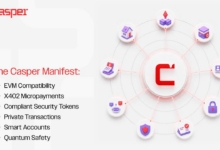
The Casper Association has published "The Casper Manifest," a multi-year technical roadmap for Casper Network. Introduced at the Digital Finance Forum in Bermuda, the roadmap outlines nine coordinated initiatives designed to position the layer-1 blockchain as the infrastructure for regulated real-world asset (RWA) tokenization and the machine-to-machine economy. Key initiatives focus on: 1. **Developer Access:** Adding full Ethereum Virtual Machine (EVM) compatibility alongside its existing WebAssembly (Wasm) execution layer. 2. **User Experience:** Implementing gasless transactions, batch operations, and smart accounts with biometric authentication. 3. **Institutional Compliance & Privacy:** Building compliant security tokens aligned with the ERC-3643 standard and a multi-phase roadmap for confidential transactions with built-in audit tools. 4. **Machine Economy:** Implementing the X402 open payment standard to enable AI agents and machines to make autonomous, programmatic micropayments. 5. **Token Infrastructure:** Creating a Native Token Registry to give all tokens protocol-level status with fixed, predictable costs. 6. **Quantum Safety:** Developing hybrid accounts with both classical and quantum-resistant keys. The first initiative, X402 micropayments, is expected within weeks. Subsequent releases through 2026 and 2027 will include EVM compatibility, compliant security tokens, the Native Token Registry, gasless transactions, and quantum-safe features. The goal is to create a blockchain that is frictionless for users, trusted by institutions, and native for machines.

TheNewsCrypto05/12 13:20

Casper Network Publishes the Casper Manifest, a Multi-Year Roadmap to Power Regulated Real-World Assets and the Machine Economy

TheNewsCrypto05/12 13:20

Can the Solana Foundation and Google's Collaboration on Pay.sh Bridge the Payment Link Between Web2 and Web3 in the Agent Economy?

Solana Foundation, in collaboration with Google Cloud, has launched Pay.sh, a payment gateway designed to bridge the gap between AI agents and enterprise-grade service infrastructure. The initiative aims to solve a key bottleneck in the "agent economy": existing payment systems are ill-suited for autonomous AI agents. Traditional methods like credit cards require human verification, while newer on-chain protocols like x402 and MPP create a separate, Web3-native system that raises barriers for service providers. Pay.sh functions as a universal payment layer. It allows users to fund a Solana wallet via credit card or stablecoin, which then acts as an identity and payment proxy for AI agents. When an agent needs to access a paid API service (e.g., Google Cloud, Alibaba Cloud), Pay.sh handles the transaction seamlessly. It leverages the HTTP 402 status code ("Payment Required") to initiate payments, intelligently choosing between one-time transfers (x402-style) or session-based authorizations (MPC-style) based on the service's billing model. This spares agents from manual account registration and API key management. A key feature for service providers is low integration effort. They can adopt Pay.sh by providing a declarative configuration file, enabling features like tiered pricing, free tiers, and automatic revenue splitting to multiple addresses (e.g., for royalties, cloud costs). Providers can also list their APIs in a central Pay Skill Registry for agent discovery. The collaboration with Google Cloud provides crucial infrastructure for API proxying, traffic routing, and compliance logging, aiming to keep agent activities within regulated boundaries. By connecting Web2 services with Web3 payment rails, Pay.sh positions the Solana wallet as a foundational identity and payment tool for AI agents, potentially driving more transaction volume to the Solana ecosystem. However, the report notes challenges. The service registry currently lacks robust vetting, risking exposure to unauthorized or malicious third-party APIs. Pay.sh also inherits security and compatibility risks from its underlying payment protocols (x402, MPC). Furthermore, adoption may be hindered by varying regional data privacy and payment compliance regulations among API providers. Despite these hurdles, Pay.sh represents a significant step towards integrating Web2 and Web3 for autonomous agent commerce.

marsbit05/12 10:16

Can the Solana Foundation and Google's Collaboration on Pay.sh Bridge the Payment Link Between Web2 and Web3 in the Agent Economy?

marsbit05/12 10:16

活动图片