Project Updates

Tracks blockchain projects from inception to their latest updates and major milestones. By covering project financing, partnerships, and product upgrades, it helps investors stay informed about the latest industry trends and developments.

MuleRun CTO: The Moat of Agents Lies in Data Density and User Memory

In a speech titled "Handing AI's Keys to the On-Chain Controllers," MuleRun CTO Shu Junliang discussed the evolution and security of AI Agents in finance and Web3. He outlined six dimensions for a complete AI assistant: dialogue, data input, agent capability, execution environment, user memory, and continuous learning. MuleRun's product integrates these through features like multi-platform IM bots, real-time multi-asset data, smart model routing, cloud sandboxes, persistent user profiles, and a shared knowledge network. Shu emphasized that while AI Agents are advancing from assisting to autonomously executing decisions—potentially enabling individuals to operate like small funds—safety remains paramount. He detailed MuleRun's security measures, including local key handling, isolated sandboxes, full audit trails, and strict permission controls. However, he acknowledged persistent risks like data exposure, model hallucinations, prompt injection, and the "black box" nature of AI decisions, advising manual confirmation for financial operations. He identified key trends: the shift from human-led to Agent-led on-chain interactions requiring infrastructure redesign; the erosion of information advantages replaced by competition in execution speed and strategy; and the balancing effect of Agents, which democratize access but ultimately advantage those with superior judgment. Shu concluded that an Agent's true moat lies in data density and accumulated user memory, not easily replicable technology, and that while Agents will reshape finance and Web3, human oversight over critical decisions must remain.

marsbit05/14 08:50

MuleRun CTO: The Moat of Agents Lies in Data Density and User Memory

marsbit05/14 08:50

EASY Residency Season 3 Graduation List Released: Which Tracks is YZi Lab Focusing On?

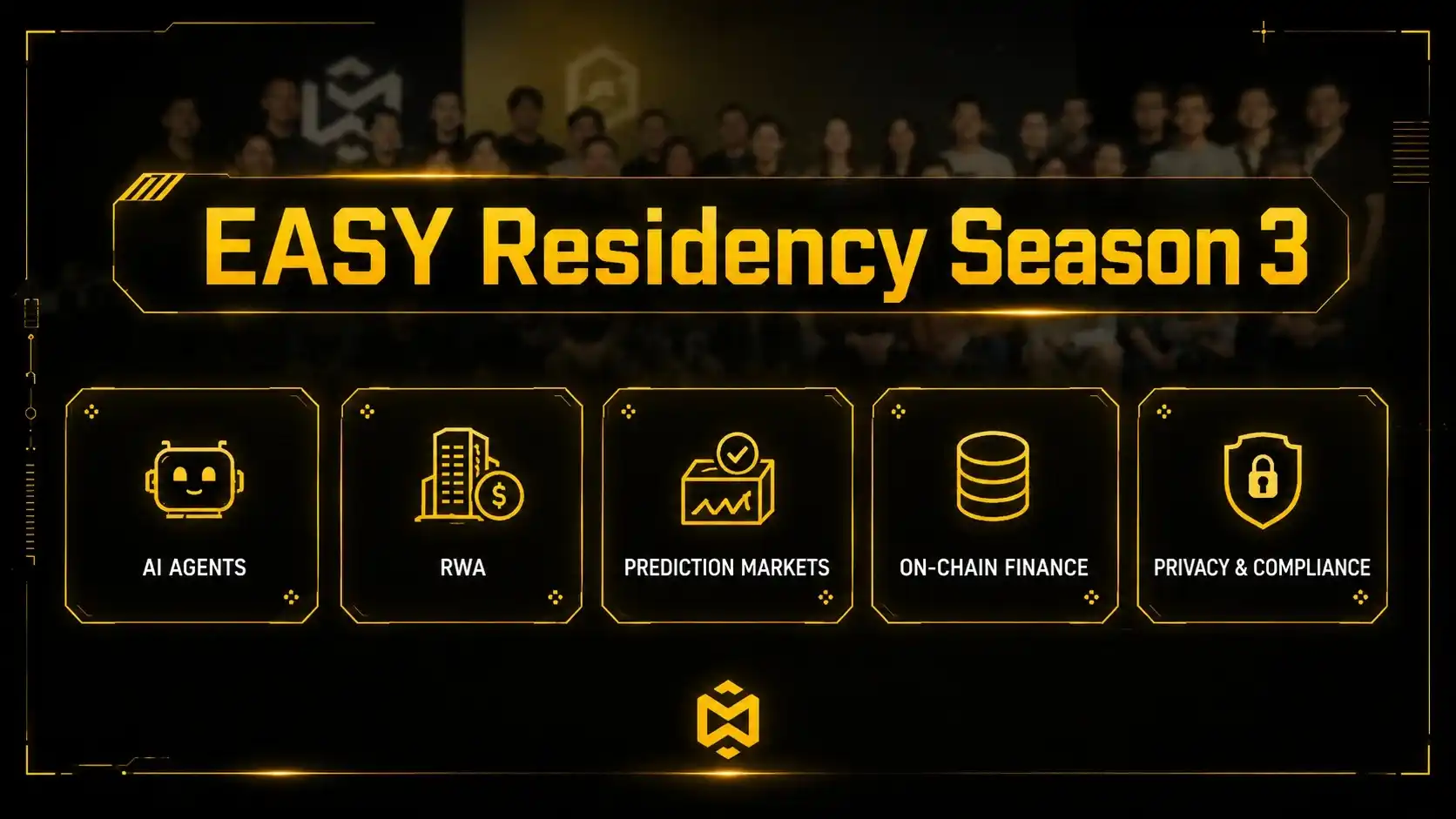
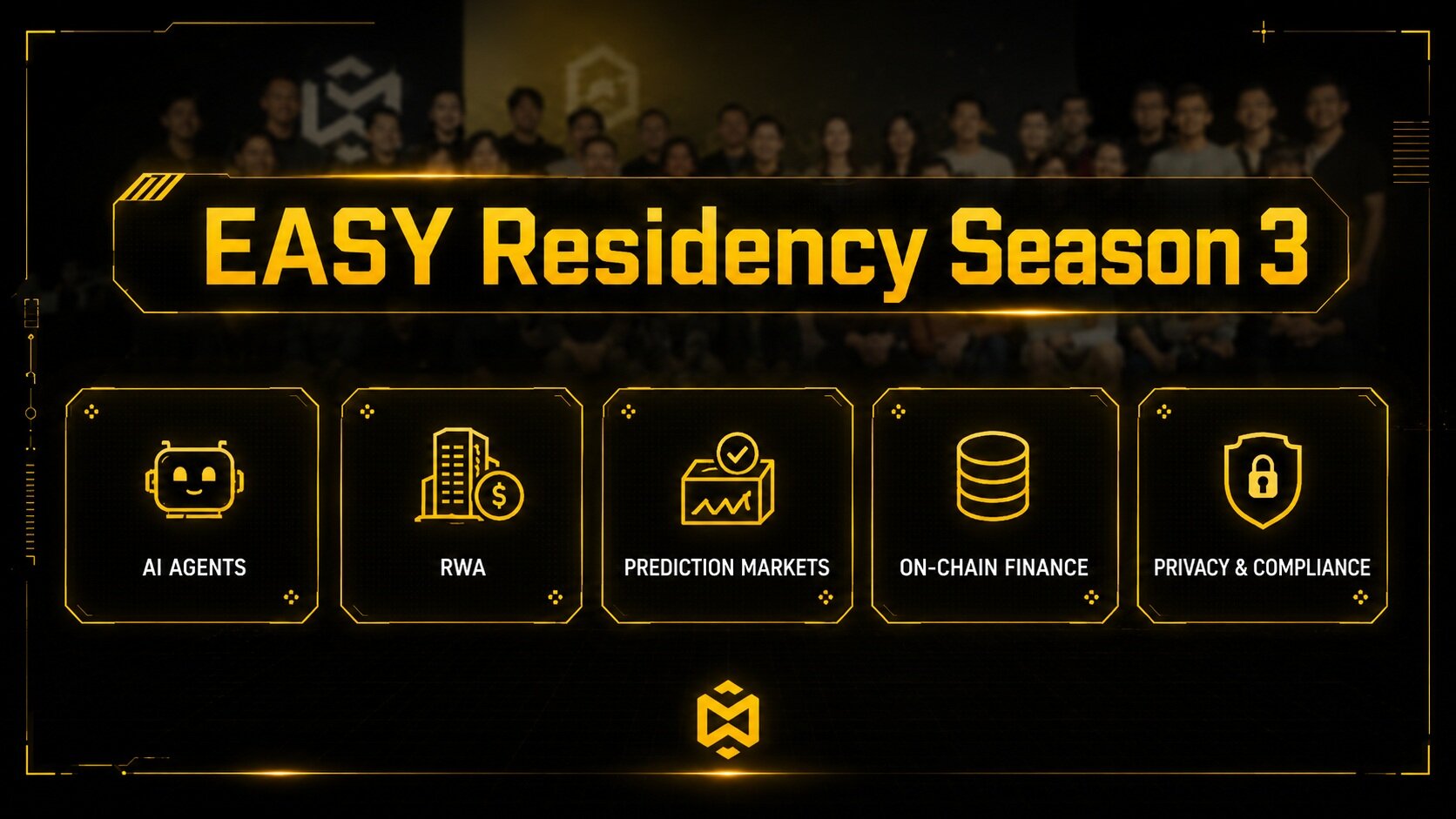
YZi Labs has announced the 25 graduating projects from the third season of its flagship incubation program, EASY Residency. This cohort is focused on key Web3 sectors including the reconstruction of on-chain financial market structures, AI agents, tokenized real-world assets (RWA), prediction markets, and privacy/compliance infrastructure. The selected projects span a wide range of applications. In the AI and infrastructure domain, Bank of AI provides identity and payment infrastructure for AI agents on BNB Chain, while Cournot focuses on making AI probabilistic outputs verifiable. Functor addresses self-custody authorization for AI agent workflows. For decentralized finance (DeFi) and trading, several projects aim to enhance liquidity and user experience. LunarBase offers CEX-level on-chain liquidity, Möbius is building a unified margin layer, and Nemesis is a permissionless margin trading protocol. Others like LayerV and Vibe.fun are working on structured products and exotic derivatives. The RWA and asset tokenization category includes Renaiss, which provides liquidity infrastructure for physical collectibles, and Openstocks, a platform for tokenized private market exposure. Prediction markets and novel financial primitives are represented by Polysights (automation infrastructure for prediction markets) and PokerFi (an on-chain poker skill-games options market). Privacy and compliance are addressed by projects like 0xBow.io, which offers compliance-oriented privacy infrastructure, and SilentSwap, a cross-chain privacy swap protocol. The list also features projects targeting specific niches or improving core processes, such as Isaac, a non-interest stablecoin neobank for the Muslim market, Brief Tech, an AI-powered legal evidence indexing tool, and Flap, a programmable token launch infrastructure. Overall, this cohort reflects YZi Labs' investment thesis in foundational infrastructure layers, AI integration, sophisticated DeFi products, and real-world asset tokenization, aiming to advance the usability and capability of the on-chain ecosystem.

marsbit05/14 02:09

EASY Residency Season 3 Graduation List Released: Which Tracks is YZi Lab Focusing On?

marsbit05/14 02:09

EASY Residency Season 3 Graduation List Announced: Which Sectors is YZi Lab Eyeing?

YZi Labs has announced the 25 projects graduating from the third season of its flagship incubation program, EASY Residency. The cohort focuses on key areas such as rebuilding on-chain financial market structures, AI agents, tokenized real-world assets (RWA), prediction markets, and privacy/compliance infrastructure. Notable projects include: Bank of AI, building AI Agent identity and payment infrastructure for BNB Chain; Cournot, creating a verifiable reasoning platform for AI probability outputs; and LunarBase, a liquidity platform aiming for CEX-like execution quality on Base and BNB Chain. Other highlights are: Flap, a programmable token launch infrastructure; GEMINT, a marketplace for collectibles and IP assets; and Renaiss, providing liquidity infrastructure for physical collectibles as RWAs. In DeFi, projects like Möbius (unified margin layer), TermMax (fixed-rate lending), and LayerV (on-chain options) aim to enhance sophistication and capital efficiency. Several projects tackle AI automation, such as Newsliquid (automating news-based trading) and Taco AI (AI agent trading). Privacy and compliance are addressed by 0xBow.io (privacy infrastructure with compliance proofs) and SilentSwap (private cross-chain swaps). The selection reflects YZi Labs' focus on foundational infrastructure across AI, DeFi, tokenization, and next-generation financial primitives, supporting early-stage projects that aim to advance these critical sectors.

Odaily星球日报05/14 02:02

EASY Residency Season 3 Graduation List Announced: Which Sectors is YZi Lab Eyeing?

Odaily星球日报05/14 02:02

Wall Street Capital Enters ARC, Circle Sparks a System-Level Competition for Stablecoins

Wall Street Capital Enters the ARC Arena as Circle Launches a System-Level Battle for Stablecoin Dominance On May 11, Circle successfully raised $222 million in a pre-sale funding round for its new blockchain and native token, ARC, giving the network a fully diluted valuation of $3 billion. The investor lineup, featuring Wall Street giants like BlackRock and Intercontinental Exchange alongside top-tier venture capital firms such as a16z and ARK Invest, signaled a collective strategic bet on future financial infrastructure. This move marks Circle's significant evolution from a stablecoin issuer (notably USDC) to a designer of financial systems. While USDC operates on external blockchains like Ethereum, making Circle dependent on their performance, ARC aims to create a dedicated infrastructure for the circulation, payment, and clearing of stablecoins. This would integrate currency issuance and circulation into one system, potentially shifting Circle's business model from asset management to infrastructure provision. The convergence of traditional finance and crypto-native capital in this funding round underscores a broader industry shift: stablecoins are transitioning from being mere trading tools to becoming core components of financial infrastructure. By controlling both the issuance (via USDC) and the流通 pathway (via ARC), Circle could establish a closed-loop system from issuance to settlement. If successful, this infrastructure could optimize costs, lower barriers for institutional adoption, and promote standardization in on-chain finance. Ultimately, it has the potential to challenge traditional systems like SWIFT in areas such as cross-border payments, representing a possible step toward the重构 of global financial infrastructure.

marsbit05/13 14:54

Wall Street Capital Enters ARC, Circle Sparks a System-Level Competition for Stablecoins

marsbit05/13 14:54

活动图片