# Сопутствующие статьи по теме Productivity

Новостной центр HTX предлагает последние статьи и углубленный анализ по "Productivity", охватывающие рыночные тренды, новости проектов, развитие технологий и политику регулирования в криптоиндустрии.

3 People with 100 AI Programmers, Burning Through $1.3 Million a Month! OpenAI: I'll Foot the Bill

In a striking demonstration of AI-powered development, Peter Steinberger (creator of OpenClaw) shared that his three-person team spent $1.3 million in one month to run approximately 100 AI agents (primarily Codex instances). OpenAI covered the cost. The expenditure consumed 6.03 trillion tokens across 7.6 million requests. Steinberger argues that, with "fast mode" disabled, the cost falls below that of a single engineer while providing significantly greater output. This "cloud programmer army" handles core but tedious software engineering tasks: reviewing pull requests, finding security vulnerabilities, deduplicating issues, fixing bugs, monitoring benchmarks, and even generating PRs after meetings. This shifts AI's role from merely writing code to maintaining the entire collaborative fabric of a project. Steinberger's tool, CodexBar (a macOS menu bar app), tracks usage and costs across various AI coding services, highlighting how token consumption is becoming a key metric—a new "means of production." The experiment poses a profound question: if token cost ceases to be a barrier, how will software development transform? As model prices fall, the capability for small teams to leverage large numbers of AI agents could become commonplace, fundamentally altering the scale and speed of development. The future, Steinberger suggests, is arriving rapidly.

marsbit23 ч. назад

3 People with 100 AI Programmers, Burning Through $1.3 Million a Month! OpenAI: I'll Foot the Bill

marsbit23 ч. назад

No Coding Required: Build Your First AI Agent in 2 Days (Complete Tutorial)

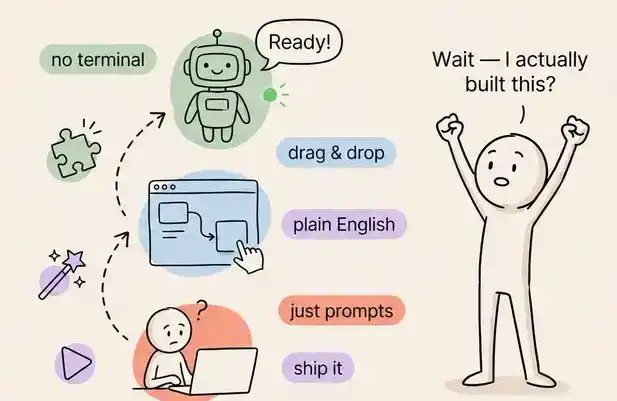
A No-Code Guide to Building Your First AI Agent in a Weekend This article presents a weekend, zero-code tutorial for beginners to build a functional AI Agent using tools like Claude. It clarifies the core difference between a chatbot, which responds to queries, and an Agent, which autonomously plans and executes multi-step tasks using tools to deliver a final result. The process is broken into four stages over two days: 1. **Saturday Morning: Understanding Agents.** Learn that an Agent requires a clear Goal, a Plan, necessary Tools, and an execution Loop. Identify a simple, multi-step task from your own work/life as your first project. 2. **Saturday Afternoon: Building with Claude.** Create a one-page "Agent Blueprint" answering: the Goal, sequential Steps, required Tools, the desired Output format, and error-handling rules. Implement this blueprint in Claude (Desktop Cowork or web Projects) and run the Agent for the first time. 3. **Sunday Morning: Debugging & Optimization.** Review the initial (often 60-70% accurate) output. Identify flaws, trace them back to vague instructions in your blueprint, and refine it with more specific criteria and error handling. Iterate this run-review-refine cycle 3-4 times to reach ~90% reliability. 4. **Sunday Afternoon: Expansion.** Apply the learned workflow to quickly build a second, different Agent (e.g., for research, content repurposing, or meeting prep), experiencing the compounding efficiency gains. The core skill is not writing a perfect blueprint initially, but rapidly iterating based on output. By the end of the weekend, you'll have built two usable Agents, moving beyond just chatting with AI to automating multi-step workflows, fundamentally changing how you approach repetitive tasks.

marsbitВчера 15:19

No Coding Required: Build Your First AI Agent in 2 Days (Complete Tutorial)

marsbitВчера 15:19

YC Partner Reveals: Building an AI-Native Company from Scratch

"YC Partner Reveals: Building an AI-Native Company from Scratch" YC partner Diana Hu argues that true AI-native companies operate 1000x faster than incumbents, not by using AI for mere efficiency, but by making it the company's core operating system. This requires a fundamental shift: companies must become "queryable" to AI, with all workflows and communications generating data for AI to learn from, creating a "closed-loop" system for continuous optimization. For example, an AI agent with access to tickets, code, meetings, and customer feedback can analyze past performance and autonomously plan future engineering cycles, dramatically increasing output. In product development, the new paradigm is the "AI software factory": humans write specifications and tests, while AI agents generate the code. This transparent, data-driven model renders traditional middle management obsolete. Future AI-native companies will consist of three roles: Independent Contributors (who build/operate with AI), Directly Responsible Individuals (who own outcomes), and the AI Founder who leads by example. The critical shift is maximizing token usage over headcount. A small, AI-augmented team can outperform large traditional teams. Startups have a key advantage: they can design their entire culture and systems around AI from day one, unburdened by legacy processes. The core takeaway: Founders must personally experience AI's transformative power. The future belongs to those who embed AI into their company's DNA from the start.

marsbit05/15 01:12

YC Partner Reveals: Building an AI-Native Company from Scratch

marsbit05/15 01:12

Warsh Takes the Helm at the Fed: A Capital Layout Clearing the Way for AI Productivity

Kevin Warsh's confirmation as the 17th Federal Reserve Chair signals a significant strategic pivot, not merely a political victory. The core narrative, as framed by the author's "Universal Code," is that capital flows towards maximizing intelligence output per unit of energy—currently represented by the AI-driven semiconductor and energy infrastructure boom. Warsh, uniquely among candidates, is a former tech investor who has personally invested in this AI "productivity miracle." His mandate is to enable this transformation by aligning monetary policy to support, not stifle, the capital-intensive AI buildout. His proposed policy framework blends elements of 1950s financial repression with Alan Greenspan's 1990s playbook: tolerating higher headline inflation driven by volatile components (e.g., energy) while relying on AI-driven productivity gains to suppress core inflation and unit labor costs. This allows for a more accommodative stance than conventional models suggest. The strategy's success hinges on a coordinated "Treasury-Fed Accord" with Treasury Secretary Bessant. Bessant's role is international: securing foreign demand for long-term U.S. debt through bilateral agreements (e.g., with China, Japan, Gulf states) that offer access to AI infrastructure in exchange for recycling trade surpluses into Treasuries. A weaker dollar and controlled real yields are essential to make this foreign duration buying viable. Warsh's Fed must avoid overly restrictive policy that would break this flow. The underlying coalition driving this agenda consists of crypto founders, AI infrastructure operators, and energy investors seeking policy stability. While Warsh's initial meetings may not deliver immediate rate cuts, they will signal a shift in focus toward core inflation and greater policy discretion. The critical variable is the bond market. If long-term yields, term premiums, or real yields rise beyond certain thresholds (e.g., 10-year yields above 5.5%), the entire architecture could fail regardless of Fed actions. The next six months will determine whether the bond market grants the new Fed Chair the space to implement this framework. If successful, the cycle extends, benefiting risk assets, cryptocurrencies, and AI capital expenditure stocks. The market's current pricing of a conventional inflation fight creates an asymmetry versus this productivity-led, financially repressive framework, which represents the potential for significant returns.

marsbit05/14 10:07

Warsh Takes the Helm at the Fed: A Capital Layout Clearing the Way for AI Productivity

marsbit05/14 10:07

The Essence of AI Layoffs: Why More AI Adoption Leads to More Corporate Anxiety?

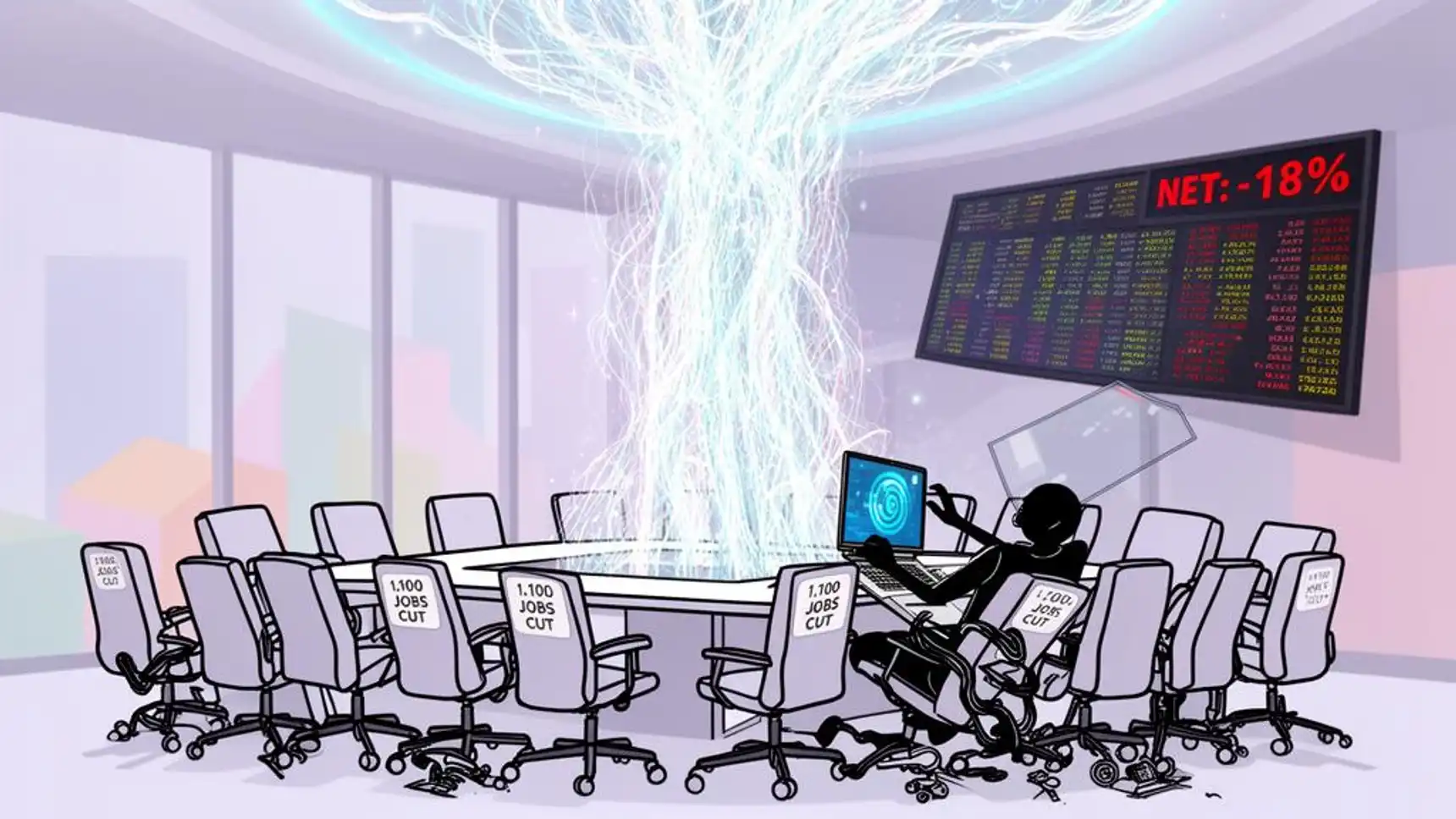
The author, awaiting potential inclusion on an 8000-person layoff list, analyzes the true nature of recent "AI-driven" layoffs. They argue that while AI use, particularly tools like Claude for code generation, has skyrocketed and boosted developer output (e.g., 2-5x more code commits), this has not translated into proportional business growth or revenue. The core issue is a misalignment between increased "Input" (code) and tangible "Outcomes" (user value, revenue). AI acts as a costly B2B SaaS, inflating operational expenses without guaranteed returns. Two key problems emerge: 1) The friction that once filtered out bad ideas is gone, as AI allows cheap pursuit of even weak concepts. 2) Organizational "alignment tax"—the difficulty of coordinating across teams—becomes crippling when development velocity outpaces consensus-building. Thus, layoffs serve two immediate purposes: 1) To offset ballooning AI costs (Token consumption) and maintain cash flow, as rising input costs without outcome growth destroys unit economics. 2) To reduce organizational bloat and alignment friction by simply removing teams, thereby speeding up execution in the short term. Therefore, these layoffs are fundamentally caused by AI, even if AI doesn't directly replace roles. They represent a painful correction until companies learn to convert AI-driven productivity into real business outcomes and streamline organizational coordination to match the new pace of work. The cycle will continue until this learning curve is mastered.

marsbit05/12 10:23

The Essence of AI Layoffs: Why More AI Adoption Leads to More Corporate Anxiety?

marsbit05/12 10:23

How to Automate Any Workflow with Claude Skills (Complete Tutorial)

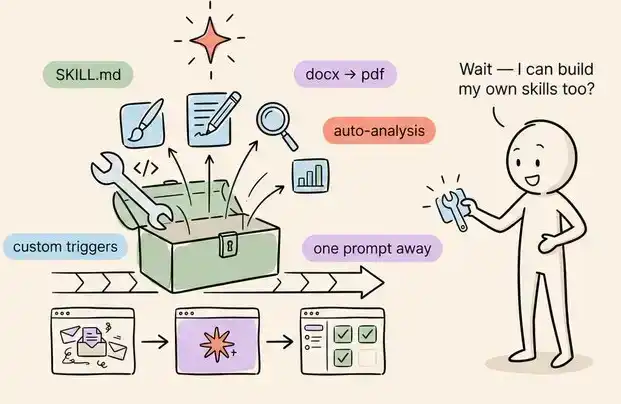
This is a comprehensive guide to mastering Claude Skills, a feature for creating permanent, reusable instruction sets that automate specific workflows. Unlike simple saved prompts, Skills function like trained employees, delivering consistent, high-quality outputs by defining the entire task process, standards, error handling, and output format. The guide is structured in four phases: **Phase 1: Installation (5 minutes).** Skills are folders containing a `SKILL.md` file. The user is instructed to find a relevant Skill online, install it, test it on a real task, and compare its performance to one-off prompts. **Phase 2: Building Your First Custom Skill.** Start by rigorously defining the Skill's purpose, trigger phrases, and providing a concrete example of perfect output. The `SKILL.md` file has two parts: a YAML frontmatter with a specific name/description/triggers, and a detailed, step-by-step workflow written in natural language with examples and quality standards. **Phase 3: Testing & Optimization for Production.** Test the Skill in three scenarios: 1) a standard, common task; 2) edge cases with missing or conflicting data; and 3) a pressure test with maximum complexity. Any failure indicates a needed instruction. Implement a weekly optimization cycle to continuously refine the Skill based on real usage. **Phase 4: Building a Complete Skill Library.** The goal is to create a team of Skills for all repetitive tasks. Examples are given for industries like real estate, marketing, finance, consulting, and e-commerce. The user should list their tasks, prioritize them, and build one new Skill per week, maintaining a master document to track their library. The conclusion emphasizes the compounding time savings: ten Skills saving 30 minutes each per week reclaims over 260 hours (6.5 work weeks) per year, fundamentally transforming one's work system.

marsbit05/12 09:45

How to Automate Any Workflow with Claude Skills (Complete Tutorial)

marsbit05/12 09:45

活动图片