CFTC gives prediction markets leeway on data and record-keeping rules

cointelegraphPublished on 2025-12-12Last updated on 2025-12-12

Abstract

The U.S. Commodity Futures Trading Commission (CFTC) has issued no-action letters to several prediction market platforms—including Polymarket US, LedgerX, PredictIt, and Gemini Titan—exempting them from certain swap data reporting and record-keeping requirements. The exemption applies under specific conditions, such as ensuring full collateralization of contracts and publishing transaction data post-execution. Prediction markets allow trading on event outcomes and are regulated as designated contract markets. The no-action relief temporarily reduces enforcement risk but does not change existing laws. The sector has seen significant growth, with platforms like Kalshi and Polymarket recording billions in trading volume.

The Commodity Futures Trading Commission has issued “no-action” letters to a group of prediction markets, exempting them from requirements related to swap data reporting and record-keeping regulations.

The CFTC’s Division of Market Oversight and the Division of Clearing and Risk won’t initiate enforcement action against several prediction market platforms for shirking certain recordkeeping demands, provided they follow other specific requirements, the agencies said in a statement on Thursday.

“The no-action letters apply only in narrow circumstances and are comparable to no-action letters issued for other similarly situated designated contract markets and derivatives clearing organizations,” they added.

The companies that received a no-action letter are Polymarket US, LedgerX, PredictIt and crypto exchange Gemini’s prediction markets arm, Gemini Titan.
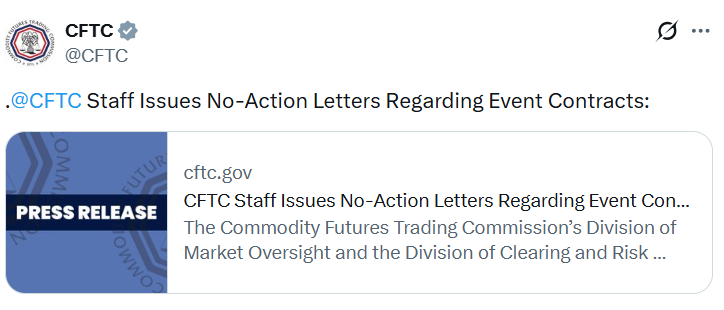
Source: CFTC


As part of the requirements to avoid enforcement, the platforms must fully collateralize all their contracts by ensuring its completely covered by assets held in reserve, and also publish time and sales data for all event contract transactions on their websites “after execution of the transactions,” according to the letters.

Prediction markets and event contracts enable traders to take positions on the outcome of various events, including sports and unconventional topics such as the clothing choices of political figures.

These contracts trigger extensive reporting and record-keeping obligations in the US as prediction markets are regulated as designated contract markets; however, the no-action letter now frees them from the threat of immediate enforcement risk if those obligations aren’t kept.

Related: Gemini soars 14% as new license opens door to US prediction markets

A no‐action letter means the CFTC staff won’t recommend enforcement if the requesting party fails to comply with certain regulations under very specific terms; however, it doesn’t change the law, and they are generally used to temporarily reduce regulatory risk while the market or product evolves.

Prediction markets record bumper 2025

Prediction markets have become one of the most popular crypto offerings this year, with trading volumes on platforms such as Kalshi and Polymarket regularly recording billions of transactions.

Kalshi has had a trading volume of $5.`14 billion over the last 30 days, according to DeFi data aggregator DefiLlama. In comparison, Polymarket, a cryptocurrency-based prediction market, has recorded $1.9 billion in trading volume over the last 30 days.

Crypto.com recently began offering a prediction market platform, which is set to be integrated with Trump Media, while tech researcher Jane Manchun Wong said on Nov.19 that website data indicated Coinbase was also working on creating a prediction market platform.

Magazine: Can Robinhood or Kraken’s tokenized stocks ever be truly decentralized?

Related Reads

This Chip Sector Is on Fire

The global AI chip market is undergoing a significant paradigm shift, with ASICs (Application-Specific Integrated Circuits) emerging from a niche to a mainstream force, challenging the long-held dominance of GPUs in AI training. This "golden era" for ASICs is primarily driven by the industry's pivot from training to inference, where the cost and energy efficiency advantages of custom chips become critical for scaling to billions of users. Key signals include Google's TPU capturing 78% of its AI server shipments in Q1 2026, OpenAI's plans for a massive custom ASIC cluster with Broadcom, and cloud providers (CSPs) increasingly favoring in-house or custom designs for supply chain control and cost efficiency. Market forecasts are bullish: AI ASIC revenue is projected to hit $300 billion by 2027, with a 34% CAGR, potentially reaching a 45% share of the AI chip market. The competitive landscape is expanding beyond traditional leaders Broadcom and Marvell. MediaTek is aggressively targeting the data center ASIC market, projecting over $10 billion in 2026 revenue, while Qualcomm, leveraging its AlphaWave acquisition, is launching customized inference chips. These mobile chip giants are leveraging their SoC design expertise for a cloud-side transition. In China, companies like VeriSilicon and ASR Microelectronics are capitalizing on this trend as pivotal "enablers," providing full-stack ASIC design services and experiencing explosive order growth, particularly for cloud-side AI projects. However, challenges remain: high development costs, software ecosystem gaps compared to NVIDIA's CUDA, dependency on advanced packaging capacity (like TSMC's CoWoS), and the fundamental trade-off between customization and flexibility. The future is not a simple replacement of GPUs by ASICs but a more specialized coexistence. The consensus points toward "GPUs for training, ASICs for inference," or hybrid clusters. Ultimately, the rise of ASICs represents a democratization of computing power, shifting definition authority from a single chip giant to a broader ecosystem of cloud providers and end-users, offering the industry more choice in the silicon that powers AI.

marsbit41m ago

This Chip Sector Is on Fire

marsbit41m ago

Trading

Spot
Futures

Hot Articles

What is GENIUS

I. Project Introduction1. What Is Genius?Genius (GENIUS) is positioned as the “ultimate on-chain terminal,” a decentralized trading platform focused on privacy and speed. By integrating top-tier privacy technology, it aims to build a next-generation privacy trading infrastructure across networks such as BNB Chain, enabling users to interact on-chain with a seamless experience comparable to centralized exchanges.2. How Does Genius Work?Genius's core technical architecture is structured as follows:(1) Chain-invisible: Users do not need to manually handle multi-step approvals for cross-chain operations, asset wrapping, or complex gas management.(2) Signatureless Trading: Through integrations such as Turnkey, Genius enables instant trading without pop-up confirmations or per-transaction authorization.(3) Aggregator of Aggregators: Genius is powered by a best-in-class aggregation stack integrated with more than 150 DEXs, claiming superior quote efficiency compared with competing products.(4) Account Management: The platform adopts a non-custodial architecture and leverages Turnkey and Lit Protocol for key management, allowing users to securely access their accounts through passkeys.3. Who Created Genius?According to its official Terms of Service, Genius was developed by Shuttle Labs, Inc. Based on the project’s official X account, Ryan Myher is one of the key contributors driving product iteration, including developments such as the rollout of the Ghost protocol, as well as broader community engagement.Binance founder CZ has officially joined the project as an advisor, with the goal of helping the team build a faster and more privacy-preserving on-chain trading experience.In addition, the project has received strong backing from YZi Labs, which has invested in Genius and works alongside the Genius Foundation, responsible for maintaining the core Genius Bridge Protocol (GBP).4. Genius TokenomicsGENIUS is the native token of the Genius ecosystem. As of now, the project has not released a full tokenomics document.Based on the latest official disclosures, Genius incorporates a deflationary mechanism, and 4.6% of the total token supply had already been burned during the early launch phase.Genius Points (GP) System:(1) Trade-to-Earn: The platform has established a reward pool of 200 million Genius Points, and users earn GP for every trade executed through the terminal.(2) Tiering and Badges: Genius features a progression-based badge system ranging from Smart to God, with higher levels unlocking additional perks and benefits.(3) Native Yield: Users holding designated assets such as usdGG in the dashboard can earn native yield directly without going through complex staking.(4) Referral Incentives: Referrers can earn fee rebates of over 45% paid in USDC, along with additional GP.5. Timeline & Key MilestonesMarch 2020: The project’s official X account was created, marking the beginning of its early preparation phase.January 13, 2026: Genius announced a multi-million-dollar investment from YZi Labs and simultaneously confirmed CZ as an advisor to accelerate the buildout of its privacy trading infrastructure.April 18, 2026: The project announced that the Ghost privacy protocol would be launching soon.April 29, 2026: The Ghost protocol officially opened to its first 50 testers, marking the beginning of a new era for privacy trading on BNB Chain. At the same time, the team confirmed 4.6% of tokens have been burnt.​II. Token Information1) Basic InformationToken name: GENIUS (Genius)III. Related LinksWebsite:https://www.tradegenius.com/homeExplorers:https://bscscan.com/address/0x1f12b85aac097e43aa1555b2881e98a51090e9a6Socials:https://x.com/GeniusTerminalNote: The project introduction comes from the materials published or provided by the official project team, which is for reference only and does not constitute investment advice. HTX does not take responsibility for any resulting direct or indirect losses.

1.2k Total ViewsPublished 2026.04.29Updated 2026.05.11

What is GENIUS

How to Buy GENIUS

Welcome to HTX.com! We've made purchasing Genius (GENIUS) simple and convenient. Follow our step-by-step guide to embark on your crypto journey.Step 1: Create Your HTX AccountUse your email or phone number to sign up for a free account on HTX. Experience a hassle-free registration journey and unlock all features.Get My AccountStep 2: Go to Buy Crypto and Choose Your Payment MethodCredit/Debit Card: Use your Visa or Mastercard to buy Genius (GENIUS) instantly.Balance: Use funds from your HTX account balance to trade seamlessly.Third Parties: We've added popular payment methods such as Google Pay and Apple Pay to enhance convenience.P2P: Trade directly with other users on HTX.Over-the-Counter (OTC): We offer tailor-made services and competitive exchange rates for traders.Step 3: Store Your Genius (GENIUS)After purchasing your Genius (GENIUS), store it in your HTX account. Alternatively, you can send it elsewhere via blockchain transfer or use it to trade other cryptocurrencies.Step 4: Trade Genius (GENIUS)Easily trade Genius (GENIUS) on HTX's spot market. Simply access your account, select your trading pair, execute your trades, and monitor in real-time. We offer a user-friendly experience for both beginners and seasoned traders.

2.4k Total ViewsPublished 2026.04.29Updated 2026.05.11

How to Buy GENIUS

Discussions

Welcome to the HTX Community. Here, you can stay informed about the latest platform developments and gain access to professional market insights. Users' opinions on the price of A (A) are presented below.

活动图片