Institutional Shift? Jane Street Turns Toward Ethereum After Reducing Bitcoin ETF Exposure

bitcoinistPublished on 2026-05-16Last updated on 2026-05-16

Abstract

Institutional investors are increasingly shifting focus from Bitcoin to Ethereum, with Jane Street notably reducing its Bitcoin ETF exposure while increasing its stake in ETH. This reflects a broader trend of institutions viewing Ethereum not just as an altcoin but as a distinct macro asset, driven by its growing role in DeFi and tokenization. Concurrently, Ethereum's network recorded its highest realized profits in three weeks, with $74.58 million in profits despite a recent price dip, as earlier accumulators sold into the downturn. On-chain data shows increased transaction volume and distribution activity at around $2,241, suggesting cautious investor sentiment. Analysts advise monitoring for deeper realized losses as a potential bottoming signal before considering aggressive positions.

For long, Bitcoin has remained the major target for institutional investors, but lately Ethereum is turning up strongly on their radars too. Many companies have begun to accumulate the leading altcoin at a significant rate, with some even dumping a portion of their Bitcoin holdings to buy more ETH.

Jane Street Shows Interest In Ethereum

As the crypto sector expands, the market is now experiencing a major shift in institutional investors’ interest. A number of companies are starting to increase their exposure to Ethereum while reducing their exposure to Bitcoin.

Jane Street is changing the way it is exposed to cryptocurrencies by increasing its stake in Ethereum and decreasing its holdings in Bitcoin Exchange-Traded Funds (ETFs). The move is gaining attention throughout the crypto market because it may represent shifting institutional preferences in the market for digital assets.

Deci, a market commentator, stated that Jane Street’s addition of ETH funds and reduction of exposure to BTC ETFs does not automatically make them ETH maximis. However, it does point to a growing and real rotation.

Large investors are becoming more interested in ETH, possibly due to its growing role in Decentralized Finance (DeFi), tokenization, and blockchain infrastructure, even though Bitcoin has long dominated institutional portfolios. According to the expert, institutional investors are beginning to treat ETH less like an altcoin and more like a separate macro asset next to Bitcoin and Gold.

In the expert’s view, BTC was the first digital store of value, but now ETH is becoming the financial infrastructure trade. Such a distinction, he believes, is where the market keeps underpricing the altcoin.

ETH Network Sees A Large Realized Profit Margin

After a brief price rebound, Ethereum has witnessed a surge in realized profits, indicating a shift in market dynamics. On Thursday, Santiment, a market intelligence and on-chain data analytics platform, reported that ETH registered its highest network realized profits in 3 weeks.

This may appear counterintuitive to see a spike of $74.58 million in realized profits because ETH’s price has fallen by 5.5% over the past 3 days. However, this trend is linked to investors’ behavior during the price action. ETH holders with a much lower cost basis are selling into the dip.

While ETH traded below $2,000 throughout much of February and March, savvy traders accumulated despite war fears and heightened uncertainty in crypto at the time. Furthermore, wallets that were collected during those months are still profitable despite this mid-May downturn. Meanwhile, many have chosen to sell while they believe they still have a chance to make money.
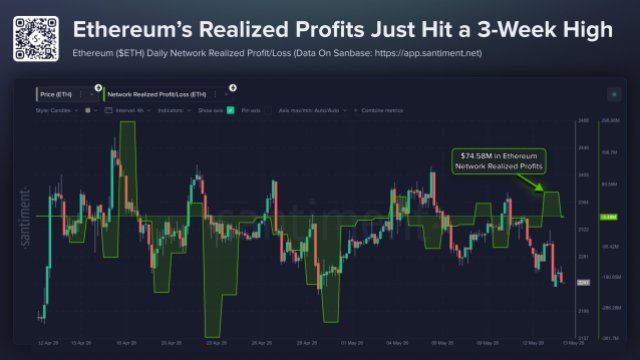
Source: Chart from Santiment on X

Santiment also highlighted an increase in the volume of on-chain movement on the Ethereum blockchain. The 4-hour candles exhibit significant price compression at $2,241, indicating increased distribution activity on the chain. Historically, more transactions have led to more realized P&L events. When volume is increased, even little individual profits add up to significant network-level totals.

Based on current ETH trader behavior, Santiment noted that investors are leaning cautious. However, this does not mean new investors should be bearish. Rather, the platform suggests watching for deeper realized losses as a potential bottoming signal and avoiding aggressive positioning until the distribution phase shows clear signs of ending.

ETH trading at $2,265 on the 1D chart | Source: ETHUSDT on Tradingview.com

Related Questions

QWhat significant shift in institutional investment is highlighted in the article regarding Jane Street?

AThe article highlights that Jane Street is increasing its exposure to Ethereum while reducing its holdings in Bitcoin ETFs, indicating a shift in institutional interest towards Ethereum.

QAccording to market commentator Deci, what does Jane Street's move signify about institutional preferences?

AAccording to Deci, while Jane Street's move does not automatically make them 'ETH maximalists,' it points to a growing and real rotation in institutional investment, with Ethereum being treated more as a separate macro asset alongside Bitcoin and Gold.

QWhat on-chain data did Santiment report regarding Ethereum, and why was it considered counterintuitive?

ASantiment reported that Ethereum registered its highest network realized profits in 3 weeks, with a spike of $74.58 million. This was considered counterintuitive because ETH's price had fallen by 5.5% over the preceding 3 days.

QWhat behavior among ETH holders explains the surge in realized profits despite a price drop?

AThe surge in realized profits is explained by ETH holders with a much lower cost basis selling into the price dip. These savvy traders had accumulated ETH when it traded below $2,000 in February and March, so they were still profitable and chose to sell during the mid-May downturn.

QWhat current trader behavior does Santiment note, and what advice does it give to new investors based on this?

ASantiment notes that current ETH investors are leaning cautious. It advises new investors to watch for deeper realized losses as a potential bottoming signal and to avoid aggressive positioning until the distribution phase shows clear signs of ending.

Related Reads

Dumping US Bonds, Buying Japanese Bonds: Wall Street Prepares for 'Capital Repatriation to Japan'

Wall Street is bracing for a potential "great repatriation" of Japanese capital as yields on Japanese Government Bonds (JGBs) soar to multi-decade highs. The 10-year JGB yield recently hit 2.73%, its highest since 1997, while the 30-year yield broke 4% for the first time. This dramatic shift is causing global asset managers to reassess a long-ignored risk: that Japanese investors, who hold roughly $1 trillion in U.S. Treasury debt, could start bringing that money home. For decades, Japan's ultra-low interest rates pushed domestic insurers, pension funds, and banks to seek yield overseas, primarily in U.S. Treasuries. Now, with the Bank of Japan hiking rates and JGB yields climbing, the incentive is reversing. Firms like BlueBay Asset Management are preparing for this shift, believing new Japanese investments will be directed domestically rather than to foreign bonds. Early signs of repatriation are emerging, with record monthly inflows into Japanese sovereign bond funds in March. Some managers, like Ruffer's Matt Smith, hold yen as a hedge, anticipating that market stress could trigger a rapid acceleration of capital returning to Japan. However, analysts caution that a mass exodus hasn't begun yet. Japanese investors were still net buyers of foreign bonds over the past year. Uncertainty remains high as Japan's government fiscal plans could push JGB yields even higher, making investors hesitant to buy immediately. Furthermore, the Bank of Japan's withdrawal as a dominant bond buyer has increased market volatility. Nevertheless, the potential scale of Japanese selling poses a tangible risk to the U.S. Treasury market. As the largest foreign holder of U.S. debt, any sustained shift by Japanese institutions could materially impact supply and demand dynamics, pushing U.S. yields higher. Wall Street's current positioning is a forward-looking bet on this logic becoming increasingly compelling as Japanese yields continue to rise.

marsbit35m ago

Dumping US Bonds, Buying Japanese Bonds: Wall Street Prepares for 'Capital Repatriation to Japan'

marsbit35m ago

How Did Institutions Adjust Their Crypto Asset Holdings in Q1? Who Increased and Who Exited?

The Q1 2026 13F filings reveal a sharply divided picture of institutional activity in crypto assets. Sovereign wealth funds and bank capital increased exposure, while major endowment funds notably de-risked. The most significant buying came from the Abu Dhabi sovereign wealth fund Mubadala, which expanded its position in the iShares Bitcoin Trust (IBIT). JPMorgan Chase dramatically increased its IBIT exposure by 174%, with other global banks like RBC, Scotiabank, and Barclays also adding to Bitcoin ETF holdings, while using options for asymmetric protection. Conversely, the Harvard Management Company (Harvard University's endowment), once a major academic holder, cut its IBIT position by 43% and fully exited a BlackRock Ethereum ETF. The reallocated capital flowed into traditional assets like TSMC, Microsoft, and gold. Other Ivy League endowments showed varied strategies: Brown and Dartmouth maintained Bitcoin positions, with Dartmouth making a nuanced shift by moving Ethereum exposure to a staking ETF and adding a Solana staking ETF to capture yield. Hedge fund Jane Street significantly reduced Bitcoin ETF holdings, locking in profits, while Wells Fargo increased its Ethereum stake. Overall, institutions are deploying traditional capital market tactics—buying, selling, hedging, and rotating—within crypto via spot ETFs. The Q2 reports will be crucial to determine if Harvard's retreat is an outlier or the start of a broader trend among endowments.

marsbit1h ago

How Did Institutions Adjust Their Crypto Asset Holdings in Q1? Who Increased and Who Exited?

marsbit1h ago

Blockchain Capital Partner: Most People Have a Narrow Understanding of the On-Chain Economy

Author Spencer Bogart, a partner at Blockchain Capital, argues that most people have a narrow view of the on-chain economy, seeing it primarily as a faster, cheaper version of existing financial systems. While this represents a significant opportunity, he believes it's only a small part of the story. Bogart compares the current state of crypto to the early internet, where email was the obvious "faster mail" application. The truly transformative categories—like search, social media, and cloud computing—were entirely new and unimaginable beforehand. Similarly, the most profound innovations in crypto will not be incremental improvements but entirely new categories enabled by the core properties of public blockchains: atomic execution, shared global state, programmable custody, and composability. He cites the "flash loan" as a prime example of a "new verb"—a financial action structurally impossible before programmable assets and atomic settlement. It allows for uncollateralized, trustless borrowing of any size, provided repayment occurs within the same transaction, enabling novel strategies like arbitrage and collateral swaps. Bogart admits the difficulty in precisely predicting these future innovations, as human imagination tends to extrapolate from the past. He posits that the most exciting applications in ten years will be things that don't exist today and have no precedent—products only possible in a global, composable, always-on environment with programmable assets. While the exploration of this vast design space will involve many failures, the potential for transformative, category-defining breakthroughs is what makes the next decade so promising.

链捕手1h ago

Blockchain Capital Partner: Most People Have a Narrow Understanding of the On-Chain Economy

链捕手1h ago

Trading

Spot
Futures

Hot Articles

Discussions

Welcome to the HTX Community. Here, you can stay informed about the latest platform developments and gain access to professional market insights. Users' opinions on the price of ETH (ETH) are presented below.

活动图片