Author: New Zhiyuan
Crazy! A dinner-plate-sized chip directly created the biggest tech IPO of 2026. Surging 108% on its debut, it not only earned Altman nearly a tenfold return but also officially fired the starting shot for the super $3 trillion IPO tsunami of the ASI era.
In 2026, the largest tech IPO in the U.S. is born!
Today, AI chip company Cerebras officially debuted on NASDAQ, with its stock price soaring 108% on the first day.
Priced at $185 per share for the IPO, it opened directly at $385 and closed at $311, with its valuation once reaching $100 billion.

Cerebras sold 30 million shares in one go, raising $5.55 billion.
This is one of the largest IPOs for a U.S. tech company since Uber's 2019 listing, with even more momentum than Snowflake back then.

At the NASDAQ trading floor, Cerebras founder and CEO Andrew Feldman rang the opening bell.
Now, a large group of VC investors became rich overnight. Altman, holding 89,000 shares, saw his investment multiply tenfold to approximately $30 million on paper.
Cerebras's stunning opening successfully ignited the AI IPO debut of 2026. Next up, OpenAI, SpaceX, and Anthropic are queuing to enter.


The big explosion of AI IPOs is about to begin.
The Biggest AI IPO of 2026, Surging 108% on Debut
It must be said, a year ago, no one believed this day would come.
In 2015, semiconductor industry veteran Andrew Feldman, together with senior experts in the chip industry, founded Cerebras.
When they started selling chips in 2019, Feldman himself said, "No one cared, the market wasn't ready."

But if you say Cerebras's road to IPO is a suspense drama, it's not an exaggeration.
In September 2024, Cerebras first filed for IPO.
Then, it was targeted by the Committee on Foreign Investment in the United States (CFIUS) –
The reason: its major customer and investor G42 is from Abu Dhabi, and G42 accounted for 87% of Cerebras's revenue at that time.
The national security review dragged on and on, investor confidence collapsed, and the IPO plan was forced to be shelved.
One year later today, the plot has completely reversed.
AI models finally became "smart and useful," and Cerebras's business exploded:
2025 revenue was $510 million, a 76% year-over-year increase. More crucially, it turned from a loss of $482 million directly into a profit of $238 million.

In just one year, turning from massive losses to huge profits, this flip made investors completely unable to sit still.
The customer list also shifted from being dominated by G42 to multiple players including OpenAI, AWS, G42, and MBZUAI running in parallel.
More importantly, two heavyweight new customers appeared –
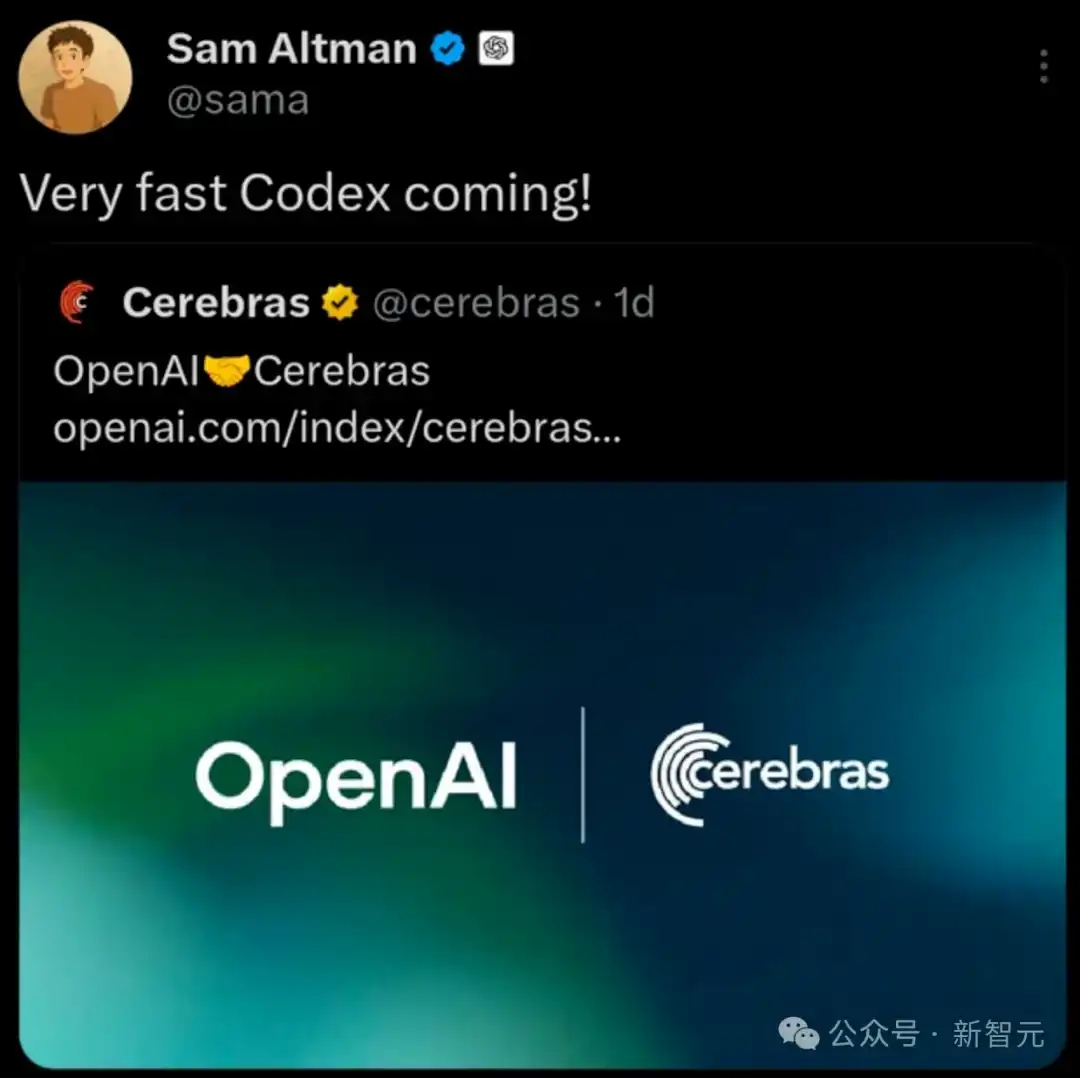
OpenAI, signed a multi-year contract worth over $20 billion, locking in 750 megawatts of Cerebras computing power, to be deployed in phases starting in 2026.
AWS announced it will deploy Cerebras CS-3 chips in its own data centers, making them available to developers through Amazon Bedrock.
In a recent interview, Feldman revealed that during the roadshow, the three core points he most needed investors to believe were:
First, inference demand will explode by a factor of 1 million;
Second, computing power doesn't have to rely solely on GPUs;
Third, CUDA's moat is actually overhyped.
This time, Cerebras successfully launched the opening battle for AI IPOs, and its debut was nothing short of stunning.
Overnight Riches in the ASI Era, OpenAI Also Becomes a "Big Winner"
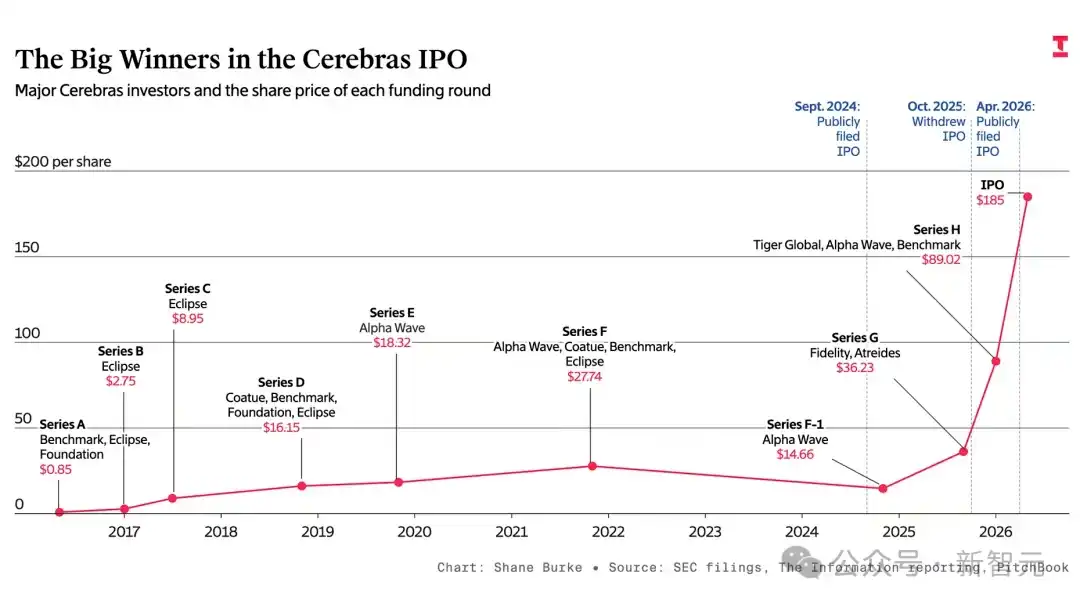
Cerebras's IPO created a textbook-level VC exit bonanza.
From seed round to ringing the bell, these institutions waited a full decade.
-
Foundation Capital: $37M → $2.8B, 76x Return
Foundation Capital invested about $37 million, holding a 7% stake. Based on the IPO price of $185, it's worth $2.8 billion, a 76x return.
Based on the first-day closing price of $311, it's approximately $4.8 billion.
-
Benchmark: $268M → $3.3B, 12x Return
Benchmark also joined in the Series A round in 2016, led by general partner Eric Vishria.
It invested a total of $268 million, holding an 8.1% stake. At the IPO price, that corresponds to $3.2 billion, a 12x return. Based on the closing price, it directly soared to $5.5 billion.
-
Eclipse Capital: $146.5M → $2.5B, 17x Return
Eclipse Ventures invested $146.5 million, holding a 6.2% stake. At the IPO price, that corresponds to $2.5 billion, a 17x return.
Eclipse's story is even more legendary. The person who made the investment decision was 95-year-old veteran Pierre Lamond from "Fairchild Semiconductor."
While at Khosla Ventures, Lamond had invested in Feldman's previous company, SeaMicro. He later joined Eclipse.
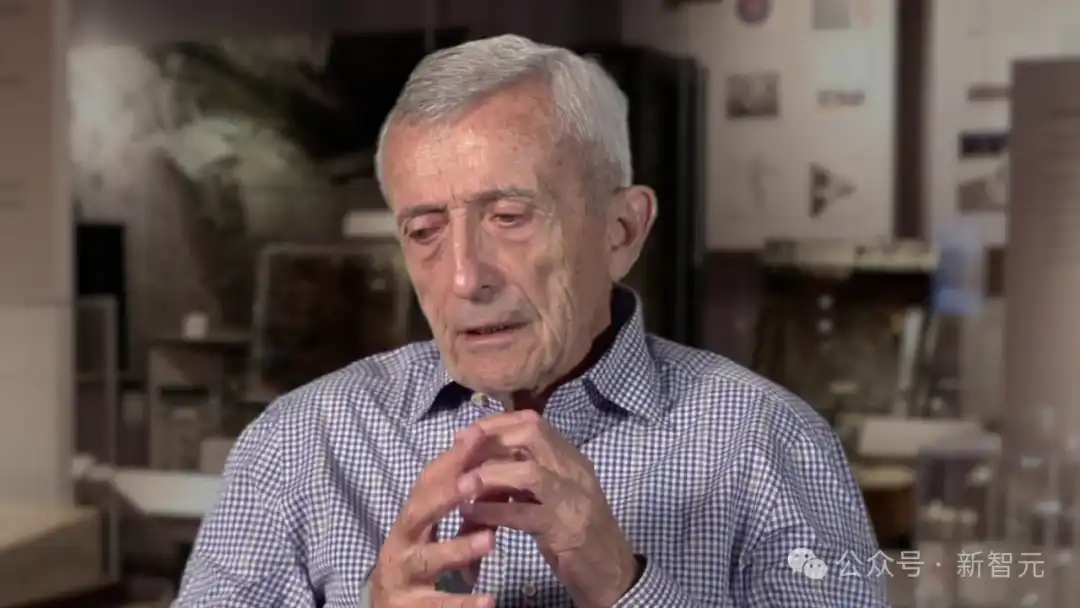
A year after Cerebras was founded in 2016, he decided to invest again. This is like the godfather of Silicon Valley chips personally stamping his approval on Cerebras.
He once said in 2017, "Feldman is probably one of the few entrepreneurs I would invest in twice."
Altman's 10x 'Passive' Earnings, Bought in for 1 Cent
To talk about the most outrageous VC return among them, it's OpenAI!
First, Altman personally.
According to exposed court documents, Altman personally invested in Cerebras as early as February 2017, back when ChatGPT didn't even exist.
As of the end of 2025, he held 89,373 shares, valued at approximately $3.2 million at the time.
On the first day of trading, the value of these shares soared to approximately $30 million.
This money quietly multiplied tenfold.

Previously, OpenAI had once considered directly acquiring Cerebras.
Although the acquisition didn't happen, the two sides reached a "mysterious agreement" on a Christmas Eve –
In the coming years, if OpenAI purchases tens of billions of dollars worth of inference computing resources from Cerebras, it can obtain up to 11% of the shares.
And the price OpenAI paid for these shares was less than 1 cent per share.

With the IPO price set at $185, the value of OpenAI's holdings instantly ballooned. It is currently estimated that OpenAI has a paper gain of about $1.8 billion.
It is worth mentioning that OpenAI co-founder Greg Brockman also personally held about 77,000 shares of Cerebras.
Based on the closing price of $311, Brockman's personal holdings are worth approximately $24 million.
Technical Trump Card: A Dinner-Plate-Sized Chip
As is well known, Cerebras's core weapon is the WSE-3 (Wafer Scale Engine 3).
One chip occupies an entire 300mm wafer, with an area of 46,225 square millimeters, roughly the size of a dinner plate.
An ordinary chip is about 800 square millimeters; the WSE-3 is nearly 60 times larger.

In terms of parameters, the WSE-3 achieves overwhelming superiority –
-
4 trillion transistors (19x Nvidia's B200)
-
900,000 AI-optimized cores
-
125 petaflops of AI computing power (28x B200)
-
5nm process, manufactured by TSMC
While others use "multi-card parallelization" to solve computing power problems, Cerebras directly turns the entire wafer into a giant processor.
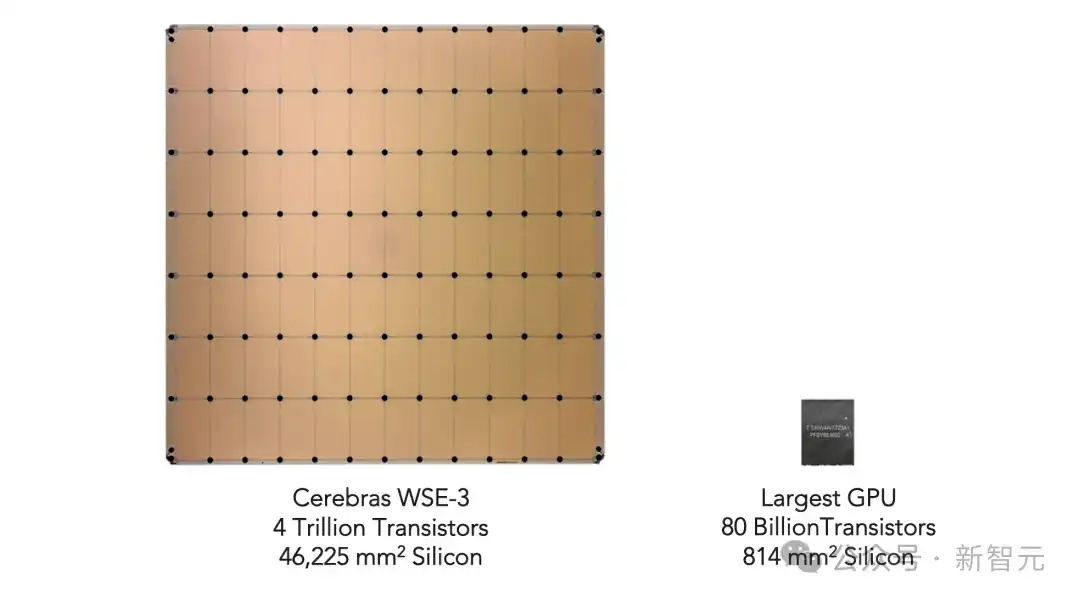
Behind this brute-force aesthetic is a key judgment: Inference is the future battlefield for AI.
Training a large model might only need to be done once.
But inference — having the model answer every question, execute every Agent task — is a continuous, never-ending consumption of computing power.
Cerebras claims their inference speed is 10 to 20 times faster than Nvidia GPU clusters.
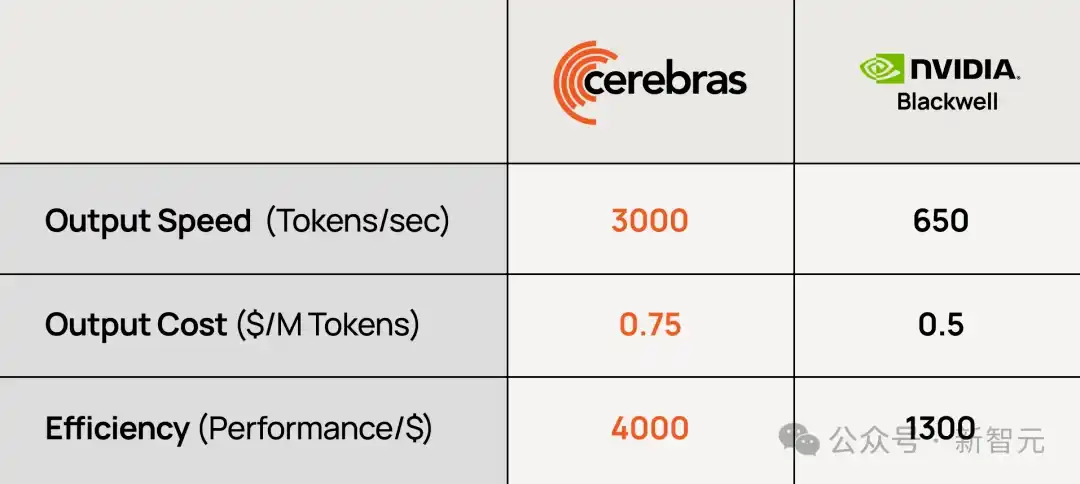
AI IPO Tsunami: $3 Trillion Looming
You must know, the Cerebras IPO is just the appetizer.
The real main event is still to come –
SpaceX (including xAI): Roadshow as early as June, valuation target of $1.75 trillion, planning to offer 30% to retail investors, unprecedented in IPO history.
If successful, it will be the largest IPO in human history.
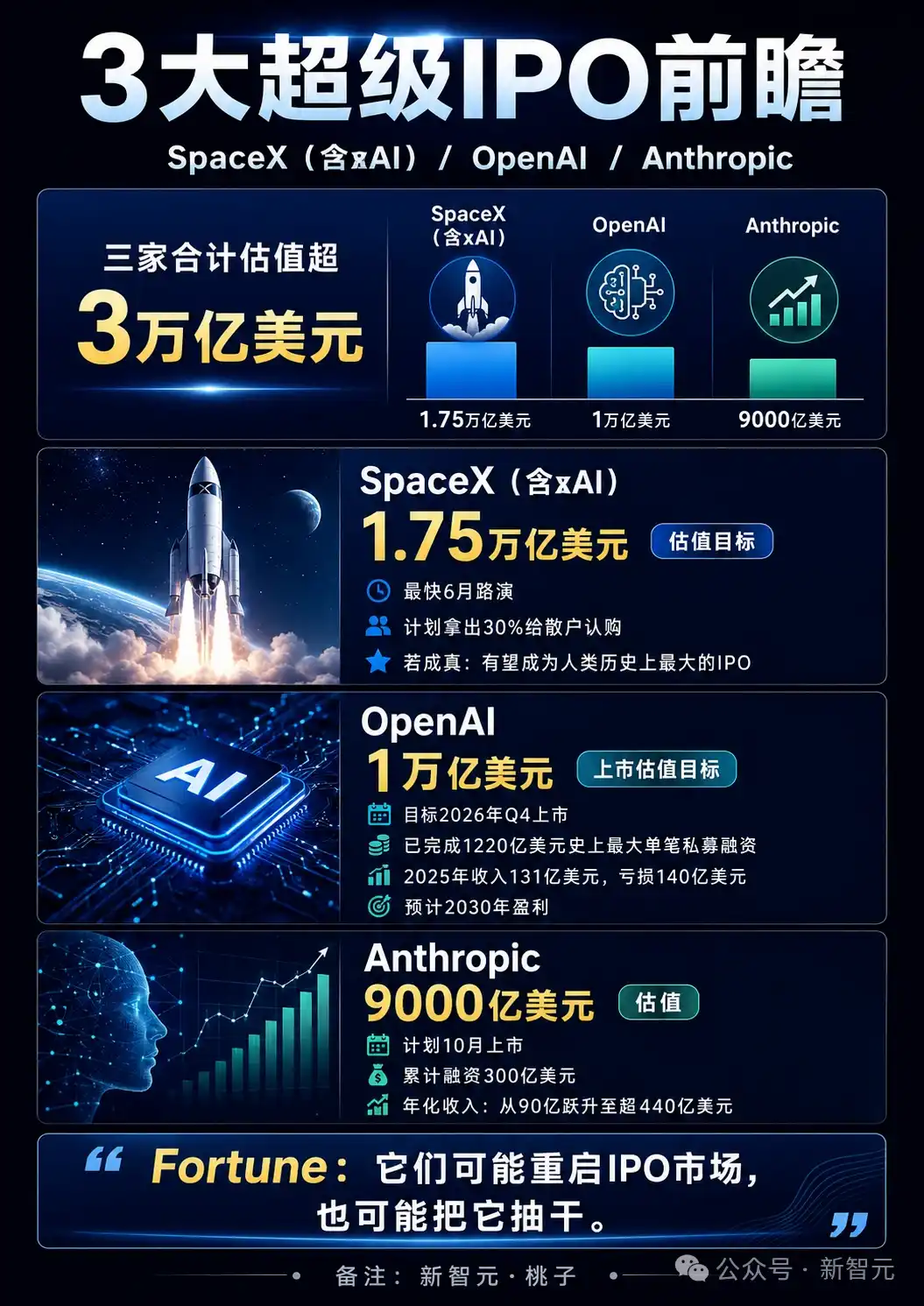
OpenAI: Targeting Q4 2026 listing, valuation aiming for $1 trillion.
Just completed a historic $122 billion single private financing round. However, 2025 revenue was $13.1 billion with a loss as high as $14 billion. It's projected to become profitable only by 2030.
Anthropic: Planning to go public in October, has already secured $300 billion in financing, valuation at $900 billion. IPO fundraising may exceed $60 billion.
Latest data shows its annualized revenue has soared from $9 billion at the end of 2025 to over $44 billion.
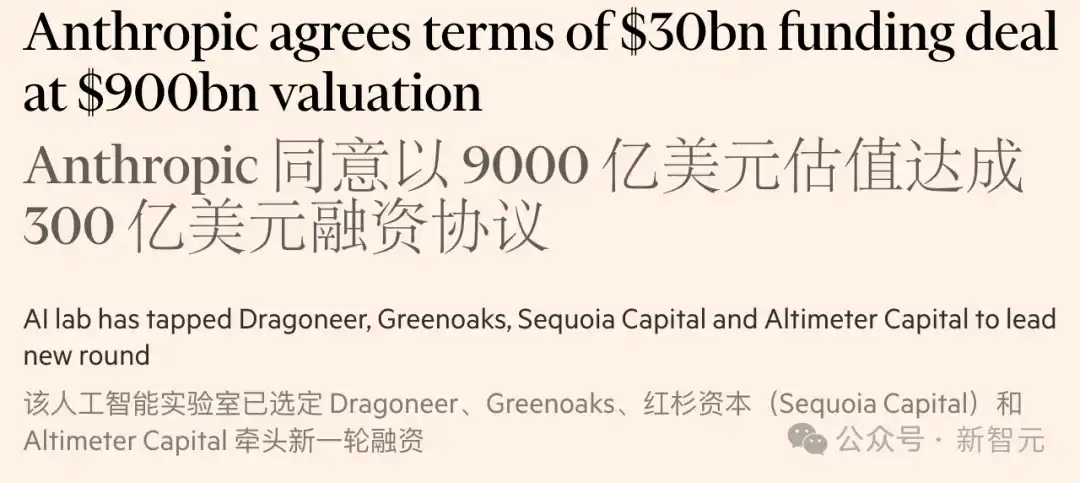
The combined valuation of the three exceeds $3 trillion.
Fortune wrote a harsh line: "SpaceX, OpenAI and Anthropic may restart the IPO market, or they may drain it."
| |
|
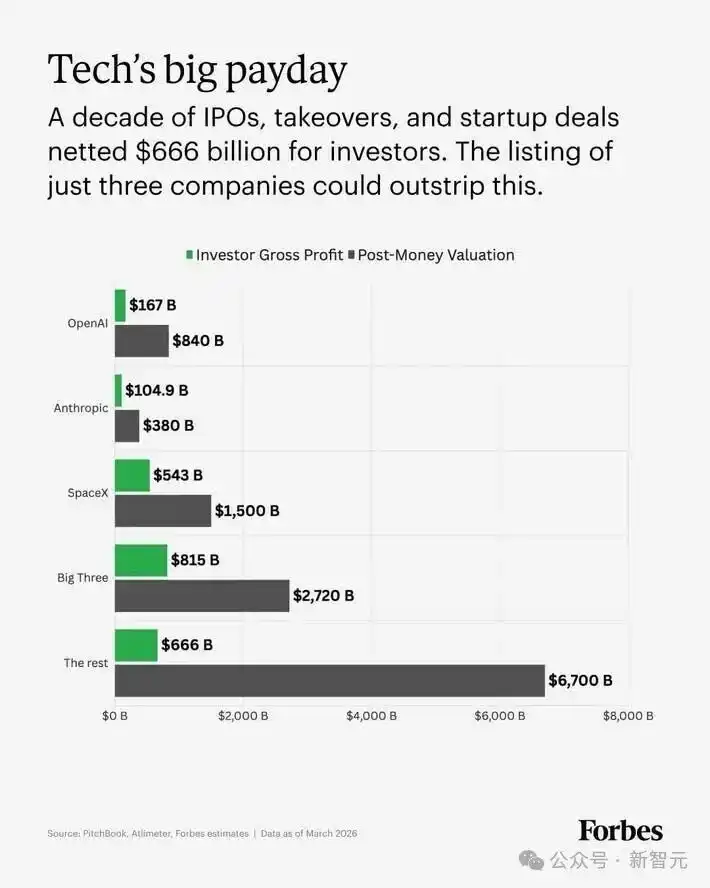
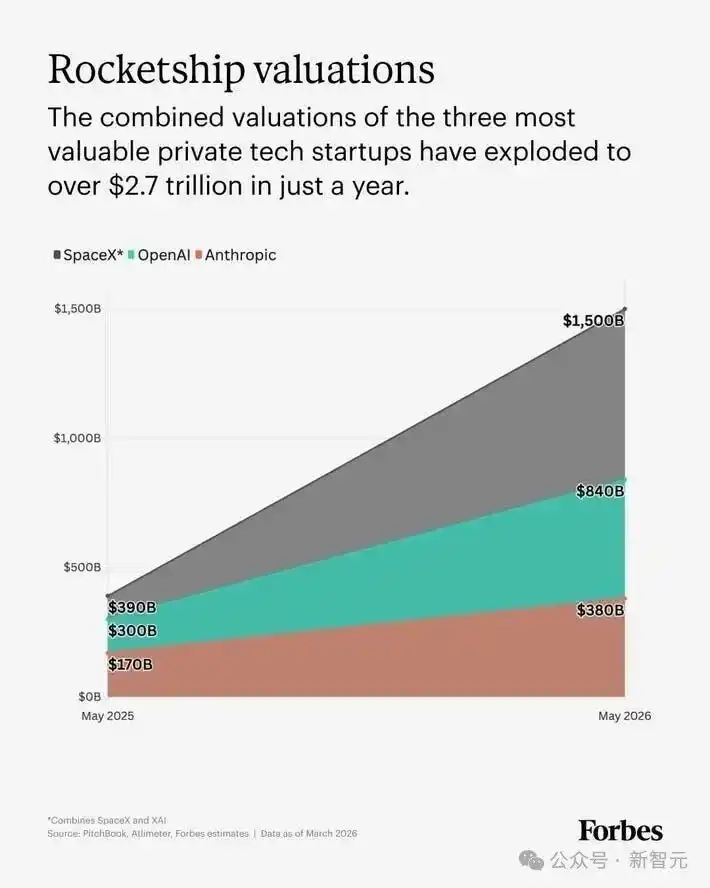
If the three go public concentrated within six months, the total fundraising could exceed $240 billion, surpassing the total annual IPO fundraising in the U.S. in most recent years.
Final Battle: When Capital Starts Betting on ASI
But if you think Wall Street is just gambling on a chip company's financial statements, you're being naive.
Taking a longer timeline, the Cerebras story reveals a deeper logic: Capital is placing early bets on ASI (Artificial Superintelligence).
Go back to 2017, Greg Brockman wrote a sentence in an email to the OpenAI team:
Having exclusive access to Cerebras's hardware would give OpenAI an overwhelming computing power advantage over Google.
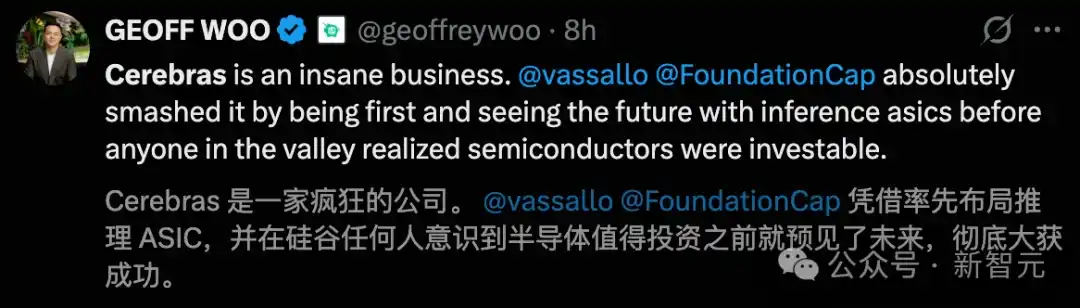
Back then, ChatGPT didn't exist, and LLMs were still concepts in academic papers, but OpenAI's core team already clearly knew one thing:
The path to AGI and even ASI is ultimately an arms race in computing power. In 2026 today, this judgment is being frantically validated.
What this IPO is truly betting on was never just a company's P/E ratio.
It's betting on this: The next type of intelligence humanity is building. And this intelligence requires a scale of computing power that far exceeds everyone's imagination today.
When capital uses $66 billion to price a 10-year-old chip company, when OpenAI is willing to put down $20 billion just to lock in 1/40th of its computing power shortfall, when SpaceX, OpenAI, Anthropic are lining up for trillion-dollar IPOs –
This is human civilization laying the groundwork in advance for the arrival of superintelligence.
Whoever lays the groundwork first wins the entry ticket to the ASI era. Whoever hesitates will forever remain a spectator.