Artículos Relacionados con Valuation

El Centro de Noticias de HTX ofrece los artículos más recientes y un análisis profundo sobre "Valuation", cubriendo tendencias del mercado, actualizaciones de proyectos, desarrollos tecnológicos y políticas regulatorias en la industria de cripto.

Surging 108% on Debut! The Biggest AI Dark Horse of 2026 is Born, Altman Profits 'Passively' Again

Cerebras, an AI chip company known for its wafer-scale "dinner plate-sized" WSE-3 processor, completed a landmark IPO on the NASDAQ in 2026. Its shares surged 108% on the first day of trading, with the valuation reaching approximately $100 billion at its peak. The offering raised $5.55 billion, marking one of the largest U.S. tech IPOs since Uber in 2019. The company's dramatic turnaround was a key driver, moving from a $482 million loss to a $238 million profit in 2025, with revenue growing 76% to $510 million. Major new contracts, including a multi-year deal with OpenAI potentially worth over $20 billion and a deployment agreement with AWS, boosted investor confidence. Founder Andrew Feldman emphasized to investors the coming explosion in AI inference demand, the viability of non-GPU compute, and the perceived overestimation of NVIDIA's CUDA ecosystem moat. The IPO created substantial returns for early investors like Foundation Capital (76x return) and Benchmark (12x return). OpenAI, through a strategic agreement linked to future compute purchases, secured an estimated $1.8 billion in paper gains, while Sam Altman's personal 2017 investment grew roughly tenfold to around $30 million. Cerebras' success is positioned as the opening act for a wave of massive AI-focused IPOs expected in 2026, including potential listings from SpaceX (targeting a $1.75 trillion valuation), OpenAI ($1 trillion), and Anthropic ($900 billion), collectively representing over $3 trillion in potential market value. The article concludes that these moves signal capital is placing foundational bets on the immense compute infrastructure required for the future development of Artificial Superintelligence (ASI).

marsbitHace 2 días 11:20

Surging 108% on Debut! The Biggest AI Dark Horse of 2026 is Born, Altman Profits 'Passively' Again

marsbitHace 2 días 11:20

The First OpenAI Employees to Sell Their Shares Have Become Millionaires

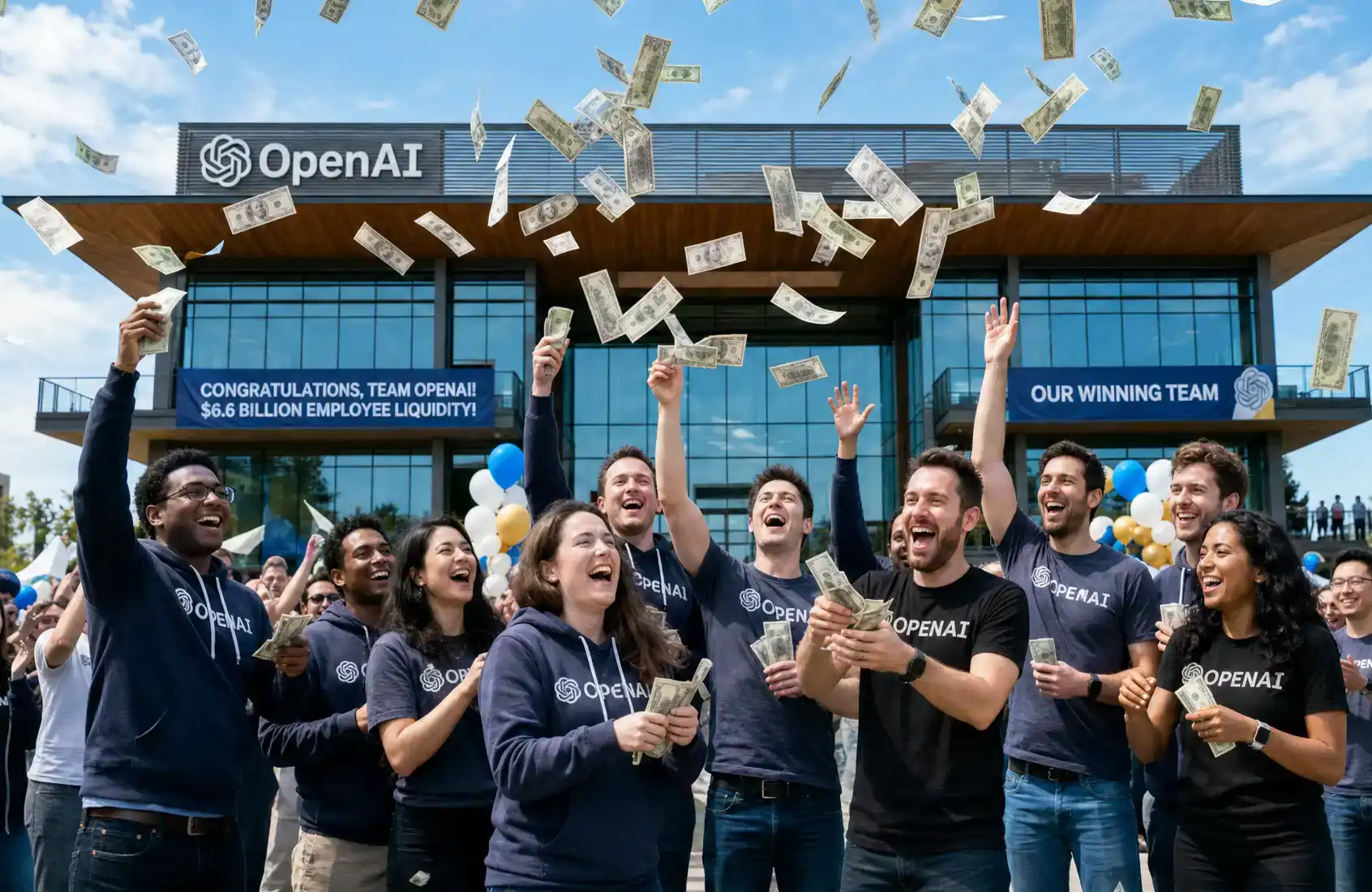
Early OpenAI Employees Become Millionaires Before IPO A recent report reveals that OpenAI allowed over 600 current and former employees to sell shares in October, cashing out a total of $6.6 billion. Approximately 75 employees each realized about $30 million. This highlights a significant shift in the AI industry: employees at top companies can now gain substantial wealth through secondary market sales, tender offers, and other liquidity events long before a traditional IPO. For OpenAI, this generous equity incentive strategy, alongside high salaries and bonuses, has become a powerful tool to attract and retain top AI talent amid fierce competition. The company has adjusted its policies, increasing individual sale limits and allowing newer employees to participate. This trend extends beyond OpenAI. Chinese AI firm DeepSeek is reportedly seeking its first external funding round at a potential $50 billion valuation. This move is seen as crucial for establishing an external market price, which is necessary to make employee equity grants meaningful and competitive for retaining talent. The pathways to wealth creation in AI are diversifying. Beyond waiting for IPOs (e.g., Anthropic, chipmaker Cerebras), companies are exiting via acquisitions (e.g., Databricks buying MosaicML) or through complex deals like technology licensing and team transfers (e.g., Google's deal with Character.AI). These mechanisms allow investors, founders, and employees to realize gains earlier and through more varied routes than in previous tech cycles. In summary, the AI boom is creating a new wave of wealth, distributed not just to founders and investors but also to technical talent, and the liquidity events are occurring sooner and through more channels than ever before.

marsbit05/14 13:39

The First OpenAI Employees to Sell Their Shares Have Become Millionaires

marsbit05/14 13:39

The Real AI Bubble, You Can't Buy It

The article argues that the real "bubble" in the current AI boom is largely invisible and inaccessible to the average investor. Unlike the 2000 dot-com bubble, where overvalued companies were publicly traded, the most significant value surges and financial risks are occurring in private markets. Core AI companies like OpenAI, Anthropic, xAI, and Databricks have seen valuations skyrocket (e.g., OpenAI's from $157B to $852B in 18 months), but these transactions happen through private secondary sales, not public stock exchanges. These opaque markets create an "anxiety exposure," leading public investors to chase indirect proxies like memory chip or utility stocks. The author highlights how AI wealth extraction has been radically front-loaded. Employees and founders can cash out years before a potential IPO through structured secondary sales, "founder-led secondary" deals, and collateralized loans against private equity. Major tech firms also use "acqui-hires" or technology licensing deals (like Google/Character.AI, Microsoft/Inflection AI) to secure talent and tech without full acquisitions, allowing early exits outside of regulatory scrutiny. Furthermore, the AI infrastructure build-out is compared to the 2008 real estate bubble. Massive data center projects are financed through complex, off-balance-sheet structures involving private credit, joint ventures, and asset-backed securities using GPUs as collateral (e.g., CoreWeave's deals). This creates a "shadow borrowing" system where the stability of future AI demand underpins trillions in debt, posing systemic risks if expectations falter. The recent collapse of SaaS company Pluralsight, financed by major private credit firms, is cited as a warning. The conclusion is that the most dangerous part of the AI bubble isn't in plain sight on public markets; by the time the average investor sees it, the critical wealth transfers have already occurred in private, unregulated spaces.

marsbit05/14 07:10

The Real AI Bubble, You Can't Buy It

marsbit05/14 07:10

Has the Winter of Crypto IPOs Arrived? Consensys and Ledger Hit Pause

Crypto IPO Winter Arrives? Consensys and Ledger Hit Pause. Following a boom in 2025, the window for crypto company initial public offerings has narrowed sharply in 2026. Major players like MetaMask developer Consensys and hardware wallet firm Ledger have recently postponed their US listing plans, joining exchange Kraken which paused its process earlier this year. This slowdown follows a strong 2025 where companies like Circle and Bullish went public, raising billions as Bitcoin hit all-time highs. However, in 2026, declining Bitcoin prices and trading volumes have cooled investor risk appetite. Newly listed crypto stocks, including BitGo, have seen significant price drops post-IPO, reinforcing investor caution. The cooling crypto IPO market contrasts sharply with the red-hot AI sector, where companies like SpaceX and OpenAI command massive valuations and investor interest based on "productivity revolution" narratives. Crypto firms, seen as more cyclical and volatile, struggle to compete for capital. The IPO delays are prompting a strategic shift. Companies are focusing on strengthening fundamentals, pursuing private funding, and expanding into more stable revenue streams like institutional services. This phase may accelerate industry consolidation, favoring firms with robust compliance and infrastructure. Analysts suggest a potential second wave of crypto IPOs in late 2026 could depend on a Bitcoin price recovery and clearer regulatory developments.

marsbit05/14 06:31

Has the Winter of Crypto IPOs Arrived? Consensys and Ledger Hit Pause

marsbit05/14 06:31

Suzerain State: Anthropic

Anthropic, a five-year-old AI lab dubbed a "suzerain," has rapidly gained unprecedented influence by securing massive financial and computational commitments from tech giants, positioning itself at the center of AI infrastructure power dynamics. In May 2026, it announced securing over 300 MW of computing power from SpaceX's Colossus 1 data center, on top of earlier multi-billion dollar deals with Amazon and Google, effectively locking in over 20 GW of future compute. These investments are tied to reciprocal spending commitments on the investors' cloud platforms, resembling infrastructure pre-sales. This "suzerain" status is fueled by explosive growth. By May 2026, Anthropic's annualized revenue reportedly surged to over $44 billion, with Claude surpassing OpenAI in LLM market share. Its high-revenue-per-user efficiency and flagship product Claude Code have secured a strong enterprise foothold. However, its pre-IPO status faces scrutiny. OpenAI challenged Anthropic's accounting, alleging its reported revenue includes gross payments shared with cloud partners, unlike OpenAI's net revenue reporting. The resolution of this debate is critical as both companies approach public listings. Currently, Anthropic holds unique leverage as the only top-tier model available across AWS, Google Cloud, and Microsoft Azure, inverting traditional vendor-customer dynamics. Yet, its suzerainty is considered a time-limited game, dependent on converting its current advantages into sustainable, audited profitability and navigating the complex web of strategic dependencies with its powerful patrons.

marsbit05/14 00:41

Suzerain State: Anthropic

marsbit05/14 00:41

Circle's Three-Dimensional Valuation Framework: Where Is the Bottom, Where Is the Top

"Circle's 3D Valuation Framework: Where is the Bottom, Where is the Top?" - Article Summary The article analyzes Circle's valuation following its Q1 2026 earnings. While its core business generates substantial interest income from USDC reserves ($6.53B in Q1, up 17% YoY), this revenue is highly sensitive to interest rates and shared significantly with Coinbase. The author proposes a three-dimensional valuation framework: 1. **Interest Business (The Floor):** Valued like a bank (8-15x P/E) on net interest income after Coinbase's share. This provides a conservative valuation baseline. 2. **Payment & Platform Business (The Inflection Point):** Includes CPN (Circle Payments Network) and "Other Revenue" (transaction, integration services). This high-growth segment, not shared with Coinbase, is valued on a platform/network model (higher P/S multiples), similar to Visa/Mastercard. It represents Circle's shift beyond pure interest income. 3. **Arc Network & ARC Token (The Future / Optionality):** Arc is an institutional-focused, EVM-compatible L1 blockchain where USDC is the native gas token. A $222M ARC token pre-sale at a $3B FDV attracted major traditional finance players (BlackRock, Apollo, ICE). While Circle holds 25% of ARC tokens, their value is separate from CRCL equity. This dimension represents the long-term, high-upside bet on Circle becoming an "economic operating system." Current market cap (~$30B) prices in significant future growth beyond the sum-of-the-parts valuation derived from current earnings. The investment thesis hinges on believing in Circle's transition from a "stablecoin issuer" to a broader financial infrastructure and network platform. Key variables for the future include USDC adoption growth, CPN network effects, Arc's success, and potential renegotiation of the Coinbase revenue-sharing agreement.

marsbit05/13 13:56

Circle's Three-Dimensional Valuation Framework: Where Is the Bottom, Where Is the Top

marsbit05/13 13:56

The AI Bull Market Revalues Everything, Including the 'Male Valuation System' in the Dating Market

AI Bull Market Reprices Everything, Including the "Male Valuation System" in the Dating Market A new hierarchy is emerging in dating markets, driven by the AI boom. Men working for AI infrastructure and core companies are now considered top prospects. The article presents a "Dating Desirability Ranking" for men in the AI era. **Top Tier ("Extremely Hot"): NVIDIA & SK Hynix Employees** NVIDIA, viewed as the "oil" of AI, and SK Hynix, a leading HBM memory maker, are in a league of their own. SK Hynix employees, in particular, have become highly sought-after in South Korea's matchmaking scene due to their massive performance bonuses, which averaged ~$65,000 per employee last year and are projected to reach millions. This has led to increased interest in office romances for "economic synergy." **High Tier ("Hot"): Anthropic & OpenAI Employees** Employees at these leading AI labs have seen significant wealth realization through large-scale employee stock sales. Unlike the paper wealth of the dot-com era, substantial amounts have been cashed out, placing their actual wealth far above traditional tech workers. They are considered high-growth, high-volatility assets. **Elite Tier ("Top Tier"): DeepSeek & ByteDance AI Team Members** Fierce competition for AI talent has made employees at these companies highly valuable. ByteDance's valuation has soared with its massive AI investment, leading to significant employee stock appreciation. DeepSeek is also fighting to retain core talent with substantial funding rounds. Being on the "main stage" of AI makes these individuals extremely scarce. **Mid Tier ("NPC"): Samsung & Tencent Employees** Once dominant, these companies are now seen as playing catch-up in the AI race. Samsung has lost ground to SK Hynix in the HBM market, leading to employee strikes demanding better bonuses. Tencent's more cautious AI investment, compared to ByteDance's aggressive spending, and slowing traditional growth raise questions about its future in AI. **Bottom Tier ("Fallen Off"): Traditional Finance Bros & Crypto Bros** Their appeal has diminished as the core wealth distribution shifts to AI. Compared to the massive bonuses and stock windfalls in AI, the traditional allure of finance and the fading "get-rich-quick" narrative of crypto have lost their luster in the current dating market. The AI revolution is not just reshaping industries and stock prices, but also the social and economic perceptions that influence personal markets like dating.

marsbit05/13 13:00

The AI Bull Market Revalues Everything, Including the 'Male Valuation System' in the Dating Market

marsbit05/13 13:00

AI Bull Market Reprices Everything, Including the 'Male Valuation System' in the Marriage Market

The AI boom is redefining value across markets, including the male "valuation system" in the dating scene. A new hierarchy is emerging, based on company valuation, employee income, and industry status within the AI sector. At the top are NVIDIA and SK Hynix employees, dubbed the "T0 version." NVIDIA is the AI world's cash machine, while SK Hynix employees are seeing astronomical bonuses due to HBM demand, making them highly sought-after "AI concept stocks" in Korea's dating market. Next are OpenAI and Anthropic staff, representing the "new elite." Unlike the paper wealth of the past internet boom, these employees are actively realizing significant wealth through stock sales, though their status is considered more volatile. DeepSeek and ByteDance AI team members are rated as "top-tier." Their companies are engaged in fierce talent wars with massive investments, making these employees scarce, high-value players. Samsung and Tencent employees are seen as "NPCs" still searching for their AI "ticket." Samsung has been outpaced by SK Hynix in the memory race, while Tencent's more cautious AI investment contrasts with ByteDance's aggressive strategy, raising questions about their future position. Finally, traditional finance and crypto men are rated at the bottom ("pulled"). Their once-dominant wealth and status are being eclipsed by the new AI-driven economic order and its redistribution of value and opportunity.

Odaily星球日报05/13 12:53

AI Bull Market Reprices Everything, Including the 'Male Valuation System' in the Marriage Market

Odaily星球日报05/13 12:53

活动图片