# Stablecoin Related Articles

HTX News Center provides the latest articles and in-depth analysis on "Stablecoin", covering market trends, project updates, tech developments, and regulatory policies in the crypto industry.

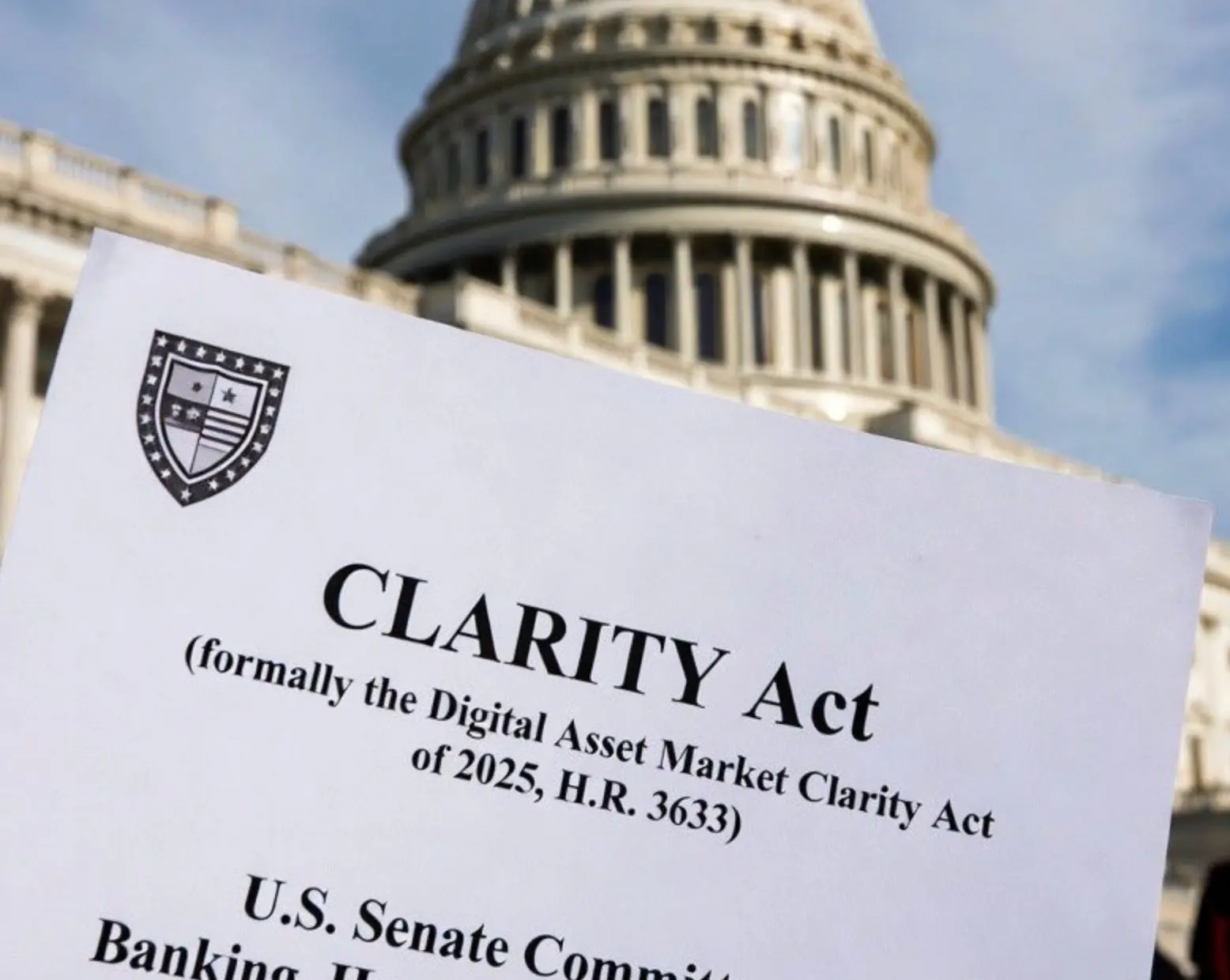
CLARITY Bill Still Unsettled, Caught Up in U.S. Bipartisan Political Game

The U.S. Senate Banking Committee voted 15-9 to advance the CLARITY Act for a full Senate vote, overcoming a key industry compromise on stablecoin rewards. However, the legislation faces significant political hurdles as it moves forward. The vote fell largely along party lines, with all 13 Republican committee members voting in favor and only two Democrats—Ruben Gallego and Angela Alsobrooks—joining them. Both Democrats indicated their support was conditional to keep debate alive and could be withdrawn later. The path to final passage in the full Senate remains difficult. The bill requires 60 votes to pass. With a current 53-47 Republican majority, this means at least 7 Democratic votes are needed, assuming no Republican defections. The narrow, partisan committee vote suggests securing that level of bipartisan support will be challenging. During the committee process, Democrats pushed for numerous amendments, including a key ethics provision to restrict top government officials' financial ties to the crypto industry. Republicans used their majority to block these amendments, leaving core Democratic concerns unaddressed. These issues, particularly around anti-money laundering and ethics, are expected to resurface as major points of contention during the full Senate debate. Republicans are pushing for a swift Senate vote, ideally before the July 4 recess and the upcoming election season, fearing that a shift in congressional power after the next election could jeopardize the bill's future. However, given the current political stalemate and Democratic demands for concessions, the act's prospects for becoming law in 2026 are uncertain.

Odaily星球日报2 days ago 10:48

CLARITY Bill Still Unsettled, Caught Up in U.S. Bipartisan Political Game

Odaily星球日报2 days ago 10:48

Behind the Coinbase Acquisition of USDH: Hyperliquid’s Interest-Driven Choice

The article discusses the transition of the Hyperliquid ecosystem's native stablecoin, USDH, following its acquisition by Coinbase. Last September, USDH, issued by Native Markets, was a focal point in the ecosystem. Recently, Coinbase announced it will become the official USDC treasury deployer on Hyperliquid. Native Markets granted Coinbase the rights to purchase the USDH brand assets, leading to the gradual phase-out of USDH. Users can convert USDH to USDC or fiat without fees during this period. USDC is now Hyperliquid's official stablecoin. The move is framed as a three-way win: * **Coinbase & Circle:** Deepen ties with Hyperliquid's on-chain economy. Both companies are staking HYPE tokens. Circle had already invested in HYPE previously. * **Hyperliquid:** Becomes the primary beneficiary, set to receive the vast majority (estimated ~90%) of the reserve yield income from the ~$5.16 billion in USDC on its platform. This could translate to significant daily HYPE buybacks. The alliance with Coinbase may also offer regulatory advantages in the US. * **Native Markets:** While exiting the stablecoin business, the team reportedly received economic compensation from Coinbase for the USDH brand assets, framing it as a successful conclusion to USDH's role. However, the article notes criticism from some Hyperliquid community members. They view the shift as a step back for decentralization and argue that the original USDH issuer vote was driven by internal interests rather than user benefit, leaving regular users with nothing. The conclusion reflects that the eventual partnership between Hyperliquid and the giants (Coinbase/Circle) underscores a reality of利益分配 (interest distribution) over initial ideals of community and ecosystem advocacy.

Odaily星球日报2 days ago 06:48

Behind the Coinbase Acquisition of USDH: Hyperliquid’s Interest-Driven Choice

Odaily星球日报2 days ago 06:48

CLARITY Act Passes Crucial Hurdle, But a Long Road Remains Ahead

The CLARITY Act, a major U.S. digital asset market structure bill, has advanced from the Senate Banking Committee with a 15-9 bipartisan vote, ending a four-month legislative standstill. The bill's core aim is to resolve the long-standing jurisdictional conflict between the SEC and CFTC by clearly defining which digital assets are securities or commodities. It also establishes rules for exchanges and custodians while providing protections for non-custodial software developers and blockchain validators, shielding them from being classified as money transmitters. The committee's approval triggered a positive market reaction, with Bitcoin rising and crypto-related stocks outperforming the broader market. However, the passage was secured only after last-minute negotiations and compromises, including the addition of amendments on investor protection, bank activities, and defining "truly decentralized" DeFi projects. Two key Democratic senators provided the crucial swing votes but cautioned that their future support in a full Senate vote is not guaranteed. Significant hurdles remain. The bill must still pass the full Senate, requiring 60 votes, and a major point of contention is a Democratic demand for an ethics clause restricting financial ties between high-level government officials and crypto firms—a provision opposed by Republicans and the White House. Additionally, the bill must be reconciled with a version from the Senate Agriculture Committee. If not passed before the August congressional recess, the next viable legislative window might not open until 2030. The legislation also faced, and ultimately withstood, last-minute lobbying opposition from traditional banking groups concerned about deposit outflows to crypto. If ultimately enacted, the CLARITY Act would initiate a multi-year rulemaking process, with new regulations likely not taking full effect until 2027 or later. While a critical milestone, the path to becoming law remains a challenging race against time.

链捕手2 days ago 04:54

CLARITY Act Passes Crucial Hurdle, But a Long Road Remains Ahead

链捕手2 days ago 04:54

Morning Post | Digital Bank Fasset Completes $51M Series B Funding; Jane Street Increases Holdings in Ethereum ETFs and Galaxy Digital in Q1; SATA to Pay Cash Dividend Starting June 16

"ChainCatcher" News Summary: **Key Developments:** - **Jane Street**: Q1 saw significant reductions in Bitcoin ETF holdings alongside increased positions in Ethereum ETFs and Galaxy Digital. - **Morgan Stanley**: Substantially boosted Bitcoin ETF exposure in Q1, with holdings in BlackRock's IBIT surging 174%. The bank also initiated positions in a Solana ETF and increased Ethereum ETF holdings while exiting XRP ETF positions. - **CME Group**: Plans to launch Nasdaq CME Cryptocurrency Index Futures (subject to regulatory review) on June 8th, offering exposure to a basket of top cryptocurrencies. - **Fasset**: The stablecoin-focused digital bank completed a $51 million Series B round with investors including SBI Group. It facilitates over $32 billion in annual transactions across 125 countries. - **SATA Dividend**: Strive's perpetual preferred stock (SATA) will begin paying cash dividends daily starting June 16th, a first for a U.S.-listed security, offering an effective annualized yield of ~13.88%. - **Consensys**: Has delayed potential IPO plans until autumn due to unfavorable market conditions. - **CLARITY Act**: Bipartisan negotiations stalled, with Democrats remaining divided over specific provisions. **Market Trends:** - **Meme Tokens**: GMGN data shows top-traded tokens on ETH, Solana, and Base chains over the past 24 hours, including HEX, SHIB, PEPE, TROLL, and others. **Featured Analysis:** Articles explore Kraken's acquisition of payment infrastructure company Reap, how the proposed CLARITY Act could uniquely benefit Ethereum, the rapid valuation growth of AI firm Anthropic, and the strategic rationale behind Circle's new ARC token alongside its public stock (CRCL).

链捕手2 days ago 01:40

Morning Post | Digital Bank Fasset Completes $51M Series B Funding; Jane Street Increases Holdings in Ethereum ETFs and Galaxy Digital in Q1; SATA to Pay Cash Dividend Starting June 16

链捕手2 days ago 01:40

Circle's Second Growth Curve: After the $222 Million ARC Financing, CRCL or ARC?

Circle, the issuer of USDC, announced that its new public blockchain Arc completed a $222 million private sale for its native token ARC, with the network's fully diluted valuation reaching $3 billion. The funding round was led by a16z crypto, with participation from major institutions including BlackRock, Apollo, and ICE. The article explains Circle's rationale for building its own L1 blockchain, Arc. Existing chains like Ethereum and Solana are seen as lacking native support for large-scale institutional needs, such as regulatory compliance, predictable transaction costs, and asset issuance/redemption workflows. Arc is designed to fill this gap as a foundational layer for the on-chain economy, moving beyond Circle's reliance on USDC reserve interest for revenue. It details the dual-token model of Arc: USDC serves as the stable gas token for predictable transactions, while ARC is the network's native asset used for staking in the planned transition to Proof-of-Stake, governance, and aligning long-term incentives among participants. ARC's total supply is 10 billion, with 60% allocated to ecosystem development, 25% to Circle, and 15% to a long-term reserve. All protocol fees are converted to ARC, with portions burned and distributed to stakers. The piece contrasts the value proposition of Circle's public stock (CRCL) and the ARC token. CRCL captures the company's core cash flows from USDC interest and other business lines. ARC captures the growth potential of the Arc network itself. While legally separate, network success benefits both: it drives USDC usage for Circle and increases the value of its 25% ARC holding. Finally, it outlines participation avenues for retail users, primarily through the Arc House community and testnet activities, while noting the competitive landscape with projects like Canton Network and Plasma. The article concludes that Arc's success hinges on attracting real institutional activity post-mainnet launch, scheduled for Summer 2026.

链捕手05/14 13:53

Circle's Second Growth Curve: After the $222 Million ARC Financing, CRCL or ARC?

链捕手05/14 13:53

活动图片