ChatGPT Can Manage Your Money for You. Would You Trust It with Your Bank Account?

marsbitXuất bản vào 2026-05-16Cập nhật gần nhất vào 2026-05-16

Tóm tắt

OpenAI has launched a personal finance tool for ChatGPT, currently in preview for US-based ChatGPT Pro users. This feature allows users to connect their bank and investment accounts (via Plaid, supporting over 12,000 institutions) directly to ChatGPT. It analyzes transactions, generates visual dashboards, and offers conversational financial advice—such as budgeting or planning for major purchases—based on the user's actual data. This move follows OpenAI's acquisitions of fintech startups Roi and Hiro Finance, signaling a strategic push into vertical "super assistant" applications, similar to its earlier health-focused feature. However, the launch has sparked significant privacy concerns. Critics question the safety of granting such sensitive financial access to an AI, especially amid ongoing lawsuits alleging OpenAI shared user chat data with third parties like Meta and Google. OpenAI emphasizes that ChatGPT only reads data (no transaction capabilities), deletes it within 30 days if disconnected, and offers opt-out options for model training. Yet, trust remains a major hurdle. The trend reflects a broader industry shift: AI companies like Anthropic and Perplexity are also targeting high-value, data-rich domains like finance and health. While technically promising, the tool operates in a regulatory gray area—it provides personalized guidance but disclaims formal financial advice or liability. Ultimately, OpenAI's challenge is convincing users to trust an AI with their most p...

On May 15, OpenAI launched a new feature that left many feeling "both excited and uneasy" — a ChatGPT personal finance tool. Simply put, you can now directly connect your bank accounts and investment accounts to ChatGPT.

This feature is currently available for preview only to ChatGPT Pro users (monthly fee $200) in the United States. OpenAI uses the financial data service Plaid to facilitate account connections, supporting over 12,000 financial institutions, including JPMorgan Chase, Fidelity, Charles Schwab, Robinhood, American Express, and Capital One.

It sounds great. But the comments section almost exploded — would you really dare to give your bank account to an AI?!

01

What Does Your "AI Personal CFO" Look Like?

First, let's see what this tool can actually do.

Users go to the "Finances" option in the ChatGPT sidebar, click start, or directly type "@Finances, connect my accounts" in the dialog box. ChatGPT will then guide you through connecting your bank accounts via Plaid. The entire authorization process is essentially the same as linking your bank card in apps like Venmo or Robinhood — Plaid's tokenized authentication mechanism means ChatGPT itself does not have access to your bank passwords.
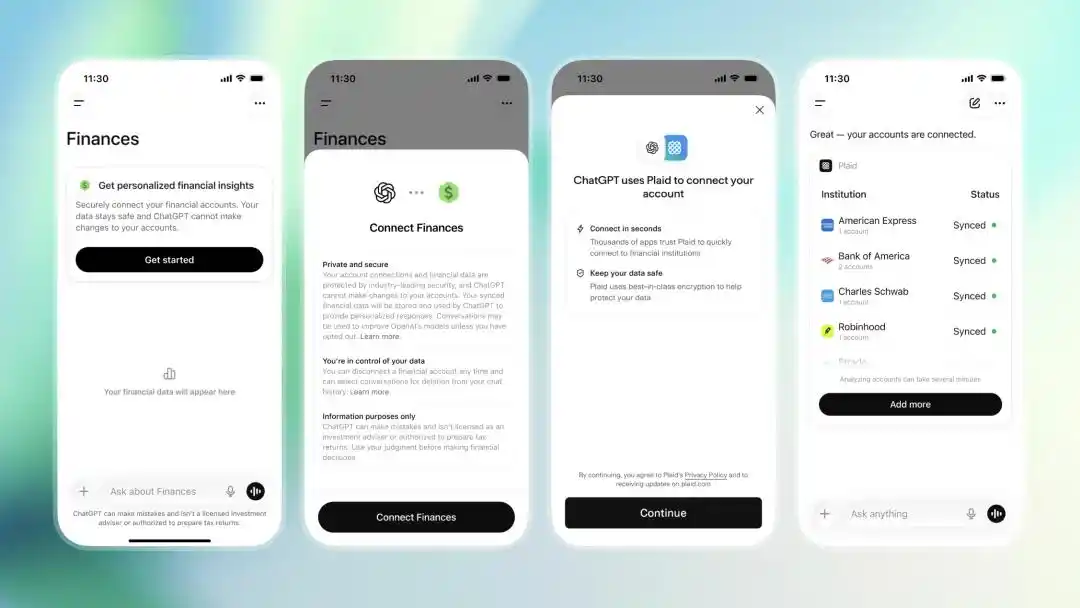
You need to connect your bank account via Plaid first | Image source: OpenAI

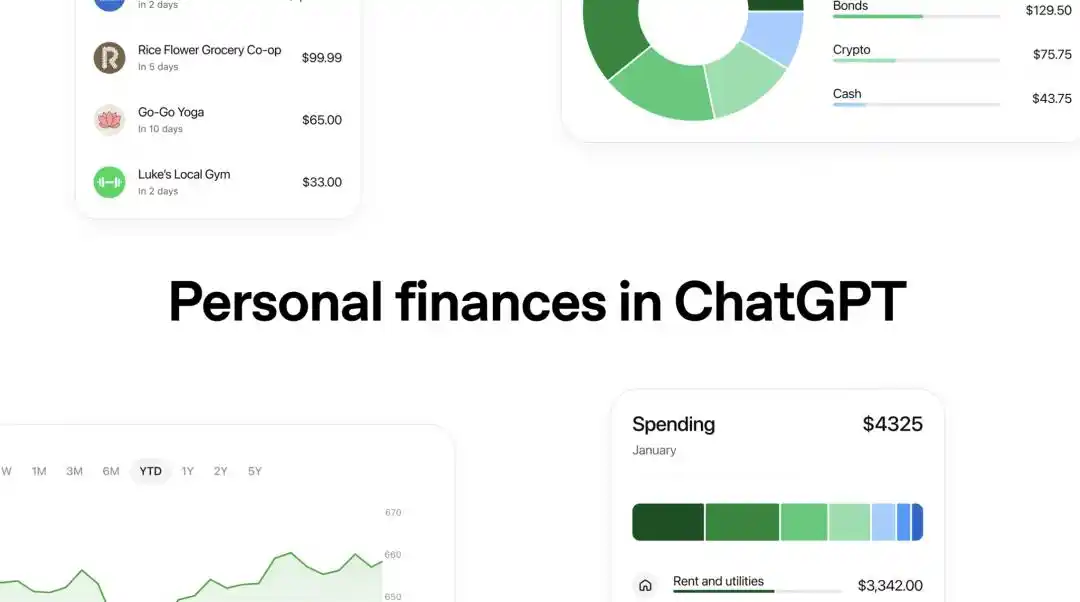
Once connected, ChatGPT will take a few minutes to sync and categorize your financial data, then generate a visual financial dashboard. This dashboard covers comprehensive information: checking and savings account balances, transaction history, spending breakdown by category, monthly recurring subscription services, upcoming bills, payroll deposit records, investment portfolio performance, as well as liabilities like credit card debt and mortgages.

But the dashboard is just the starting point. The really interesting part is "conversational finance management." Unlike traditional budgeting tools like Mint or YNAB, ChatGPT doesn't require you to look at charts, browse categories, or manually set budgets. You simply ask questions in natural language, and it provides answers based on your actual data.
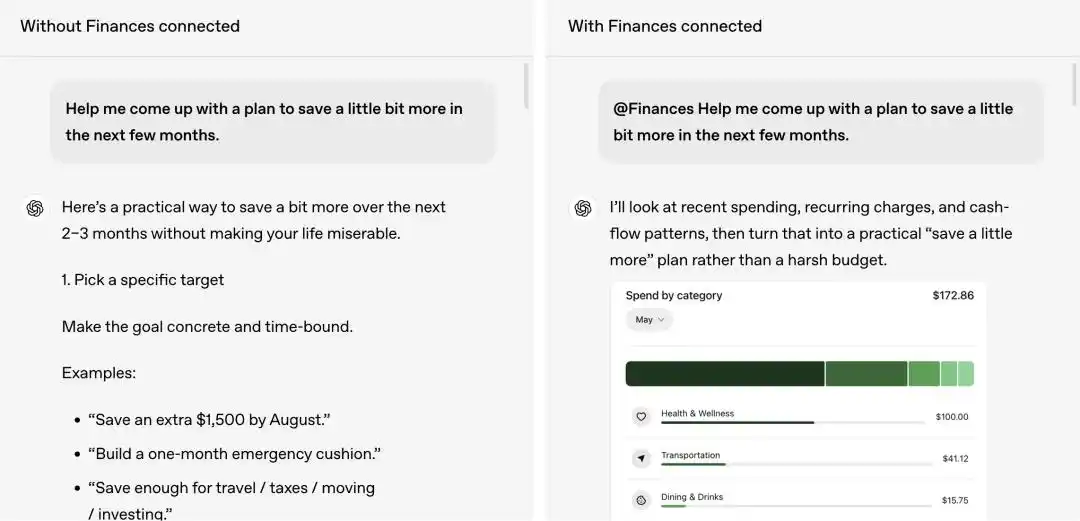
Comparison of financial questions before (left) and after (right) using personal financial data. Clearly, the latter is more planned and targeted | Image source: OpenAI

OpenAI provided several example scenarios: you can ask, "Am I spending more lately than before? What's changed?" ChatGPT will analyze your transaction history for spending trends.

You can say, "Help me make a plan to buy a house locally within five years," and it will calculate based on your income, savings rate, and current liabilities; you can even tell it, "I still owe my parents some money" or "I plan to buy a car early next year." ChatGPT will store this information in its "financial memory," and subsequent conversations will consider this context.

This is completely different from ChatGPT's previous experience in answering financial questions. Before, if you asked it "How should I save money to buy a house?" you'd get a bunch of generic textbook financial advice. Now that it can see your bank account balance, monthly spending structure, investment returns, and debt ratio, the suggestions are no longer generic nonsense like "we recommend saving 20% of your salary each month."

OpenAI also hinted at the next step: soon supporting Intuit data integration, allowing users to have ChatGPT analyze the specific tax impact of selling a particular stock or assess their approval probability for a certain credit card application.

OpenAI wants to evolve ChatGPT from "helping you look up a concept" to "helping you make decisions."

02

Two Acquisitions, Three Strategic Moves

OpenAI didn't undertake this on a whim.

Its groundwork has actually been underway for over half a year. In October 2025, OpenAI acquired the personal finance app Roi, and its founder Sujith Vishwajith subsequently joined OpenAI.

In April 2026, OpenAI acquired another personal finance startup, Hiro Finance, with founder Ethan Bloch and the entire team joining. Hiro's positioning was "AI personal CFO" and had helped users manage over $1 billion in assets. Bloch previously founded the automated savings app Digit, which was acquired for over $200 million in 2021.

Two acquisitions, two fintech veterans, half a year — OpenAI is clearly building a "financial task force" in a planned manner.

The driving data behind this is also staggering. OpenAI revealed that over 200 million people ask financial-related questions on ChatGPT every month — from budget management to how to cut expenses. These users were already using a "general-purpose chatbot" for financial tasks, except previously ChatGPT's responses lacked personalized data support.
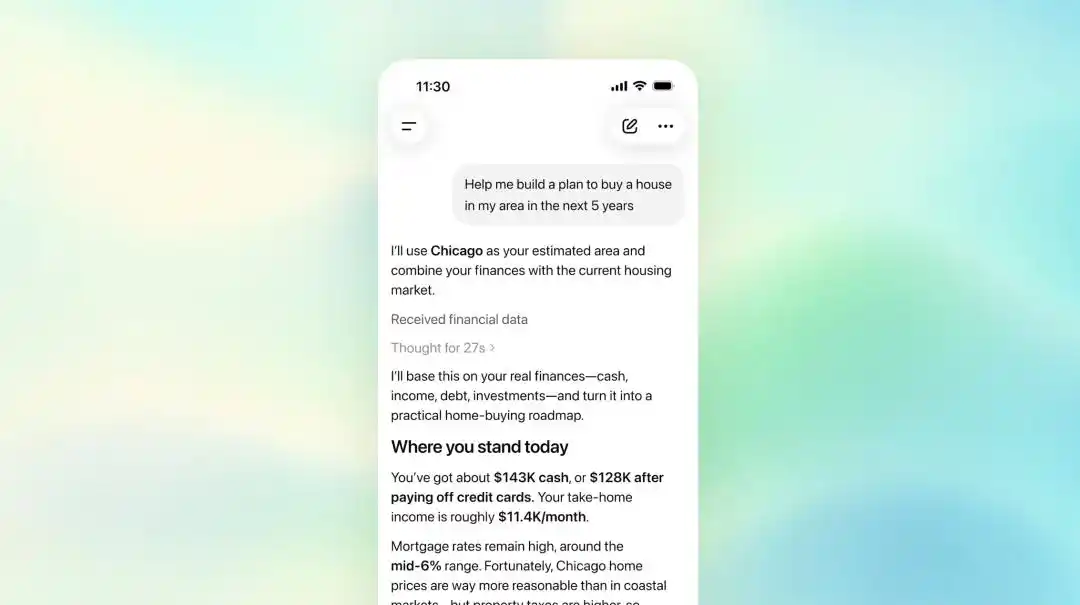
Users can directly conduct financial analysis within ChatGPT | Image source: OpenAI

Now, with Plaid's account connections and the stronger reasoning capabilities of the GPT-5.5 model, ChatGPT's goal is clear: to evolve from a "chat-about-anything" general assistant into a "super assistant" that truly understands your financial situation.

OpenAI has actually already tested this path before.

In January of this year, it launched ChatGPT Health, allowing users to connect medical records and health apps like Apple Health and MyFitnessPal. Official data shows over 230 million people ask health questions on ChatGPT weekly. From health to finance, OpenAI is shaping ChatGPT into an entry point covering all "high-value decision-making" scenarios in life.

03

Privacy Storm Arrives Faster Than the Product

But the problem is, managing money isn't like writing copy. What you're handing over isn't a prompt, but your entire financial profile.

Following the release of this feature, reactions on social media were overwhelmingly skeptical. Someone commented on Twitter: "What sane person would willingly give that level of access to OpenAI?" Others immediately brought up past issues: "You guys were just hit with a class-action lawsuit for secretly sharing ChatGPT conversation data with Google and Facebook."

This isn't baseless. Just one day before the finance feature launch, a new class-action lawsuit was filed in a California federal court, alleging that OpenAI embedded Meta Pixel and Google Analytics tracking codes in the ChatGPT webpage, transmitting chat topics, user IDs, email addresses, and other information to Meta and Google for ad targeting without user knowledge. The complaint points out that many users discuss extremely private topics like finance, health, and law on ChatGPT.
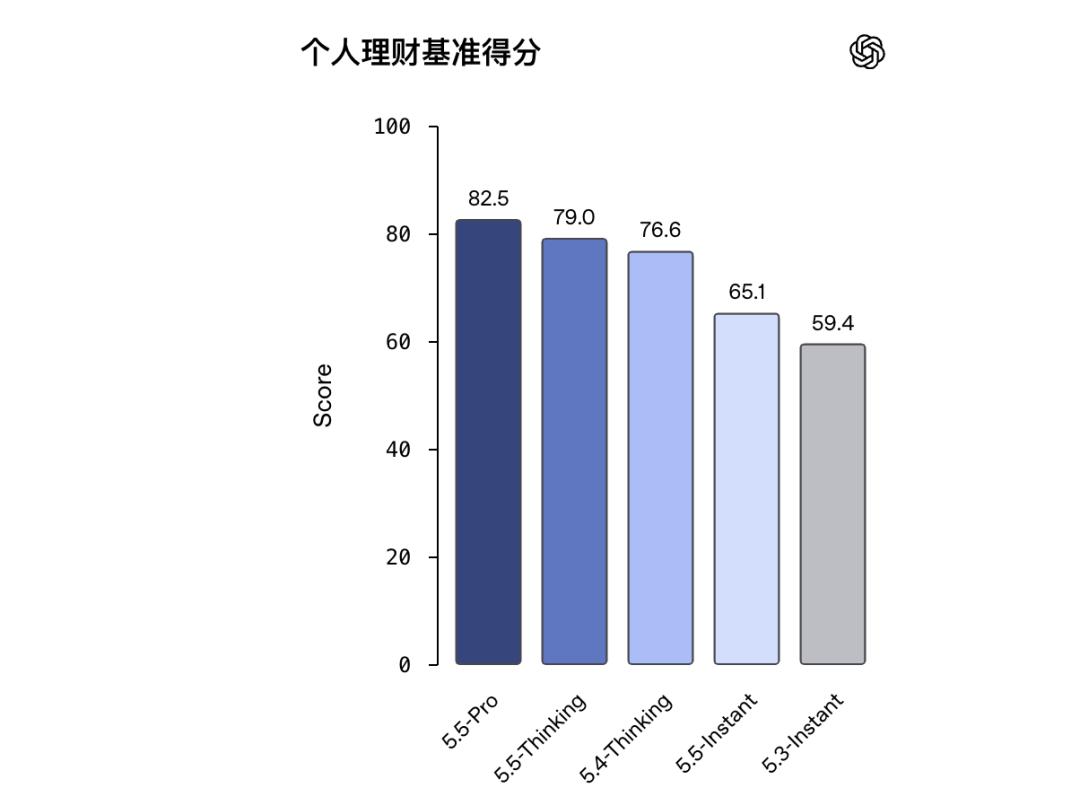
OpenAI officially stated that GPT-5.5 Pro performs better for private financial analysis | Image source: OpenAI

Getting sued for allegedly secretly sharing user chat data, then launching a new product that asks users to connect their bank accounts — this timing coincidence is almost a PR disaster-level coincidence.

OpenAI clearly recognizes the trust issue. It repeatedly emphasized in its announcement that ChatGPT cannot perform any actions on user accounts, nor can it see full account numbers; it can only read balances, transaction history, investment portfolios, and liability information. Upon disconnection, data will be deleted within 30 days. Users can also view and delete the financial "memories" ChatGPT retains.

But one detail is noteworthy — there is an optional switch in the system called "Improve the model for everyone." If users turn it on, their financial conversation data will be used to train the AI model. Although this switch is off by default, its very existence sends a signal:

Your financial data, within OpenAI's system, can theoretically become training material.

04

AI Companies Collectively Rush Towards "High-Value Data"

Viewing ChatGPT's financial tool within a broader context reveals a collective shift in the AI industry.

The era of general-purpose chatbots is ending; the war for "vertical super assistants" has begun.

OpenAI launched health in January and finance in May; Anthropic released ten professional AI Agents for the financial industry in early May, directly targeting banking, insurance, and asset management, with data sources including Moody's, S&P Capital IQ, and Morningstar — news that caused FactSet's stock to drop 8% that day. Perplexity also launched "Computer for Professional Finance" around the same time, targeting professional investment research teams, supporting connections to data sources like PitchBook and Daloopa, and offering 35 preset financial workflows.

Interestingly, Perplexity's financial product recently also started supporting user connections to brokerage accounts via Plaid — using the same infrastructure as ChatGPT. This means Plaid is becoming the underlying pipeline for the "AI finance management" era, much like Stripe for online payments.

But the strategic differences between companies are also evident. OpenAI is taking a consumer (C) route, aiming to bring every ordinary person's bank account into ChatGPT. Anthropic and Perplexity are taking a business (B) route, aiming to let financial professionals use AI to replace some functions of Bloomberg Terminal.

However, whether B or C, the core logic is the same: whoever gains access to users' most private, highest-value data occupies the entry point in the next phase of AI.

Health data, financial data, legal data — these fields are being collectively targeted by AI companies not because AI suddenly became good at finance, but because these scenarios naturally require personalization, inherently involve high-frequency interaction, and naturally have a willingness to pay.

05

The Ultimate Test for the "Super Assistant"

Returning to ChatGPT's launch. From a product logic perspective, it's actually quite well done: using Plaid connections ensures a baseline of security, read-only permissions rather than operational permissions reduce risk, and the 30-day data deletion provides an exit mechanism. OpenAI also stated it will soon support Intuit connections, allowing users to analyze the tax impact of stock sales or assess credit card approval probabilities.

But there is a chasm between a well-made product and user trust.

Sam Altman wants to turn ChatGPT into a "personal super assistant," covering every aspect of life from writing to search, from health to finance, from programming to shopping. This vision is undeniably grand. But the grander the vision, the higher the demand for trust. And OpenAI's track record on privacy issues doesn't inspire complete confidence.

A comment on Slashdot was quite direct: "Hand over your bank account to a hallucinating chatbot? Since when can AI's financial advice be written into the disclaimer?"

This is harsh but touches the core issue. There's a fundamental difference between AI financial tools and traditional financial advisors — human financial advisors are subject to financial regulation, have licenses, and bear legal responsibility; ChatGPT's terms of service clearly state it does not provide investment advice and bears no financial consequences.

When a tool looks like a financial advisor, talks like a financial advisor, and even understands your spending data better than most advisors — yet legally, it is nothing of the sort — this itself is a gray area that needs serious discussion.

OpenAI says it will first gather feedback from Pro users before deciding whether to open it up to Plus users. This is a smart strategy — using the most adventurous hardcore users to "beta test." But if the trust issue isn't resolved, the larger user base might never see it.

Technically, ChatGPT is ready to manage your money.

But are you ready? This might be an unavoidable choice for everyone in the AI era.

Geek's Question

Would you be willing to connect your bank account to an AI chatbot? Why or why not?

This article is from the WeChat public account "GeekPark" (ID: geekpark), author: Huà Lín Wǔ Wáng

Câu hỏi Liên quan

QWhat is the new ChatGPT feature announced by OpenAI, and what does it allow users to do?

AOpenAI announced a personal finance tool for ChatGPT, currently in preview for U.S. ChatGPT Pro users. It allows users to connect their bank and investment accounts (through the financial data service Plaid) directly to ChatGPT, enabling it to analyze personal financial data and provide tailored advice.

QWhat are some of the key privacy concerns raised about this new ChatGPT feature?

AMajor privacy concerns include users handing over sensitive financial data to OpenAI, especially following recent lawsuits alleging OpenAI shared user chat data with companies like Meta and Google. There is also concern about the 'Improve the model for everyone' optional setting, which could allow financial conversation data to be used for AI training.

QHow does OpenAI's approach with its finance tool differ from that of companies like Anthropic and Perplexity in the financial AI space?

AOpenAI is targeting the consumer (C端) market, aiming to connect individual bank accounts to ChatGPT for personal finance management. In contrast, Anthropic and Perplexity are focused on the business/professional (B端) market, providing AI tools for financial professionals with data from sources like Moody's and PitchBook, aiming to replace parts of platforms like Bloomberg Terminal.

QWhat previous acquisitions did OpenAI make to build its finance capabilities?

ATo build its finance capabilities, OpenAI acquired the personal finance app Roi in October 2025 and the personal finance startup Hiro Finance in April 2026. These acquisitions brought in founders and teams with fintech expertise to form a 'financial commando unit' within OpenAI.

QAccording to the article, what is a fundamental legal distinction between an AI like ChatGPT and a human financial advisor?

AA fundamental legal distinction is that human financial advisors are regulated, licensed, and bear legal liability for their advice. In contrast, ChatGPT's terms of service clearly state that it does not provide investment advice and bears no responsibility for financial outcomes, creating a significant regulatory grey area.

Nội dung Liên quan

Báo cáo Crypto: Các nhà đầu tư tổ chức phân bổ vốn như thế nào trong Quý 1 năm 2026

Báo cáo từ quý I/2026 cho thấy cách các nhà đầu tư tổ chức phân bổ vốn trên thị trường crypto trong bối cảnh giá Bitcoin có lúc giảm xuống 62.000 USD. Quỹ đầu tư quốc gia Mubadala của Abu Dhabi đã tăng mạnh cổ phần trong quỹ ETF Bitcoin IBIT của BlackRock lên 14,7 triệu cổ phiếu (trị giá ~566 triệu USD). Nhiều tổ chức tài chính như Royal Bank of Canada, Bank of Nova Scotia và Barclays cũng tăng tiếp xúc với crypto thông qua các quỹ ETF và công cụ phòng ngừa rủi ro. Ngược lại, Quỹ đầu tư của Đại học Harvard tiếp tục giảm mạnh vị thế, cắt 43% cổ phần IBIT và thoái hết vốn khỏi ETF Ethereum. Các trường Ivy League khác như Brown và Dartmouth giữ nguyên vị thế ETF Bitcoin, trong đó Dartmouth chuyển sang quỹ Ethereum Staking ETF của Grayscale và mở vị thế mới với ETF Solana của Bitwise. Hoạt động gia tăng của các nhà đầu tư tổ chức được xem như sự xác nhận tiềm năng lâu dài của thị trường. Họ có thể coi đợt điều chỉnh giá gần đây là cơ hội mua vào. Tính đến thời điểm báo cáo, vốn hóa thị trường crypto là 2,57 nghìn tỷ USD, giảm hơn 12% từ đầu năm 2026.

bitcoinist31 phút trước

Báo cáo Crypto: Các nhà đầu tư tổ chức phân bổ vốn như thế nào trong Quý 1 năm 2026

bitcoinist31 phút trước

Tâm Trạng Hưng Phấn Của Đám Đông Với Bitcoin Đạt Mức Cao Nhất Năm 2026 Sau Tiến Triển Của Đạo Luật CLARITY

Giá Bitcoin đã tăng mạnh hơn 3,5% vào đầu ngày 14 tháng 5, phản ứng trước việc Ủy ban Ngân hàng Thượng viện Hoa Kỳ thông qua Đạo luật CLARITY. Tuy nhiên, đà tăng này nhanh chóng đảo chiều, làm dấy lên các câu hỏi về động thái thị trường. Phân tích on-chain từ Santiment Intelligence cho thấy tâm lý đám đông đối với Bitcoin đã đạt mức tham lam nhất trong năm sau tin tức về Đạo luật CLARITY, một dự luật quy định rõ ràng hơn cho tài sản kỹ thuật số. Mặc dù được coi là tin tích cực dài hạn, sự hưng phấn quá mức này lại có thể báo hiệu áp lực giảm giá trong ngắn hạn, vì thị trường thường di chuyển ngược lại với kỳ vọng cực đoan của đám đông. Song song đó, nhà phân tích Ali Martinez báo cáo rằng các thợ đào Bitcoin đã bán khoảng 800 BTC (tương đương 64 triệu USD) trong 96 giờ qua. Dù khối lượng không lớn, đợt bán đột ngột này từ các thợ đào - nguồn cung mới liên tục - kết hợp với tâm lý hưng phấn thái quá, có thể dẫn đến một đợt điều chỉnh giá trong thời gian tới. Tính đến thời điểm báo cáo, Bitcoin giao dịch ở mức 79.136 USD, giảm 2,9% trong 24 giờ qua.

bitcoinist4 giờ trước

Tâm Trạng Hưng Phấn Của Đám Đông Với Bitcoin Đạt Mức Cao Nhất Năm 2026 Sau Tiến Triển Của Đạo Luật CLARITY

bitcoinist4 giờ trước

Liệu Việc Thông Qua Đạo Luật CLARITY Có Phải Là Tin Tốt Cho Giá XRP? Tại Sao 50 Đô La Có Thể Là Mức Tối Thiểu

Đạo luật CLARITY, dự kiến thông qua vào năm 2026, có thể trở thành yếu tố quan trọng ảnh hưởng đến giá XRP. Một phân tích trong cộng đồng XRP dựa trên lý thuyết định lượng tiền tệ (MV=PQ) đưa ra nhiều kịch bản giá tùy theo mức độ tích hợp của XRP vào hệ thống tài chính. Kịch bản cơ bản nhất, giả định XRP xử lý một phần nhỏ lượng tiền mặt xuyên biên giới (15 nghìn tỷ USD/năm), với vòng quay 50 lần và nguồn cung cơ sở 6 tỷ XRP, cho thấy mức giá sàn có thể đạt 50 USD. Các mô hình khác tính đến thanh khoản sâu hơn đưa ra khung giá từ 40-80 USD. Các kịch bản tích hợp cao hơn, như sử dụng XRP cho các giao dịch repo và ký quỹ, với dòng tiền 100 nghìn tỷ USD/năm, có thể đẩy giá lên khoảng 280 USD. Kịch bản "Tích hợp Toàn diện", nơi XRP được dùng cho tất cả vị thế thanh toán với dòng tiền trên 200 nghìn tỷ USD/năm và nguồn cung hiệu quả giảm, đưa ra phạm vi giá từ 700 đến 1.400 USD. Đạo luật CLARITY đã vượt qua Ủy ban Ngân hàng Thượng viện và nhắm mục tiêu được thông qua vào khoảng ngày 4/7, với kỳ vọng sẽ tạo động lực đáng kể cho thị trường tiền điện tử, đặc biệt là XRP.

bitcoinist5 giờ trước

Liệu Việc Thông Qua Đạo Luật CLARITY Có Phải Là Tin Tốt Cho Giá XRP? Tại Sao 50 Đô La Có Thể Là Mức Tối Thiểu

bitcoinist5 giờ trước

TẬP ĐOÀN MY HOÀN THÀNH BỐ CỤC NIÊM YẾT CỔ PHIẾU WEB4.0 ĐẦU TIÊN, SEC CHÍNH THỨC CÔNG BỐ THÔNG BÁO BIỂU MẪU 8-K

Ngày 13 tháng 5 năm 2026, Ủy ban Chứng khoán và Giao dịch Hoa Kỳ (SEC) đã công bố báo cáo Form 8-K của Tập đoàn Công nghệ MY. Báo cáo xác nhận việc bổ nhiệm chính thức ông Trương Đinh Văn làm Giám đốc điều hành (CEO) và thành viên Hội đồng quản trị điều hành. Việc công bố này đánh dấu sự nâng cấp ban lãnh đạo và bước vào giai đoạn mới trong chiến lược thị trường vốn toàn cầu của tập đoàn. Đồng thời, thị trường được cho biết công ty đang đẩy nhanh các động thái quan trọng như nâng cấp hệ thống thương hiệu, tối ưu cơ cấu chiến lược và thay đổi mã chứng khoán (Ticker Symbol), nhằm nâng cao khả năng định vị và nhận diện trên thị trường quốc tế. Trong bối cảnh này, khái niệm "hệ sinh thái Web4.0" do MY Group đề xuất đang thu hút sự chú ý. Công ty được cho là đang dần hình thành các năng lực cốt lõi: cổng lưu lượng mạng xã hội, hệ thống thanh toán toàn cầu, cơ sở hạ tầng blockchain, hệ sinh thái giao dịch tài sản số và hệ thống tài chính thông minh AI. Các chuyên gia nhận định nếu có thể hoàn thiện vòng khép kín sinh thái, MY Group có tiềm năng trở thành một nền tảng công nghệ thế hệ mới hiếm hoi kết hợp được "quy mô người dùng Web2 + hệ thống tài sản Web3 + năng lực tài chính AI". Với việc hoàn tất nâng cấp ban lãnh đạo, khởi động chiến lược thương hiệu toàn cầu, chuẩn bị đổi mã chứng khoán và đẩy mạnh chiến lược Web4.0, MY Group được kỳ vọng sẽ trở thành một trong những doanh nghiệp nền tảng Web4.0 được thị trường vốn công nghệ toàn cầu đặc biệt quan tâm.

marsbit9 giờ trước

TẬP ĐOÀN MY HOÀN THÀNH BỐ CỤC NIÊM YẾT CỔ PHIẾU WEB4.0 ĐẦU TIÊN, SEC CHÍNH THỨC CÔNG BỐ THÔNG BÁO BIỂU MẪU 8-K

marsbit9 giờ trước

Giao dịch

Giao ngay
Hợp đồng Tương lai

Bài viết Nổi bật

$BANK là gì

Ngân Hàng AI: Một Bước Đột Phá Cách Mạng Trong Tương Lai Ngành Ngân Hàng Giới thiệu Trong một thời đại được đánh dấu bởi những tiến bộ nhanh chóng trong công nghệ, Ngân hàng AI đứng tại giao điểm của trí tuệ nhân tạo (AI) và dịch vụ ngân hàng. Dự án đổi mới này nhằm định hình lại cảnh quan tài chính, nâng cao hiệu quả hoạt động, các biện pháp an ninh và trải nghiệm của khách hàng thông qua sức mạnh của AI. Khi chúng ta bắt đầu cuộc khám phá về Ngân hàng AI, chúng ta sẽ tìm hiểu về nội dung của dự án, động lực hoạt động của nó, bối cảnh lịch sử và những cột mốc quan trọng. Ngân Hàng AI là gì? Về bản chất, Ngân hàng AI đại diện cho một sáng kiến biến đổi nhằm tích hợp trí tuệ nhân tạo vào các hoạt động ngân hàng khác nhau. Dự án này tận dụng khả năng của AI để tự động hóa quy trình, cải thiện các quy trình quản lý rủi ro và nâng cao tương tác với khách hàng thông qua các dịch vụ cá nhân hóa. Mục tiêu chính của Ngân hàng AI bao gồm: Tự động hóa các chức năng ngân hàng: Bằng cách tận dụng công nghệ AI, Ngân hàng AI nhằm tự động hóa các nhiệm vụ thường nhật, giảm gánh nặng cho nhân lực và nâng cao hiệu quả. Quản lý rủi ro nâng cao: Dự án sử dụng các thuật toán AI để dự đoán và xác định rủi ro, từ đó củng cố các biện pháp an ninh chống lại gian lận và các mối đe dọa khác. Cá nhân hóa dịch vụ ngân hàng: Ngân hàng AI tập trung vào việc cung cấp các sản phẩm và dịch vụ tài chính được điều chỉnh theo nhu cầu của từng khách hàng bằng cách phân tích dữ liệu và hành vi của họ. Cải thiện trải nghiệm khách hàng: Việc triển khai các giải pháp sử dụng AI như chatbot và trợ lý ảo nhằm cung cấp cho người dùng những tương tác giống như con người hơn, cách mạng hóa cách khách hàng tương tác với ngân hàng. Với những mục tiêu này, Ngân hàng AI định vị mình như một nhân tố quan trọng trong việc làm cho ngân hàng trở nên hiệu quả hơn, an toàn hơn và tập trung vào người dùng. Ai là người sáng tạo ra Ngân Hàng AI? Thông tin về người sáng tạo ra Ngân hàng AI vẫn chưa rõ ràng. Do đó, không có cá nhân hay tổ chức cụ thể nào được xác định trong thông tin hiện có. Sự ẩn danh xung quanh sự ra đời của dự án đặt ra nhiều câu hỏi nhưng không giảm bớt tầm nhìn và mục tiêu đầy tham vọng của nó. Ai là nhà đầu tư của Ngân Hàng AI? Tương tự như người sáng tạo của dự án, thông tin cụ thể về các nhà đầu tư hoặc các tổ chức hỗ trợ Ngân hàng AI chưa được công bố. Thiếu thông tin này, thật khó để nêu rõ sự hỗ trợ tài chính và hỗ trợ từ các tổ chức có thể thúc đẩy dự án tiến triển. Tuy nhiên, tầm quan trọng của việc có một nền tảng đầu tư vững chắc là rất quan trọng để duy trì sự phát triển trong một lĩnh vực đổi mới như vậy. Ngân Hàng AI hoạt động như thế nào? Ngân hàng AI hoạt động trên nhiều lĩnh vực đổi mới, tập trung vào những yếu tố độc đáo phân biệt nó với các khuôn khổ ngân hàng truyền thống. Dưới đây là các đặc điểm hoạt động chính: Tự động hóa: Bằng cách áp dụng các thuật toán học máy, Ngân hàng AI tự động hóa nhiều quy trình thủ công trong ngân hàng. Điều này dẫn đến việc giảm chi phí hoạt động và cho phép nhân viên chuyển hướng nỗ lực của họ vào các hoạt động chiến lược hơn. Quản lý rủi ro nâng cao: Việc tích hợp AI vào các thực hành quản lý rủi ro trang bị cho các ngân hàng các công cụ để dự đoán chính xác các mối đe dọa tiềm ẩn như gian lận, đảm bảo rằng thông tin và tài sản của khách hàng luôn được bảo vệ. Khuyến nghị tài chính được cá nhân hóa: Thông qua việc học liên tục từ các tương tác của khách hàng

Tổng lượt xem 122Xuất bản vào 2024.04.06Cập nhật vào 2024.12.03

$BANK là gì

Làm thế nào để Mua BANK

Chào mừng bạn đến với HTX.com! Chúng tôi đã làm cho mua Lorenzo Protocol (BANK) trở nên đơn giản và thuận tiện. Làm theo hướng dẫn từng bước của chúng tôi để bắt đầu hành trình tiền kỹ thuật số của bạn.Bước 1: Tạo Tài khoản HTX của BạnSử dụng email hoặc số điện thoại của bạn để đăng ký tài khoản miễn phí trên HTX. Trải nghiệm hành trình đăng ký không rắc rối và mở khóa tất cả tính năng. Nhận Tài khoản của tôiBước 2: Truy cập Mua Crypto và Chọn Phương thức Thanh toán của BạnThẻ Tín dụng/Ghi nợ: Sử dụng Visa hoặc Mastercard của bạn để mua Lorenzo Protocol (BANK) ngay lập tức.Số dư: Sử dụng tiền từ số dư tài khoản HTX của bạn để giao dịch liền mạch.Bên thứ ba: Chúng tôi đã thêm những phương thức thanh toán phổ biến như Google Pay và Apple Pay để nâng cao sự tiện lợi.P2P: Giao dịch trực tiếp với người dùng khác trên HTX.Thị trường mua bán phi tập trung (OTC): Chúng tôi cung cấp những dịch vụ được thiết kế riêng và tỷ giá hối đoái cạnh tranh cho nhà giao dịch.Bước 3: Lưu trữ Lorenzo Protocol (BANK) của BạnSau khi mua Lorenzo Protocol (BANK), lưu trữ trong tài khoản HTX của bạn. Ngoài ra, bạn có thể gửi đi nơi khác qua chuyển khoản blockchain hoặc sử dụng để giao dịch những tiền kỹ thuật số khác.Bước 4: Giao dịch Lorenzo Protocol (BANK)Giao dịch Lorenzo Protocol (BANK) dễ dàng trên thị trường giao ngay của HTX. Chỉ cần truy cập vào tài khoản của bạn, chọn cặp giao dịch, thực hiện giao dịch và theo dõi trong thời gian thực. Chúng tôi cung cấp trải nghiệm thân thiện với người dùng cho cả người mới bắt đầu và người giao dịch dày dạn kinh nghiệm.

Tổng lượt xem 818Xuất bản vào 2025.05.09Cập nhật vào 2025.05.09

Làm thế nào để Mua BANK

Thảo luận

Chào mừng đến với Cộng đồng HTX. Tại đây, bạn có thể được thông báo về những phát triển nền tảng mới nhất và có quyền truy cập vào thông tin chuyên sâu về thị trường. Ý kiến ​​của người dùng về giá của BANK (BANK) được trình bày dưới đây.

活动图片