CLARITY Act Could Unlock Wider Tech Growth In America, Says a16z

bitcoinist2026-05-17 tarihinde yayınlandı2026-05-17 tarihinde güncellendi

Özet

The CLARITY Act, a crypto market structure bill, faces its main hurdle in securing bipartisan Senate support, according to Grayscale. While it advanced from committee with mostly Republican votes, achieving the needed 60 votes will require significant Democratic support. Analysts cite the bipartisan passage of the GENIUS Act as a hopeful precedent. Venture firm a16z argues the bill's impact extends beyond crypto, claiming a clear U.S. legal framework would drive wider domestic innovation and bolster the dollar's global standing. Internationally, the legislation is seen as a regulatory signal for other countries. The outcome now depends on Senate vote counts.

Bipartisan support remains the main obstacle standing between the CLARITY Act and becoming law. That was the assessment from asset management firm Grayscale on Friday, even as the company said it believes the bill has a strong chance of passing.

Republicans hold 53 Senate seats, meaning at least seven Democrats would need to cross the aisle for the legislation to clear the full chamber.

CLARITY Act Advances

The CLARITY Act advanced out of the US Senate Banking Committee last Thursday after a vote that split mostly along party lines. All 13 Republican members voted in favor, joined by two Democrats.

Nine Democrats voted against it. The bill, which aims to give the crypto industry clearer rules around market structure, has been a subject of intense debate since its introduction in July 2025.

Grayscale pointed to the GENIUS Act as a possible guide for what comes next. That stablecoin legislation passed the Senate with 66 votes, including 18 Democrats.

Based on that track record, Grayscale said it believes similar bipartisan backing for the CLARITY Act is achievable, though it acknowledged that several hurdles remain before it can be signed into law.

Broader Economic Stakes

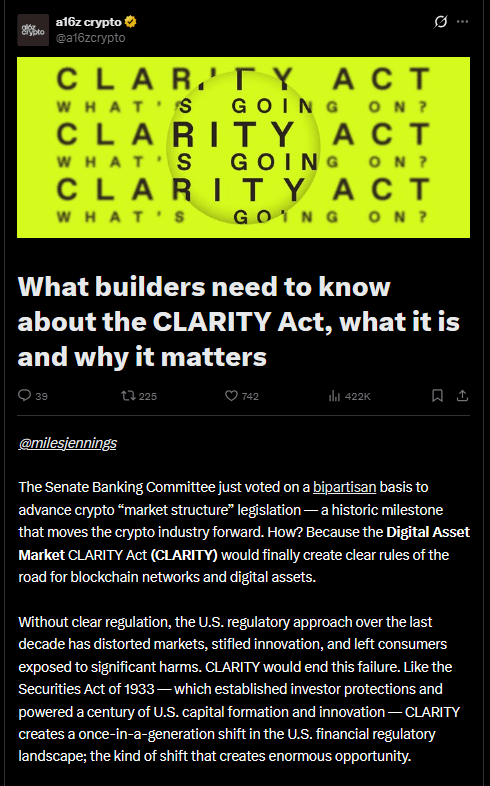
Venture capital firm a16z crypto argued Friday that the implications of the bill go well beyond the crypto sector. According to the firm, giving builders in the US a clear legal framework would drive wider domestic innovation.

BTCUSD now trading at $78,417. Chart: TradingView

It cited the GENIUS Act’s passage as a precedent, saying that legislation produced strong growth and adoption that it described as beneficial not just for the US economy but for the long-term position of the US dollar globally.

The US dollar index, which measures the dollar’s strength against a basket of major currencies, stood at 99.26 at the time of publication, up 1.25% over the prior 30 days, according to TradingView data.

Image: IQ.wiki

Global Signal

Sharplink Gaming CEO Joseph Chalom added another dimension to the conversation, saying the bill is being watched far beyond US borders.

While many see the legislation as a domestic matter, Chalom said other countries are treating it as a signal for how they might approach their own crypto regulations.

A16z framed the broader stakes plainly: when US legal frameworks balance innovation with consumer protection, the country tends to lead and the rest of the world follows.

Whether the Senate delivers that framework is now a question of vote counting.

Featured image from MadebyBaurley, chart from TradingView

İlgili Sorular

QWhat is the main obstacle for the CLARITY Act to become law according to Grayscale?

ABipartisan support remains the main obstacle for the CLARITY Act to become law.

QHow did the US Senate Banking Committee vote on the CLARITY Act, and what was the party-line split?

AThe CLARITY Act advanced out of the US Senate Banking Committee with all 13 Republican members voting in favor, joined by two Democrats, while nine Democrats voted against it.

QWhat precedent does a16z crypto cite to argue for the potential benefits of the CLARITY Act?

Aa16z crypto cites the passage of the GENIUS Act as a precedent, saying it produced strong growth and adoption beneficial for the US economy and the long-term global position of the US dollar.

QAccording to Sharplink Gaming CEO Joseph Chalom, how are other countries viewing the CLARITY Act?

AJoseph Chalom said that other countries are treating the CLARITY Act as a signal for how they might approach their own crypto regulations, watching it far beyond US borders.

QWhat does a16z crypto argue is the broader implication of passing the CLARITY Act for US innovation?

Aa16z crypto argues that giving builders in the US a clear legal framework through the CLARITY Act would drive wider domestic innovation.

İlgili Okumalar

Cloud PC Gets a Second Chance, Google/Alibaba/Microsoft Battle for Cloud AI Dominance

Google unexpectedly announced "Android Computer," a new high-end productivity-focused PC series, positioning cloud AI as its core rather than an add-on. This move signals a potential revival for the "cloud computer" concept in the AI era. The article argues that current "AI PCs" are essentially traditional Windows machines with AI features grafted on, heavily reliant on cloud AI for complex tasks due to limited local consumer-grade hardware capabilities. This reliance raises questions about the value of premium local AI hardware. Cloud computers, which struggled with latency-sensitive applications like cloud gaming, are seen as a natural fit for AI PCs due to AI's higher tolerance for response time. Google's Android Computer deeply integrates AI (powered by its Gemini model) into the OS interface, making it contextually available. Its hardware-agnostic approach (supporting both x86 and ARM chips) further underscores the shift towards cloud-centric AI. Other players are adapting: Cloud service providers like Alibaba are enhancing their AI cloud computer offerings; chipmakers (Intel, AMD) are focusing on data center AI chips; traditional PC brands are adding AI software layers; and Apple is leveraging its ecosystem and affordable hardware. Microsoft is defining AI PC standards, embedding Copilot (powered by GPT and Bing) into Windows, and also relying on cloud AI. In conclusion, Android Computer challenges the traditional PC form factor by proposing a "light local, heavy cloud" model. This approach appears promising amid rising hardware costs and local compute bottlenecks. The future PC market will involve a multifaceted competition around cloud integration, OS-level AI, and cross-device ecosystems, potentially redefining the PC as a screen and network conduit to cloud-based AI productivity.

marsbit6 dk önce

Cloud PC Gets a Second Chance, Google/Alibaba/Microsoft Battle for Cloud AI Dominance

marsbit6 dk önce

Encrypted ETF Weekly Report | Last Week, US Bitcoin Spot ETF Net Outflow $9.95 Billion; US Ethereum Spot ETF Net Outflow $255 Million

Last week, U.S. Bitcoin spot ETFs saw significant net outflows totaling $995 million over three days, with a major contribution of $317 million from BlackRock's IBIT. Their total net asset value (NAV) stands at $104.2 billion. U.S. Ethereum spot ETFs also experienced net outflows of $255 million over five days, largely from BlackRock's ETHA ($186 million out), bringing their total NAV to $12.93 billion. In Hong Kong, Bitcoin spot ETFs recorded a net outflow of 24.91 BTC, reducing their NAV to $323 million. Hong Kong's Ethereum spot ETFs saw no inflows, with an NAV of $68.13 million. U.S. Bitcoin spot ETF options showed increased activity, with a total nominal trading volume of $797 million and a put/call trading ratio of 1.63, indicating a bullish market sentiment. The total open interest reached $23.08 billion. Key developments include VanEck and Grayscale simultaneously filing amended proposals for BNB ETFs, signaling potential SEC review progress. Grayscale also filed for the first U.S. privacy coin ETF (Zcash). Avenir Group remains Asia's largest institutional holder of Bitcoin ETFs. 21Shares launched an actively managed crypto ETF (TKNS), and Bitwise's Hyperliquid ETF (BHYP) is set to list on the NYSE. Institutional activity varied: JPMorgan dramatically increased its Bitcoin ETF holdings (IBIT up 174%), while Jane Street significantly reduced its exposure (IBIT down 71%). Dartmouth College disclosed holdings of $7.7M in Bitcoin ETF and $3.4M in a Solana ETF.

链捕手10 dk önce

Encrypted ETF Weekly Report | Last Week, US Bitcoin Spot ETF Net Outflow $9.95 Billion; US Ethereum Spot ETF Net Outflow $255 Million

链捕手10 dk önce

Vitalik: What We Need to Do Is Not Fight AI, But Create Sanctuaries

Vitalik Buterin, in an a16z podcast, addresses the core challenge of the AI era: not to fight AI, but to build "sanctuary technologies" that protect humans without stripping away privacy and agency. He argues the greatest risk is not super-intelligent AI, but humans becoming passive passengers who outsource decisions to centralized systems and AI, leading to a disempowering safety. He redefines Ethereum/crypto's mission as creating such a sanctuary—a parallel, optional space for free coordination, not a fix for the existing system. This becomes crucial as AI and corporate power centralize. Reflecting on his journey from a 19-year-old on "autopilot" to an active "pilot," Vitalik emphasizes that the world reinvents itself every 5-10 years, demanding proactive adaptation. He stresses that active learning is 10x more effective than passive learning, even with equal time. His key advice is to intentionally maintain "manual mode" amidst powerful AI: do tasks yourself, engage in active learning, and avoid total cognitive outsourcing to prevent mental atrophy. For builders, the focus should be on creating tools that preserve human sovereignty, foster serendipity, and keep strategic control. In summary, the AI era demands greater human initiative. True value lies not in computational power, but in active, sovereign individuals who use technology as a tool for agency, not a replacement for it.

marsbit27 dk önce

Vitalik: What We Need to Do Is Not Fight AI, But Create Sanctuaries

marsbit27 dk önce

İşlemler

Spot
Futures
活动图片