South Korea's Crypto Tax Countdown Begins: Escalating Three-Way Game Between CEXs, Retail Investors, and Regulators

marsbitОпубликовано 2026-05-08Обновлено 2026-05-08

Введение

South Korea's National Tax Service has initiated final preparations to implement a virtual asset tax starting January 2027, with reporting for comprehensive income tax due by May 2028. The tax applies a 22% rate on annual profits exceeding 2.5 million KRW from transfers and leasing, affecting an estimated 13.26 million people. To enforce this, authorities plan to collect data from major domestic exchanges like Upbit and Bithumb and launch a comprehensive virtual asset analysis system. This move follows two previous postponements and signifies a shift towards institutionalized management. The plan also involves international data sharing under the OECD's CARF framework from next year to curb capital flight. However, tensions exist between regulators and exchanges over data sharing and new anti-money laundering rules. The industry, represented by DAXA, opposes proposed regulations requiring the reporting of all cross-border transfers over $6,800 as suspicious, arguing it renders AI risk systems useless and creates an impractical administrative burden. Given Korea's market—comprising 30% of global volume with 85% in altcoins and dominated by retail speculation—the tax could reduce short-term speculative trading and stabilize the domestic market by limiting capital outflows. Its implementation may also influence global crypto regulatory and taxation models, serving as a significant case study for other jurisdictions.

Author: Gallina, CryptoPulse Labs

At the end of April, the South Korean National Tax Service formally initiated preparatory work for taxation on virtual assets, with plans to implement it in January 2027 and prepare for comprehensive income tax declarations in May 2028.

This taxation covers income from the transfer and leasing of virtual assets, applying a 22% tax rate to annual gains exceeding 2.5 million won. It is expected to involve approximately 13.26 million people.

To this end, the National Tax Service plans to obtain data from domestic trading platforms such as Upbit, Bithumb, and Coinone and promote the launch of a comprehensive virtual asset analysis system to establish a complete taxation infrastructure.

South Korea's virtual asset taxation is transitioning from policy preparation to institutional enforcement, while simultaneously facing practical challenges regarding cooperation from trading platforms and regulatory coordination. This may serve as an important window for observing the global crypto market.

1. Preparations Before Tax Implementation: How the National Tax Service is Building the Virtual Asset System

The South Korean National Tax Service categorizes income from the transfer and leasing of virtual assets as "other income," setting a clear tax rate of 22%, with the aim of establishing a systematic and operational taxation mechanism.

Previously, virtual asset taxation experienced two postponements in 2022 and 2024, reflecting the difficulty in coordinating technology, law, and the market. The clarification of the target timeline this time indicates that the taxation infrastructure has entered its final preparatory stage.

The National Tax Service plans to acquire transaction data from major domestic exchanges while constructing a comprehensive virtual asset analysis system to promote cross-platform data integration. The launch of this system will enable tax authorities to monitor capital flows, track profit distribution, and provide data support for future tax declarations.

More importantly, this taxation plan will also rely on the OECD's CARF international information exchange agreement, sharing data on overseas investors starting next year to prevent capital flight and tax evasion.

By classifying virtual assets under the "other income" category rather than traditional capital gains, the South Korean tax system simplifies the collection process while laying the groundwork for future regulatory classification.

This move reflects the South Korean government's shift from fragmented regulation to institutionalized management in the digital asset field, aiming to establish a transparent and enforceable tax framework while balancing compliance and market stability.

2. The Tug-of-War Between Regulation and Crypto Platforms: Data Sharing and Compliance Challenges

During the implementation of taxation preparatory work, a delicate tension has emerged in the relationship between South Korean authorities and various trading platforms.
Recently, the South Korean Personal Information Protection Commission launched an investigation into Upbit and Bithumb, focusing on whether the two platforms shared order book data with overseas platforms without user consent.

These cross-border data transfers are primarily used to enhance trading liquidity but may violate relevant provisions of the Personal Information Protection Act. The investigation has completed written inquiries and on-site inspections, with results expected in the second half of 2026.

Previously, the two trading platforms have been subject to multiple reviews for inadequate fulfillment of anti-money laundering obligations or other compliance issues, with Bithumb even facing record fines for violations.

Similarly, recently, the South Korean crypto industry collectively opposed further tightening of anti-money laundering regulations.

According to Yonhap News Agency reports, the Digital Asset eXchange Alliance (DAXA), representing 27 registered Virtual Asset Service Providers (VASPs), submitted comments on the proposed amendment to the Enforcement Decree of the Specific Financial Information Act.

The new regulations require domestic VASPs to report as a Suspicious Transaction Report (STR) any virtual asset transfers to or from overseas VASPs, regardless of risk level, if the amount reaches 10 million won (approximately $6,800) or more.

While intended to strengthen anti-money laundering monitoring, the requirement for "non-discriminatory reporting of large cross-border transfers" may lead to a disconnect between regulatory objectives and the industry's practical operational capabilities.

DAXA pointed out that the rule, ignoring transaction risk levels, reduces the value of AI risk control systems invested in by exchanges, such as Upbit's abnormal transaction detection, to mere formality, degrading intelligent compliance to mechanical reporting.

Furthermore, the new regulation would cause the annual report volume of South Korea's five major trading platforms—Upbit, Bithumb, Coinone, Korbit, and Gopax—to surge from about 63,000 cases last year to over 5.4 million cases, an 85-fold increase, posing extreme operational difficulties.

The industry also opposes the proposed additional requirement to verify the accuracy of customer information, viewing it as imposing obligations not clearly stipulated by law.

The highly localized nature of the South Korean virtual asset market is also noteworthy, with its trading volume accounting for 30% of the global total, altcoins comprising up to 85%, while the proportion of Bitcoin and Ethereum is relatively low. The main market participants are retail investors, exhibiting obvious speculative characteristics.

This structure places continuous pressure on trading platforms to balance maintaining liquidity and fulfilling compliance obligations. The friction between regulatory demands and platform business objectives, to some extent, reflects the unique investor behavior and institutional environment of the South Korean market.

3. Capital Flows and Price Volatility: Potential Transmission of Tax Policy

The advancement of virtual asset taxation in South Korea has a direct impact on its domestic market. Taxation will regulate investor behavior, making taxes transparent and potentially curbing short-term speculative activities.

Simultaneously, relying on cross-border information exchange agreements, the space for capital flight is limited, promoting greater stability in the local market order. Tax policy will also influence exchange operating strategies, forcing platforms to adjust between ensuring liquidity and compliance.

From a global perspective, while the South Korean market has a large trading volume, its high proportion of altcoins and relatively insufficient market depth mean its price volatility has a significant spillover effect on global markets.
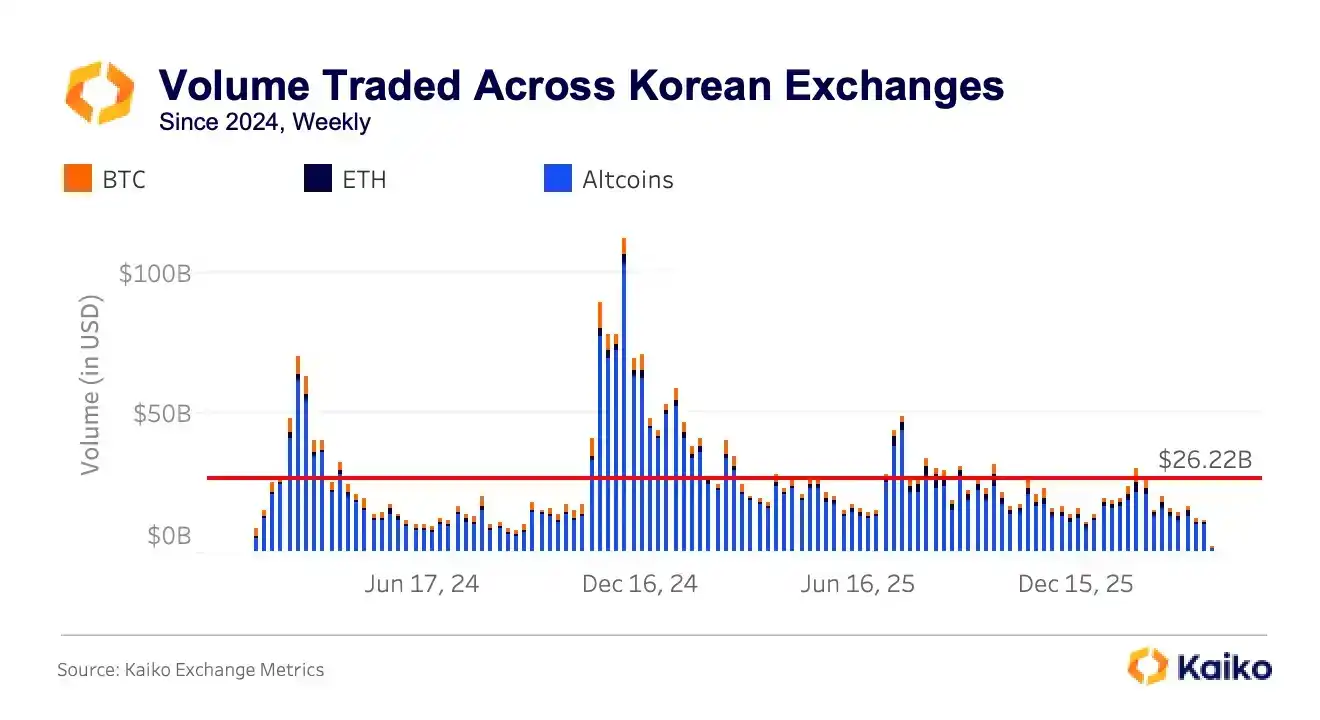
After tax implementation, market funds may be redistributed. Trading enthusiasm for high-volatility assets domestically may decline, affecting international investors' participation strategies in Asian markets.

South Korea's regulatory model and information-sharing experience can serve as a reference for other countries, potentially influencing the global virtual asset taxation and compliance system.

The clear timeline and technical infrastructure construction for this taxation also provide institutional expectations for international capital, offering clearer references for the global market regarding price discovery, liquidity risks, and investment strategies in the South Korean market.

Especially in the areas of cross-border capital management and personal information protection, South Korea's practices may become reference cases for other jurisdictions when formulating policies.

Conclusion

The initiation of virtual asset taxation by the South Korean National Tax Service marks a critical step from policy deliberation to institutionalized management. Although friction exists between domestic trading platforms and regulatory agencies, the construction of tax and data infrastructure helps standardize the market and control capital flows.

The highly speculative nature and cross-border transaction characteristics of the South Korean market mean its taxation practice will not only affect the domestic ecosystem but may also serve as a reference for global cryptocurrency regulation and tax models. Observing market reactions after the final tax implementation will aid in understanding the trends and challenges in the global virtual asset market's institutionalization process.

Связанные с этим вопросы

QWhat are the key steps and timeline for South Korea's upcoming virtual asset taxation plan?

ASouth Korea's National Tax Service (NTS) has officially started preparations in April, with the tax scheduled for implementation on January 1, 2027. This is in preparation for the comprehensive income tax filing in May 2028. The plan involves building a Virtual Asset Comprehensive Analysis System, collecting transaction data from major domestic exchanges like Upbit and Bithumb, and leveraging international information exchange agreements like the OECD's CARF.

QWhat is the tax rate and threshold for virtual asset gains in South Korea's new system?

AThe taxation applies to gains from the transfer and leasing of virtual assets. Gains exceeding 2.5 million KRW (approximately $1,700) per year will be subject to a tax rate of 22%. This is expected to affect approximately 13.26 million people.

QWhat are the main points of friction between South Korean regulators and cryptocurrency exchanges (CEXs)?

AThere are two primary areas of tension. First, data sharing and privacy: regulators are investigating exchanges like Upbit and Bithumb for potentially sharing user order book data with overseas platforms without proper consent. Second, compliance burden: the industry, represented by DAXA, strongly opposes a proposed anti-money laundering rule that would require reporting *all* cross-border transfers over 10 million KRW (~$6,800) as suspicious transactions, which they argue renders AI risk-control systems useless and would increase reporting volume by 85 times, making it operationally unfeasible.

QHow might South Korea's virtual asset taxation policy impact its domestic market and global investors?

ADomestically, the policy aims to standardize investor behavior, reduce short-term speculation, and stabilize the market by limiting capital flight through international data sharing. It may reduce trading volume in high-volatility altcoins, which dominate the Korean market. Globally, Korea's high trading volume and unique market structure (85% altcoin share) mean its price volatility significantly impacts global markets. The country's regulatory model and experience with data sharing could serve as a reference for other jurisdictions shaping their own crypto tax and compliance frameworks.

QWhat is the classification of virtual asset income under the South Korean tax system, and why is it significant?

AVirtual asset transfer and leasing income is classified as 'Other Income' rather than traditional capital gains. This is significant because it simplifies the taxation process within the existing legal framework and establishes a foundational category for future regulatory classification, marking a shift from fragmented oversight to systematic, institutionalized management of digital assets.

Похожее

MY Group Completes Web4.0 First Stock Listing Layout, SEC Officially Discloses Form 8-K Announcement

MY Group has completed the listing layout for the "Web4.0 First Share," with the U.S. Securities and Exchange Commission (SEC) formally disclosing a Form 8-K report. According to the filing, the company's board has officially appointed Mr. Zhang Dingwen as Chief Executive Officer (CEO) and Executive Director, marking a significant upgrade in management and the entry into a new phase of its global capital market strategy. The disclosure of Form 8-K, used for reporting major corporate events, coincides with market information indicating the company is advancing several key capital market initiatives. These include a global brand system upgrade, corporate strategic restructuring, and a change of its stock ticker symbol. These moves are viewed by industry experts as signals of accelerated internationalization and enhanced global market presence. Concurrently, MY Group's proposed "Web4.0 Ecosystem" is garnering market attention. The company is integrating core capabilities across social traffic portals, global payment systems, public blockchain infrastructure, digital asset trading, and AI-powered financial systems. Analysts suggest that by closing this ecosystem loop, MY Group has the potential to become a next-generation platform merging Web2 user scale with Web3 asset frameworks and AI financial capabilities. With the management upgrade finalized, the global brand strategy launched, and the stock ticker change pending, MY Group is positioning itself as a focal point in the global technology capital market as a potential leading Web4.0 platform enterprise.

marsbit9 ч. назад

MY Group Completes Web4.0 First Stock Listing Layout, SEC Officially Discloses Form 8-K Announcement

marsbit9 ч. назад

Торговля

Спот
Фьючерсы

Популярные статьи

Как купить S

Добро пожаловать на HTX.com! Мы сделали приобретение Sonic (S) простым и удобным. Следуйте нашему пошаговому руководству и отправляйтесь в свое крипто-путешествие.Шаг 1: Создайте аккаунт на HTXИспользуйте свой адрес электронной почты или номер телефона, чтобы зарегистрироваться и бесплатно создать аккаунт на HTX. Пройдите удобную регистрацию и откройте для себя весь функционал.Создать аккаунтШаг 2: Перейдите в Купить криптовалюту и выберите свой способ оплатыКредитная/Дебетовая Карта: Используйте свою карту Visa или Mastercard для мгновенной покупки Sonic (S).Баланс: Используйте средства с баланса вашего аккаунта HTX для простой торговли.Третьи Лица: Мы добавили популярные способы оплаты, такие как Google Pay и Apple Pay, для повышения удобства.P2P: Торгуйте напрямую с другими пользователями на HTX.Внебиржевая Торговля (OTC): Мы предлагаем индивидуальные услуги и конкурентоспособные обменные курсы для трейдеров.Шаг 3: Хранение Sonic (S)После приобретения вами Sonic (S) храните их в своем аккаунте на HTX. В качестве альтернативы вы можете отправить их куда-либо с помощью перевода в блокчейне или использовать для торговли с другими криптовалютами.Шаг 4: Торговля Sonic (S)С легкостью торгуйте Sonic (S) на спотовом рынке HTX. Просто зайдите в свой аккаунт, выберите торговую пару, совершайте сделки и следите за ними в режиме реального времени. Мы предлагаем удобный интерфейс как для начинающих, так и для опытных трейдеров.

1.3k просмотров всегоОпубликовано 2025.01.15Обновлено 2025.03.21

Как купить S

Sonic: Обновления под руководством Андре Кронье – новая звезда Layer-1 на фоне спада рынка

Он решает проблемы масштабируемости, совместимости между блокчейнами и стимулов для разработчиков с помощью технологических инноваций.

2.2k просмотров всегоОпубликовано 2025.04.09Обновлено 2025.04.09

Sonic: Обновления под руководством Андре Кронье – новая звезда Layer-1 на фоне спада рынка

HTX Learn: Пройдите обучение по "Sonic" и разделите 1000 USDT

HTX Learn — ваш проводник в мир перспективных проектов, и мы запускаем специальное мероприятие "Учитесь и Зарабатывайте", посвящённое этим проектам. Наше новое направление .

1.8k просмотров всегоОпубликовано 2025.04.10Обновлено 2025.04.10

HTX Learn: Пройдите обучение по "Sonic" и разделите 1000 USDT

Обсуждения

Добро пожаловать в Сообщество HTX. Здесь вы сможете быть в курсе последних новостей о развитии платформы и получить доступ к профессиональной аналитической информации о рынке. Мнения пользователей о цене на S (S) представлены ниже.

活动图片