New Protocol Tacit: The ZEC of the Bitcoin Ecosystem

marsbitОпубликовано 2026-05-14Обновлено 2026-05-14

Введение

The article discusses Tacit, a new privacy-focused Bitcoin asset protocol emerging after a period of relative quiet in the Bitcoin ecosystem. Unlike BRC-20 or Runes, Tacit is a "meta-protocol" where the indexer runs directly in the user's browser, removing the need for centralized servers. Its key innovation is enabling privacy for token amounts on the Bitcoin mainnet. Tacit employs cryptographic techniques like Pedersen Commitments and Bulletproofs to conceal transaction amounts while proving conservation of funds. It uses Mimblewimble-style signatures to prevent inflation and ECDH encryption to ensure only senders and receivers can decrypt real amounts. This makes it a native "privacy coin" for Bitcoin, albeit one that hides amounts but not the direction of fund flows between addresses. The protocol, developed by ross.wei (known for Ethereum's ZAMM), has rapidly evolved since its May 7 launch. It now supports fair launches, a marketplace, token swaps, and a novel mixer similar to Tornado Cash but without relying on smart contracts. However, this privacy comes at a cost, with transaction fees estimated to be about 10 times higher than Runes. Future plans include privacy-wrapping native Bitcoin (cBTC), implementing silent receipts, and hiding the token type in transfers. The main token, $TAC, has gained traction with a market cap around $4 million. Positioned between simpler token standards and complex solutions like RGB, Tacit represents a significant and innovative step ...

The Bitcoin ecosystem had been forgotten for a long time. Especially after Magic Eden, once the largest Bitcoin ecosystem marketplace, stopped supporting the Bitcoin ecosystem and discontinued its Magic Eden Wallet service, it gave players who hadn't paid attention to the Bitcoin ecosystem for a while a feeling that "the Bitcoin ecosystem is over."

However, not only are veteran Bitcoin infrastructure projects like UniSat and Xverse still working hard, but after Magic Eden, marketplaces like SatFlow and ord.net have also filled the gap. Recently, the emergence of a new Bitcoin asset protocol has brought the Bitcoin ecosystem back into the spotlight.

This new protocol is called Tacit.

What is Tacit?

First, we need to classify Tacit into the "meta-protocol" category like BRC-20 and Runes, which rely on indexers to handle asset confirmation. If there's any difference, it's that Tacit's indexer runs directly in the user's browser, eliminating the need to trust any centralized server (indexer). As long as two computers run the same code and view the same Bitcoin blockchain data, they will arrive at the same balance results.

Tacit's unique aspect is that it is a new Bitcoin asset protocol focused on "privacy." Many players promoting this new protocol directly use analogies like "ZEC on Bitcoin." This has some merit but isn't entirely accurate, because Tacit's hiding capability only applies to the *amount* of tokens (including the total supply amount specified during new token deployment and the specific amount of each transfer), not to the on-chain address graph.

In other words, Tacit hides the *amount* of fund flow, but not the *direction* of fund flow.

Nevertheless, it is still a native privacy asset protocol on the Bitcoin mainnet. Let's use a simple analogy to explain how it achieves this on the Bitcoin mainnet.

An ordinary Bitcoin transaction is like a transparent ledger; everyone can see a transaction and how much money is involved. Tacit, on the other hand, is like putting the transaction into a "black box" (a Pedersen commitment).

People can still see that this transaction occurred. Although they cannot see the amount, you can prove to everyone that "the money I put in plus the money I take out balances the books."

Pedersen commitments and Bulletproofs are used to hide the transaction amount while proving to the entire network that you haven't fabricated tokens out of thin air (e.g., proving the transferred amount is not negative and the total is conserved).

Mimblewimble-style signatures prove that the outgoing amount equals the incoming amount, ensuring tokens cannot be maliciously inflated.

When the sender transfers tokens to the receiver, the amount information is encrypted using ECDH and written onto the blockchain. Only the sender and receiver can decrypt and see the real amount using their private keys; to others, this data is just gibberish.

Finally, the indexer built into the dApp (the user's browser) reads the data on the Bitcoin chain, independently verifies the aforementioned cryptographic proofs, and thereby calculates your real balance.

Since its launch on May 7th, developer ross.wei (@z0r0zzz) has been updating quickly. Currently, Tacit already supports fair launches, has a marketplace, supports token swaps, and even has a mixer.
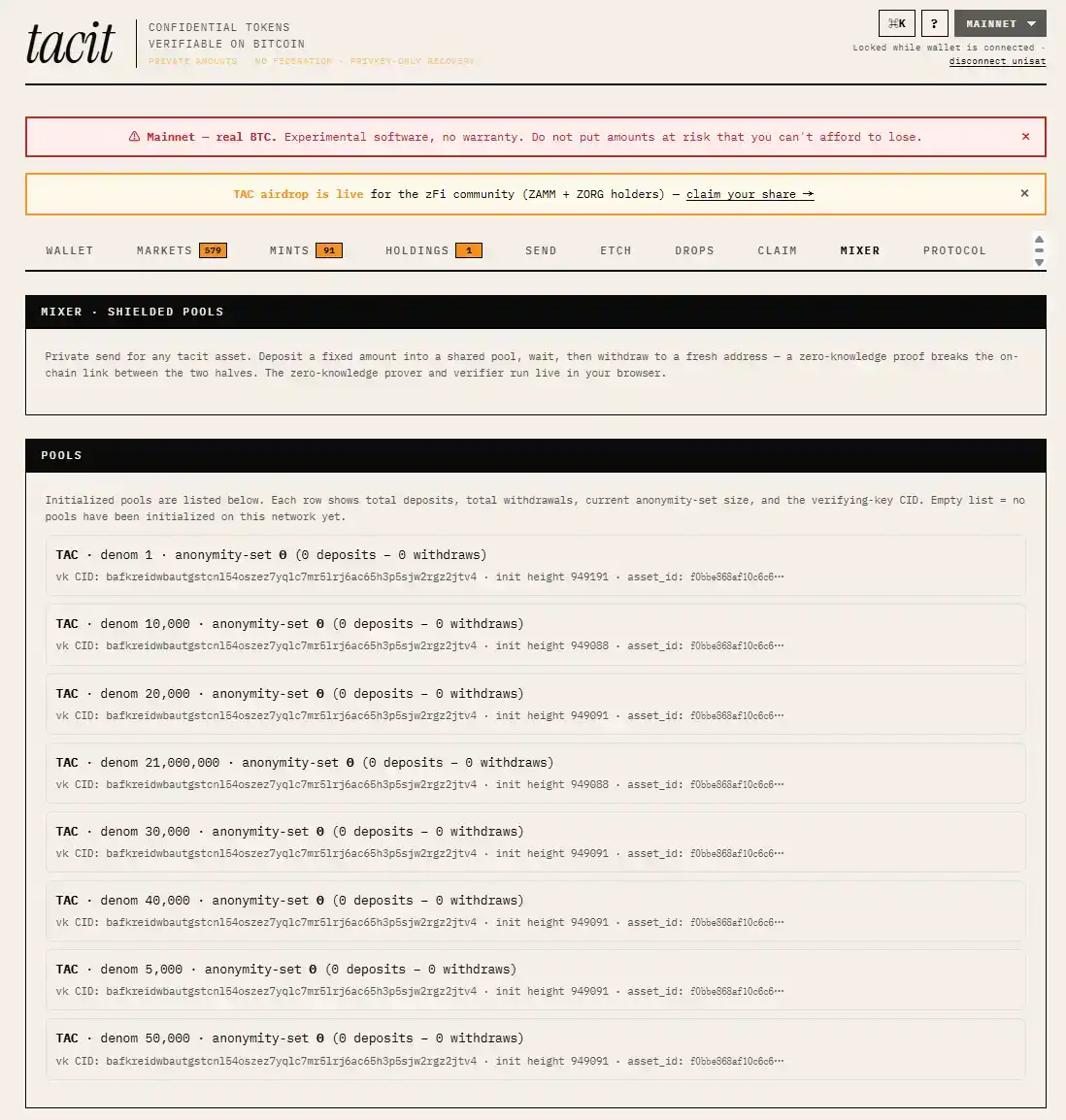
This mixer is somewhat similar to Tornado Cash—the more people deposit, the higher the privacy (harder to identify which addresses in the pool correspond). However, Tacit's mixer does not rely on smart contracts. It embeds the deposit proof in the Taproot transaction note, and the zero-knowledge proof for withdrawals is handled by the indexer in the browser.

It's even slightly stronger than Tornado Cash in some aspects because Tornado Cash cannot hide the amount being mixed. However, Tacit's mixer cannot mix native Bitcoin because hiding the mixing amount itself requires first wrapping the Bitcoin.

Of course, privacy comes at a cost. According to the GitHub documentation, due to the larger witness data required for hiding, the transfer cost corresponds to a mainnet fee rate of approximately 10 sat/vB, meaning each transfer costs about 25,000-30,000 sat, roughly 10 times the cost of a Runes transfer.

Who Built Tacit?

Developer ross.wei (@z0r0zzz) is a relatively well-known developer in the Ethereum ecosystem. He previously developed ZAMM, which uses a single contract for creating new tokens, managing LPs, farming, and swaps, significantly improving gas efficiency and user experience.

$ZAMM was also a notable project on Ethereum in the past, reaching a market cap in the tens of millions of dollars and receiving a retweet from crypto KOL Ansem.

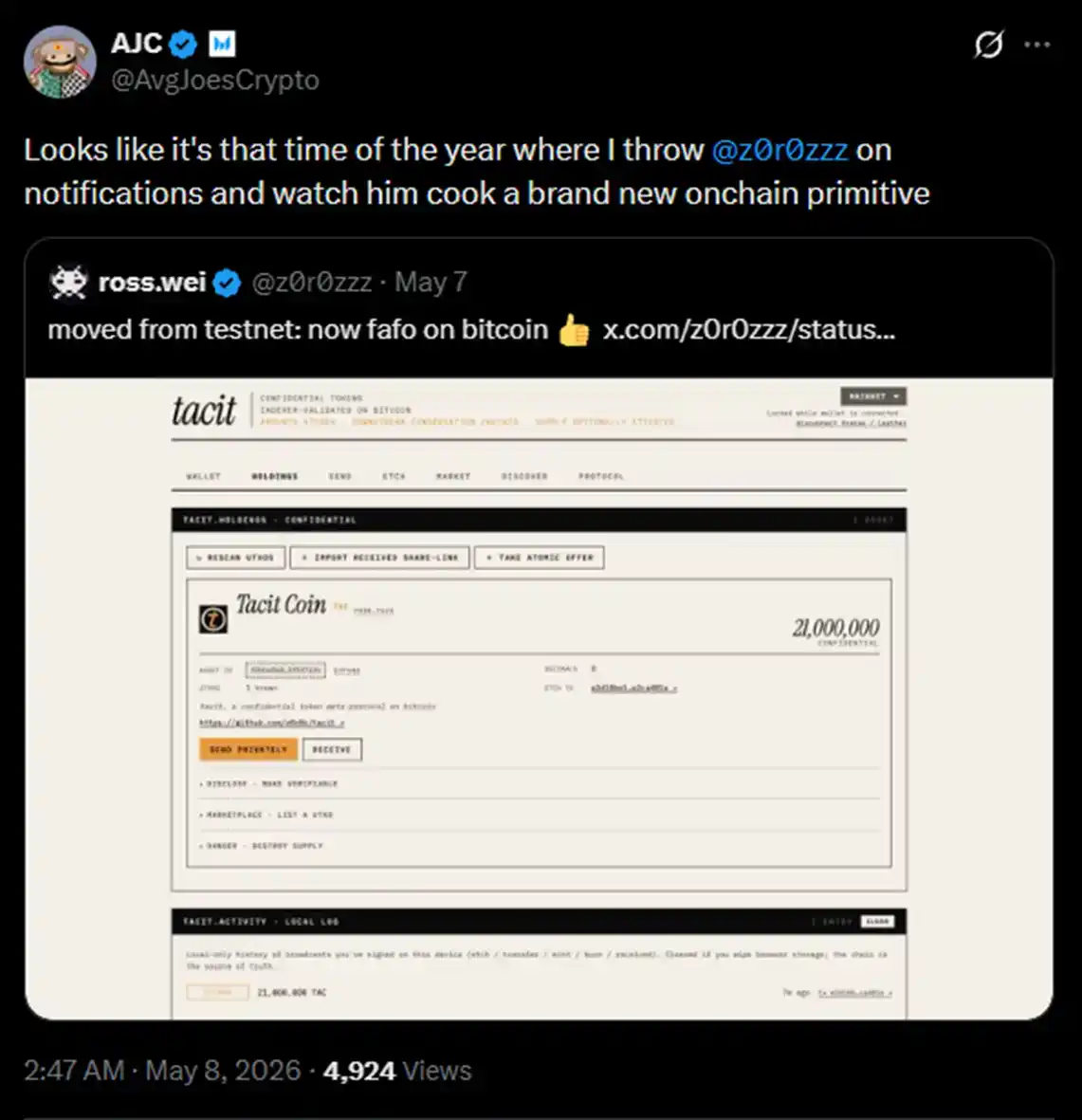
Tacit isn't something he suddenly created on a whim; he has been interested in Bitcoin technology for a while. This new protocol has also garnered attention from Messari Enterprise Research Manager @AvgJoesCrypto.
In the future, the author also plans to implement privacy-wrapped native Bitcoin (cBTC), silent receiving (generating a new one-time address for each receiving transaction), and hiding the type of currency being transferred.

Relevant Assets

Currently, the token with the highest trading volume is $TAC. This token was deployed by the protocol author himself and was airdropped not long ago based on holdings of the $ZORG staking token from the Ethereum-based $ZAMM. Its current market cap is approximately $4 million, making it the undisputed leader.

The first token launched via fair launch is $FAIR, though trading for this token is not yet available on the marketplace.

Conclusion

This is indeed an innovative Bitcoin asset protocol. Compared to BRC-20 and Runes, it has already implemented amount privacy and plans to achieve more. Compared to RGB, Taproot Assets, and Liquid CT, it doesn't rely on off-chain client-side proofs or exist as a sidechain; it operates entirely using on-chain data.

After repurposing its own protocol components to create a mixer, it has also addressed the hiding of the on-chain address graph.

Although the usage cost is relatively high, this is truly a refreshing and eye-catching innovation not seen in the Bitcoin ecosystem for a long time.


Связанные с этим вопросы

QWhat is the main characteristic that differentiates the new Bitcoin asset protocol Tacit from protocols like BRC-20 and Runes?

ATacit is a privacy-focused Bitcoin asset protocol. Its primary differentiating characteristic is that it can hide the amount of tokens in transactions (including the total supply defined at deployment and the specific amount in each transfer), while protocols like BRC-20 and Runes have transparent ledgers. However, Tacit does not hide the direction of fund flows (i.e., the address graph).

QHow does Tacit achieve transaction amount privacy on the Bitcoin mainnet according to the article?

ATacit uses a combination of cryptographic techniques: Pedersen commitments and Bulletproofs to hide the transaction amount while proving to the network that no tokens are fraudulently created (e.g., proving amounts are non-negative and conserved). Mimblewimble-style signatures prove that the output amount equals the input amount, preventing malicious inflation. The actual amount information is encrypted using ECDH and written on-chain, decryptable only by the sender and receiver with their private keys.

QWho is the developer behind the Tacit protocol, and what is their background mentioned in the article?

AThe developer behind Tacit is ross.wei (@z0r0zzz). He is a well-known Ethereum developer who previously created ZAMM, a project that reached a multi-million dollar market cap and gained attention from crypto KOLs like Ansem. His interest in Bitcoin technology led to the development of Tacit.

QWhat is the current primary token associated with the Tacit protocol, and how was it distributed?

AThe primary token is $TAC. It was deployed by the protocol author and recently airdropped to holders of $ZORG, the staking token of the Ethereum-based $ZAMM project. Its current market capitalization is approximately $4 million.

QWhat are some of the planned future features for the Tacit protocol as mentioned in the article?

APlanned future features for Tacit include: privacy encapsulation for native Bitcoin (cBTC), silent receiving (generating a new one-time address for each incoming transaction), and hiding the type of token being transferred.

Похожее

MY Group Completes Web4.0 First Stock Listing Layout, SEC Officially Discloses Form 8-K Announcement

MY Group has completed the listing layout for the "Web4.0 First Share," with the U.S. Securities and Exchange Commission (SEC) formally disclosing a Form 8-K report. According to the filing, the company's board has officially appointed Mr. Zhang Dingwen as Chief Executive Officer (CEO) and Executive Director, marking a significant upgrade in management and the entry into a new phase of its global capital market strategy. The disclosure of Form 8-K, used for reporting major corporate events, coincides with market information indicating the company is advancing several key capital market initiatives. These include a global brand system upgrade, corporate strategic restructuring, and a change of its stock ticker symbol. These moves are viewed by industry experts as signals of accelerated internationalization and enhanced global market presence. Concurrently, MY Group's proposed "Web4.0 Ecosystem" is garnering market attention. The company is integrating core capabilities across social traffic portals, global payment systems, public blockchain infrastructure, digital asset trading, and AI-powered financial systems. Analysts suggest that by closing this ecosystem loop, MY Group has the potential to become a next-generation platform merging Web2 user scale with Web3 asset frameworks and AI financial capabilities. With the management upgrade finalized, the global brand strategy launched, and the stock ticker change pending, MY Group is positioning itself as a focal point in the global technology capital market as a potential leading Web4.0 platform enterprise.

marsbit8 ч. назад

MY Group Completes Web4.0 First Stock Listing Layout, SEC Officially Discloses Form 8-K Announcement

marsbit8 ч. назад

Торговля

Спот
Фьючерсы

Популярные статьи

Как купить ZEC

Добро пожаловать на HTX.com! Мы сделали приобретение Zcash (ZEC) простым и удобным. Следуйте нашему пошаговому руководству и отправляйтесь в свое крипто-путешествие.Шаг 1: Создайте аккаунт на HTXИспользуйте свой адрес электронной почты или номер телефона, чтобы зарегистрироваться и бесплатно создать аккаунт на HTX. Пройдите удобную регистрацию и откройте для себя весь функционал.Создать аккаунтШаг 2: Перейдите в Купить криптовалюту и выберите свой способ оплатыКредитная/Дебетовая Карта: Используйте свою карту Visa или Mastercard для мгновенной покупки Zcash (ZEC).Баланс: Используйте средства с баланса вашего аккаунта HTX для простой торговли.Третьи Лица: Мы добавили популярные способы оплаты, такие как Google Pay и Apple Pay, для повышения удобства.P2P: Торгуйте напрямую с другими пользователями на HTX.Внебиржевая Торговля (OTC): Мы предлагаем индивидуальные услуги и конкурентоспособные обменные курсы для трейдеров.Шаг 3: Хранение Zcash (ZEC)После приобретения вами Zcash (ZEC) храните их в своем аккаунте на HTX. В качестве альтернативы вы можете отправить их куда-либо с помощью перевода в блокчейне или использовать для торговли с другими криптовалютами.Шаг 4: Торговля Zcash (ZEC)С легкостью торгуйте Zcash (ZEC) на спотовом рынке HTX. Просто зайдите в свой аккаунт, выберите торговую пару, совершайте сделки и следите за ними в режиме реального времени. Мы предлагаем удобный интерфейс как для начинающих, так и для опытных трейдеров.

616 просмотров всегоОпубликовано 2024.03.29Обновлено 2025.03.21

Как купить ZEC

Обсуждения

Добро пожаловать в Сообщество HTX. Здесь вы сможете быть в курсе последних новостей о развитии платформы и получить доступ к профессиональной аналитической информации о рынке. Мнения пользователей о цене на ZEC (ZEC) представлены ниже.

活动图片