Fed Rate Cut Tonight Almost Certain, This Meeting More Like a 'Political Pressure Test'!

marsbitОпубликовано 2025-12-10Обновлено 2025-12-10

Введение

This week's Federal Reserve policy meeting is set to be one of the most contentious in recent years. With key economic data missing due to a 43-day U.S. government shutdown, the meeting has evolved into a stress test of the Fed’s independence and decision-making process. Market expectations for a rate cut have surged from 30% to 97%, reflecting both data uncertainty and growing political influence. Internally, the Fed is deeply divided, with a 4-4 split among key officials between holding rates and cutting. The dot plot shows a rare "bimodal distribution," with 7 officials favoring no change and 8 supporting a 50-basis-point cut. Doves point to a weakening labor market—unemployment rose to 4.3% in August, a four-year high—while hawks emphasize persistent inflation, with core PCE at 2.7%, above the 2% target. Political pressure has intensified, notably through appointments like Stephen Milan, who voted for a deeper cut just one day into his role, aligning with former President Trump’s public demands. The upcoming Fed leadership transition adds further uncertainty, as officials may be positioning for future roles. Amid data gaps and political interference, the Fed faces a complex risk-management dilemma: balancing concerns over slowing employment against inflation risks and soaring government debt interest costs. Communication challenges are heightened by internal divisions, forcing the Fed to rely more on high-frequency and alternative data. This meeting may mark a shift to...

This week's Federal Reserve policy meeting will be one of the most controversial decisions in recent years.

Against the backdrop of a 43-day U.S. government shutdown that has led to a lack of key economic data, this meeting has transcended the realm of pure monetary policy, evolving into a stress test for the Fed's independence and decision-making mechanisms.
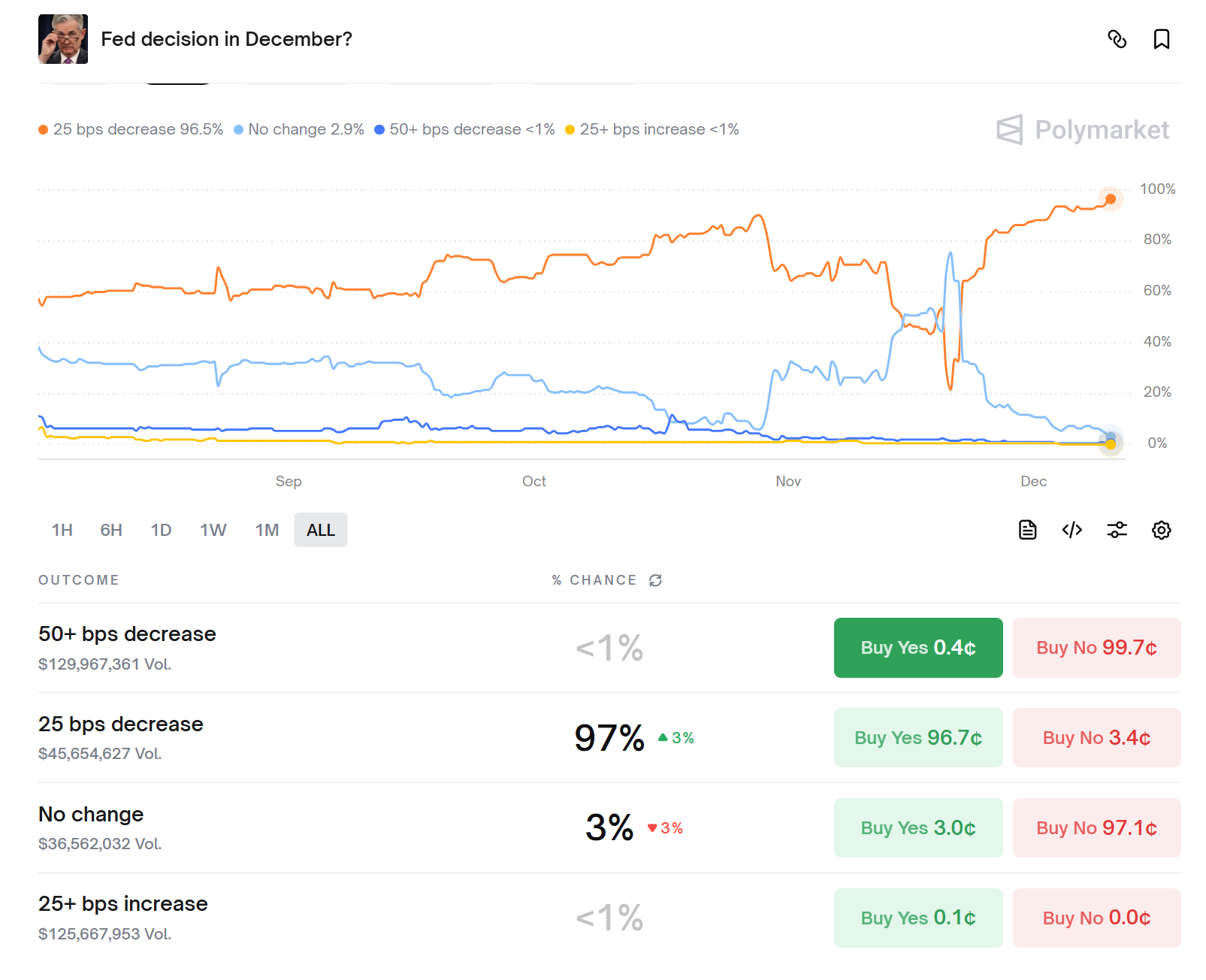
Market expectations for a rate cut have surged from 30% three weeks ago to 97% currently. This dramatic shift not only reflects collective anxiety in a data vacuum but also reveals that political pressure's influence on monetary policy is becoming more explicit.

Data Fog and Internal Divisions

The decision-making environment for the Fed at this meeting is exceptionally unique—the record 43-day U.S. government shutdown has resulted in the absence of most key economic data. This leaves the Fed, which has long emphasized being "data-dependent," seemingly navigating through a fog without clear coordinates for decision-making.

The absence of key official economic data, combined with the "mixed" nature of other alternative data, means the macroeconomic situation lacks a clear, objective anchor, leading to significant divergence in interpretations from various parties. Internal disagreements have become public and are trending toward polarization.

Currently, the stance on rate cuts among Federal Reserve Board members plus the New York Fed President presents a delicate 4-to-4 deadlock. This division is directly reflected in the dot plot, showing a rare "bimodal distribution"—7 officials support keeping rates unchanged for the full year, while 8 believe rates should be cut by 50 basis points.

More notably, the reasoning from both sides is equally compelling. Dovish officials argue the job market has clearly deteriorated, with the unemployment rate rising to 4.3% in August, a four-year high, and nonfarm payrolls increasing by only 22,000, far below expectations. Hawkish officials, however, are focused on inflation issue, with the core PCE price index rising 2.7% year-on-year, still above the Fed's long-term 2% target.


Pathways of Political Pressure Infiltration

The uniqueness of this meeting stems not only from the lack of economic data but also from the fact that political pressure is介入 (intervening in) the monetary policy arena in an unprecedentedly direct manner.

The Trump administration is directly influencing the structure of the Fed's decision-making layer through personnel appointments, breaking the long-standing tradition of "political neutrality" at the Fed.

The appointment of new Governor Stephen Milan is of symbolic significance. As a Fed governor simultaneously serving as Chairman of the White House Council of Economic Advisers, Milan cast a dissenting vote just one day after taking office, advocating for a more aggressive 50 basis point rate cut.

This policy stance highly aligns with Trump's public demand to "cut rates immediately and by a larger margin," raising deep concerns about the Fed's independence. More alarmingly, the Trump administration has clearly indicated that a nomination for the next Fed Chairperson might be announced before the end of December.

For the current core Fed decision-makers, this meeting might be their last chance to state their position and choose sides. Policy decisions during this power transition period inevitably involve considerations of personal career prospects.

The Fed faces not just a technical decision on interest rate adjustments but a severe test of its institutional independence. The balance between political pressure and professional judgment has become a key variable affecting the outcome of this meeting.


The Dilemma of Risk Management

Under the dual challenges of data absence and political pressure, the Fed's decision this time is essentially a complex risk management practice, requiring finding a balance between conflicting objectives. On one hand, the Fed needs to address the downside risks from a weakening labor market. Nonfarm payrolls increased by only 22,000 in August, a significant drop from the revised 79,000 in July, and the unemployment rate rose to a four-year high of 4.3%. If this slowing trend continues, it could trigger a vicious cycle of consumption contraction and economic recession.

On the other hand, inflation risks persist. Although current price pressures mainly stem from supply-side factors (such as import costs pushed up by tariff policies) rather than demand-pull from an overheating economy, whether inflation expectations can be effectively anchored remains uncertain. If the rate cut is too large, it could increase inflation risks, even triggering a wage-price spiral.

Making it more complex, the U.S. government's interest expense on debt has reached $1.1 trillion annually. While rate cuts could ease fiscal pressure, they might also fuel asset bubbles. This权衡 (trade-off) under multiple objectives complicates the Fed's decision-making framework, going beyond the traditional "dual mandate."


Institutional Resilience and Communication Challenges

This meeting tests not only the Fed's decision-making wisdom but also its institutional resilience and communication capabilities. With serious internal divisions, how to form a consensus and effectively communicate policy signals is a key challenge facing Chair Powell.

The divergence in the dot plot is phenomenal. Among the 19 policymakers, 6 believe no further rate cuts are needed, 9 support two more cuts, and there is also one clear outlier (likely Milan) hoping for an additional 125 basis points of cuts this year. This dispersed forecast distribution increases market skepticism about the Fed's communication strategy.

The Fed might address this challenge by strengthening forward guidance. A possible strategy is to emphasize the principle of "deciding meeting-by-meeting," avoiding clear commitments to the future path while stressing that policy will remain flexible. While this strategy might temporarily sidestep internal disagreements, it could weaken the effectiveness of policy signals.

A more profound challenge is how to gain market trust for decisions made in a data-deficient environment. The Fed may rely more heavily on high-frequency data (like weekly jobless claims) and alternative indicators (such as business surveys and the Beige Book) as references for decision-making. This shift in decision-making mode itself is a test of its communication ability.

As 2025 draws to a close, the Fed's future path remains full of unknowns. The分散的 (scattered) predictions on the dot plot indicate that officials hold differing views on the economic outlook and policy path for 2026. This meeting might inaugurate a全新的 (brand new) monetary policy framework: data absence will become the norm, not the exception; political pressure will move from behind the scenes to the forefront; and the Fed's independence will depend on its ability to maintain policy resolve in a complex environment.


Связанные с этим вопросы

QWhy is the Federal Reserve's upcoming policy meeting considered a 'political pressure test'?

AThe meeting is seen as a political pressure test because it is occurring amid unprecedented political influence, including direct demands from the Trump administration for rate cuts and the appointment of a Fed governor who also serves as a White House economic advisor, challenging the Fed's traditional independence.

QWhat makes the decision-making environment for this Fed meeting particularly unusual?

AThe decision-making environment is unusual due to the 43-day U.S. government shutdown, which has resulted in a lack of key economic data, leaving the Fed to operate in a 'data fog' without clear benchmarks for its typically data-dependent approach.

QHow are the Fed officials divided on the issue of interest rates according to the dot plot?

AThe dot plot shows a rare bimodal distribution: 7 officials support keeping rates unchanged for the year, while 8 expect a 50 basis point cut. One outlier, likely Stephen Milan, even advocates for a 125 basis point cut by year-end.

QWhat are the key risks the Fed must balance in its rate decision?

AThe Fed must balance the risk of a weakening labor market, with unemployment at a four-year high, against persistent inflation concerns, as core PCE remains above the 2% target, while also considering the impact on government debt costs and potential asset bubbles.

QWhat challenges does the Fed face in communicating its policy amid internal divisions?

AThe Fed faces challenges in forming a consensus and effectively signaling policy due to stark internal divisions. It may emphasize a 'meeting-by-meeting' approach and rely more on high-frequency and alternative data, but this could weaken the clarity of its policy guidance.

Похожее

MY Group Completes Web4.0 First Stock Listing Layout, SEC Officially Discloses Form 8-K Announcement

MY Group has completed the listing layout for the "Web4.0 First Share," with the U.S. Securities and Exchange Commission (SEC) formally disclosing a Form 8-K report. According to the filing, the company's board has officially appointed Mr. Zhang Dingwen as Chief Executive Officer (CEO) and Executive Director, marking a significant upgrade in management and the entry into a new phase of its global capital market strategy. The disclosure of Form 8-K, used for reporting major corporate events, coincides with market information indicating the company is advancing several key capital market initiatives. These include a global brand system upgrade, corporate strategic restructuring, and a change of its stock ticker symbol. These moves are viewed by industry experts as signals of accelerated internationalization and enhanced global market presence. Concurrently, MY Group's proposed "Web4.0 Ecosystem" is garnering market attention. The company is integrating core capabilities across social traffic portals, global payment systems, public blockchain infrastructure, digital asset trading, and AI-powered financial systems. Analysts suggest that by closing this ecosystem loop, MY Group has the potential to become a next-generation platform merging Web2 user scale with Web3 asset frameworks and AI financial capabilities. With the management upgrade finalized, the global brand strategy launched, and the stock ticker change pending, MY Group is positioning itself as a focal point in the global technology capital market as a potential leading Web4.0 platform enterprise.

marsbit9 ч. назад

MY Group Completes Web4.0 First Stock Listing Layout, SEC Officially Discloses Form 8-K Announcement

marsbit9 ч. назад

Торговля

Спот
Фьючерсы

Популярные статьи

Как купить HPP

Добро пожаловать на HTX.com! Мы сделали приобретение House Party Protocol (HPP) простым и удобным. Следуйте нашему пошаговому руководству и отправляйтесь в свое крипто-путешествие.Шаг 1: Создайте аккаунт на HTXИспользуйте свой адрес электронной почты или номер телефона, чтобы зарегистрироваться и бесплатно создать аккаунт на HTX. Пройдите удобную регистрацию и откройте для себя весь функционал.Создать аккаунтШаг 2: Перейдите в Купить криптовалюту и выберите свой способ оплатыКредитная/Дебетовая Карта: Используйте свою карту Visa или Mastercard для мгновенной покупки House Party Protocol (HPP).Баланс: Используйте средства с баланса вашего аккаунта HTX для простой торговли.Третьи Лица: Мы добавили популярные способы оплаты, такие как Google Pay и Apple Pay, для повышения удобства.P2P: Торгуйте напрямую с другими пользователями на HTX.Внебиржевая Торговля (OTC): Мы предлагаем индивидуальные услуги и конкурентоспособные обменные курсы для трейдеров.Шаг 3: Хранение House Party Protocol (HPP)После приобретения вами House Party Protocol (HPP) храните их в своем аккаунте на HTX. В качестве альтернативы вы можете отправить их куда-либо с помощью перевода в блокчейне или использовать для торговли с другими криптовалютами.Шаг 4: Торговля House Party Protocol (HPP)С легкостью торгуйте House Party Protocol (HPP) на спотовом рынке HTX. Просто зайдите в свой аккаунт, выберите торговую пару, совершайте сделки и следите за ними в режиме реального времени. Мы предлагаем удобный интерфейс как для начинающих, так и для опытных трейдеров.

161 просмотров всегоОпубликовано 2026.04.29Обновлено 2026.04.29

Как купить HPP

Что такое GENIUS

I. Введение в проект1. Что такое Genius?Genius (GENIUS) позиционируется как «конечный терминал на блокчейне», децентрализованная торговая платформа, ориентированная на конфиденциальность и скорость. Интегрируя технологии конфиденциальности высшего уровня, она стремится создать инфраструктуру торговли с конфиденциальностью нового поколения на таких сетях, как BNB Chain, позволяя пользователям взаимодействовать на блокчейне с бесшовным опытом, сопоставимым с централизованными биржами.2. Как работает Genius?Основная техническая архитектура Genius структурирована следующим образом:(1) Невидимость для цепочки: Пользователям не нужно вручную обрабатывать многоступенчатые одобрения для кросс-цепочных операций, упаковки активов или сложного управления газом.(2) Торговля без подписи: Благодаря интеграциям, таким как Turnkey, Genius позволяет мгновенно торговать без всплывающих подтверждений или авторизации на каждую транзакцию.(3) Аггрегатор аггрегаторов: Genius работает на основе лучшего в своем классе стека агрегации, интегрированного с более чем 150 DEX, утверждая о превосходной эффективности котировок по сравнению с конкурентными продуктами.(4) Управление аккаунтом: Платформа использует некастодиальную архитектуру и использует Turnkey и Lit Protocol для управления ключами, позволяя пользователям безопасно получать доступ к своим аккаунтам через пасскоды.3. Кто создал Genius?Согласно официальным Условиям обслуживания, Genius был разработан компанией Shuttle Labs, Inc. На основе официального аккаунта проекта в X, Райан Майер является одним из ключевых участников, способствующих итерации продукта, включая разработки, такие как внедрение протокола Ghost, а также более широкое вовлечение сообщества.Основатель Binance CZ официально присоединился к проекту в качестве советника с целью помочь команде создать более быструю и конфиденциальную торговлю на блокчейне.Кроме того, проект получил сильную поддержку от YZi Labs, которая инвестировала в Genius и работает вместе с Фондом Genius, ответственным за поддержание основного Протокола Моста Genius (GBP).4. Токеномика GeniusGENIUS — это родной токен экосистемы Genius. На данный момент проект не выпустил полный документ по токеномике.Согласно последним официальным раскрытиям, Genius включает дефляционный механизм, и 4,6% от общего объема токенов уже было сожжено в ходе ранней фазы запуска.Система Genius Points (GP):(1) Торговля за вознаграждение: Платформа создала пул вознаграждений в 200 миллионов Genius Points, и пользователи зарабатывают GP за каждую сделку, выполненную через терминал.(2) Уровни и значки: Genius предлагает систему значков на основе прогрессии от Умного до Бога, с более высокими уровнями, открывающими дополнительные привилегии и преимущества.(3) Родной доход: Пользователи, держащие определенные активы, такие как usdGG на панели управления, могут зарабатывать родной доход напрямую, не проходя через сложное стекинг.(4) Реферальные стимулы: Рефереры могут зарабатывать возвраты комиссии более 45%, выплачиваемые в USDC, а также дополнительные GP.5. Хронология и ключевые вехиМарт 2020: Официальный аккаунт проекта в X был создан, что ознаменовало начало его ранней подготовительной фазы.13 января 2026: Genius объявил о многомиллионной инвестиции от YZi Labs и одновременно подтвердил CZ в качестве советника для ускорения создания своей инфраструктуры торговли с конфиденциальностью.18 апреля 2026: Проект объявил, что протокол конфиденциальности Ghost будет запущен в ближайшее время.29 апреля 2026: Протокол Ghost официально открылся для первых 50 тестеров, что ознаменовало начало новой эры для торговли с конфиденциальностью на BNB Chain. В то же время команда подтвердила, что 4,6% токенов были сожжены.​II. Информация о токенах1) Основная информацияНазвание токена: GENIUS (Genius)III. Связанные ссылкиВебсайт: https://www.tradegenius.com/homeЭксплореры: https://bscscan.com/address/0x1f12b85aac097e43aa1555b2881e98a51090e9a6Социальные сети: https://x.com/GeniusTerminalПримечание: Введение в проект основано на материалах, опубликованных или предоставленных официальной командой проекта, и предназначено только для справки и не является инвестиционной рекомендацией. HTX не несет ответственности за любые прямые или косвенные убытки, возникшие в результате этого.

269 просмотров всегоОпубликовано 2026.04.29Обновлено 2026.05.12

Что такое GENIUS

Как купить GENIUS

Добро пожаловать на HTX.com! Мы сделали приобретение Genius (GENIUS) простым и удобным. Следуйте нашему пошаговому руководству и отправляйтесь в свое крипто-путешествие.Шаг 1: Создайте аккаунт на HTXИспользуйте свой адрес электронной почты или номер телефона, чтобы зарегистрироваться и бесплатно создать аккаунт на HTX. Пройдите удобную регистрацию и откройте для себя весь функционал.Создать аккаунтШаг 2: Перейдите в Купить криптовалюту и выберите свой способ оплатыКредитная/Дебетовая Карта: Используйте свою карту Visa или Mastercard для мгновенной покупки Genius (GENIUS).Баланс: Используйте средства с баланса вашего аккаунта HTX для простой торговли.Третьи Лица: Мы добавили популярные способы оплаты, такие как Google Pay и Apple Pay, для повышения удобства.P2P: Торгуйте напрямую с другими пользователями на HTX.Внебиржевая Торговля (OTC): Мы предлагаем индивидуальные услуги и конкурентоспособные обменные курсы для трейдеров.Шаг 3: Хранение Genius (GENIUS)После приобретения вами Genius (GENIUS) храните их в своем аккаунте на HTX. В качестве альтернативы вы можете отправить их куда-либо с помощью перевода в блокчейне или использовать для торговли с другими криптовалютами.Шаг 4: Торговля Genius (GENIUS)С легкостью торгуйте Genius (GENIUS) на спотовом рынке HTX. Просто зайдите в свой аккаунт, выберите торговую пару, совершайте сделки и следите за ними в режиме реального времени. Мы предлагаем удобный интерфейс как для начинающих, так и для опытных трейдеров.

215 просмотров всегоОпубликовано 2026.04.29Обновлено 2026.05.12

Как купить GENIUS

Обсуждения

Добро пожаловать в Сообщество HTX. Здесь вы сможете быть в курсе последних новостей о развитии платформы и получить доступ к профессиональной аналитической информации о рынке. Мнения пользователей о цене на A (A) представлены ниже.

活动图片