Crypto CLARITY Act Faces 100-Plus Amendments As Stablecoin, Banking Fight Intensifies

bitcoinistОпубликовано 2026-05-13Обновлено 2026-05-13

Введение

The U.S. Senate Banking Committee's CLARITY Act faces over 100 proposed amendments ahead of a key markup vote, intensifying debates on stablecoins, banking, and crypto regulation. Key points of contention include stablecoin rewards, with proposed bans on yield for idle balances and bank-backed amendments seeking stricter rules. Senator Elizabeth Warren filed over 40 amendments, including one to block crypto firms from Federal Reserve accounts, while another from Senator Jack Reed aims to prohibit using crypto for tax payments, countering industry goals for broader adoption. The bill, positioned as a consumer protection measure, also proposes treating crypto exchanges as financial institutions under anti-money laundering laws and creating exemptions for small fundraising. Banking industry groups are actively lobbying for tighter restrictions. Despite some Democratic leadership support, the bill's path remains uncertain due to ongoing negotiations on ethics and conflict-of-interest provisions, with critics warning of risks to investors and financial stability.

The US Senate Banking Committee’s crypto market structure push is running into a dense wall of amendments ahead of Thursday’s markup, with lawmakers filing more than 100 proposed changes to the CLARITY Act. The amendment rush puts stablecoin rewards, crypto firms’ access to the Federal Reserve system and even the use of digital assets for tax payments at the center of Washington’s latest fight over crypto regulation.

According to Politico, committee members submitted more than 100 amendments before the markup vote. Crypto journalist Eleanor Terrett reported that Senator Elizabeth Warren alone filed more than 40 amendments, including one that would prevent the Federal Reserve from issuing master accounts to crypto companies. Terrett also flagged an amendment from Senator Jack Reed that would “prohibit crypto from being used as legal tender, for example, to pay taxes.”

That language would cut directly against one of the industry’s longer-running policy goals: expanding digital assets beyond investment and trading into payments, settlement and public-sector use cases. Terrett noted the contrast with prior pro-Bitcoin tax-payment proposals, writing that Representative Warren Davidson had introduced a bill last year “to do that very thing” with BTC.

Crypto Bill Enters High-Stakes Senate Markup

The latest clash comes after Senate Banking Committee Chairman Tim Scott, Senator Cynthia Lummis and Senator Thom Tillis released new market structure text that will serve as the basis for the committee markup. The committee said the text reflects negotiations with Democrats and input from lawmakers, regulators, law enforcement, financial institutions, innovators and consumer advocates. Scott framed the bill as a consumer-protection and national-competitiveness measure.

“Over the past year, we have listened, negotiated, and strengthened this bill because families, small businesses, investors, and innovators all benefit from clear rules of the road,” Scott said. “This bill reflects serious, good-faith work across the Committee and delivers the certainty, safeguards, and accountability Americans deserve.”

The most immediate fault line remains stablecoin rewards. The Senate text would ban rewards on idle stablecoin balances that closely resemble bank deposits, while allowing rewards tied to transaction-based activity, such as stablecoin payments. The SEC, CFTC and Treasury Department would be tasked with issuing joint rules to implement that provision.

Banks are not satisfied. Brendan Pedersen reported that Reed and Senator Tina Smith filed an amendment that would incorporate bank-requested changes to stablecoin yield restrictions, forcing lawmakers to choose between the crypto and banking industries. The amendment would target rewards “substantially similar” to deposit interest, a phrase that goes to the core of the banking lobby’s argument: that crypto platforms should not be allowed to compete with deposits through yield-like incentives while avoiding bank-style regulation.

Terrett reported separately that American Bankers Association members had sent more than 8,000 letters to Senate offices urging lawmakers to revise the stablecoin-yield compromise. The ABA has argued that the current language does not adequately close what it calls a loophole allowing exchanges and other digital asset service providers to bypass the GENIUS Act’s ban on interest or yield on payment stablecoins.

The bill also reaches well beyond stablecoins. Digital commodity exchanges, brokers and dealers would be treated as financial institutions under the Bank Secrecy Act, bringing them into anti-money-laundering, customer-identification and due-diligence regimes. The text would also allow crypto companies to raise up to $50 million annually, and up to $200 million total, without SEC registration, while clarifying that tokenized securities remain subject to securities law.

The political path is still fragile. Terrett said Senate Minority Leader Chuck Schumer appeared engaged in a Democratic member meeting and eager for members to reach a “yes” on the CLARITY Act, but stressed that ethics negotiations needed to move further before Thursday’s markup. Warren, the committee’s top Democrat, has been pressing that issue hard, saying the bill “puts investors, our national security and our entire financial system at risk” and would “turbocharge Donald Trump’s crypto corruption” without stronger conflict-of-interest provisions.

At press time, the total crypto market cap stood at $2.67 trillion.
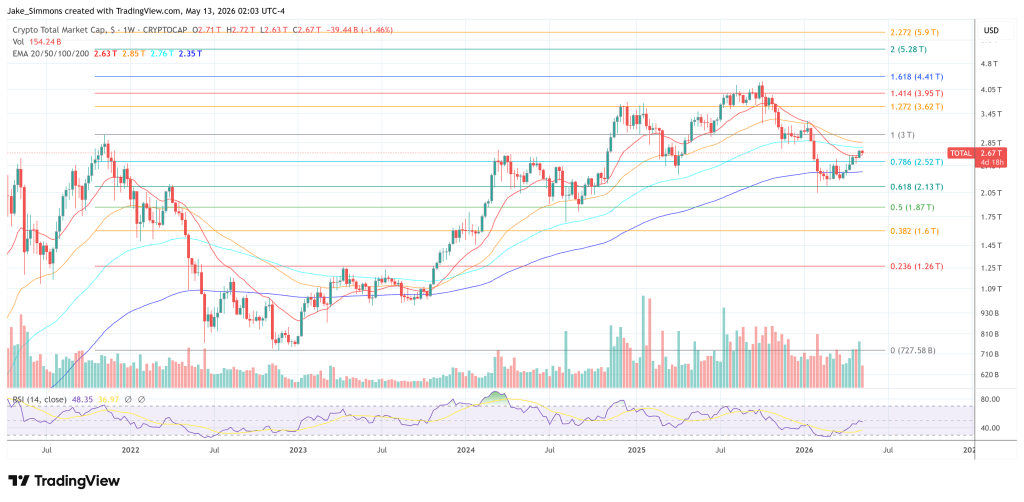
Total crypto market cap faces the 100-week EMA, 1-week chart | Source: TOTAL on TradingView.com

Связанные с этим вопросы

QWhat is the CLARITY Act, and what key issues are highlighted by the large number of amendments it faces?

AThe CLARITY Act is a crypto market structure bill under consideration by the US Senate Banking Committee. The large number of amendments (over 100) highlights intense debate over key issues including: banning or restricting stablecoin rewards that resemble bank deposit interest, crypto firms' access to Federal Reserve master accounts, and whether digital assets can be used for payments like tax settlements.

QWhich specific amendment proposed by Senator Elizabeth Warren is mentioned, and what would it prevent?

AThe article mentions that Senator Elizabeth Warren filed an amendment that would prevent the Federal Reserve from issuing master accounts to crypto companies. Master accounts are crucial for financial institutions to access Fed payment and settlement services directly.

QAccording to the article, what is the core argument of the banking lobby regarding stablecoin rewards?

AThe banking lobby's core argument is that crypto platforms should not be allowed to offer rewards 'substantially similar' to bank deposit interest while avoiding the stringent regulations that banks face. They view this as an unfair competitive loophole.

QHow does the current Senate bill text propose to handle stablecoin rewards?

AThe Senate bill text proposes to ban rewards on idle stablecoin balances that closely resemble bank deposits. However, it would allow rewards tied to transaction-based activities, such as making stablecoin payments. Regulatory agencies would be tasked with creating joint rules to implement this provision.

QBeyond stablecoins, what are two other significant regulatory changes proposed in the bill's text?

ATwo other significant changes are: 1) Treating digital commodity exchanges, brokers, and dealers as financial institutions under the Bank Secrecy Act, subjecting them to AML, KYC, and due diligence rules. 2) Allowing crypto companies to raise up to $50 million annually (up to $200M total) without SEC registration, while clarifying that tokenized securities remain under securities law.

Похожее

MY Group Completes Web4.0 First Stock Listing Layout, SEC Officially Discloses Form 8-K Announcement

MY Group has completed the listing layout for the "Web4.0 First Share," with the U.S. Securities and Exchange Commission (SEC) formally disclosing a Form 8-K report. According to the filing, the company's board has officially appointed Mr. Zhang Dingwen as Chief Executive Officer (CEO) and Executive Director, marking a significant upgrade in management and the entry into a new phase of its global capital market strategy. The disclosure of Form 8-K, used for reporting major corporate events, coincides with market information indicating the company is advancing several key capital market initiatives. These include a global brand system upgrade, corporate strategic restructuring, and a change of its stock ticker symbol. These moves are viewed by industry experts as signals of accelerated internationalization and enhanced global market presence. Concurrently, MY Group's proposed "Web4.0 Ecosystem" is garnering market attention. The company is integrating core capabilities across social traffic portals, global payment systems, public blockchain infrastructure, digital asset trading, and AI-powered financial systems. Analysts suggest that by closing this ecosystem loop, MY Group has the potential to become a next-generation platform merging Web2 user scale with Web3 asset frameworks and AI financial capabilities. With the management upgrade finalized, the global brand strategy launched, and the stock ticker change pending, MY Group is positioning itself as a focal point in the global technology capital market as a potential leading Web4.0 platform enterprise.

marsbit12 ч. назад

MY Group Completes Web4.0 First Stock Listing Layout, SEC Officially Discloses Form 8-K Announcement

marsbit12 ч. назад

Торговля

Спот
Фьючерсы
活动图片