Indepth Research

Provide in-depth research reports and independent analysis, leveraging data, technology, and economic insights to deliver a comprehensive examination of the blockchain ecosystem, project potential, and market trends.

ENS Governance Crisis: Decentralization = Low Quality and Inefficiency

ENS Governance Crisis: Decentralization Leads to Inefficiency and Mediocrity In November 2025, ENS founder Nick Johnson publicly criticized the state of ENS DAO, warning that political infighting was driving away dedicated contributors and risking the organization's takeover by inexperienced or self-interested participants. This sparked a broader discussion about systemic failures in the DAO's structure. Limes, the DAO's long-serving secretary, proposed dissolving three key working groups (Meta-Governance, Ecosystem, and Public Goods), arguing that the current structure incentivized relationship preservation over truth-seeking and lacked mechanisms to remove underperforming contributors. He highlighted that poor contributors drive out talented ones, and the system inherently discourages honesty. Multiple high-caliber contributors, including lawyers, programmers, and scientists, confirmed they had exited due to a toxic culture of gatekeeping, conflicts of interest, and self-dealing. Critical questions were discouraged, and the drafting of essential documents like a constitution was mishandled, leading to wasted funds and stagnation. Analyst clowes.eth noted that the working groups saw almost no new active participants throughout the year, and the governance model failed to attract or empower leaders. Participants avoided sharing honest opinions due to political repercussions, making mediocrity the norm. The core issue is distorted incentives: when future funding depends on relationships, the rational choice is to avoid criticism, leading to log-rolling (mutual proposal support), adverse selection (talented people leave), and low decision quality. This is compounded by the "DAO premium," where services cost 2-3 times more than in traditional organizations. The openness that initially empowered the DAO became its weakness, as it allowed participation based on availability rather than capability without quality control. Nick Johnson supported a "pause" rather than abolition of the groups, acknowledging concerns about the DAO's ability to meet legal obligations if professional contributors leave. The community split into two camps: one advocating for a comprehensive, paid audit before any structural changes, and another pushing for immediate dissolution and action. Deeper issues were highlighted, including a lack of transparency from ENS Labs, the core development team funded by the DAO, which operates opaquely despite its central role. The crisis underscores a fundamental challenge: in consensus-based systems, saying the truth carries high relational, political, and opportunity costs. Without mechanisms to reward honesty and ensure accountability, decentralization can lead to institutional silence and inefficiency. Proposed solutions range from radical ideas like stripping voting rights from service providers to pragmatic steps like creating a more centralized operational company (OpCo) within the DAO for better execution. The debate continues, with elections delayed and proposals under review. The crisis remains unresolved, but the organization's willingness to self-reflect and consider dismantling its own structure is a notable achievement in itself.

marsbit12/16 07:13

ENS Governance Crisis: Decentralization = Low Quality and Inefficiency

marsbit12/16 07:13

Before You Jump on Any ICO Bandwagon, Read This First

Before participating in any ICO, it's crucial to understand that most projects fail, and only a few achieve success. The recent hype around ICOs, driven by projects like MegaETH and Plasma, often leads to impulsive investments without proper due diligence. Here are key points to consider: 1. **Product Fundamentals**: Evaluate if the product solves a real problem and has genuine innovation. Avoid projects based on future promises or testnet data without a working product. 2. **Team Experience**: The team's track record matters. Experienced teams can adapt to market changes, while weak teams may disappear when hype fades. 3. **Investors and Valuation**: Check if reputable VCs are involved and assess the valuation. Avoid projects where insiders have low valuations, leaving retail investors at risk. 4. **Authentic Data**: Look beyond surface metrics like TVL or user numbers. Ensure data is genuine and not inflated by incentives or fake activity. 5. **Marketing and Narrative**: Strong projects control their narrative and attract organic attention. Poor projects rely on buzzwords without substance. 6. **Tokenomics**: Understand token unlock schedules, vesting, and fully diluted valuation (FDV). Avoid structures that favor insiders and shift risk to retail. 7. **Market Conditions**: Market cycles significantly impact valuation and returns. The same project may perform differently in a bull vs. bear market. ICO investments are not free money. Avoid FOMO-driven decisions and prioritize projects with real value over hype.

深潮12/16 06:49

Before You Jump on Any ICO Bandwagon, Read This First

深潮12/16 06:49

Detailed Analysis of Robinhood's Latest Fundamentals and Revenue Sources in Its 'Full Transition to Cryptocurrency'

Robinhood has emerged as a top performer in the current market cycle, with its stock surging 17x from its 2022 lows. The company is undergoing a strategic "full pivot to crypto" and has significantly diversified its revenue streams beyond its core transaction-based income. In 2024, Robinhood is projected to generate $2.95 billion in revenue, a 58% increase from 2023. Its revenue composition is now more balanced: transaction-based revenue (from stocks, options, and crypto) accounts for 58% of total revenue, down from 77% in 2021. This diversification is driven by new revenue lines, including its fast-growing prediction market platform (Kalshi, with $100M in annualized revenue) and Robinhood Gold (2.34M paid subscribers). Net interest income now constitutes 35% of total revenue. Notably, crypto is a major profit driver, contributing 21% of YTD revenue despite representing only 12% of total trading volume. This highlights its superior monetization model compared to stock trading. Options remain the largest revenue source. Robinhood's ambitious crypto roadmap includes the integration of the acquired Bitstamp exchange, development of a crypto wallet V2 with DeFi connectivity, plans to build an L2 on Arbitrum, and a pioneering strategy to tokenize public and private equities. This positions Robinhood to become a full-stack platform for tokenization, crypto trading, and financial services. Key risks include intense competition from traditional brokers and crypto-native firms like Coinbase, execution challenges in merging its user experience with crypto, and potential slow adoption of its equity tokenization strategy by issuers. Trading at a high P/E of 56, Robinhood's stock may be susceptible to a significant pullback if retail risk appetite cools, potentially creating a long-term buying opportunity. The company's leadership, user experience, and aggressive crypto vision make it a potential future leader in finance.

marsbit12/15 12:29

Detailed Analysis of Robinhood's Latest Fundamentals and Revenue Sources in Its 'Full Transition to Cryptocurrency'

marsbit12/15 12:29

Witnessing History! Just Now, the First Limit-Up! Are Commodities Rallying Across the Board?

On December 15, the platinum futures contract on the Guangzhou Futures Exchange surged by 7%, hitting a daily limit up for the first time since its listing, closing at 482.4 yuan/gram. Palladium futures also rose sharply by 4.73%. This rally reflects a broader global trend, with international platinum prices up 93% year-to-date, driven by structural supply constraints and growing demand. Supply-side issues are critical. Over 70% of global platinum production comes from South Africa, where aging infrastructure, power instability, and high operational costs hinder output. Similarly, palladium supply remains tight, with Russia—supplying over 40%—facing geopolitical risks. Global platinum supply has declined significantly from 258.4 tons in 2021 to an estimated 227.4 tons in 2024. Demand is robust and diversifying. Automotive applications (37.4% of platinum demand) remain stable, while industrial use (30%) spans chemicals, glass, and electronics. The hydrogen economy presents a major growth opportunity, as platinum is essential for fuel cells and electrolyzers. Investment demand is rising due to macroeconomic uncertainty and potential monetary easing. Analysts are bullish long-term, with some predicting platinum could reach $2,170–$2,300/oz by 2026. However, risks include high volatility, potential demand substitution from elevated prices, and sensitivity to global industrial activity. The rally underscores a broader commodities momentum, with some drawing parallels to Bitcoin’s role as "digital gold."

marsbit12/15 10:43

Witnessing History! Just Now, the First Limit-Up! Are Commodities Rallying Across the Board?

marsbit12/15 10:43

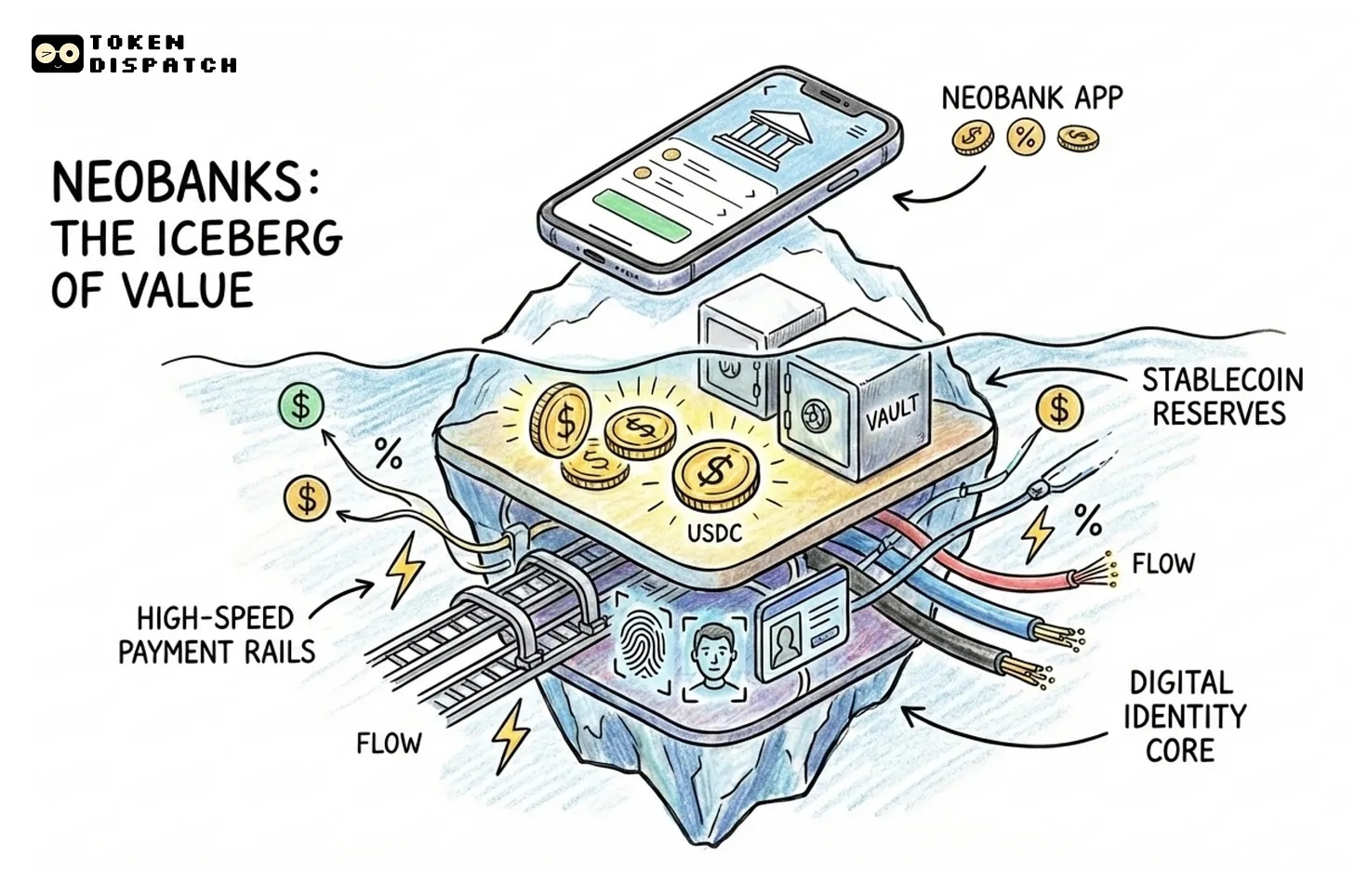
Digital Banks Are No Longer in the Banking Business; The Real Gold Mine Lies in Stablecoins and Identity Verification

The article argues that the core value of digital banking has shifted away from traditional models. Valuation is no longer driven by user numbers but by revenue per customer, as seen with Revolut's diversified income streams versus Nubank's reliance on credit. The true "gold mines" are now stablecoins and identity verification. For stablecoins, the primary profit is the interest earned on reserve assets (like Treasury bills), a revenue stream captured by the issuer (e.g., Circle) rather than the consumer-facing digital bank. This is leading to vertical integration, with companies like Stripe and Circle building proprietary settlement networks (Tempo, Arc) to control this profitable infrastructure and ensure privacy. Stablecoins are disrupting the old, multi-layered payment system by enabling direct, peer-to-peer transfers, forcing digital banks to become efficient routing layers for these transactions or risk obsolescence. Simultaneously, identity is becoming the new account core. The trend is moving away from siloed KYC processes towards portable, verifiable credentials (e.g., EU's Digital Identity Wallet, Worldcoin, Polygon ID). This will allow a user's identity to travel across platforms, simplifying compliance and making the crypto wallet the central hub for assets and identity. The article concludes that user count, cards, and UI are no longer competitive advantages. Future successful digital banks will be "wallet-first" systems, falling into one of three models: 1. **Interest-driven:** Profit from holding user stablecoin balances and earning yield on reserves. 2. **Payment-flow-driven:** Profit from facilitating a high volume of stablecoin transactions. 3. **Stablecoin infrastructure-driven:** The most profitable model, controlling the issuance, reserves, and settlement of stablecoins itself. The market will split between simple consumer apps and powerful infrastructure providers that control the core of the financial stack.

深潮12/15 09:52

Digital Banks Are No Longer in the Banking Business; The Real Gold Mine Lies in Stablecoins and Identity Verification

深潮12/15 09:52

Market Liquidity Survey: Under Diminishing Liquidity, Retail Investors 'Buy Lottery Tickets', Main Players 'Purchase Insurance'

Following the sharp market decline on October 11, the crypto market has entered a period of low activity and structural divergence. Analysis of order book depth, derivatives data, and stablecoin flows reveals a clear trend: liquidity is deteriorating, institutional players are adopting defensive strategies, while retail investors remain in a wait-and-see mode. Order book depth on major exchanges like Binance has weakened significantly, with both bid and ask liquidity thinning out. Altcoin open interest and trading volumes have also declined, indicating a lack of retail participation and speculative interest. A notable shift is observed in the options market. Bitcoin options now dominate trading activity, with put options—particularly those concentrated around the $85,000 strike—carrying significantly higher premiums than calls. This suggests that while retail traders are buying cheap, out-of-the-money call options (like “lottery tickets”), institutions are paying high premiums for downside protection, reflecting a bearish or defensive stance. The max pain point for December is around $100,000, indicating a key level where option sellers would profit most. Stablecoin data further highlights this divide. USDT reserves on exchanges have reached an all-time high, suggesting available capital from retail and non-compliant players waiting to enter. In contrast, USDC—predominantly used by U.S. institutions—has seen a sharp 40% withdrawal from exchanges, signaling institutional exodus or de-risking. Overall, the market shows fragile liquidity, major capital fleeing or hedging, and a cautious retail crowd. A break below the $85,000 support—where institutional puts are concentrated—may be more critical than any push toward $100,000.

marsbit12/15 09:29

Market Liquidity Survey: Under Diminishing Liquidity, Retail Investors 'Buy Lottery Tickets', Main Players 'Purchase Insurance'

marsbit12/15 09:29

Pakistan, from 'Iron Brother' to 'On-Chain Iron'?

Pakistan is strategically embracing cryptocurrency and blockchain technology as a key part of its economic transformation. In December 2025, the Pakistan Virtual Asset Regulatory Authority (PVARA) granted No Objection Certificates (NOCs) to two major global crypto exchanges, signaling a significant regulatory shift. With over 40 million digital asset users and an estimated annual trading volume exceeding $300 billion, Pakistan ranks third globally in crypto adoption. The country’s crypto growth has been largely grassroots-driven, fueled by high smartphone penetration (over 70%), a young population, and significant overseas remittances—over $30 billion annually—which can be processed faster and cheaper via cryptocurrencies like USDT. Pakistan’s geographic location also positions it as a potential hub for digital asset flows in South and Central Asia. Under the new regulatory framework, Pakistan is exploring a $2 billion national asset tokenization initiative, aiming to digitize sovereign bonds, treasury bills, and commodities like oil and gas to enhance transparency and attract foreign investment. This initiative aligns with broader efforts to formalize and monetize the country’s growing crypto economy while mitigating risks like fraud and money laundering. The move reflects a strategic pivot from informal adoption to state-sanctioned experimentation, positioning Pakistan as an emerging player in the global digital economy and a case study for other developing nations facing similar economic challenges.

深潮12/15 08:07

Pakistan, from 'Iron Brother' to 'On-Chain Iron'?

深潮12/15 08:07

活动图片