Author: Deep Chao TechFlow
On November 17, 2025, 61-year-old Jeff Bezos once again became the CEO of a company. It was the first time he returned to an operational role since stepping down from Amazon in 2021. The new company is called Project Prometheus, with a startup fund of $6.2 billion, focusing on "Physical AI" and targeting the manufacturing industry.
Seven months earlier, 70-year-old Eric Schmidt took control of a rocket company called Relativity Space and appointed himself as CEO. He didn't explain why he needed to step in at his age, perhaps "every day matters in the AI era" was the default answer.
In June of the same year, Steve Jobs' widow, Laurene Powell Jobs, gave a rare public interview. She sat next to Jony Ive, talking about the prototype she saw at the company io. It was an "AI device" acquired by OpenAI with $6.4 billion in stock, reportedly screenless and shaped like a player hanging around the neck. Her evaluation of the prototype was: "It's an incredible thing to see an idea become reality."
Three people, three different postures. But they are all placing bets at the same casino.
Over the past three years, top moneybags in Silicon Valley have almost all been doing the same thing: pouring money from family offices, venture capital, and charitable foundations into AI. Schmidt, Bezos, and Powell Jobs are just the three most prominent examples. But a closer look at their target lists reveals that this is not the same game; they are betting on three completely different futures.
Schmidt: Treating AI as the Next Cold War
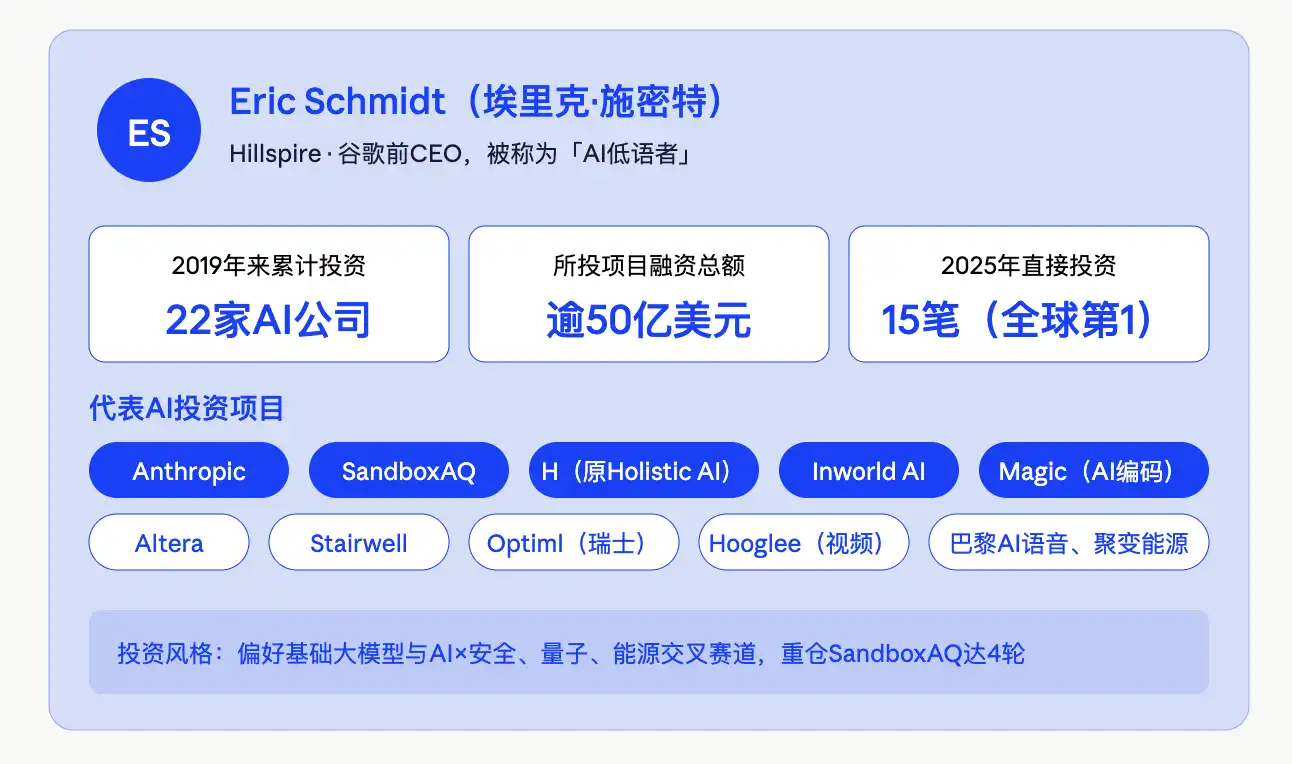
According to data cited by Wikipedia and The AI Insider, Schmidt's family office Hillspire has invested in over 22 AI companies since 2019, totaling more than $5 billion. The list includes Anthropic, SandboxAQ (a quantum+AI company spun off from Alphabet), Inworld AI, Holistic AI, and Altera. These are the targets that "insiders in the industry" would list.
But what truly reveals his underlying approach is another list.
White Stork: A company producing AI drones in Ukraine. Rebellion Defense: Defense AI. Istari: Simulation. Swift Beat: Military software. This is a family office that treats AI as the next generation of military equipment.
Schmidt has served as Chairman of the Defense Innovation Board since 2016 and co-led the National Security Commission on Artificial Intelligence from 2019 to 2021. He is a player who treats AI policy, defense procurement, and energy infrastructure as one and the same. In January 2024, Forbes disclosed that he simultaneously launched White Stork's drone projects in the U.S. and Ukraine, treating the Ukrainian battlefield as a "laboratory for AI weapons."
Then there's infrastructure.
In January 2026, he co-founded a company called Bolt Data & Energy with Texas Pacific Land, serving as its chairman. This company doesn't rent server rooms or buy electricity from the grid; it aims to build its own natural gas power plants in the West Texas wilderness, directly pumping electricity into data centers. The plan is to first reach 1 gigawatt, eventually scaling to 10 gigawatts, equivalent to the electricity consumption of 7 million households. Texas Pacific Land contributed $50 million, plus priority water supply rights. In an email reply to Fortune, Schmidt said: "The biggest bottleneck for AI is not algorithms, it's energy."
In March of the same year, he took control of Relativity Space. This company is developing a reusable rocket called Terran R, aiming to challenge SpaceX's monopoly in medium-to-low orbit launches. By that time, it had $2.9 billion in orders.
Putting these pieces together, the logic becomes clear.
Schmidt doesn't believe in the approach of "investing in a basket of large model companies." He believes the outcome of AI will ultimately depend on three things: computing power (data centers and electricity), transport (rockets, satellites, drones), and policy (defense committees and congressional hearings). He also invests in model companies, and even publicly wrote an article calling for the U.S. to increase open-source investment after DeepSeek emerged, but that's just one piece on his chessboard, not the whole game.
His reaction to DeepSeek is very telling. After DeepSeek's release in early 2025, Schmidt immediately wrote an article in The Washington Post, calling it a "turning point in the global AI race." His prescription wasn't retreat, but escalation, including more open source, more Stargate-style infrastructure, and more sharing of training methods between model labs.
In other words, he sees AI as an endurance race between nations, and he has already positioned himself on the sidelines while also serving as a committee member. At 70, stepping out to become CEO of Relativity might seem like a struggle to outsiders. He explains it himself: Kissinger worked until he was 100, "times of major transformation require responsibility, not withdrawal."
Bezos: The Full-Stack Control Freak
Bezos's approach is completely different from Schmidt's.
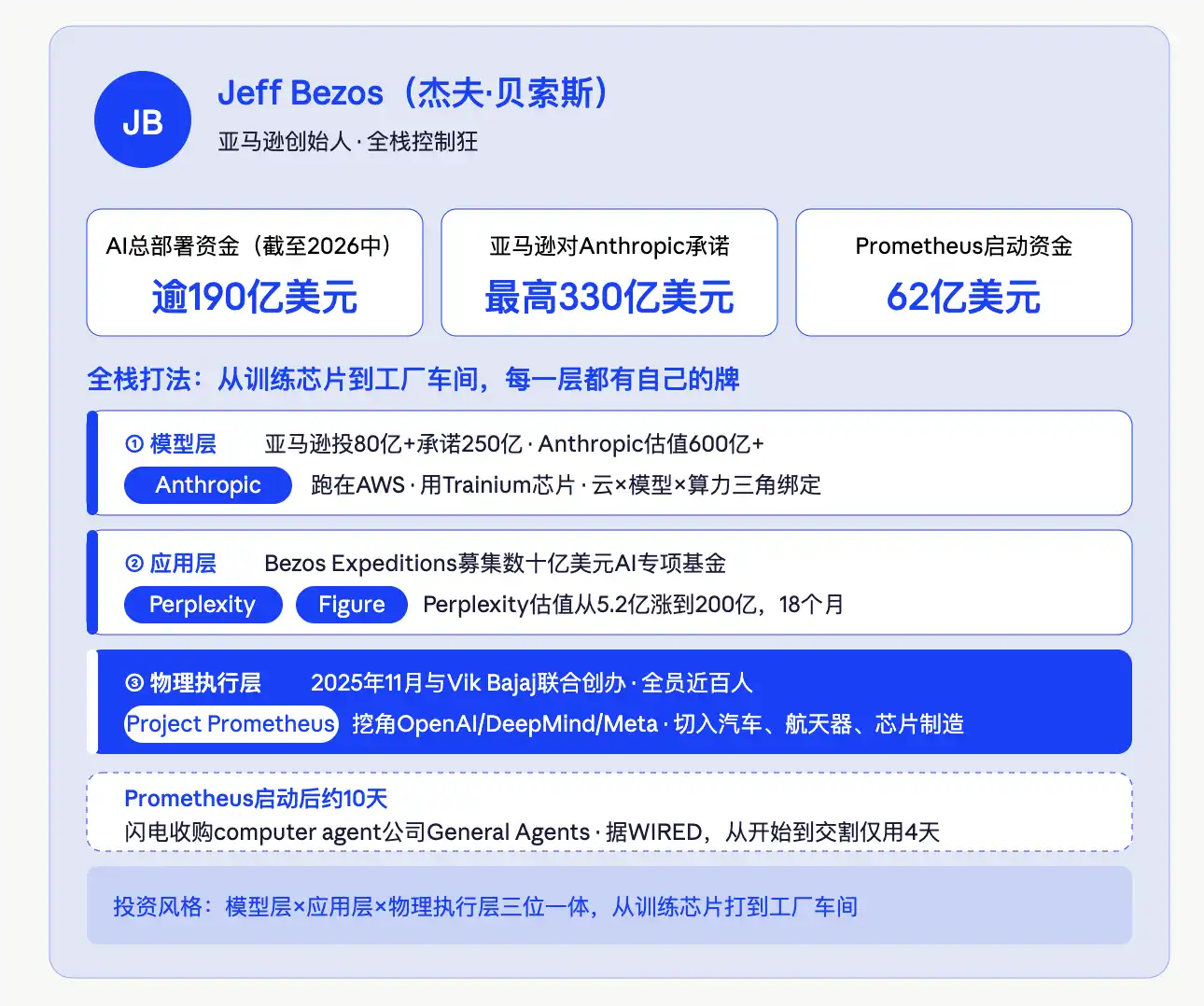
According to data cited by StartupHub from TechCrunch, The Information, and the Bezos Earth Fund, as of mid-2026, Bezos had deployed over $19 billion into AI. This number is still rising.
Breaking it down, it's mainly divided into three parts.
The first part is Anthropic. Amazon started investing in September 2023, eventually reaching $8 billion, and in April 2026, committed to adding up to $25 billion more. Anthropic runs on AWS, using Amazon's Trainium chips. This binds Amazon's cloud infrastructure, Bezos's model-layer bet, and Anthropic's research capacity into a triangle, going far beyond a mere financial investment. When Anthropic's valuation soared above $60 billion, Amazon had already captured the largest external slice of the pie.
The second part is the scattered investments of Bezos Expeditions. Bezos Expeditions is raising a multi-billion dollar AI-specific fund, upgrading "Bezos's personal angel investments" into "institutional investor." Among them, its investment in Perplexity, an AI search company, rose from a $520 million valuation in January 2024 to $20 billion in September 2025.
The third part is Project Prometheus.
In November 2025, Bezos and former Google X executive Vik Bajaj jointly announced the founding of this company, with a startup fund of $6.2 billion, nearly 100 employees. The team was recruited from OpenAI, DeepMind, and Meta. The founding advisor list included Ashish Vaswani and Jakob Uszkoreit, two of the authors of the 2017 paper "Attention Is All You Need." The company's goal is to apply AI to manufacturing, including cars, spacecraft, and chips.
Why manufacturing? Because this neatly meshes with Bezos's other businesses. Amazon has the Kuiper satellite constellation; once manufacturing AI is realized, its first batch of customers will be right in his own backyard.
Musk called Project Prometheus a "copycat" on X.
But structurally, this is not copying.
Bezos holds the model layer through Anthropic, the application layer through Perplexity and Figure, and the computing layer through Amazon. Now, by creating Prometheus, he's integrating AI into manufacturing, taking on the "physical world execution layer" as well. This is a full-stack approach, with his own cards at every layer, from training chips to deployment on the factory floor.
About 10 days after Project Prometheus launched, it quietly acquired a company called General Agents. This company developed "computer agents," AI agents capable of directly operating an entire computer. WIRED later disclosed that this acquisition, from start to closing, took only four days.
Donely's CEO Harsha Abegunasekara commented: "What General Agents truly cracked is speed; Ace runs on your computer almost instantaneously." His company was originally a competitor of General Agents.
From angel investing to forming a specialized fund, to personally taking the CEO role, Bezos only needed 18 months. He is essentially building a system larger than Amazon.
Powell Jobs: The Low-Key Camp
Looking at these three individuals together, Powell Jobs is the one who least resembles an "AI investor."
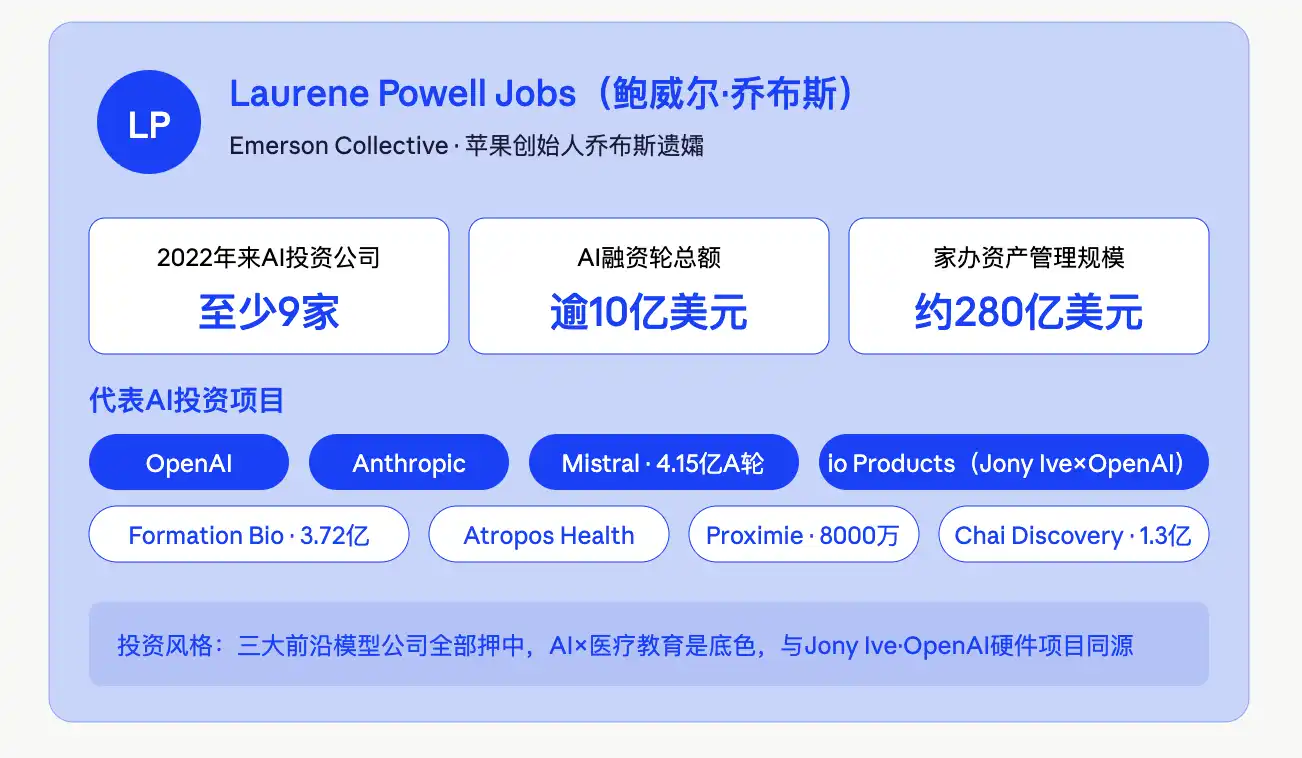
According to CNBC citing data from the private wealth platform Fintrx, her family office, Emerson Collective, has invested in at least 9 AI-related startups since 2022, participating in funding rounds totaling over $1 billion. This figure is not on the same scale as Schmidt's or Bezos's.
But the interesting part is the list itself.
Proximie: A remote surgical connection platform; Atropos Health: Clinical data AI; Formation Bio: AI drug discovery; Curipod: A Norwegian AI teaching tool; Mistral: The French large model company, Europe's sole contender against OpenAI.
No defense, no data centers, no rockets.
Emerson Collective's website clearly states its investment directions: Education, Energy & Environment, Digital Health, Fintech, Media. AI is just a tool woven into these themes. She holds a majority stake in The Atlantic and is very adept at Columbia-style "soft power" investments.
But the one investment she truly nailed is not on the same line as the ones mentioned above.
After Jony Ive left Apple in 2019, Powell Jobs invested in his design firm LoveFrom through Emerson Collective. Ive later said in a Financial Times interview: "If it weren't for Laurene, LoveFrom wouldn't exist at all." A few years later, Ive founded another hardware company called io, specializing in AI devices, and Powell Jobs invested again. In May 2025, OpenAI acquired io in an all-stock transaction worth $6.4 billion, making Ive a billionaire on paper. Emerson Collective also cashed out.
Another key investment: Emerson Collective was one of the early investors in Mistral AI when this French company was still Europe's last remaining contender in large models.
Putting these together, her AI bets are concentrated in two directions: either "using AI to solve specific human problems" or "reshaping the way humans and machines interact" (io's devices, Ive's design).
VC Sheet described Emerson Collective in an assessment: "An intentionally opaque LLC that houses venture capital, philanthropy, policy advocacy, art, and media ownership under one roof, able to use whichever tool—grants, policy lobbying, or investment—is most effective."
Philosophically, she is closer to the older generation of East Coast family offices: influence is more important than returns, the long term more important than the short term, having the microphone more important than the spotlight.
Three Investment Philosophies
Placing the three lists side by side, you see three sets of judgments about AI's future.
Schmidt is betting on national competition and infrastructure bottlenecks. In his world, AI will ultimately be determined by "who has the most electricity, the fastest rockets, the strongest drones." Models are just the entry ticket; the real moat is in the physical layer. That's why he personally steps in to lead Relativity and Bolt. What he wants is not returns, but control.
Bezos is betting on application diffusion at an industrial revolution scale. He believes AI will eventually permeate every machine tool, every airplane, every satellite like electricity. So he locks down the model layer through Amazon, the manufacturing layer through Prometheus, and embeds into the consumer application layer through Expeditions. He's not betting on whether a specific company will win, but whether this entire "full-stack" structure can win.
Powell Jobs is betting on something else. She's betting that humans will ultimately be unable to tolerate the current human-machine interaction model. She and Ive repeatedly emphasized in the Financial Times interview that "humans deserve better." Her investments in io, LoveFrom, medical AI, and educational AI are based on the same judgment: the biggest market of the next decade will be "fixing the side effects caused by the internet in the last decade."
Three sets of judgments, three different approaches.
Which one is right? No one knows. Schmidt might overestimate the weight of geopolitics in the AI economy. Bezos might underestimate the capital consumption of the "full-stack" heavy-asset model—a typical example is that Prometheus hasn't shipped anything yet, and there's already talk of needing to raise another $10 billion. Powell Jobs faces an even more awkward question: io's devices won't go into mass production until 2027, and OpenAI's own financial model has been repeatedly questioned by the market.
But one thing is certain. When the winners of the last internet generation collectively turn their family funds toward AI, this is no longer a small hype cycle in a certain sector. Bolt has already raised $150 million in startup funds; Anthropic alone is set to receive Amazon's committed $33 billion. Capital flows of this magnitude will shape the industrial geography of the next decade on their own.
As for who will have the last laugh, we'll have to look back in 2030. Until then, the three old-timers are still at the table, and the chips are still being added.