The Real AI Bubble, You Can't Buy It

marsbitPublicado em 2026-05-14Última atualização em 2026-05-14

Resumo

The article argues that the real "bubble" in the current AI boom is largely invisible and inaccessible to the average investor. Unlike the 2000 dot-com bubble, where overvalued companies were publicly traded, the most significant value surges and financial risks are occurring in private markets. Core AI companies like OpenAI, Anthropic, xAI, and Databricks have seen valuations skyrocket (e.g., OpenAI's from $157B to $852B in 18 months), but these transactions happen through private secondary sales, not public stock exchanges. These opaque markets create an "anxiety exposure," leading public investors to chase indirect proxies like memory chip or utility stocks. The author highlights how AI wealth extraction has been radically front-loaded. Employees and founders can cash out years before a potential IPO through structured secondary sales, "founder-led secondary" deals, and collateralized loans against private equity. Major tech firms also use "acqui-hires" or technology licensing deals (like Google/Character.AI, Microsoft/Inflection AI) to secure talent and tech without full acquisitions, allowing early exits outside of regulatory scrutiny. Furthermore, the AI infrastructure build-out is compared to the 2008 real estate bubble. Massive data center projects are financed through complex, off-balance-sheet structures involving private credit, joint ventures, and asset-backed securities using GPUs as collateral (e.g., CoreWeave's deals). This creates a "shadow borrowing" syste...

Recently, when I open my phone, the groups are mostly discussing these things:

Nvidia hits new highs again, and the overall US stock market reaches record highs; the memory sector soars, with SanDisk up more than 4 times this year, Micron achieving its strongest weekly gain since 2008, and even the A-share storage sector takes off.

Group friends simultaneously discuss 'What is the next target to get on board?' and 'Is this a replay of the peak of the dot-com bubble?'

It sounds contradictory, but it's actually the same sentiment: fear of missing out, and fear of a crash.

But in reality, the 'bubble' we are discussing now might not be the real bubble of this AI wave. Or, more accurately, the most dangerous part of this round of AI bubble isn't anywhere you can see when you open your trading account.

A few days ago, OpenAI was exposed as having arranged a stock sale and cash-out transaction for employees in October last year. 75 people cashed out at the maximum cap of $30 million, and the remaining 500+ employees cashed out an average of about $6 million each. The company originally planned to issue $6 billion, but due to too many external investors, it was temporarily increased to $10.3 billion. This round valued OpenAI at $500 billion, more than three times its valuation from six months prior.

This happened last October, but most people only found out in May this year. If it weren't for the Wall Street Journal report, many might still not know. And during these seven-plus months, OpenAI's valuation rose from $500 billion to $852 billion, an increase of 70%.

The memory surge, Nvidia's new highs—these are real, but they are not the most dangerous part of this AI bubble. The real bubble is increasingly happening in places you cannot see or buy.

This time, ordinary people didn't fail to see the bubble. It's that by the time they see the bubble, the most important trades have already been completed.

The valuation finishes rising, and you might not even see it

Yesterday, OpenAI issued a statement on its official website, saying that OpenAI equity cannot be traded privately, and transfers or pledges without written authorization are invalid. The announcement also specifically prohibited several products: packaging equity into shell companies to sell to investors, turning equity into crypto tokens to sell on-chain, and using 'forward contracts' to promise buyers a share of OpenAI's post-IPO gains.

If we compare this to the 2000 dot-com bubble, the biggest difference is that when that bubble burst, Google, Amazon, Yahoo, and various .com companies were already publicly listed. Retail investors could directly buy shares of these companies with P/E ratios of 100 or 200 times in their brokerage accounts. The bubble formed in the public market, and it collapsed in the public market.

OpenAI's current valuation is $852 billion, compared to $157 billion a year and a half ago. Anthropic's valuation is nearing $900 billion, compared to $61.5 billion a year ago, an increase of more than 10 times. xAI reached a valuation of $250 billion in just three years since its founding. Databricks saw its valuation rise from $62 billion to $134 billion in a year. But none of these numbers, growing faster than a rocket, emerged from the public market.
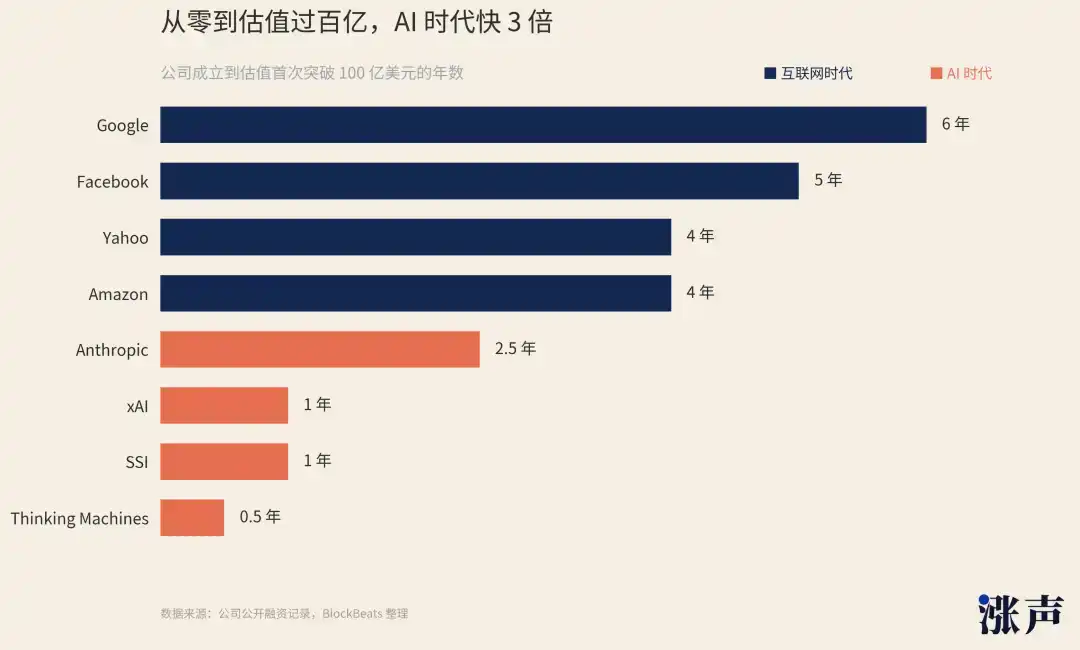
The process of inflating this round of the AI bubble is happening where the public cannot participate.

Anxiety, unable to find an entry point, seeks substitutes. A while ago, a bunch of media reported that Anthropic's valuation broke through $1.2 trillion, surpassing OpenAI. This number came from an on-chain decentralized pre-IPO platform that packaged Anthropic's equity into crypto synthetic assets for trading (exactly the type of transaction OpenAI prohibited). But this platform's actual 24-hour trading volume is less than $1.4 million, with only a little over three hundred people participating.

What users buy is not actual Anthropic common stock, but an 'anxiety exposure.' This $1.2 trillion is not Anthropic's real valuation; it's more like an outburst of AI anxiety at a liquidity breaking point. Silicon Valley elites understand this anxiety all too well. They even hope for more and larger anxiety so they can sell more anxiety products.

Last month, the well-known Silicon Valley investor Naval launched a fund called USVC, a 'civilian fund' with the concept of allowing ordinary people to invest in AI companies. The fund's portfolio contains shares of the hottest AI companies like OpenAI, Anthropic, and xAI. Non-accredited investors can also buy in, starting at $500.

But it's a closed-end registered fund. The shares are not listed on an exchange. The quarterly buyback limit is 5%, and the board can decide not to buy back. If you dig into the prospectus, you'll also find it expects investors to 'treat the shares as illiquid assets.' Many people on social media directly called it a 'dump fund.'

The surge in the memory sector also follows this logic. The Mag 7, especially Nvidia, are already too expensive. OpenAI and Anthropic are out of reach, but you can still buy into targets along the AI industry chain: chips, memory, power, even helium, copper, silver.

The bubble you see and talk about in the public market is actually more like capital anxiety spilling over from the private market.

Cashing out is like breathing; exiting doesn't require waiting for an IPO

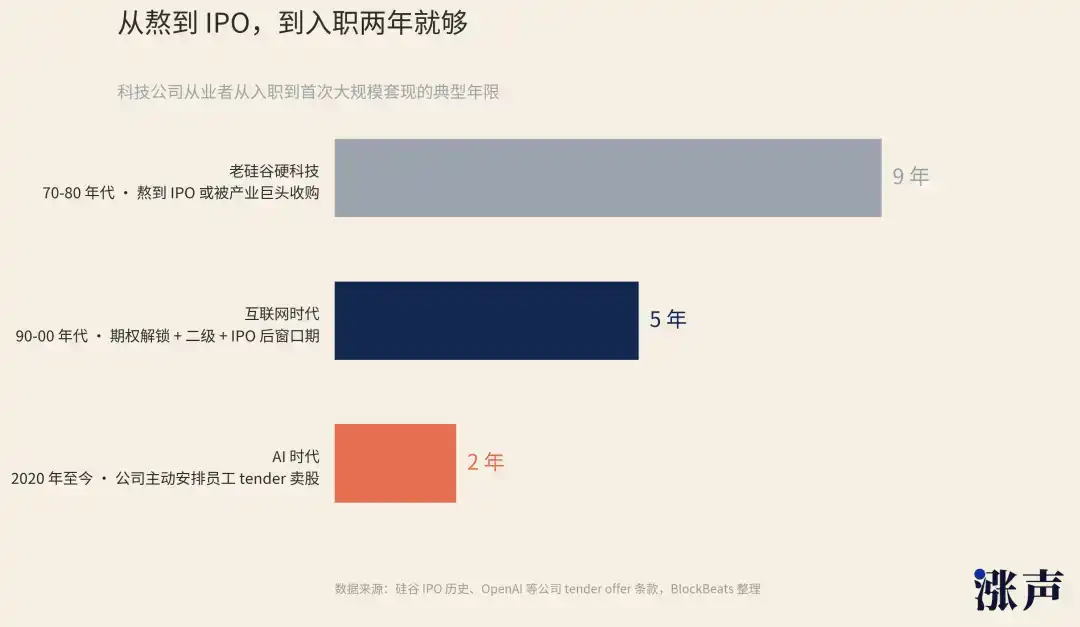
In the old Silicon Valley hard tech companies, employees had to endure 7 to 10 years to get cash, either waiting for an IPO or to be acquired by an industry giant. After the internet era, this cycle was compressed to about 5 years. Option vesting, secondary market transfers, post-IPO lockup periods—wealth distribution began to have multiple nodes, but IPO was still the biggest one.

In the AI era, cashing out has been thoroughly moved forward to the pre-IPO stage.

OpenAI's recent stock sale threshold for employees is only two years. ChatGPT was released in November 2022. Employees who joined after that started unlocking their stock sale eligibility in the second half of 2024, just in time for that $6.6 billion cash-out in October last year.

It's not just internal at OpenAI. Founders and core teams of AI companies are using new ways to exit early, without needing acquisition or an IPO.

Google's acquisition of Character.AI in 2024, by old Silicon Valley standards, wouldn't even be considered a real acquisition. Google didn't buy the whole company but spent $3 billion to obtain the technology usage rights of Character.AI, with $2.5 billion used to pay out existing Character.AI shareholders and the remaining $500 million as a technology licensing fee.

Simply put, it's technology licensing plus team migration. The company itself remains, but the most valuable people and the most critical technology have already exited through a non-public transaction. The two co-founders of Character.AI hold over 30% of the company's shares. This single deal could net them nearly $1 billion.

Similar cases include Microsoft acquiring Inflection AI, spending $650 million to license the technology and directly hiring the founders and core team. Amazon also used this method to acquire Adept AI.

The US Federal Trade Commission (FTC) launched an investigation into such deals in early 2025, focusing on whether big companies were using this structure to avoid merger review. But all the 'acquisitions' mentioned above happened in 2024, without regulatory review and without needing to put valuations on a prospectus.
From a primary market perspective, today's AI doesn't even need comparison with the internet bubble back then because the heat has already exceeded it by several orders of magnitude.

AI startups casually raise funding rounds starting in the tens of billions of dollars. Most crucially, teams and founders don't need to wait for an IPO to exit. The money in the private market alone is already more than enough, and the ways this money enters the pockets of employees and founders are increasing and becoming more concealed.

Before last October's employee stock sale, OpenAI had conducted two similar internal transactions. Large unicorns like Anthropic and Databricks have also done this. AI companies no longer need to wait for an IPO; they can have 'exit windows' periodically.

Founders have their own channels too. 'Founder-led secondary' transactions are popular in Silicon Valley now, where entrepreneurs sell part of their equity without leaving the company. They can enjoy the continued rise in the company's valuation while also getting cash early.

Or they can take out loans secured by their equity. A company called Pluto specializes in this, helping AI founders and early investors use their private equity holdings as collateral to get cash, with loan-to-value ratios of 20% to 35%. No need to sell shares; just get the cash directly.

Early investors don't need to wait for the company's IPO to deliver returns to LPs. They can have the original VC firm set up a new fund, sell the star assets from the old fund to the new fund, and old LPs can choose to cash out or continue holding through the new fund. This method is called a 'GP-led continuation fund.' In the first half of 2025, the scale of such deals was nearly $50 billion, double that of 2024.

Another indirect exit method is starting a new company. Among the companies founded by people who left OpenAI, at least 7 have become unicorns, with Anthropic, Thinking Machines Lab, and SSI being representatives of this wave. The original team leaves, reassembles, raises funds again—a single departure triggers a new round of wealth distribution.

Every exit method mentioned above doesn't require regulatory review or putting valuations on a prospectus. AI is the biggest beneficiary because many quality AI assets cannot IPO for now.

AI Infrastructure is More Like the Real Estate Bubble

Many people compare today to the 2000 internet bubble, but that comparison is off. The current AI bubble is actually more like the 2008 real estate bubble.

In the 2008 subprime mortgage crisis, the houses were real, the rents were real, but housing prices, loans, ratings, and securitization were all built on the same overly optimistic expectations. The result was Lehman Brothers collapsed, and mortgage-backed bonds became worthless.

Now, similar financialization is happening with AI data centers, GPUs, and compute contracts, and on an even larger scale.

AI training and inference require data centers. Data centers require land, electricity, water, cooling, networks, and long-term clients. So data centers are no longer just the backend server rooms of tech companies; they are assets competed for by real estate funds, private credit, and insurance funds.

Meta announced a partnership with Blue Owl last year to develop the Hyperion data center in Louisiana, with a total development cost of $27 billion, enough to build about 30 Shanghai Towers. Funds managed by Blue Owl hold 80%, a large portion raised through private debt issuance. Meta holds 20%, contributes land and construction in progress, and then signs a 4-year operating lease with the joint venture, plus a 16-year residual value guarantee. If the lease is not renewed at expiry, Meta compensates based on the data center's value at that time.

Meta didn't simply say 'I'm going to spend $27 billion to build a data center.' It turned the data center into a joint venture, turned capital expenditure into a lease, turned residual value into a guarantee, and then sold part of the project as debt to private bond investors. This logic is identical to mortgages being packaged into financial derivatives in 2008.
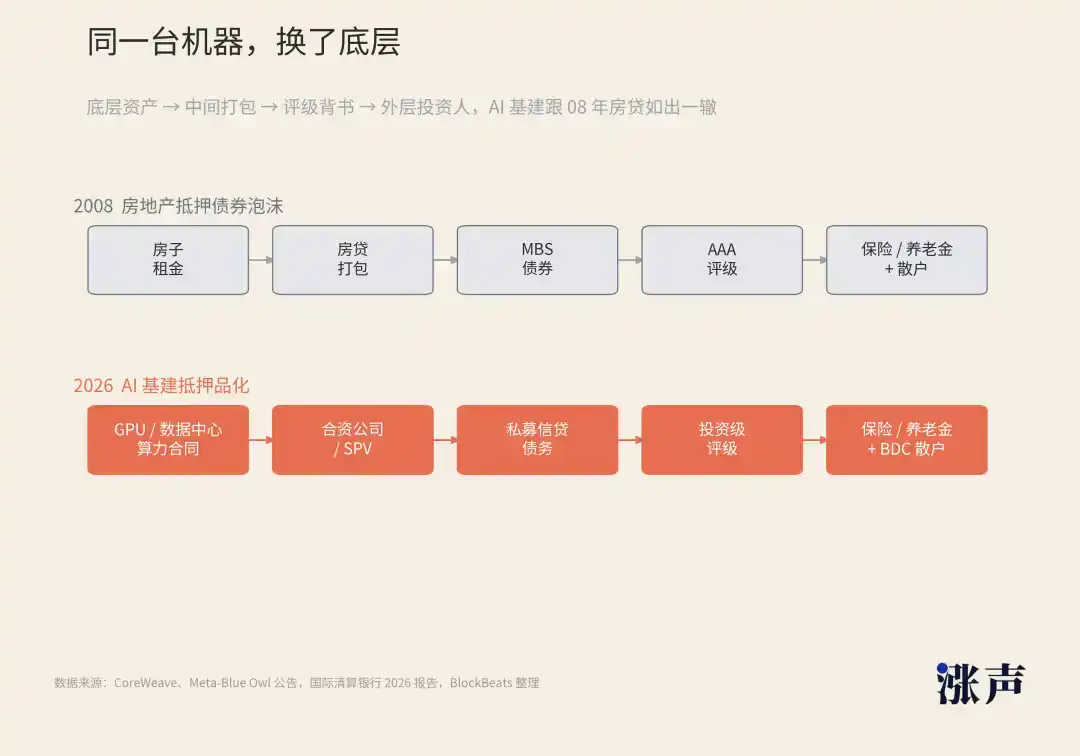
CoreWeave is another typical case. In 2023, it completed $2.3 billion in debt financing, using Nvidia chips as collateral. In 2024, it signed $7.5 billion in debt financing, led by Blackstone. In 2026, it completed $8.5 billion in GPU-backed financing, receiving an A3 investment-grade rating from Moody's—the first-ever investment-grade-rated GPU-backed financing.

And it's not just CoreWeave. Lambda completed $1 billion in senior secured credit this year; Crusoe secured $750 million in credit from Brookfield, plus $11.6 billion for building OpenAI's Stargate compute factory. Broadcom is reportedly also negotiating a $35 billion AI chip financing deal with Apollo and Blackstone.

Each one is turning AI compute assets into financeable, pledgeable credit products.

Regulators have already named this. The Bank for International Settlements, in its 2026 report, called this structure 'shadow borrowing.' Tech giants hold data center assets through joint ventures and SPVs, assume debt in the form of long-term leases and guarantees, but this debt doesn't appear on their balance sheets. They borrow money to buy GPUs and build data centers while waiting for the GPUs to depreciate. And the borrowed money has long terms, while GPU depreciation is fast.

The bubble risk on this path doesn't actually need this wave of AI to validate; the recent private equity fund turmoil was a preview.

In 2020, private equity firm Vista Equity bought an online technical training SaaS company called Pluralsight for $3.5 billion. Its creditors were all top players in private credit: Blue Owl, Ares, Goldman Sachs, BlackRock. By 2024, Pluralsight couldn't sustain itself, and Vista had to 'hand over' the entire company to the creditors, with Vista and co-investors losing $4 billion.

The reason it couldn't sustain wasn't 'how much money the company is making now,' but 'how stable the company's future subscription renewal revenue will be.' When AI changed the renewal logic of the software market, all 'seemingly stable cash flows' needed reinterpretation. The moat of SaaS private credit suddenly turned from water to sand.

Blue Owl, which lent to Pluralsight, is one of the top players in private credit. Earlier this year, its OCIC private credit fund faced 40% redemptions from retail investors due to AI's impact on SaaS. But even so, Blue Owl continues lending for AI data centers. Besides the Meta data center mentioned earlier, it's also a major financier behind OpenAI's Stargate compute project.

The most dangerous aspect of private credit is that its opacity can cause widespread valuation distortions. External investors have no way to verify the fund's underlying assets.

In August last year, BlackRock's private credit division HPS was defrauded of over $400 million by an Indian-born telecom entrepreneur using fake invoices. HPS lent to several telecom companies under this entrepreneur, with the collateral being these companies' customer accounts receivable. It was only when an HPS employee noticed issues with the customer email addresses that the entire collateral was discovered to be non-existent.

If a top player like BlackRock can't even clearly see if the money it lent out has real collateral, how much can the investors buying its fund shares possibly know?

All these AI data center financings, GPU-backed loans, new SPV structures are built on one assumption: the underlying assets are valuable.

But how fast do GPUs depreciate? Will data center client contracts renew? Will AI inference demand materialize enough to support this compute? Even the agencies rating these assets and the banks underwriting the funds can only give judgments 'based on available information.' Ordinary investors see only a prospectus, a rating report, and a name.

The Real Bubble Doesn't Necessarily Quote You First

Back to the opening question, 'What is the next target to get on board?'

What most people can get on board with now is essentially the shadow cast by the core assets. The 2000 internet bubble peaked in the public market and crashed in the public market. You could see it, feel it, read about that day in the news.

This time, the most bubbly, most dangerous part is happening where you can't see it. By the time you see these, the most important trades have already been completed.


Perguntas relacionadas

QAccording to the article, what is the main difference between the current AI bubble and the 2000 internet bubble?

AThe main difference is where the bubble forms and bursts. During the 2000 internet bubble, the bubble formed and burst in the public markets, where retail investors could directly buy stocks of companies like Google and Amazon. In the current AI bubble, the most significant and potentially dangerous part of the valuation surge is happening in private markets, in transactions that are opaque and inaccessible to the general public.

QWhat are some of the new ways AI company founders and employees can cash out without waiting for an IPO?

AAI founders and employees can cash out through several non-public, pre-IPO methods. These include internal company-sponsored secondary sales (like OpenAI's), 'founder-led secondary' sales, pledging private equity as collateral for loans, and 'GP-led continuation funds' where VCs sell assets from an old fund to a new one. Additionally, acquisitions that are structured as technology licensing and team migrations (like Google's deal with Character.AI) allow for significant payouts without a full buyout or IPO.

QWhy does the article compare the current AI infrastructure bubble to the 2008 real estate bubble?

AThe article compares it because similar financialization is occurring. Just as real assets (houses) were bundled into complex, over-leveraged financial products (mortgage-backed securities) in 2008, AI infrastructure assets like data centers and GPU computing power are now being packaged into financial structures involving joint ventures, off-balance-sheet debt, long-term leases, and specialized loans (e.g., GPU-collateralized financing). These structures create layers of debt and risk based on optimistic future demand assumptions, mirroring the pre-2008 housing market dynamics.

QWhat is 'shadow borrowing' in the context of AI, as mentioned in the article?

AAccording to the article, 'shadow borrowing' refers to the financial structure where tech giants finance AI infrastructure (like data centers) through special purpose vehicles (SPVs) and joint ventures. They take on debt in the form of long-term leases and guarantees for these assets, but this debt does not appear on their corporate balance sheets. This creates opaque, off-balance-sheet leverage that funds the massive capital expenditure for AI, similar to shadow banking practices.

QWhat point does the article make about the investment products that claim to give ordinary people access to hot AI companies like OpenAI?

AThe article is critical of such products, suggesting they are often a way to sell 'exposure to anxiety' rather than genuine, liquid investment. It cites the example of the USVC 'retail fund' and synthetic crypto assets based on private company equity. These products often have low liquidity, high restrictions (like quarterly repurchase limits), and do not offer direct ownership of the underlying AI company shares. They are presented as solutions for the 'anxiety' of missing out on the private market boom.

Leituras Relacionadas

MY Group Completes Web4.0 First Stock Listing Layout, SEC Officially Discloses Form 8-K Announcement

MY Group has completed the listing layout for the "Web4.0 First Share," with the U.S. Securities and Exchange Commission (SEC) formally disclosing a Form 8-K report. According to the filing, the company's board has officially appointed Mr. Zhang Dingwen as Chief Executive Officer (CEO) and Executive Director, marking a significant upgrade in management and the entry into a new phase of its global capital market strategy. The disclosure of Form 8-K, used for reporting major corporate events, coincides with market information indicating the company is advancing several key capital market initiatives. These include a global brand system upgrade, corporate strategic restructuring, and a change of its stock ticker symbol. These moves are viewed by industry experts as signals of accelerated internationalization and enhanced global market presence. Concurrently, MY Group's proposed "Web4.0 Ecosystem" is garnering market attention. The company is integrating core capabilities across social traffic portals, global payment systems, public blockchain infrastructure, digital asset trading, and AI-powered financial systems. Analysts suggest that by closing this ecosystem loop, MY Group has the potential to become a next-generation platform merging Web2 user scale with Web3 asset frameworks and AI financial capabilities. With the management upgrade finalized, the global brand strategy launched, and the stock ticker change pending, MY Group is positioning itself as a focal point in the global technology capital market as a potential leading Web4.0 platform enterprise.

marsbitHá 11h

MY Group Completes Web4.0 First Stock Listing Layout, SEC Officially Discloses Form 8-K Announcement

marsbitHá 11h

Trading

Spot
Futuros

Artigos em Destaque

O que é GROK AI

Grok AI: Revolucionar a Tecnologia Conversacional na Era Web3 Introdução No panorama em rápida evolução da inteligência artificial, a Grok AI destaca-se como um projeto notável que liga os domínios da tecnologia avançada e da interação com o utilizador. Desenvolvida pela xAI, uma empresa liderada pelo renomado empreendedor Elon Musk, a Grok AI procura redefinir a forma como interagimos com a inteligência artificial. À medida que o movimento Web3 continua a florescer, a Grok AI visa aproveitar o poder da IA conversacional para responder a consultas complexas, proporcionando aos utilizadores uma experiência que é não apenas informativa, mas também divertida. O que é a Grok AI? A Grok AI é um sofisticado chatbot de IA conversacional projetado para interagir com os utilizadores de forma dinâmica. Ao contrário de muitos sistemas de IA tradicionais, a Grok AI abraça uma gama mais ampla de perguntas, incluindo aquelas tipicamente consideradas inadequadas ou fora das respostas padrão. Os principais objetivos do projeto incluem: Raciocínio Fiável: A Grok AI enfatiza o raciocínio de senso comum para fornecer respostas lógicas com base na compreensão contextual. Supervisão Escalável: A integração de assistência de ferramentas garante que as interações dos utilizadores sejam monitorizadas e otimizadas para qualidade. Verificação Formal: A segurança é primordial; a Grok AI incorpora métodos de verificação formal para aumentar a fiabilidade das suas saídas. Compreensão de Longo Contexto: O modelo de IA destaca-se na retenção e recordação de um extenso histórico de conversas, facilitando discussões significativas e contextualizadas. Robustez Adversarial: Ao focar na melhoria das suas defesas contra entradas manipuladas ou maliciosas, a Grok AI visa manter a integridade das interações dos utilizadores. Em essência, a Grok AI não é apenas um dispositivo de recuperação de informações; é um parceiro conversacional imersivo que incentiva um diálogo dinâmico. Criador da Grok AI A mente por trás da Grok AI não é outra senão Elon Musk, um indivíduo sinónimo de inovação em vários campos, incluindo automóvel, viagens espaciais e tecnologia. Sob a égide da xAI, uma empresa focada em avançar a tecnologia de IA de maneiras benéficas, a visão de Musk visa reformular a compreensão das interações com a IA. A liderança e a ética fundacional são profundamente influenciadas pelo compromisso de Musk em ultrapassar os limites tecnológicos. Investidores da Grok AI Embora os detalhes específicos sobre os investidores que apoiam a Grok AI permaneçam limitados, é reconhecido publicamente que a xAI, a incubadora do projeto, é fundada e apoiada principalmente pelo próprio Elon Musk. As anteriores empreitadas e participações de Musk fornecem um forte apoio, reforçando ainda mais a credibilidade e o potencial de crescimento da Grok AI. No entanto, até agora, informações sobre fundações ou organizações de investimento adicionais que apoiam a Grok AI não estão prontamente acessíveis, marcando uma área para exploração futura potencial. Como Funciona a Grok AI? A mecânica operacional da Grok AI é tão inovadora quanto a sua estrutura conceptual. O projeto integra várias tecnologias de ponta que facilitam as suas funcionalidades únicas: Infraestrutura Robusta: A Grok AI é construída utilizando Kubernetes para orquestração de contêineres, Rust para desempenho e segurança, e JAX para computação numérica de alto desempenho. Este trio assegura que o chatbot opere de forma eficiente, escale eficazmente e sirva os utilizadores prontamente. Acesso a Conhecimento em Tempo Real: Uma das características distintivas da Grok AI é a sua capacidade de aceder a dados em tempo real através da plataforma X—anteriormente conhecida como Twitter. Esta capacidade concede à IA acesso às informações mais recentes, permitindo-lhe fornecer respostas e recomendações oportunas que outros modelos de IA poderiam perder. Dois Modos de Interação: A Grok AI oferece aos utilizadores a escolha entre “Modo Divertido” e “Modo Regular”. O Modo Divertido permite um estilo de interação mais lúdico e humorístico, enquanto o Modo Regular foca em fornecer respostas precisas e exatas. Esta versatilidade assegura uma experiência adaptada que atende a várias preferências dos utilizadores. Em essência, a Grok AI combina desempenho com envolvimento, criando uma experiência que é tanto enriquecedora quanto divertida. Cronologia da Grok AI A jornada da Grok AI é marcada por marcos fundamentais que refletem as suas fases de desenvolvimento e implementação: Desenvolvimento Inicial: A fase fundamental da Grok AI ocorreu ao longo de aproximadamente dois meses, durante os quais o treinamento inicial e o ajuste do modelo foram realizados. Lançamento Beta do Grok-2: Numa evolução significativa, o beta do Grok-2 foi anunciado. Este lançamento introduziu duas versões do chatbot—Grok-2 e Grok-2 mini—cada uma equipada com capacidades para conversar, programar e raciocinar. Acesso Público: Após o seu desenvolvimento beta, a Grok AI tornou-se disponível para os utilizadores da plataforma X. Aqueles com contas verificadas por um número de telefone e ativas há pelo menos sete dias podem aceder a uma versão limitada, tornando a tecnologia disponível para um público mais amplo. Esta cronologia encapsula o crescimento sistemático da Grok AI desde a sua concepção até ao envolvimento público, enfatizando o seu compromisso com a melhoria contínua e a interação com o utilizador. Principais Características da Grok AI A Grok AI abrange várias características principais que contribuem para a sua identidade inovadora: Integração de Conhecimento em Tempo Real: O acesso a informações atuais e relevantes diferencia a Grok AI de muitos modelos estáticos, permitindo uma experiência de utilizador envolvente e precisa. Estilos de Interação Versáteis: Ao oferecer modos de interação distintos, a Grok AI atende a várias preferências dos utilizadores, convidando à criatividade e personalização na conversa com a IA. Base Tecnológica Avançada: A utilização de Kubernetes, Rust e JAX fornece ao projeto uma estrutura sólida para garantir fiabilidade e desempenho ótimo. Consideração de Discurso Ético: A inclusão de uma função de geração de imagens demonstra o espírito inovador do projeto. No entanto, também levanta considerações éticas em torno dos direitos autorais e da representação respeitosa de figuras reconhecíveis—uma discussão em curso dentro da comunidade de IA. Conclusão Como uma entidade pioneira no domínio da IA conversacional, a Grok AI encapsula o potencial para experiências transformadoras do utilizador na era digital. Desenvolvida pela xAI e impulsionada pela abordagem visionária de Elon Musk, a Grok AI integra conhecimento em tempo real com capacidades avançadas de interação. Esforça-se por ultrapassar os limites do que a inteligência artificial pode alcançar, mantendo um foco nas considerações éticas e na segurança do utilizador. A Grok AI não apenas incorpora o avanço tecnológico, mas também representa um novo paradigma de conversas no panorama Web3, prometendo envolver os utilizadores com conhecimento hábil e interação lúdica. À medida que o projeto continua a evoluir, ele permanece como um testemunho do que a interseção da tecnologia, criatividade e interação humana pode alcançar.

431 Visualizações TotaisPublicado em {updateTime}Atualizado em 2024.12.26

O que é GROK AI

O que é ERC AI

Euruka Tech: Uma Visão Geral do $erc ai e as suas Ambições no Web3 Introdução No panorama em rápida evolução da tecnologia blockchain e das aplicações descentralizadas, novos projetos surgem frequentemente, cada um com objetivos e metodologias únicas. Um desses projetos é a Euruka Tech, que opera no vasto domínio das criptomoedas e do Web3. O foco principal da Euruka Tech, particularmente do seu token $erc ai, é apresentar soluções inovadoras concebidas para aproveitar as capacidades crescentes da tecnologia descentralizada. Este artigo tem como objetivo fornecer uma visão abrangente da Euruka Tech, uma exploração das suas metas, funcionalidade, a identidade do seu criador, potenciais investidores e a sua importância no contexto mais amplo do Web3. O que é a Euruka Tech, $erc ai? A Euruka Tech é caracterizada como um projeto que aproveita as ferramentas e funcionalidades oferecidas pelo ambiente Web3, focando na integração da inteligência artificial nas suas operações. Embora os detalhes específicos sobre a estrutura do projeto sejam um tanto elusivos, ele é concebido para melhorar o envolvimento dos utilizadores e automatizar processos no espaço cripto. O projeto visa criar um ecossistema descentralizado que não só facilita transações, mas também incorpora funcionalidades preditivas através da inteligência artificial, daí a designação do seu token, $erc ai. O objetivo é fornecer uma plataforma intuitiva que facilite interações mais inteligentes e um processamento eficiente de transações dentro da crescente esfera do Web3. Quem é o Criador da Euruka Tech, $erc ai? Neste momento, a informação sobre o criador ou a equipa fundadora da Euruka Tech permanece não especificada e algo opaca. Esta ausência de dados levanta preocupações, uma vez que o conhecimento sobre o histórico da equipa é frequentemente essencial para estabelecer credibilidade no setor blockchain. Portanto, categorizamos esta informação como desconhecida até que detalhes concretos sejam disponibilizados no domínio público. Quem são os Investidores da Euruka Tech, $erc ai? De forma semelhante, a identificação de investidores ou organizações de apoio para o projeto Euruka Tech não é prontamente fornecida através da pesquisa disponível. Um aspeto que é crucial para potenciais partes interessadas ou utilizadores que consideram envolver-se com a Euruka Tech é a garantia que vem de parcerias financeiras estabelecidas ou apoio de empresas de investimento respeitáveis. Sem divulgações sobre afiliações de investimento, é difícil tirar conclusões abrangentes sobre a segurança financeira ou a longevidade do projeto. Em linha com a informação encontrada, esta seção também se encontra no estado de desconhecido. Como funciona a Euruka Tech, $erc ai? Apesar da falta de especificações técnicas detalhadas para a Euruka Tech, é essencial considerar as suas ambições inovadoras. O projeto procura aproveitar o poder computacional da inteligência artificial para automatizar e melhorar a experiência do utilizador no ambiente das criptomoedas. Ao integrar IA com tecnologia blockchain, a Euruka Tech visa fornecer funcionalidades como negociações automatizadas, avaliações de risco e interfaces de utilizador personalizadas. A essência inovadora da Euruka Tech reside no seu objetivo de criar uma conexão fluida entre os utilizadores e as vastas possibilidades apresentadas pelas redes descentralizadas. Através da utilização de algoritmos de aprendizagem automática e IA, visa minimizar os desafios enfrentados por utilizadores de primeira viagem e agilizar as experiências transacionais dentro do quadro do Web3. Esta simbiose entre IA e blockchain sublinha a importância do token $erc ai, que se apresenta como uma ponte entre interfaces de utilizador tradicionais e as capacidades avançadas das tecnologias descentralizadas. Cronologia da Euruka Tech, $erc ai Infelizmente, devido à informação limitada disponível sobre a Euruka Tech, não conseguimos apresentar uma cronologia detalhada dos principais desenvolvimentos ou marcos na jornada do projeto. Esta cronologia, tipicamente inestimável para traçar a evolução de um projeto e compreender a sua trajetória de crescimento, não está atualmente disponível. À medida que informações sobre eventos notáveis, parcerias ou adições funcionais se tornem evidentes, atualizações certamente aumentarão a visibilidade da Euruka Tech na esfera cripto. Esclarecimento sobre Outros Projetos “Eureka” É importante abordar que múltiplos projetos e empresas partilham uma nomenclatura semelhante com “Eureka.” A pesquisa identificou iniciativas como um agente de IA da NVIDIA Research, que se concentra em ensinar robôs a realizar tarefas complexas utilizando métodos generativos, bem como a Eureka Labs e a Eureka AI, que melhoram a experiência do utilizador na educação e na análise de serviços ao cliente, respetivamente. No entanto, estes projetos são distintos da Euruka Tech e não devem ser confundidos com os seus objetivos ou funcionalidades. Conclusão A Euruka Tech, juntamente com o seu token $erc ai, representa um jogador promissor, mas atualmente obscuro, dentro do panorama do Web3. Embora os detalhes sobre o seu criador e investidores permaneçam não divulgados, a ambição central de combinar inteligência artificial com tecnologia blockchain destaca-se como um ponto focal de interesse. As abordagens únicas do projeto em promover o envolvimento do utilizador através da automação avançada podem diferenciá-lo à medida que o ecossistema Web3 avança. À medida que o mercado cripto continua a evoluir, as partes interessadas devem manter um olhar atento sobre os avanços em torno da Euruka Tech, uma vez que o desenvolvimento de inovações documentadas, parcerias ou um roteiro definido pode apresentar oportunidades significativas no futuro próximo. Neste momento, aguardamos por insights mais substanciais que possam desvendar o potencial da Euruka Tech e a sua posição no competitivo panorama cripto.

475 Visualizações TotaisPublicado em {updateTime}Atualizado em 2025.01.02

O que é ERC AI

O que é DUOLINGO AI

DUOLINGO AI: Integrar a Aprendizagem de Línguas com Inovação Web3 e IA Numa era em que a tecnologia transforma a educação, a integração da inteligência artificial (IA) e das redes blockchain anuncia uma nova fronteira para a aprendizagem de línguas. Apresentamos DUOLINGO AI e a sua criptomoeda associada, $DUOLINGO AI. Este projeto aspira a unir o poder educativo das principais plataformas de aprendizagem de línguas com os benefícios da tecnologia descentralizada Web3. Este artigo explora os principais aspectos do DUOLINGO AI, analisando os seus objetivos, estrutura tecnológica, desenvolvimento histórico e potencial futuro, mantendo a clareza entre o recurso educativo original e esta iniciativa independente de criptomoeda. Visão Geral do DUOLINGO AI No seu cerne, DUOLINGO AI procura estabelecer um ambiente descentralizado onde os alunos podem ganhar recompensas criptográficas por alcançar marcos educativos em proficiência linguística. Ao aplicar contratos inteligentes, o projeto visa automatizar processos de verificação de habilidades e alocação de tokens, aderindo aos princípios do Web3 que enfatizam a transparência e a propriedade do utilizador. O modelo diverge das abordagens tradicionais de aquisição de línguas ao apoiar-se fortemente numa estrutura de governança orientada pela comunidade, permitindo que os detentores de tokens sugiram melhorias ao conteúdo dos cursos e à distribuição de recompensas. Alguns dos objetivos notáveis do DUOLINGO AI incluem: Aprendizagem Gamificada: O projeto integra conquistas em blockchain e tokens não fungíveis (NFTs) para representar níveis de proficiência linguística, promovendo a motivação através de recompensas digitais envolventes. Criação de Conteúdo Descentralizada: Abre caminhos para educadores e entusiastas de línguas contribuírem com os seus cursos, facilitando um modelo de partilha de receitas que beneficia todos os colaboradores. Personalização Através de IA: Ao empregar modelos avançados de aprendizagem de máquina, o DUOLINGO AI personaliza as lições para se adaptar ao progresso de aprendizagem individual, semelhante às características adaptativas encontradas em plataformas estabelecidas. Criadores do Projeto e Governança A partir de abril de 2025, a equipa por trás do $DUOLINGO AI permanece pseudónima, uma prática frequente no panorama descentralizado das criptomoedas. Esta anonimidade visa promover o crescimento coletivo e o envolvimento das partes interessadas, em vez de se concentrar em desenvolvedores individuais. O contrato inteligente implementado na blockchain Solana indica o endereço da carteira do desenvolvedor, o que significa o compromisso com a transparência em relação às transações, apesar da identidade dos criadores ser desconhecida. De acordo com o seu roteiro, o DUOLINGO AI pretende evoluir para uma Organização Autónoma Descentralizada (DAO). Esta estrutura de governança permite que os detentores de tokens votem em questões críticas, como implementações de funcionalidades e alocação de tesouraria. Este modelo alinha-se com a ética de empoderamento comunitário encontrada em várias aplicações descentralizadas, enfatizando a importância da tomada de decisão coletiva. Investidores e Parcerias Estratégicas Atualmente, não existem investidores institucionais ou capitalistas de risco publicamente identificáveis ligados ao $DUOLINGO AI. Em vez disso, a liquidez do projeto origina-se principalmente de trocas descentralizadas (DEXs), marcando um contraste acentuado com as estratégias de financiamento das empresas tradicionais de tecnologia educacional. Este modelo de base indica uma abordagem orientada pela comunidade, refletindo o compromisso do projeto com a descentralização. No seu whitepaper, o DUOLINGO AI menciona a formação de colaborações com “plataformas de educação blockchain” não especificadas, com o objetivo de enriquecer a sua oferta de cursos. Embora parcerias específicas ainda não tenham sido divulgadas, estes esforços colaborativos sugerem uma estratégia para misturar inovação em blockchain com iniciativas educativas, expandindo o acesso e o envolvimento dos utilizadores em diversas vias de aprendizagem. Arquitetura Tecnológica Integração de IA O DUOLINGO AI incorpora dois componentes principais impulsionados por IA para melhorar as suas ofertas educativas: Motor de Aprendizagem Adaptativa: Este motor sofisticado aprende a partir das interações dos utilizadores, semelhante a modelos proprietários de grandes plataformas educativas. Ele ajusta dinamicamente a dificuldade das lições para abordar desafios específicos dos alunos, reforçando áreas fracas através de exercícios direcionados. Agentes Conversacionais: Ao empregar chatbots alimentados por GPT-4, o DUOLINGO AI oferece uma plataforma para os utilizadores se envolverem em conversas simuladas, promovendo uma experiência de aprendizagem de línguas mais interativa e prática. Infraestrutura Blockchain Construído na blockchain Solana, o $DUOLINGO AI utiliza uma estrutura tecnológica abrangente que inclui: Contratos Inteligentes de Verificação de Habilidades: Esta funcionalidade atribui automaticamente tokens aos utilizadores que passam com sucesso em testes de proficiência, reforçando a estrutura de incentivos para resultados de aprendizagem genuínos. Emblemas NFT: Estes tokens digitais significam vários marcos que os alunos alcançam, como completar uma seção do seu curso ou dominar habilidades específicas, permitindo-lhes negociar ou exibir as suas conquistas digitalmente. Governança DAO: Membros da comunidade com tokens podem participar na governança votando em propostas-chave, facilitando uma cultura participativa que incentiva a inovação nas ofertas de cursos e funcionalidades da plataforma. Cronologia Histórica 2022–2023: Conceituação O trabalho preliminar para o DUOLINGO AI começa com a criação de um whitepaper, destacando a sinergia entre os avanços em IA na aprendizagem de línguas e o potencial descentralizado da tecnologia blockchain. 2024: Lançamento Beta Um lançamento beta limitado introduz ofertas em línguas populares, recompensando os primeiros utilizadores com incentivos em tokens como parte da estratégia de envolvimento comunitário do projeto. 2025: Transição para DAO Em abril, ocorre um lançamento completo da mainnet com a circulação de tokens, promovendo discussões comunitárias sobre possíveis expansões para línguas asiáticas e outros desenvolvimentos de cursos. Desafios e Direções Futuras Obstáculos Técnicos Apesar dos seus objetivos ambiciosos, o DUOLINGO AI enfrenta desafios significativos. A escalabilidade continua a ser uma preocupação constante, particularmente no equilíbrio dos custos associados ao processamento de IA e à manutenção de uma rede descentralizada responsiva. Além disso, garantir a criação e moderação de conteúdo de qualidade num ambiente descentralizado apresenta complexidades na manutenção dos padrões educativos. Oportunidades Estratégicas Olhando para o futuro, o DUOLINGO AI tem o potencial de aproveitar parcerias de micro-certificação com instituições académicas, proporcionando validações verificadas em blockchain das habilidades linguísticas. Além disso, a expansão cross-chain poderia permitir que o projeto acedesse a bases de utilizadores mais amplas e a ecossistemas de blockchain adicionais, melhorando a sua interoperabilidade e alcance. Conclusão DUOLINGO AI representa uma fusão inovadora de inteligência artificial e tecnologia blockchain, apresentando uma alternativa focada na comunidade aos sistemas tradicionais de aprendizagem de línguas. Embora o seu desenvolvimento pseudónimo e o modelo económico emergente tragam certos riscos, o compromisso do projeto com a aprendizagem gamificada, educação personalizada e governança descentralizada ilumina um caminho a seguir para a tecnologia educativa no domínio do Web3. À medida que a IA continua a avançar e o ecossistema blockchain evolui, iniciativas como o DUOLINGO AI poderão redefinir a forma como os utilizadores interagem com a educação linguística, empoderando comunidades e recompensando o envolvimento através de mecanismos de aprendizagem inovadores.

408 Visualizações TotaisPublicado em {updateTime}Atualizado em 2025.04.11

O que é DUOLINGO AI

Discussões

Bem-vindo à Comunidade HTX. Aqui, pode manter-se informado sobre os mais recentes desenvolvimentos da plataforma e obter acesso a análises profissionais de mercado. As opiniões dos utilizadores sobre o preço de AI (AI) são apresentadas abaixo.

活动图片