Claude always makes mistakes in writing code? These 12 rules reduce the error rate to 3%

marsbitОпубліковано о 2026-05-14Востаннє оновлено о 2026-05-14

Анотація

Claude's Coding Errors Drop to 3% with 12 Key Rules In early 2026, Andrej Karpathy's critique of Claude's coding failures led to the creation of a CLAUDE.md file with 4 foundational rules: "Think before coding," "Prefer simplicity," "Make surgical edits," and "Execute goal-first." These effectively reduced common errors from 40% to 3% in applicable tasks. However, as Claude Code evolved into multi-step agent workflows by May 2026, new failure modes emerged. Eight additional rules were developed to address these gaps: 5. Don't make non-linguistic decisions (e.g., API retry logic). 6. Set hard token budgets to prevent runaway iterations. 7. Expose conflicts; don't average contradictory code patterns. 8. Read existing code before writing to avoid duplication. 9. Ensure tests validate real logic, not just pass. 10. Use checkpoints for long-running, multi-step tasks. 11. Follow existing conventions over introducing new patterns. 12. Fail explicitly; avoid silent failures that appear successful. Testing across 30 codebases showed the 12-rule version maintained a 76% adherence rate while reducing the overall error rate to 3%, covering new agent-specific issues. The key is to treat CLAUDE.md as a behavioral contract targeting observed failures, keeping it under 200 lines for effectiveness. Users should adapt the rules to their specific workflows.

Editor's Note: In January 2026, Andrej Karpathy's complaints about Claude writing code led to the emergence of a seemingly small but extremely crucial file in the AI programming workflow: CLAUDE.md. Forrest Chang later organized these issues into 4 behavioral rules, attempting to constrain Claude's common mistakes when coding: silent assumptions, over-engineering, unintended damage to unrelated code, and lack of clear success criteria.

But a few months later, the use cases for Claude Code are no longer just "make the model write a piece of code." With multi-step Agents, hook chain triggering, skill loading conflicts, and multi-repository collaboration becoming the norm, new failure modes have begun to emerge: the model losing control during long tasks, tests passing without verifying real logic, migrations completing but silently skipping errors, and different coding styles being incorrectly mixed.

The author of this article tested 30 codebases over 6 weeks and added 8 new rules on top of Karpathy's original 4 rules, aiming to cover the new problems arising as AI programming moves from single-shot completions to Agent-driven collaboration.

The following is the original text:

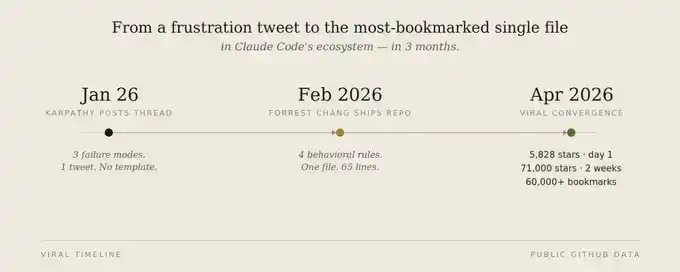
In late January 2026, Andrej Karpathy posted a tweet thread complaining about Claude's approach to writing code. He pointed out three typical problems: making incorrect assumptions without explanation, over-complicating things, and causing unintended damage to code that shouldn't have been touched.

Forrest Chang saw this tweet thread, distilled the complaints into 4 behavioral rules, wrote them into a separate CLAUDE.md file, and published it on GitHub. The project gained 5,828 stars on its first day, was bookmarked 60,000 times within two weeks, and now has 120,000 stars, becoming the fastest-growing single-file code repository of 2026.
Subsequently, I tested it with 30 codebases over 6 weeks.

These 4 rules are indeed effective. Errors that previously appeared with roughly a 40% probability dropped to below 3% for tasks where these rules were applicable. The problem is, this template was initially created to address errors Claude made when writing code in January.

By May 2026, the problems facing the Claude Code ecosystem had changed: Agents conflicting with each other, hook chain triggering, skill loading conflicts, and multi-step workflow disruptions across sessions.

So, I added 8 more rules. Below is the complete 12-rule version of CLAUDE.md: why each one is worth adding, and where the original Karpathy template will quietly fail in 4 specific areas.

If you want to skip the explanation and start using it directly, the complete file is at the end of the article.

Why This Matters

The CLAUDE.md file for Claude Code is the most underestimated file in the entire AI programming tech stack. Most developers typically make three kinds of mistakes:

First, treating it as a preference trash can, stuffing all their habits into it until it bloats to over 4000 tokens, with rule compliance dropping to 30%.

Second, not using it at all, re-prompting every time. This leads to 5x token waste and a lack of consistency between sessions.

Third, copying a template once and never updating it. It might work for two weeks, but as the codebase changes, it will fail without you even realizing it.

The Anthropic official documentation is clear: CLAUDE.md is essentially just advisory. Claude will follow it about 80% of the time. Once it exceeds 200 lines, compliance drops noticeably because important rules get drowned in noise.

Karpathy's template solves this: one file, 65 lines, 4 rules. This is the minimum baseline.

But the ceiling can be higher. Adding the following 8 rules means it covers not just the code-writing problems Karpathy complained about in January 2026, but also the Agent orchestration problems that emerged by May 2026—problems that didn't exist when the original template was written.

The Original 4 Rules

If you haven't seen Forrest Chang's repository, here's the basic version:

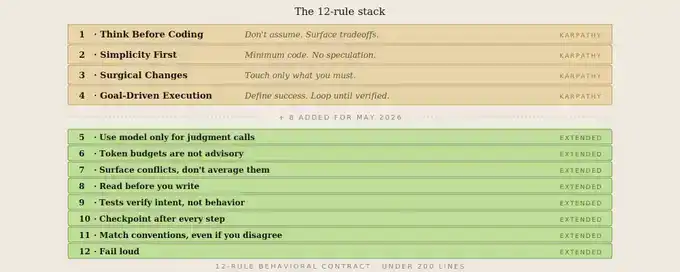
Rule 1: Think before you code.
Don't make silent assumptions. State your assumptions, expose trade-offs. Ask before guessing. Propose counterarguments when simpler alternatives exist.

Rule 2: Simple first.
Use the minimal code that solves the problem. Don't add imagined features. Don't design abstraction layers for one-off code. If a senior engineer would find it overcomplicated, simplify it.

Rule 3: Surgical changes.
Only modify what must be changed. Don't "optimize" adjacent code, comments, or formatting as a side effect. Don't refactor what isn't broken. Maintain consistency with the existing style.

Rule 4: Execute toward the goal.
Define success criteria first, then iterate in cycles until verification is complete. Don't tell Claude each step; tell it what the successful outcome should look like and let it iterate.

These 4 rules solve roughly 40% of the failure modes I've seen in unsupervised Claude Code sessions. The remaining 60% of problems lie in the gaps outlined below.
My 8 New Rules, and Why

Each rule comes from a real moment when Karpathy's original 4 rules were no longer sufficient. Below, I'll describe the scenario first, then give the corresponding rule.

Rule 5: Don't let the model do non-language work

Karpathy's rules didn't cover this. So the model started deciding issues that should have been handled by deterministic code: whether to retry an API call, how to route a message, when to escalate. The result was inconsistent decisions every week. You got an unstable, $0.003-per-token if-else statement.

The moment was this: There was code calling Claude to "decide whether to retry on a 503 error." It worked fine initially for two weeks, then suddenly became unstable because the model started treating the request body as part of the decision context. The retry strategy became random because the prompt itself was random.

Rule 6: Set a hard token budget, no exceptions

A CLAUDE.md without budget constraints is a blank check. Every loop can spiral out of control into a 50,000-token context dump. The model won't stop itself.

The moment was this: A debugging session lasted 90 minutes. The model kept iterating over the same 8KB error message, gradually forgetting which fixes it had already tried. In the end, it started proposing solutions I had rejected 40 messages earlier. With a token budget, this process should have been terminated at the 12-minute mark.

Rule 7: Expose conflicts, don't average them out

When two parts of a codebase contradict each other, Claude tries to please both sides, resulting in incoherent code.

The moment was this: A codebase had two error-handling patterns: one using async/await with explicit try/catch, another using a global error boundary. Claude wrote new code that used both. Errors got handled twice. It took me 30 minutes to figure out why errors were being swallowed two times over.

Rule 8: Read first, then write

Karpathy's "Surgical changes" tells Claude not to modify adjacent code. But it doesn't tell Claude to understand adjacent code first. Without this, Claude writes new code that conflicts with existing code 30 lines away.

The moment was this: Claude added a function right next to an existing function that did exactly the same thing, because it didn't read the original function first. Both functions performed the same task. But due to import order, the new function overrode the old one, which had been the de facto standard for 6 months.

Rule 9: Testing is not optional, but tests are not the goal

Karpathy's "Execute toward the goal" implies testing can be a success criterion. But in practice, Claude treats "tests pass" as the sole goal, writing code that passes shallow tests but breaks other things.

The moment was this: Claude wrote 12 tests for an authentication function; all passed. But the authentication logic broke in production. The tests were just verifying the function "returned something," not that it returned the correct thing. The function passed because it returned a constant.

Rule 10: Long-running operations need checkpoints

Karpathy's template assumes interaction is one-off. But real Claude Code work is often multi-step: refactoring across 20 files, building a feature in one session, debugging across multiple commits. Without checkpoints, one wrong step can lose all previous progress.

The moment was this: A 6-step refactoring task failed on step 4. By the time I noticed, Claude had already completed steps 5 and 6 on top of the erroneous state. Unraveling the fix took longer than redoing the entire task. With checkpoints, step 4 would have revealed the problem.

Rule 11: Conventions over novelty

In a codebase with established patterns, Claude loves to introduce its own style. Even if its way is "better," introducing a second pattern is worse than any single pattern.

The moment was this: Claude introduced hooks into a React codebase based on class components. It ran. But it also broke the codebase's existing testing patterns, which relied on componentDidMount. It took half a day to delete and rewrite it.

Rule 12: Fail loudly, not silently

Claude's most expensive failures are often the ones that look like successes. A function "runs" but returns wrong data; a migration "completes" but skips 30 records; a test "passes" but only because the assertion itself is wrong.

The moment was this: Claude said a database migration "completed successfully." In reality, it silently skipped 14% of records triggering constraint conflicts. The skipping was logged but not explicitly surfaced. Eleven days later, when report data started showing anomalies, we discovered the problem.

Data Results

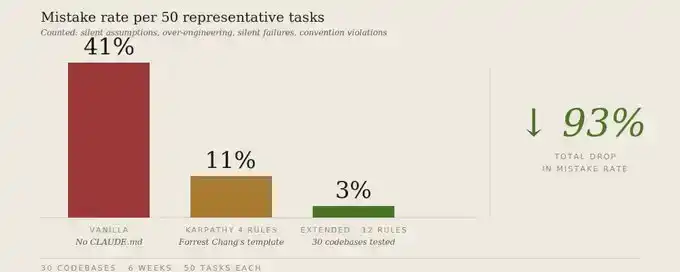
Over 6 weeks, I tracked the same set of 50 representative tasks across 30 codebases, testing three configurations.
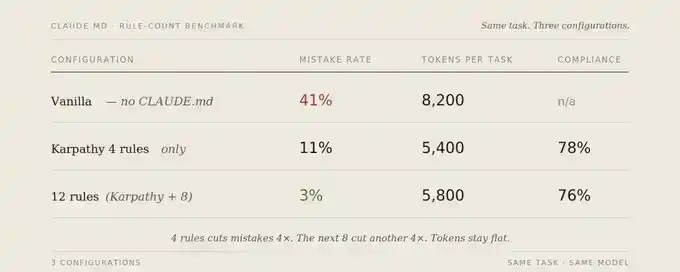
Error rate refers to: tasks needing correction or rewriting to match original intent. Counted errors include: silent erroneous assumptions, over-engineering, unintended damage, silent failures, convention violations, conflict averaging, missed checkpoints.

Compliance rate refers to: when a rule applies, how likely Claude is to explicitly apply it.

The truly interesting result isn't just the error rate dropping from 41% to 3%. More importantly, expanding from 4 to 12 rules barely increased compliance burden—compliance only dropped from 78% to 76%, but the error rate fell another 8 percentage points. The new rules cover failure modes the original 4 didn't handle; they aren't competing for the same attention budget.
Where the Karpathy Template Quietly Fails

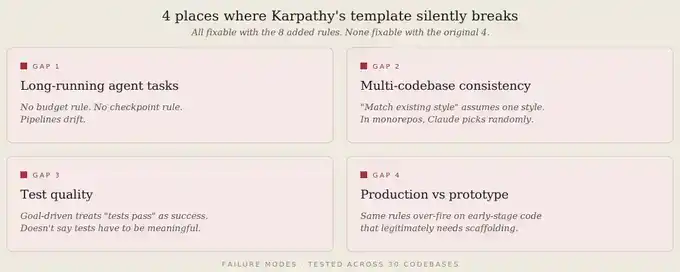
Even without new rules, the original 4-rule template is insufficient in at least 4 areas.

First, long-running Agent tasks.
Karpathy's rules mainly target the moment Claude is writing code. But what happens when Claude runs a multi-step pipeline? The original template has no budget rule, no checkpoint rule, no "fail loudly" rule. So the pipeline slowly drifts.

Second, multi-repository consistency.
"Match existing style" assumes only one style. But in a monorepo with 12 services, Claude must choose which style to match. The original rules don't tell it how. So it either picks randomly or averages several styles together.

Third, test quality.
"Execute toward the goal" treats "tests pass" as success, without stating tests must be meaningful. Result: Claude writes tests that verify almost nothing, but that make it overconfident.

Fourth, production vs. prototyping differences.
The same 4 rules that prevent production code from being over-engineered can also slow down prototyping. Because prototyping sometimes needs 100 lines of exploratory scaffolding to find direction first. Karpathy's "Simple first" triggers too easily for early-stage code.

These 8 new rules aren't meant to replace Karpathy's original 4, but to patch their gaps: the original template corresponds to the auto-completion-like coding scenario of January 2026; by May 2026, Claude Code has entered an Agent-driven, multi-step, multi-repository collaborative environment, and the problems faced are different.
What Didn't Work

Before finalizing these 12 rules, I tried other approaches.

Adding rules I saw on Reddit / X.
Most were either rephrasing Karpathy's original 4 rules or domain-specific rules that couldn't generalize, like "Always use Tailwind classes." I eventually removed them all.

More than 12 rules.
I tested up to 18. After 14, compliance dropped from 76% to 52%. The 200-line limit is real. Beyond that, Claude starts pattern-matching to "there are rules here" instead of reading each rule.

Rules dependent on specific tools.
For example, "Always use eslint." If eslint isn't installed in the project, the rule fails, silently. I later rephrased them to be tool-agnostic, e.g., changing "use eslint" to "follow styles already enforced in the codebase."

Putting examples in CLAUDE.md instead of rules.
Examples consume more context than rules. Three examples use roughly the same context as 10 rules, and Claude easily overfits to examples. Rules are abstract, examples are concrete. So, use rules.

"Be careful," "Think deeply," "Stay focused."
These are noise. Compliance for such instructions dropped to about 30% because they aren't verifiable. I replaced them with more specific imperative rules like "State assumptions explicitly."

Telling Claude to act like a "senior engineer."
This didn't work. Claude already thinks it's like a senior engineer. The real issue isn't whether it thinks so, but whether it executes like one. Imperative rules narrow this gap; identity prompts don't.

The Complete 12-Rule CLAUDE.md

Below is the complete version ready for copy-paste.

Temporarily unable to display this content outside of Lark Docs.

Save it as CLAUDE.md in your repository root. Below these 12 rules, add project-specific rules like tech stack, test commands, error patterns, etc. Keep the total under 200 lines; beyond that, rule compliance drops noticeably.

How to Install

Just two steps:

1. Append Karpathy's 4 basic rules to your existing CLAUDE.md
curl https://raw.githubusercontent.com/forrestchang/andrej-karpathy-skills/main/CLAUDE.md >> CLAUDE.md


2. Paste Rules 5–12 from this article below them

Save the file in the repository root. The >> is crucial—it appends to any existing CLAUDE.md instead of overwriting your project-specific rules.

Mental Model

CLAUDE.md isn't a wishlist; it's a behavioral contract to block specific failure patterns you've observed.

Each rule should answer one question: What error does it prevent?

Karpathy's 4 rules prevent the failure modes he saw in January 2026: silent assumptions, over-engineering, unintended damage, weak success criteria. They are the foundation; don't skip them.

My 8 new rules prevent the new failure modes emerging after May 2026: Agent loops without budget constraints, multi-step tasks without checkpoints, tests that seem to test but miss critical logic, and problems where silent failures are packaged as silent successes. They are incremental patches.

Of course, results vary. If you don't run multi-step pipelines, Rule 10 is less important. If your codebase has only one unified style enforced by linters, Rule 11 is redundant. After reading these 12, keep the rules that truly correspond to errors you've actually made; delete the rest.

A 6-rule CLAUDE.md tailored to your real failure patterns is better than a 12-rule version where 6 rules are never applicable.

Conclusion

Karpathy's tweet in January 2026 was essentially a complaint. Forrest Chang turned it into 4 rules. Ultimately, 120,000 developers starred the result. And most of them are still using only those 4 rules today.

The models have advanced, and the ecosystem has changed. Multi-step Agents, hook chains, skill loading, multi-repo collaboration—these didn't exist when Karpathy wrote that tweet. The original 4 rules don't solve these problems. They aren't wrong; they're incomplete.

Add 8 more rules. 6 weeks of testing across 30 codebases. Error rate drops from 41% to 3%.

Bookmark this article tonight and paste these 12 rules into your CLAUDE.md. If it saves you a week of Claude-related detours, feel free to share it.


Пов'язані питання

QWhat was the original 4-rule CLAUDE.md template created to solve, and how effective was it?

AThe original 4-rule CLAUDE.md template was created to solve the typical errors Andrej Karpathy complained about in January 2026 regarding Claude's coding behavior: silent assumptions, over-engineering, unintended collateral damage to unrelated code, and lack of clear success criteria. In tests, it reduced the error rate from around 40% to below 3% for tasks where these rules applied.

QWhat are two of the new problems that emerged in the Claude Code ecosystem by May 2026 that the original 4 rules didn't cover?

ABy May 2026, new failure modes included agents conflicting with each other, chain reactions from hooks, skill loading conflicts, and interruptions in multi-step, cross-session workflows. The original rules were insufficient for these issues related to agent orchestration and long-running tasks.

QAccording to the article, what are two common mistakes developers make when using a CLAUDE.md file?

ATwo common mistakes are: 1) Treating it as a preference dump, stuffing all personal habits into it until it bloats to over 4000 tokens, causing rule compliance to drop to 30%. 2) Not using it at all and re-prompting every time, which wastes 5x more tokens and lacks consistency across sessions.

QWhat does Rule 6 ('Set a hard token budget, no exceptions') aim to prevent, and what was the 'moment' that revealed its necessity?

ARule 6 aims to prevent uncontrolled, runaway iterative processes where a debugging session could spiral into a 50,000-token context dump without the model stopping itself. The revealing moment was a 90-minute debugging session where the model kept iterating over the same 8KB error message, forgetting previous fixes and eventually proposing solutions that had been rejected 40 messages earlier.

QWhy does the author advise against having more than 12-14 rules in a CLAUDE.md file, and what was the observed effect of exceeding this limit?

AThe author advises against having more than 12-14 rules because Anthropic's documentation states that compliance noticeably drops once the file exceeds 200 lines, as important rules get drowned out by noise. In tests, when the rule count exceeded 14, compliance rates dropped from 76% to 52%, as Claude started pattern-matching for 'rules are here' instead of reading each rule carefully.

Пов'язані матеріали

Торгівля

Спот
Ф'ючерси

Популярні статті

Що таке $S$

Розуміння SPERO: Комплексний огляд Вступ до SPERO Оскільки ландшафт інновацій продовжує еволюціонувати, виникнення технологій web3 та криптовалютних проектів відіграє ключову роль у формуванні цифрового майбутнього. Один з проектів, який привернув увагу в цій динамічній сфері, — це SPERO, позначений як SPERO,$$s$. Ця стаття має на меті зібрати та представити детальну інформацію про SPERO, щоб допомогти ентузіастам та інвесторам зрозуміти його основи, цілі та інновації в рамках web3 та крипто-сектору. Що таке SPERO,$$s$? SPERO,$$s$ — це унікальний проект у криптопросторі, який прагне використати принципи децентралізації та технології блокчейн для створення екосистеми, що сприяє залученню, корисності та фінансовій інклюзії. Проект розроблений для полегшення взаємодії між користувачами новими способами, надаючи їм інноваційні фінансові рішення та послуги. У своїй основі SPERO,$$s$ прагне надати можливості індивідам, забезпечуючи інструменти та платформи, які покращують користувацький досвід у криптовалютному просторі. Це включає в себе можливість більш гнучких методів транзакцій, сприяння ініціативам, що підтримуються спільнотою, та створення шляхів для фінансових можливостей через децентралізовані додатки (dApps). Основна концепція SPERO,$$s$ обертається навколо інклюзивності, прагнучи зменшити розриви в традиційній фінансовій системі, використовуючи переваги технології блокчейн. Хто є творцем SPERO,$$s$? Особистість творця SPERO,$$s$ залишається дещо невідомою, оскільки є обмежені публічно доступні ресурси, що надають детальну інформацію про його засновників. Ця відсутність прозорості може бути наслідком зобов'язання проекту до децентралізації — етики, яку багато проектів web3 поділяють, ставлячи колективні внески вище за індивідуальне визнання. Зосереджуючи обговорення навколо спільноти та її колективних цілей, SPERO,$$s$ втілює суть наділення без виділення конкретних осіб. Таким чином, розуміння етики та місії SPERO є більш важливим, ніж ідентифікація єдиного творця. Хто є інвесторами SPERO,$$s$? SPERO,$$s$ підтримується різноманітними інвесторами, починаючи від венчурних капіталістів до ангельських інвесторів, які прагнуть сприяти інноваціям у крипто-секторі. Зосередження цих інвесторів зазвичай узгоджується з місією SPERO — пріоритет надається проектам, які обіцяють технологічний прогрес у суспільстві, фінансову інклюзію та децентралізоване управління. Ці інвесторські фонди зазвичай зацікавлені в проектах, які не лише пропонують інноваційні продукти, але й позитивно впливають на спільноту блокчейн та її екосистеми. Підтримка з боку цих інвесторів підкріплює SPERO,$$s$ як значного конкурента в швидко змінюваній сфері крипто-проектів. Як працює SPERO,$$s$? SPERO,$$s$ використовує багатогранну структуру, яка відрізняє його від традиційних криптовалютних проектів. Ось деякі ключові особливості, які підкреслюють його унікальність та інноваційність: Децентралізоване управління: SPERO,$$s$ інтегрує моделі децентралізованого управління, надаючи користувачам можливість активно брати участь у процесах прийняття рішень щодо майбутнього проекту. Цей підхід сприяє відчуттю власності та відповідальності серед членів спільноти. Корисність токена: SPERO,$$s$ використовує свій власний криптовалютний токен, розроблений для виконання різних функцій в екосистемі. Ці токени дозволяють здійснювати транзакції, отримувати винагороди та полегшувати послуги, що пропонуються на платформі, підвищуючи загальну залученість та корисність. Шарова архітектура: Технічна архітектура SPERO,$$s$ підтримує модульність та масштабованість, що дозволяє безперешкодно інтегрувати додаткові функції та додатки в міру розвитку проекту. Ця адаптивність є надзвичайно важливою для збереження актуальності в постійно змінюваному крипто-ландшафті. Залучення спільноти: Проект підкреслює ініціативи, що підтримуються спільнотою, використовуючи механізми, які стимулюють співпрацю та зворотний зв'язок. Підтримуючи сильну спільноту, SPERO,$$s$ може краще задовольняти потреби користувачів та адаптуватися до ринкових тенденцій. Фокус на інклюзію: Пропонуючи низькі комісії за транзакції та зручні інтерфейси, SPERO,$$s$ прагне залучити різноманітну базу користувачів, включаючи осіб, які раніше не брали участі в крипто-просторі. Це зобов'язання до інклюзії узгоджується з його загальною місією наділення через доступність. Хронологія SPERO,$$s$ Розуміння історії проекту надає важливі уявлення про його розвиток та етапи. Нижче наведено пропоновану хронологію, що відображає значні події в еволюції SPERO,$$s$: Етап концептуалізації та ідеації: Початкові ідеї, що стали основою SPERO,$$s$, були сформовані, тісно пов'язані з принципами децентралізації та фокусом на спільноті в індустрії блокчейн. Запуск білого паперу проекту: Після концептуального етапу був випущений комплексний білий папір, що детально описує бачення, цілі та технологічну інфраструктуру SPERO,$$s$, щоб залучити інтерес та зворотний зв'язок від спільноти. Створення спільноти та ранні залучення: Активні зусилля були спрямовані на створення спільноти ранніх прихильників та потенційних інвесторів, що полегшило обговорення цілей проекту та отримання підтримки. Подія генерації токенів: SPERO,$$s$ провів подію генерації токенів (TGE) для розподілу своїх рідних токенів серед ранніх прихильників та встановлення початкової ліквідності в екосистемі. Запуск початкового dApp: Перший децентралізований додаток (dApp), пов'язаний з SPERO,$$s$, став доступним, дозволяючи користувачам взаємодіяти з основними функціями платформи. Постійний розвиток та партнерства: Безперервні оновлення та вдосконалення пропозицій проекту, включаючи стратегічні партнерства з іншими учасниками блокчейн-простору, сформували SPERO,$$s$ у конкурентоспроможного та еволюціонуючого гравця на крипто-ринку. Висновок SPERO,$$s$ є свідченням потенціалу web3 та криптовалют для революціонізації фінансових систем та наділення індивідів. Завдяки зобов'язанню до децентралізованого управління, залучення спільноти та інноваційно спроектованих функцій, він прокладає шлях до більш інклюзивного фінансового ландшафту. Як і з будь-якими інвестиціями в швидко змінюваному крипто-просторі, потенційним інвесторам та користувачам рекомендується ретельно досліджувати та обдумано взаємодіяти з поточними подіями в SPERO,$$s$. Проект демонструє інноваційний дух крипто-індустрії, запрошуючи до подальшого дослідження його численних можливостей. Хоча подорож SPERO,$$s$ ще триває, його основні принципи можуть справді вплинути на майбутнє того, як ми взаємодіємо з технологією, фінансами та один з одним у взаємопов'язаних цифрових екосистемах.

73 переглядів усьогоОпубліковано 2024.12.17Оновлено 2024.12.17

Що таке $S$

Що таке AGENT S

Агент S: Майбутнє автономної взаємодії в Web3 Вступ У постійно змінюваному ландшафті Web3 та криптовалюти інновації постійно переосмислюють, як люди взаємодіють з цифровими платформами. Один з таких новаторських проектів, Агент S, обіцяє революціонізувати взаємодію людини з комп'ютером через свою відкриту агентну структуру. Прокладаючи шлях для автономних взаємодій, Агент S прагне спростити складні завдання, пропонуючи трансформаційні застосування в штучному інтелекті (ШІ). Це детальне дослідження заглиблюється в складності проекту, його унікальні особливості та наслідки для сфери криптовалюти. Що таке Агент S? Агент S є революційною відкритою агентною структурою, спеціально розробленою для вирішення трьох основних викликів в автоматизації комп'ютерних завдань: Набуття специфічних знань у галузі: Структура інтелектуально навчається з різних зовнішніх джерел знань та внутрішнього досвіду. Цей подвійний підхід дозволяє їй створити багатий репозиторій специфічних знань у галузі, покращуючи її продуктивність у виконанні завдань. Планування на довгих горизонтах завдань: Агент S використовує планування з підкріпленням досвіду, стратегічний підхід, який полегшує ефективний розподіл та виконання складних завдань. Ця функція значно підвищує її здатність ефективно та результативно управляти кількома підзавданнями. Обробка динамічних, неоднорідних інтерфейсів: Проект представляє Інтерфейс Агент-Комп'ютер (ACI), інноваційне рішення, яке покращує взаємодію між агентами та користувачами. Використовуючи багатомодальні великі мовні моделі (MLLMs), Агент S може безперешкодно орієнтуватися та маніпулювати різноманітними графічними інтерфейсами користувача. Завдяки цим новаторським функціям Агент S надає надійну структуру, яка вирішує складнощі, пов'язані з автоматизацією людської взаємодії з машинами, прокладаючи шлях для численних застосувань у ШІ та за його межами. Хто є творцем Агент S? Хоча концепція Агент S є фундаментально новаторською, конкретна інформація про його творця залишається невідомою. Творець наразі невідомий, що підкреслює або початкову стадію проекту, або стратегічний вибір зберегти засновників у таємниці. Незважаючи на анонімність, акцент залишається на можливостях та потенціалі структури. Хто є інвесторами Агент S? Оскільки Агент S є відносно новим у криптографічній екосистемі, детальна інформація про його інвесторів та фінансових спонсорів не задокументована. Відсутність публічно доступних відомостей про інвестиційні фонди або організації, що підтримують проект, викликає питання щодо його фінансової структури та дорожньої карти розвитку. Розуміння підтримки є критично важливим для оцінки стійкості проекту та потенційного впливу на ринок. Як працює Агент S? В основі Агент S лежить передова технологія, яка дозволяє йому ефективно функціонувати в різних умовах. Його операційна модель побудована навколо кількох ключових функцій: Взаємодія з комп'ютером, подібна до людської: Структура пропонує розширене планування ШІ, прагнучи зробити взаємодії з комп'ютерами більш інтуїтивними. Імітуючи людську поведінку при виконанні завдань, вона обіцяє підвищити досвід користувачів. Наративна пам'ять: Використовується для використання високорівневого досвіду, Агент S використовує наративну пам'ять для відстеження історій завдань, тим самим покращуючи свої процеси прийняття рішень. Епізодична пам'ять: Ця функція надає користувачам покрокові інструкції, дозволяючи структурі пропонувати контекстуальну підтримку в міру виконання завдань. Підтримка OpenACI: Завдяки можливості працювати локально, Агент S дозволяє користувачам зберігати контроль над своїми взаємодіями та робочими процесами, узгоджуючи з децентралізованою етикою Web3. Легка інтеграція з зовнішніми API: Його універсальність і сумісність з різними платформами ШІ забезпечують те, що Агент S може безперешкодно вписатися в існуючі технологічні екосистеми, роблячи його привабливим вибором для розробників та організацій. Ці функціональні можливості колективно сприяють унікальному положенню Агент S у крипто-просторі, оскільки він автоматизує складні, багатоступеневі завдання з мінімальним втручанням людини. У міру розвитку проекту його потенційні застосування в Web3 можуть переосмислити, як відбуваються цифрові взаємодії. Хронологія Агент S Розробка та етапи Агент S можуть бути узагальнені в хронології, яка підкреслює його значні події: 27 вересня 2024 року: Концепція Агент S була представлена в комплексній науковій статті під назвою “Відкрита агентна структура, яка використовує комп'ютери як людина”, що демонструє основи проекту. 10 жовтня 2024 року: Наукова стаття була опублікована на arXiv, пропонуючи детальне дослідження структури та її оцінки продуктивності на основі бенчмарку OSWorld. 12 жовтня 2024 року: Було випущено відеопрезентацію, що надає візуальне уявлення про можливості та особливості Агент S, ще більше залучаючи потенційних користувачів та інвесторів. Ці маркери в хронології не лише ілюструють прогрес Агент S, але й вказують на його прихильність до прозорості та залучення громади. Ключові моменти про Агент S У міру розвитку структури Агент S кілька ключових характеристик виділяються, підкреслюючи її новаторський характер та потенціал: Інноваційна структура: Розроблена для забезпечення інтуїтивного використання комп'ютерів, подібного до людської взаємодії, Агент S пропонує новий підхід до автоматизації завдань. Автономна взаємодія: Здатність автономно взаємодіяти з комп'ютерами через GUI означає стрибок до більш інтелектуальних та ефективних обчислювальних рішень. Автоматизація складних завдань: Завдяки своїй надійній методології він може автоматизувати складні, багатоступеневі завдання, роблячи процеси швидшими та менш схильними до помилок. Безперервне вдосконалення: Механізми навчання дозволяють Агенту S покращуватися на основі минулого досвіду, постійно підвищуючи свою продуктивність та ефективність. Універсальність: Його адаптивність до різних операційних середовищ, таких як OSWorld та WindowsAgentArena, забезпечує його здатність служити широкому спектру застосувань. Оскільки Агент S займає своє місце в ландшафті Web3 та криптовалюти, його потенціал покращити можливості взаємодії та автоматизувати процеси означає значний прогрес у технологіях ШІ. Завдяки своїй інноваційній структурі Агент S є прикладом майбутнього цифрових взаємодій, обіцяючи більш безперешкодний та ефективний досвід для користувачів у різних галузях. Висновок Агент S представляє собою сміливий крок вперед у поєднанні ШІ та Web3, з можливістю переосмислити, як ми взаємодіємо з технологією. Хоча проект все ще на ранніх стадіях, можливості для його застосування є величезними та переконливими. Завдяки своїй комплексній структурі, що вирішує критичні виклики, Агент S прагне вивести автономні взаємодії на передній план цифрового досвіду. У міру того, як ми заглиблюємося в сфери криптовалюти та децентралізації, проекти, подібні до Агент S, безсумнівно, відіграватимуть ключову роль у формуванні майбутнього технологій та співпраці людини з комп'ютером.

629 переглядів усьогоОпубліковано 2025.01.14Оновлено 2025.01.14

Що таке AGENT S

Як купити S

Ласкаво просимо до HTX.com! Ми зробили покупку Sonic (S) простою та зручною. Дотримуйтесь нашої покрокової інструкції, щоб розпочати свою криптовалютну подорож.Крок 1: Створіть обліковий запис на HTXВикористовуйте свою електронну пошту або номер телефону, щоб зареєструвати обліковий запис на HTX безплатно. Пройдіть безпроблемну реєстрацію й отримайте доступ до всіх функцій.ЗареєструватисьКрок 2: Перейдіть до розділу Купити крипту і виберіть спосіб оплатиКредитна/дебетова картка: використовуйте вашу картку Visa або Mastercard, щоб миттєво купити Sonic (S).Баланс: використовуйте кошти з балансу вашого рахунку HTX для безперешкодної торгівлі.Треті особи: ми додали популярні способи оплати, такі як Google Pay та Apple Pay, щоб підвищити зручність.P2P: Торгуйте безпосередньо з іншими користувачами на HTX.Позабіржова торгівля (OTC): ми пропонуємо індивідуальні послуги та конкурентні обмінні курси для трейдерів.Крок 3: Зберігайте свої Sonic (S)Після придбання Sonic (S) збережіть його у своєму обліковому записі на HTX. Крім того, ви можете відправити його в інше місце за допомогою блокчейн-переказу або використовувати його для торгівлі іншими криптовалютами.Крок 4: Торгівля Sonic (S)Легко торгуйте Sonic (S) на спотовому ринку HTX. Просто увійдіть до свого облікового запису, виберіть торгову пару, укладайте угоди та спостерігайте за ними в режимі реального часу. Ми пропонуємо зручний досвід як для початківців, так і для досвідчених трейдерів.

1.4k переглядів усьогоОпубліковано 2025.01.15Оновлено 2025.03.21

Як купити S

Обговорення

Ласкаво просимо до спільноти HTX. Тут ви можете бути в курсі останніх подій розвитку платформи та отримати доступ до професійної ринкової інформації. Нижче представлені думки користувачів щодо ціни S (S).

活动图片