After 50x Storage Surge, Justin Sun Always Looks to the Next Decade

marsbitPublicado em 2026-05-11Última atualização em 2026-05-11

Resumo

Sun Yuchen, known for his controversial stunts like a $30 million lunch with Warren Buffett (canceled due to a kidney stone) and eating a $6.2 million duct-taped banana, is often overshadowed by a significant fact: his decade-long track record of spotting major investment trends. In 2016, he famously advised young people to invest in Bitcoin, Nvidia, Tesla, and Tencent instead of buying property. A hypothetical $20,000 investment in Nvidia and Tesla from that list would now be worth over 50 million RMB. His latest major call was on November 6, 2025, predicting a "50x storage opportunity" tied to the AI boom, which materialized with Sandisk's stock surging nearly 50-fold by 2026. Looking ahead, Sun now focuses on the next frontier: Physical AI. He identifies four key areas: 1. **Embodied AI/Robotics**: He sees this reaching its "iPhone moment," with companies like UBTech and Galaxy General leading in commercialization. 2. **Drones**: Viewed as the first commercially viable form of Physical AI, revolutionizing sectors from warfare (e.g., AeroVironment's Switchblade) to logistics. 3. **Spatial Computing**: Beyond VR, it's about AI understanding physical space, a foundational technology for robotics and autonomous systems, exemplified by Apple's Vision Pro. 4. **Space Exploration**: After a 2025 suborbital flight with Blue Origin, Sun advocates for space as the ultimate frontier, discussing blockchain's potential role in space asset management and data transactions. His in...

Most people in China know Justin Sun from his bizarre stories.

Spending 30 million to have dinner with Warren Buffett, only to cancel at the last minute due to a kidney stone; buying a duct-taped banana for 6.2 million dollars at an auction and eating it in front of everyone at a press conference; investing 75 million dollars to become the largest backer of the Trump family's crypto project, securing a seat at a White House dinner; and at the age of 35, flying past the Kármán line, declaring himself the youngest Chinese commercial astronaut.

There are also many negatives. In 2023, he was sued by the SEC for market manipulation, with accusations including over 600,000 wash trades to inflate the price of TRX and hiring celebrities for promotion without disclosing payments. Currently, he is in a lawsuit with the Trump family-related project WLFI.

These stories spread so widely that they almost overshadowed a serious matter. This man, over the past decade in the secondary capital markets, has almost never missed betting on any trend.

From buying BTC starting in late 2013, to 2016, advising post-90s generations not to buy houses, but to buy:

Bitcoin, NVIDIA, Tesla, Tencent.

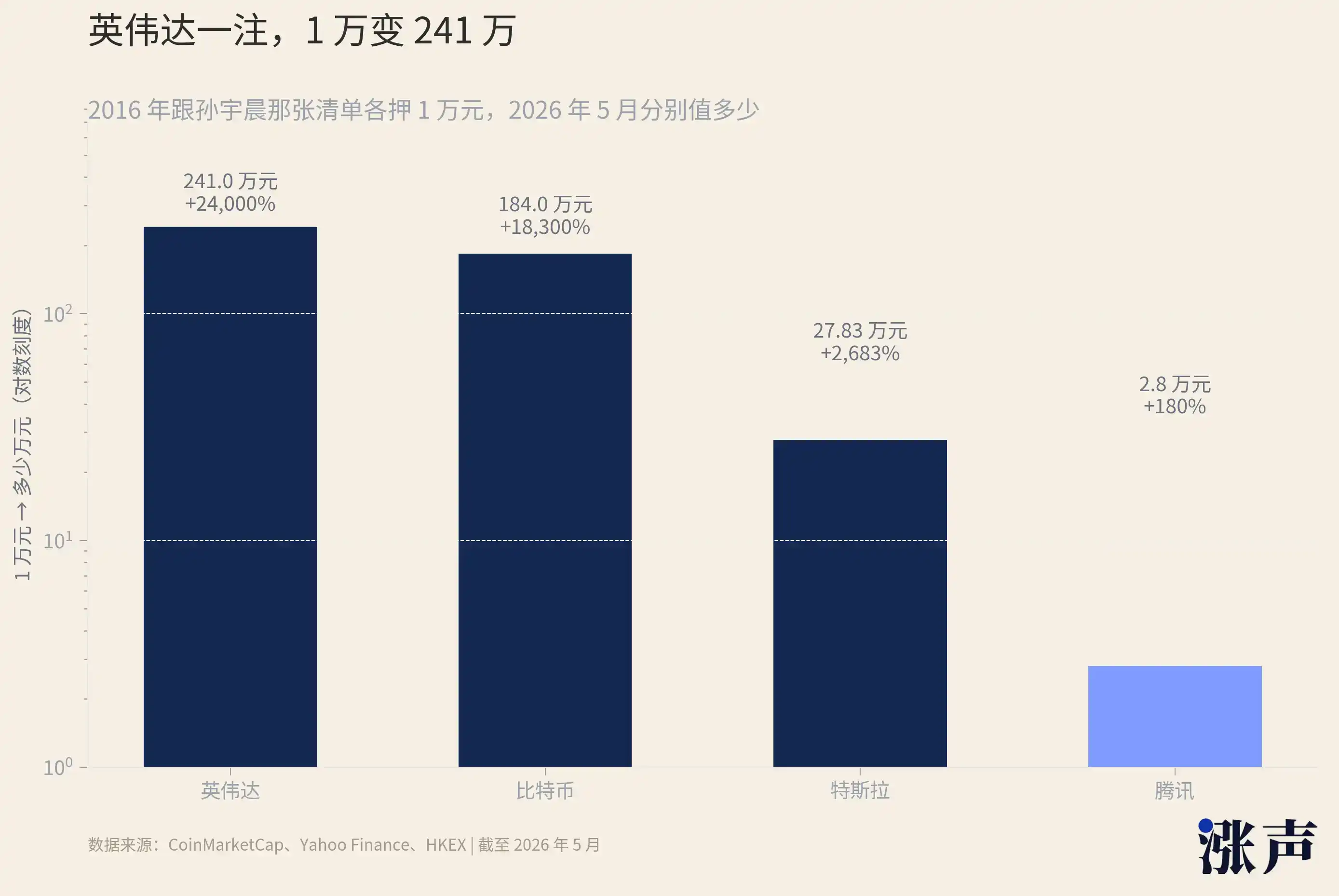
Ten years have passed. As of May 2026, Tesla's total return is approximately 2683%, and NVIDIA's total return is nearly 24000%.

If you had listened to Brother Sun back then and invested 10,000 yuan in NVIDIA, it would be 2.4 million today; 10,000 yuan in Tesla would be 278,000 today. A listener who bet 200,000 yuan on each item on that list in 2016 would have seen just the NVIDIA bet turn into approximately 48 million, and the Tesla bet into approximately 5.4 million, totaling over 53 million.
And this man continues to take shots today. On November 6, 2025, Justin Sun dropped a statement:

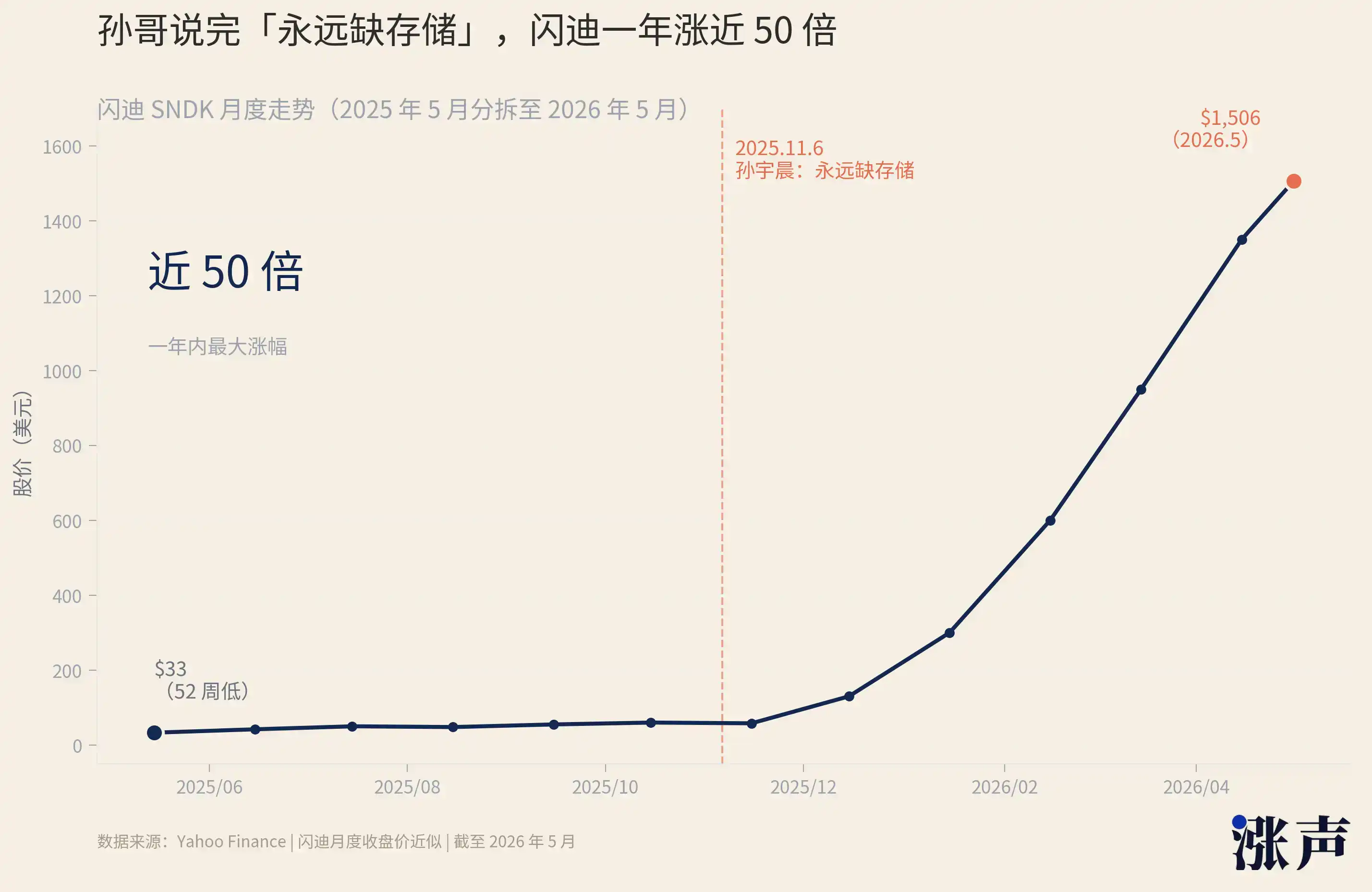
The capital market's reaction to this statement didn't reach fever pitch until 2026. SanDisk (SNDK), spun off from Western Digital, rose from a low of around $35 to $1,439 in a year, a maximum increase of nearly 50 times.
HBM memory capacity from Samsung, SK Hynix, and Micron was fully booked for 2026, already sold out, with orders scheduled through 2027-2028.

While everyone is still chasing the memory concept frenzy, in early 2026, Justin Sun changed his tune again in a video.

That video was originally about the outlook for 2026. Besides topics leaning towards wellness like putting health on the new year's list, he dedicated a segment to advise young people: embodied AI, drones, spatial computing, space exploration.

The author collected Justin Sun's public statements over the past two years regarding these four directions. Stringing them together, preliminary capital leaders have also emerged on each path.

Who Is the Next Storage Stock?

The first area Justin Sun pointed to was embodied AI.

The concept of robots has been discussed by humans for at least a hundred years. The Czech playwright Čapek coined the word "Robot" in 1920; industrial robotic arms have been used since the 1980s; Honda's ASIMO could climb stairs over twenty years ago. But the real bottleneck has always been the brain.

In the last two years, the entire industry has shifted towards VLA models—Vision-Language-Action. In plain terms, robots used to act based on code; now robots are starting to act based on seeing the world.

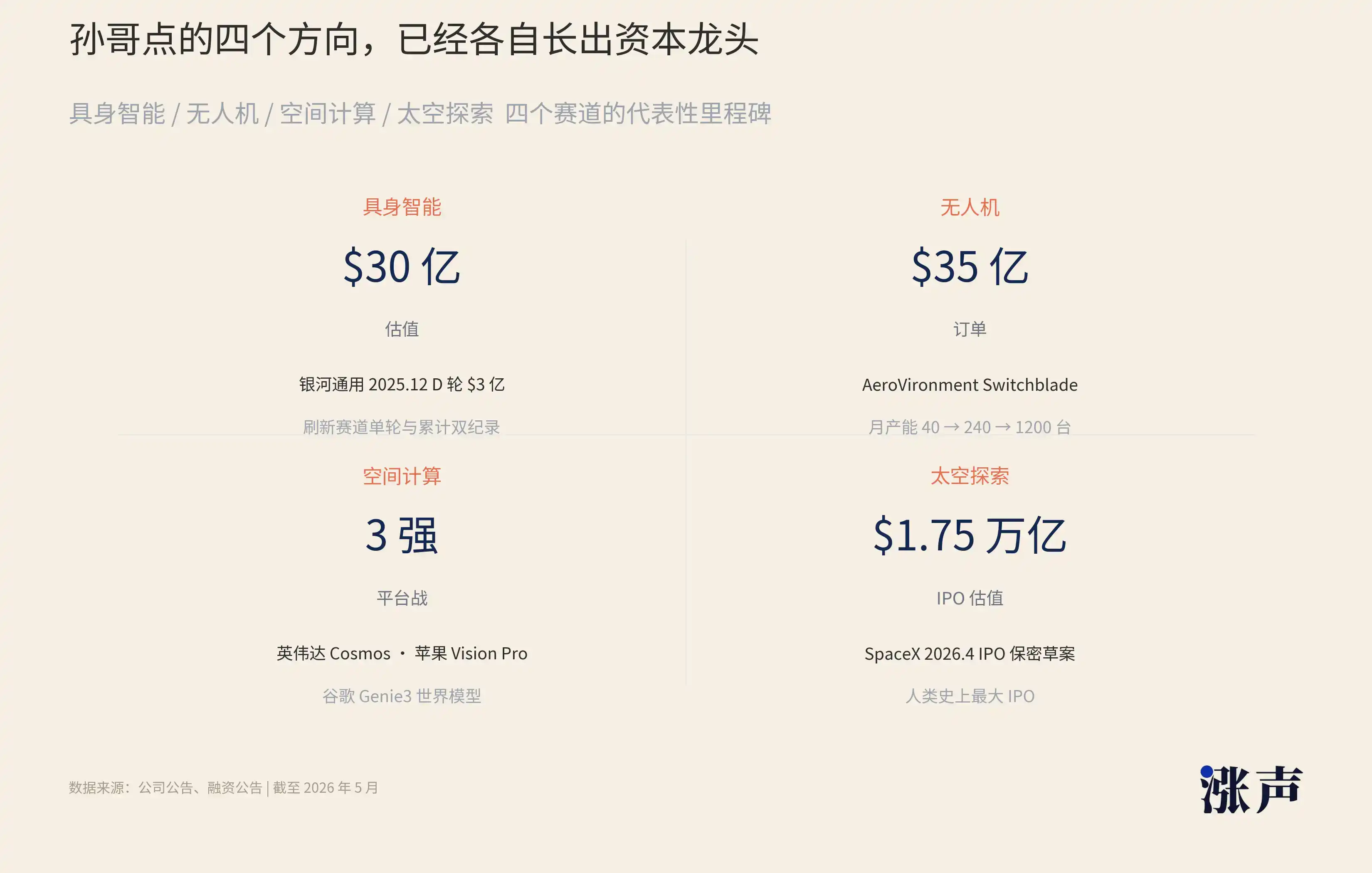
Unitree shipped over 5,500 humanoid robots in 2025, ranking first globally, and applied for a Science and Technology Innovation Board IPO in March 2026. Galaxy General raised a new round of $300 million (approx. 2.1 billion RMB) in December 2025, with cumulative funding of about $800 million and a valuation of $3 billion (approx. 21.1 billion RMB), setting new records for both single-round and total funding in the embodied AI sector.

Justin Sun said he likely won't personally venture into building robots, but he has a nose for narratives and the direction of capital flow. He said in a Bloomberg interview, "In a market where 99% of people don't know what a wallet is, the cost of education must be factored into the business model."

This statement, used to explain stablecoins in 2018, applies equally well in 2026. 99% of Chinese haven't used an embodied AI robot yet, but as long as that robot can cook, move boxes, or care for the elderly, the remaining 1% is the next opportunity.

The second sector he pointed to is drones.

While humanoid robots are still ramping up production, drones have already taken a step ahead into commercial deployment. They are naturally suited for what AI does best, from autonomous navigation to swarm coordination to data collection. They don't need to walk; flying is simpler than bipedal locomotion.

On the Russia-Ukraine battlefield, AI drone swarms have already taken over a large part of the role of tank units; Ukraine's annual drone production target has climbed to several million units. Over rice fields in rural China, DJI's agricultural drones fly, one replacing ten farm workers. In Shenzhen, Meituan has operationalized drone delivery, with order-to-delivery times not exceeding 15 minutes.

Drones are ahead of humanoid robots. They are the first form where AI has achieved a commercial closed-loop in the physical world.

The third area Justin Sun mentioned is spatial computing. This is the least mainstream among the directions he pointed out.

When Apple released the Vision Pro in 2024, most people saw it as a VR headset that cost several times more. This might be a misreading.

The Vision Pro's ambition has little to do with VR. It's Apple's first attempt to make AI understand space—how big your living room is, how far the table is from you, whether the coffee cup is to the left or right of the sofa, if you can reach it when you stretch your hand. This sounds simple but is ten times harder than training ChatGPT. Large language models only need to understand language; spatial computing needs to understand physics.

This is precisely the common prerequisite for robots, drones, and autonomous driving—they all require a form of spatial intelligence. NVIDIA's Cosmos platform, Google's Genie 3 world model, Tesla's FSD, are all doing the same thing: transitioning AI from understanding text to understanding the world.

ChatGPT only needs to understand language, but the next generation of AI needs to understand the world itself.

For the first three sectors, Justin Sun only verbally pointed them out. When it comes to space, he actually went there in person.

On August 3, 2025, he boarded Blue Origin's "New Shepard" NS-34 capsule and flew past the Kármán line.

After returning to Earth, he expressed an ambition: to make his company not just a "cryptocurrency exchange" but a "service provider for space economy infrastructure," using blockchain to solve space asset ownership, satellite data trading, and interplanetary payments. It sounds like science fiction. But look back at how he evangelized USDT ten years ago—people thought that was science fiction too back then.
Back on Earth, his message to young people was more direct: "Space exploration is a common mission for all humanity. I hope this flight inspires more young people to devote themselves to technology and innovation, collectively shaping humanity's interstellar future."

Brother Sun's Investment Logic

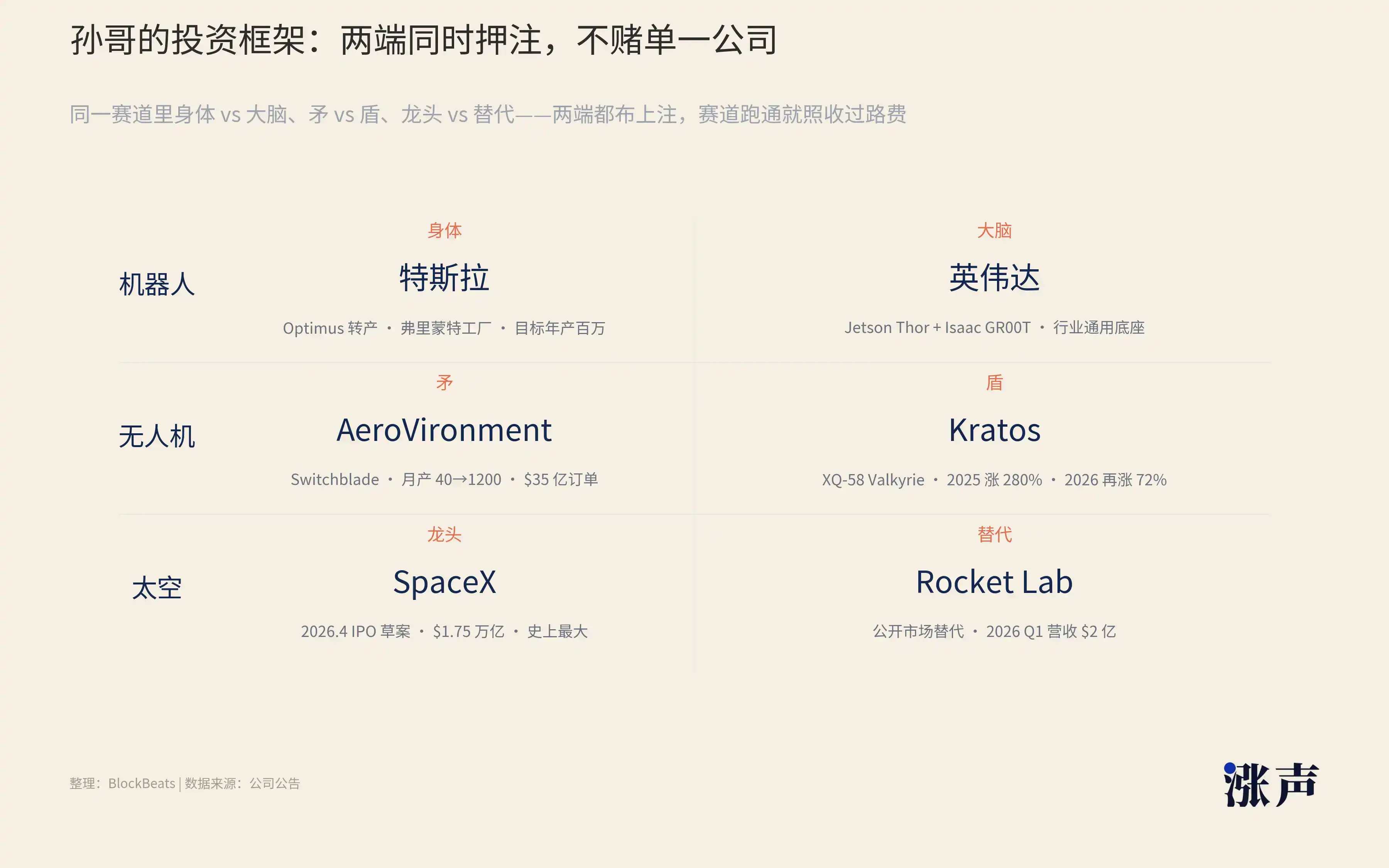
Justin Sun's publicly expressed investment logic is: find sectors with a clear direction, place bets on both ends, and do not gamble on the execution of a single company.

On the robotics line, his framework is to bet separately on the body and the brain.

Bet on Tesla for the body. In early 2026, Tesla announced discontinuing Model S and Model X, converting the Fremont factory into an Optimus production line, targeting an annual output of one million units with a mass-production unit price of about $20,000 to $25,000; current version Optimus robots are already handling parts transport and sorting at Austin and Fremont factories; the Gen 3 production line is scheduled to start in summer 2026.

Bet on NVIDIA for the brain. Jetson Thor puts server-grade AI inference into the robot body, Isaac GR00T has almost become the industry's common base, and Jensen Huang declared at GTC that there will be 1 billion humanoid robots globally by 2035.

Whether Optimus delivers on schedule is Elon Musk's problem, not NVIDIA's. As long as the sector takes off, the toll will be collected.

On the drone line, the core judgment is the irreversibility of Physical AI in military scenarios.

AeroVironment's Switchblade loitering munition became an iconic weapon in Ukraine, with monthly production capacity increased from 40 to 500 units, targeting 1,200 units; a $3.9 billion order locks in revenue for the next three years in advance. Kratos' XQ-58 Valkyrie is the "loyal wingman" to the F-35—manned aircraft on missions, drones on the flanks—with a unit price less than a fraction of a fifth-generation fighter jet, rising 280% in 2025 and another 72% in 2026.

One makes tanks uneconomical, the other makes manned fighter jets redundant—the logic on both ends is complementary.
On the space line, Justin Sun bid $28 million for a Blue Origin flight seat in 2021. This money was donated to the Blue Origin STEM charity fund, distributed among 19 non-profit organizations. On August 3, 2025, he boarded the New Shepard NS-34 mission, completing a suborbital flight.

In public markets, SpaceX filed a confidential IPO draft with the SEC in April 2026, targeting a valuation of $1.75 trillion, poised to become the largest IPO in human history; Rocket Lab's Q1 2026 revenue exceeded $200 million, making it the most direct alternative investment when SpaceX isn't available.

Once SpaceX goes public, the entire space sector's valuation framework will be rewritten.

Listen to Brother Sun

Stringing together Justin Sun's statements over the past two years, "AI, robotics, and blockchain have reached their iPhone moment" is his judgment on embodied AI. "Robot armies, robot police" is his prophecy for autonomous weaponized AI. "The integration of AI, robotics, and spatial computing" is his bet on the next generation of human-machine interfaces. "Earth is too small; it's our home" is his perspective shift after flying past the Kármán line.

These four things pieced together form the complete picture of Physical AI.

Over the past two decades, the internet changed the way information flows. WeChat replaced letters, Taobao replaced markets, Douyin replaced TV.

But the underlying rules of the physical world didn't change. Workers are still workers, factories are still factories.

In the next two decades, AI might change the very way the real world operates. Factories will have tireless humanoid robots, roads will have autonomous vehicle traffic, battlefields will roar with drone swarms, and the first "residents" on the Moon and Mars are likely to be pioneering AI robots.

That young man who in 2016 told everyone not to buy houses has now flown past the Kármán line.

And most of us are probably still waiting for the next Yanjiao.

Perguntas relacionadas

QWhat is the core of Sun Yuchen's investment philosophy as presented in the article?

ASun Yuchen's core investment philosophy, as presented, is to identify long-term, trend-based themes with high potential for change, and then invest in multiple key players across that entire value chain rather than betting on a single company. His approach focuses on the structural change of an industry.

QWhich sectors or technologies does Sun Yuchen point to as the next big opportunities after the success in the storage sector?

ASun Yuchen points to four key areas as the next big opportunities: Embodied AI/Robotics, AI Drones, Spatial Computing (the AI-powered understanding of physical space), and Space Exploration. He sees these as the frontiers where AI will begin to materially alter the physical world.

QHow does Sun Yuchen's investment strategy in the robotics sector exemplify his broader logic?

AIn the robotics sector, his strategy is to invest in both the 'body' and the 'brain' separately. He cites Tesla (Optimus) as a bet on the physical robot platform (the body) and Nvidia (Jetson Thor, Isaac platform) as a bet on the AI intelligence and operating system (the brain). This way, he benefits from the growth of the overall sector regardless of which specific company executes best.

QAccording to the article, what is the author's perspective on the historical impact of AI and its future potential?

AThe author argues that the internet and AI have so far primarily changed information flow and digital services. The future potential lies in AI fundamentally altering the operation of the physical world itself—through robots in factories, autonomous vehicles, drone swarms, and even AI/robotics pioneers in space—representing a much deeper transformation of reality.

QWhat is the significance of Sun Yuchen's space flight in the context of his overall vision?

AHis space flight on Blue Origin's New Shepard is symbolic of his shift towards a long-term, frontier-oriented vision. It represents his ambition to move beyond cryptocurrency into 'space economy infrastructure' and serves as a personal statement to inspire younger generations to engage with transformative, long-horizon technologies like space exploration.

Leituras Relacionadas

a16z: How Should Crypto Entrepreneurs Understand the CLARITY Act?

a16z: How Crypto Entrepreneurs Should Understand the CLARITY Act? The U.S. Senate Banking Committee's bipartisan vote to advance crypto market structure legislation, specifically the Digital Asset Market CLARITY Act, marks a historic moment for the industry. For a decade, a lack of clear U.S. regulation has stifled innovation, created consumer risks, and pushed development overseas. CLARITY aims to end this by establishing clear rules for blockchain networks and digital assets, similar to how the 1933 Securities Act shaped capital formation. The current regulatory patchwork has failed, causing legal confusion and enabling bad actors while hindering responsible builders. CLARITY provides a path forward by clarifying the regulatory roles of the SEC and CFTC, defining whether digital assets are securities or commodities, and establishing oversight for crypto exchanges and consumer protections. Crucially, CLARITY recognizes that blockchain networks are fundamentally different from traditional companies. Networks operate through shared rules and decentralized coordination, not centralized control. Applying corporate frameworks distorts them, leading to value extraction by intermediaries. Blockchain enables truly decentralized networks where value can be distributed to participants. CLARITY is designed to make this viable under U.S. law, allowing builders to operate transparently, raise capital domestically, and focus on long-term innovation without structural compromises due to regulatory ambiguity. The bill's progression follows earlier House efforts like FIT21 and the House CLARITY Act, which received strong bipartisan support. If passed, CLARITY could unlock significant innovation within the U.S., similar to the growth seen after the GENIUS Act for stablecoins, helping the U.S. lead in the digital economy while better combating fraud and abuse.

marsbitHá 19m

a16z: How Should Crypto Entrepreneurs Understand the CLARITY Act?

marsbitHá 19m

AI Benefits Senior Staff? 40% of CEOs Plan to Cut Junior Positions, Young People's Jobs Are More at Risk

The traditional assumption that senior employees are first in line during layoffs is being inverted in the AI era. A survey of 415 CEOs by Oliver Wyman and the NYSE reveals 43% plan to cut entry-level positions in the next 1-2 years to shift towards a mid-to-senior talent structure, a sharp rise from 17% last year. The logic is that AI excels at automating routine, cognitive tasks typically handled by junior staff (e.g., coding, data review), while the experience and judgment of senior employees remain harder to replicate. Research indicates this shift primarily manifests as a hiring freeze for junior roles rather than mass layoffs. Goldman Sachs estimates AI currently nets a loss of about 16,000 US jobs monthly, disproportionately impacting Generation Z concentrated in highly automatable white-collar roles. This raises long-term concerns about a broken talent pipeline, as companies risk having no future senior managers trained internally. Despite the dominant trend, a minority of successful AI adopters, like IBM and Salesforce, are expanding junior hiring, arguing these employees are adept at using and building AI tools. However, most companies are still in early AI deployment phases, with 67% in planning/pilot stages and many reporting returns below expectations. The overarching reality is a weakening of job security across all levels, as organizations reshape for an AI-augmented, leaner future.

marsbitHá 1h

AI Benefits Senior Staff? 40% of CEOs Plan to Cut Junior Positions, Young People's Jobs Are More at Risk

marsbitHá 1h

Physical AI is Hot, Some New Thoughts from Me

The term "Physical AI" is gaining significant traction, marking a shift from AI that processes information to AI that understands and interacts with the physical world. Unlike traditional AI confined to screens, Physical AI involves integrating intelligence into robotic bodies to perform tasks in environments governed by gravity, friction, and inertia. The concept, formally defined in a 2020 paper, focuses on creating embodied systems that can complete perception-to-action cycles. 2026 is identified as a pivotal "deployment year," where the focus moves from demonstrations to practical utility. Companies like China's Zhiyuan Robotics have transitioned to live, unscripted factory deployments and announced mass production targets. Internationally, Figure AI, after a major funding round, shifted to its own neural system, while NVIDIA partnered with major industrial robot firms to upgrade millions of existing units with AI capabilities. A key trend is the crossover from the automotive supply chain. Companies like Aptiv and Valeo are entering the Physical AI space, leveraging their expertise in sensors, control systems, and mass production from the autonomous vehicle sector. This "technology spillover" is accelerating development, as seen with Tesla's plans to repurpose automotive production lines for its Optimus robot. The technical breakthrough enabling this progress is the engineering maturity of "world models." Previously theoretical, these AI models can now simulate physical interactions and generate vast, realistic synthetic training data for robots. Innovations from NVIDIA's Cosmos, Ant's LingBot-World, and others have made this capability more accessible, drastically reducing the cost and time needed for real-world data collection. This is driving a fundamental architectural shift in robotics: from the traditional "sense-plan-act" model, reliant on pre-programmed rules, to a "sense-reason-act" paradigm where neural networks reason and make decisions. This change represents a new paradigm where machines understand the world's physics. The competition is intense, with the landscape still forming. While the direction is clear, success will depend not just on AI algorithms but on manufacturing scalability, supply chain resilience, and efficient data strategies, with infrastructure providers potentially capturing significant value in this new era.

marsbitHá 1h

Physical AI is Hot, Some New Thoughts from Me

marsbitHá 1h

Trading

Spot
Futuros

Artigos em Destaque

Como comprar SUN

Bem-vindo à HTX.com!Tornámos a compra de SUN (SUN) simples e conveniente.Segue o nosso guia passo a passo para iniciar a tua jornada no mundo das criptos.Passo 1: cria a tua conta HTXUtiliza o teu e-mail ou número de telefone para te inscreveres numa conta gratuita na HTX.Desfruta de um processo de inscrição sem complicações e desbloqueia todas as funcionalidades.Obter a minha contaPasso 2: vai para Comprar Cripto e escolhe o teu método de pagamentoCartão de crédito/débito: usa o teu visa ou mastercard para comprar SUN (SUN) instantaneamente.Saldo: usa os fundos da tua conta HTX para transacionar sem problemas.Terceiros: adicionamos métodos de pagamento populares, como Google Pay e Apple Pay, para aumentar a conveniência.P2P: transaciona diretamente com outros utilizadores na HTX.Mercado de balcão (OTC): oferecemos serviços personalizados e taxas de câmbio competitivas para os traders.Passo 3: armazena teu SUN (SUN)Depois de comprar o teu SUN (SUN), armazena-o na tua conta HTX.Alternativamente, podes enviá-lo para outro lugar através de transferência blockchain ou usá-lo para transacionar outras criptomoedas.Passo 4: transaciona SUN (SUN)Transaciona facilmente SUN (SUN) no mercado à vista da HTX.Acede simplesmente à tua conta, seleciona o teu par de trading, executa as tuas transações e monitoriza em tempo real.Oferecemos uma experiência de fácil utilização tanto para principiantes como para traders experientes.

534 Visualizações TotaisPublicado em {updateTime}Atualizado em 2025.03.21

Como comprar SUN

Discussões

Bem-vindo à Comunidade HTX. Aqui, pode manter-se informado sobre os mais recentes desenvolvimentos da plataforma e obter acesso a análises profissionais de mercado. As opiniões dos utilizadores sobre o preço de SUN (SUN) são apresentadas abaixo.

活动图片