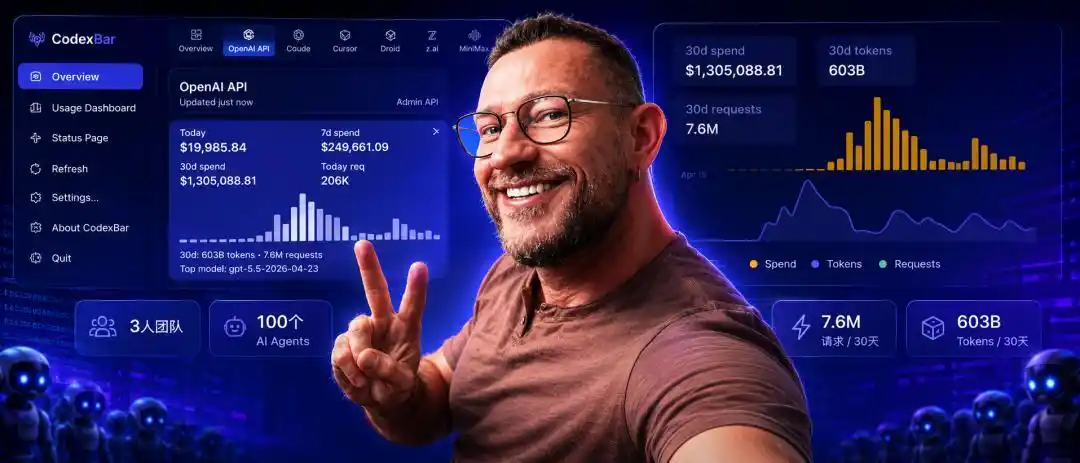
3 People with 100 AI Programmers, Burning Through $1.3 Million a Month! OpenAI: I'll Foot the Bill

marsbitPublished on 2026-05-17Last updated on 2026-05-17

Abstract

In a striking demonstration of AI-powered development, Peter Steinberger (creator of OpenClaw) shared that his three-person team spent $1.3 million in one month to run approximately 100 AI agents (primarily Codex instances). OpenAI covered the cost. The expenditure consumed 6.03 trillion tokens across 7.6 million requests. Steinberger argues that, with "fast mode" disabled, the cost falls below that of a single engineer while providing significantly greater output. This "cloud programmer army" handles core but tedious software engineering tasks: reviewing pull requests, finding security vulnerabilities, deduplicating issues, fixing bugs, monitoring benchmarks, and even generating PRs after meetings. This shifts AI's role from merely writing code to maintaining the entire collaborative fabric of a project. Steinberger's tool, CodexBar (a macOS menu bar app), tracks usage and costs across various AI coding services, highlighting how token consumption is becoming a key metric—a new "means of production." The experiment poses a profound question: if token cost ceases to be a barrier, how will software development transform? As model prices fall, the capability for small teams to leverage large numbers of AI agents could become commonplace, fundamentally altering the scale and speed of development. The future, Steinberger suggests, is arriving rapidly.

Peter Steinberger

Editor: Solomon

[New Zhiyuan Report] 3 people, 100 AI agents, burning through $1.3 million a month — The father of OpenClaw has turned software development into an "AI assembly line," with OpenAI picking up the tab.

While others show off their pay stubs, he shows off the bill — $1.3 million a month!

That's nearly 9 million RMB per month. It's left netizens utterly dumbfounded.

OpenClaw father Peter Steinberger casually posted a screenshot on X.
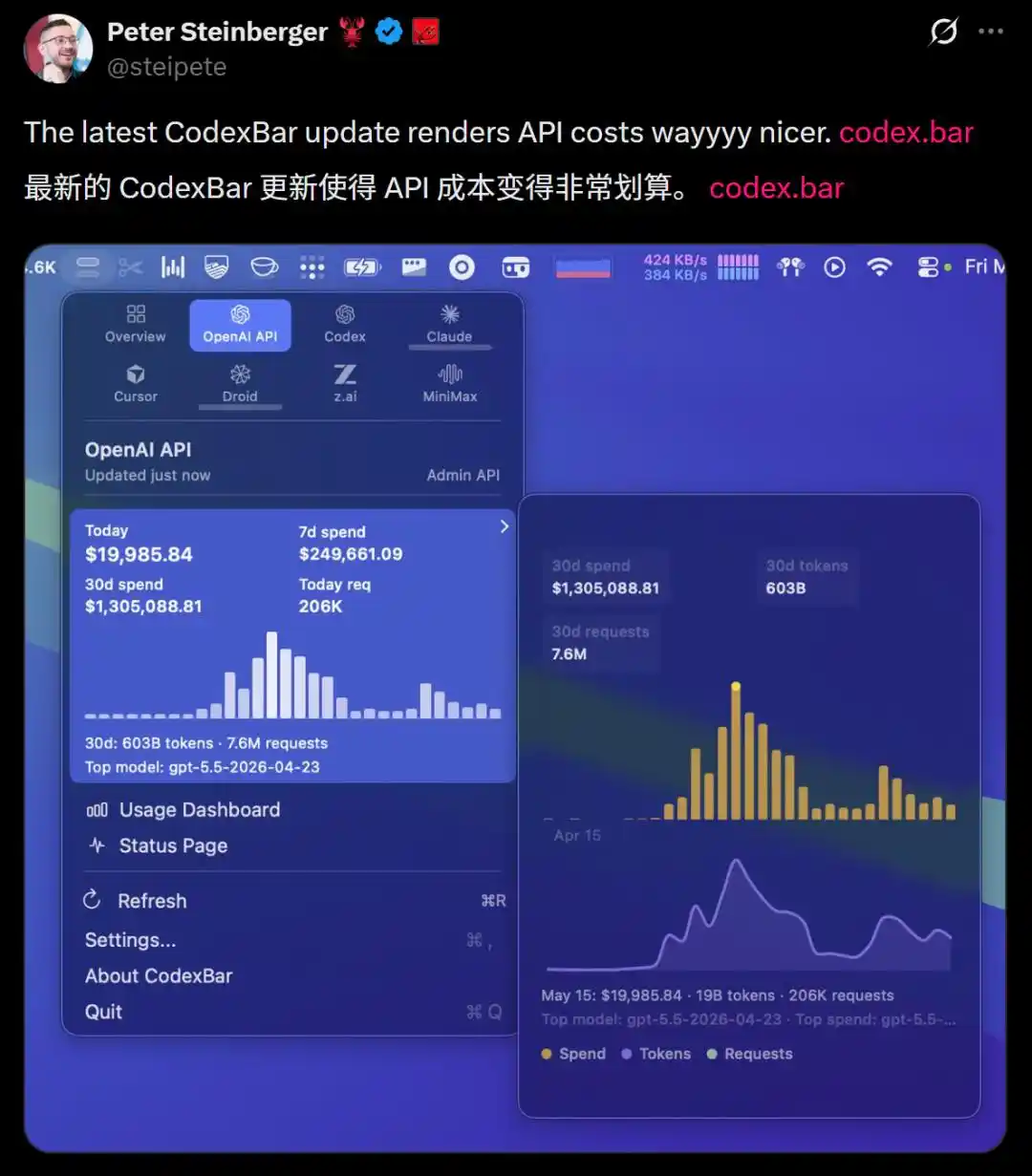
Peter Steinberger

But the numbers on the screenshot were anything but casual:

30-day spend: $1,305,088.81. Consumed 603 billion tokens. Made 7.6 million requests.

You read that right, 1.3 million U.S. dollars. And it's not a quarterly AI budget for some big tech company — it's the monthly usage of a three-person team.

Even more explosive: OpenAI is reimbursing this cost.

The comment section instantly went wild.

Some were amazed, some skeptical, some whipped out their calculators to figure out "how many programmers this equals."

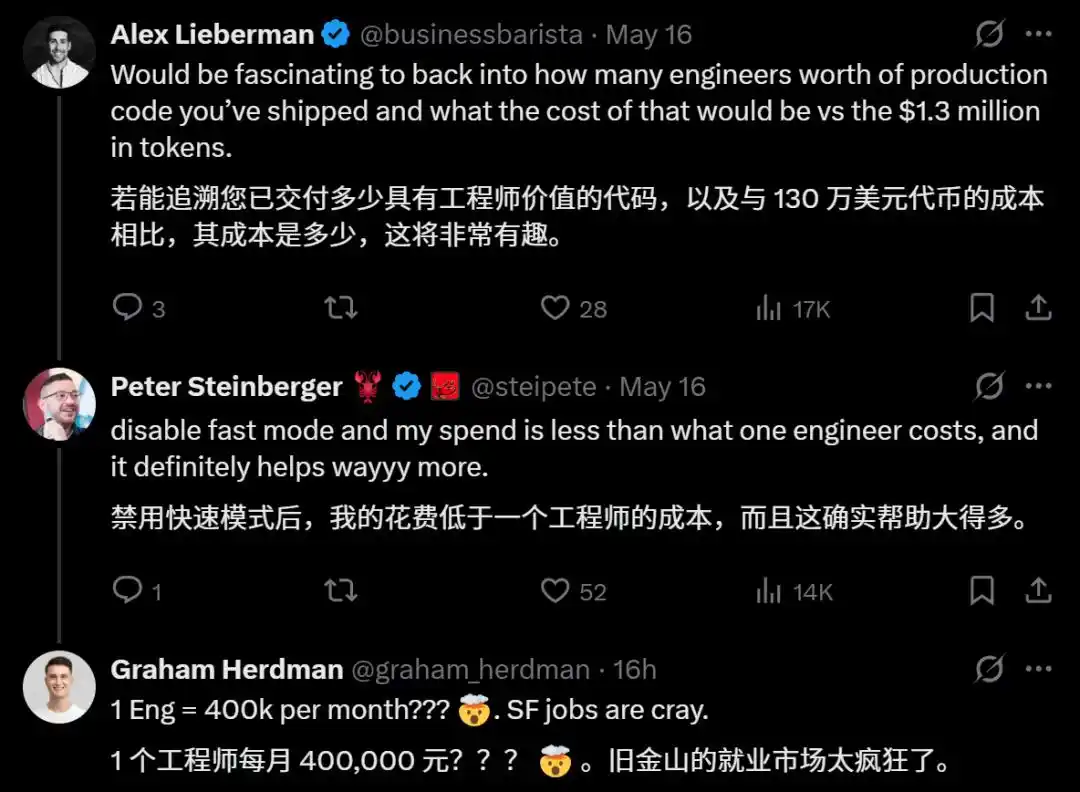
Steinberger himself calmly responded: "With fast mode off, my cost is less than an engineer, and it really helps a lot more."

Translation: — It's genuinely cost-effective!

Other netizens were shocked by the $400k/month engineer — "The San Francisco job market is insane."
Netizen comment
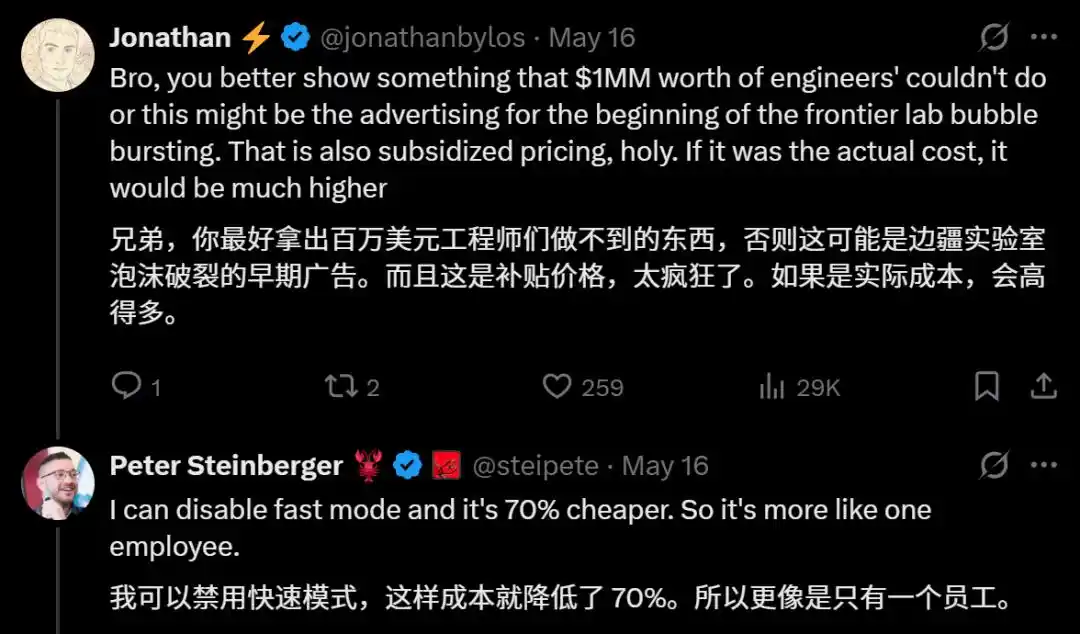
Netizen comment

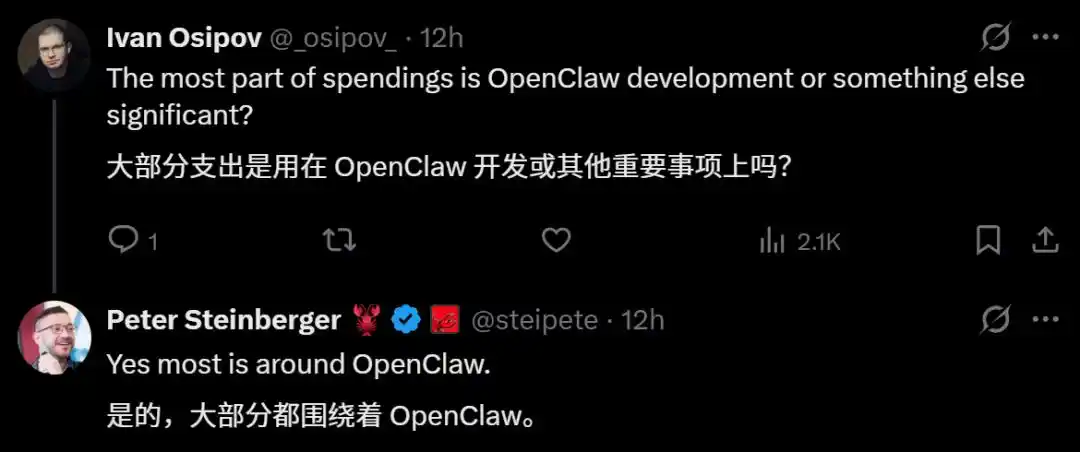
Others were curious about where this massive token usage went.

Peter responded that most was used for OpenClaw development.
Netizen comment

A Cloud-Based Programmer Army

The most outrageous thing is that Pete's small team only has 3 people.

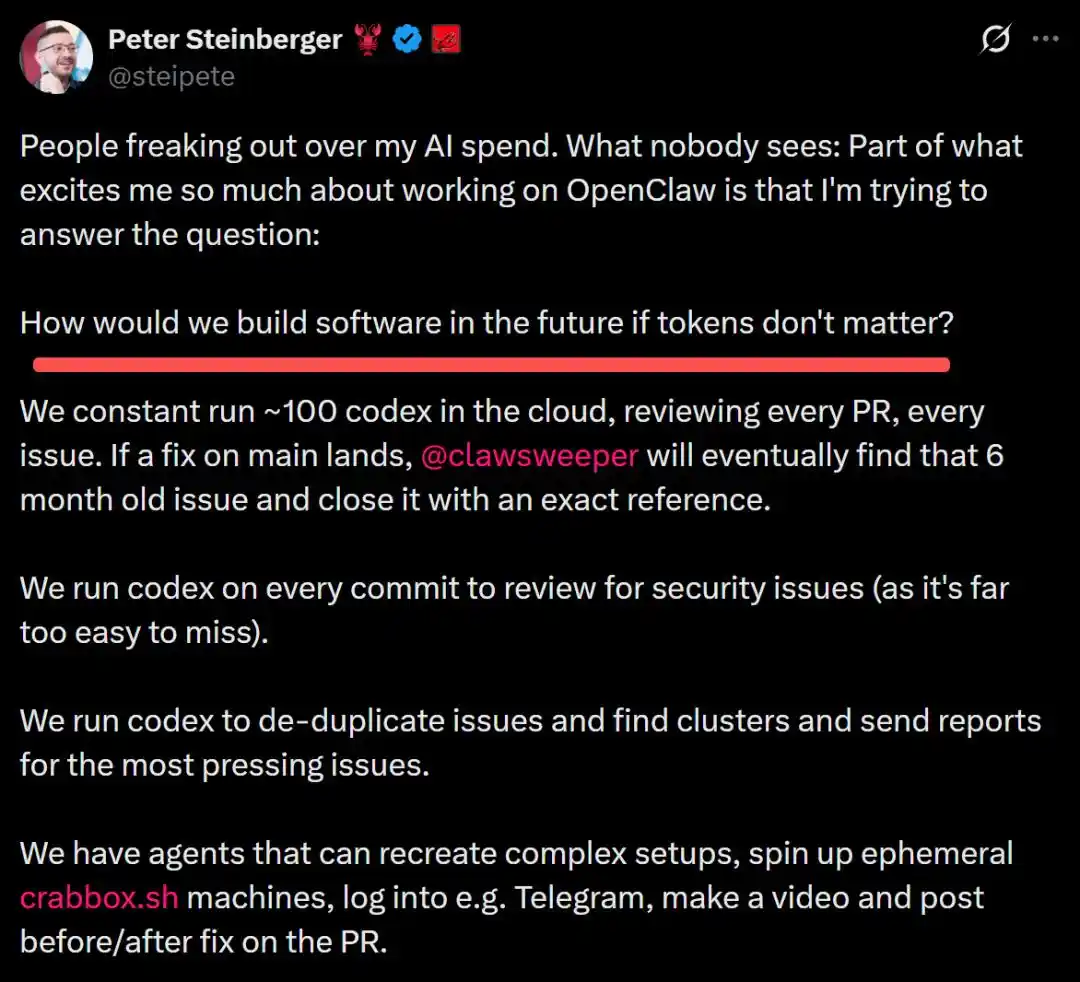
They have about 100 Codex instances running long-term in the cloud, handling the dirtiest, most grueling, most mind-numbing work in software engineering —

Reviewing PRs, finding security vulnerabilities, deduplicating issues, fixing bugs, monitoring benchmarks, posting to Discord upon discovering regressions, even opening PRs directly after listening to meetings.

Thus, AI isn't just "helping you write code," but is infiltrating every crevice of software collaboration.

This is terrifying.

Because what's truly expensive in software development is communication, comprehension, context switching, review, regression, fixes, waiting, and repetitive tasks.

In the past, a team spent a huge amount of time each day on these things that don't seem like "creation" but without which the project would rot.

Now, Peter has tossed all these processes to a bunch of AI agents at once.

This is AI starting to maintain the nervous system of an organization for you.

Illustration

There's another important detail in this screenshot: it's not the OpenAI backend, but CodexBar made by Peter.

CodexBar is a macOS menu bar tool for tracking usage windows, credits, costs, and reset times for various AI programming tools.

It supports a bunch of services like Codex, Claude, Cursor, Gemini, Copilot, etc.

What used to be in a programmer's menu bar? CPU, memory, battery, network speed.

Now there's one more thing: tokens. Tokens are becoming a new "means of production."

CodexBar

A Final Word

$1.3 million a month, 3 people, 100 AI agents.

Ponder this set of numbers — three living humans, leading a hundred digital employees who don't eat, sleep, or demand raises, doing the work of an entire engineering team.

Some felt invigorated after reading this: AI finally isn't just a decorative vase for chatting! Others felt a chill down their spine: Wait, so what do we coders do in the future?

But honestly, what keeps me up at night is Steinberger's casual remark: "I'm exploring what software development would look like if token cost wasn't an issue."
Peter Steinberger

Everyone, he said "if."

The problem is, this "if" is visibly turning into "when" at an astonishing speed.

The work that costs $1.3 million today, after one price cut for models, becomes $130k. Another cut, $13k.

On that day, having 100 AI agents working simultaneously is no longer a game exclusive to Silicon Valley big shots, but a basic operation for any three-person startup team.

Three young people in a garage, holding a hundred tireless AI programmers — this image, just thinking about it is absurd.

Peter Steinberger has revealed the bottom card.

On the card it says: The future is already knocking, and it doesn't plan to wait for you to be ready.

References:

https://the-decoder.com/for-1-3-million-a-month-openclaw-founder-peter-steinberger-runs-100-ai-agents-that-code-review-prs-and-find-bugs/

https://x.com/steipete/status/2055346265869721905

https://developers.openai.com/codex/speed

This article comes from the WeChat public account "New Zhiyuan", author: New Zhiyuan

Related Questions

QHow much money did the three-person team spend on AI development in one month, and who covered the cost?

AThe three-person team spent $1,305,088.81 (approximately 1.3 million USD) in one month on AI development, and the cost was covered by OpenAI.

QWhat is the name of the tool Peter Steinberger created to track AI development costs and usage?

APeter Steinberger created a tool called CodexBar, a macOS menu bar application that tracks usage windows, credits, costs, and reset times for various AI programming tools like Codex, Claude, Cursor, Gemini, and Copilot.

QApproximately how many AI agents (instances) does Peter Steinberger's team run for development tasks?

APeter Steinberger's team runs approximately 100 AI Codex instances to perform various development tasks.

QWhat kinds of software development tasks do the AI agents in the article handle?

AThe AI agents handle tasks such as reviewing pull requests (PRs), finding security vulnerabilities, deduplicating issues, fixing bugs, monitoring benchmarks, reporting regressions to Discord, and even opening PRs after listening to meetings.

QWhat is the core implication Peter Steinberger highlights regarding the future of software development with AI?

APeter Steinberger highlights that the core implication is exploring what software development would look like if token cost were not a limiting factor, suggesting a future where small teams can leverage large numbers of AI agents as a standard practice, dramatically changing the development landscape.

Related Reads

AI Benefits Senior Staff? 40% of CEOs Plan to Cut Junior Positions, Young People's Jobs Are More at Risk

The traditional assumption that senior employees are first in line during layoffs is being inverted in the AI era. A survey of 415 CEOs by Oliver Wyman and the NYSE reveals 43% plan to cut entry-level positions in the next 1-2 years to shift towards a mid-to-senior talent structure, a sharp rise from 17% last year. The logic is that AI excels at automating routine, cognitive tasks typically handled by junior staff (e.g., coding, data review), while the experience and judgment of senior employees remain harder to replicate. Research indicates this shift primarily manifests as a hiring freeze for junior roles rather than mass layoffs. Goldman Sachs estimates AI currently nets a loss of about 16,000 US jobs monthly, disproportionately impacting Generation Z concentrated in highly automatable white-collar roles. This raises long-term concerns about a broken talent pipeline, as companies risk having no future senior managers trained internally. Despite the dominant trend, a minority of successful AI adopters, like IBM and Salesforce, are expanding junior hiring, arguing these employees are adept at using and building AI tools. However, most companies are still in early AI deployment phases, with 67% in planning/pilot stages and many reporting returns below expectations. The overarching reality is a weakening of job security across all levels, as organizations reshape for an AI-augmented, leaner future.

marsbit14m ago

AI Benefits Senior Staff? 40% of CEOs Plan to Cut Junior Positions, Young People's Jobs Are More at Risk

marsbit14m ago

Physical AI is Hot, Some New Thoughts from Me

The term "Physical AI" is gaining significant traction, marking a shift from AI that processes information to AI that understands and interacts with the physical world. Unlike traditional AI confined to screens, Physical AI involves integrating intelligence into robotic bodies to perform tasks in environments governed by gravity, friction, and inertia. The concept, formally defined in a 2020 paper, focuses on creating embodied systems that can complete perception-to-action cycles. 2026 is identified as a pivotal "deployment year," where the focus moves from demonstrations to practical utility. Companies like China's Zhiyuan Robotics have transitioned to live, unscripted factory deployments and announced mass production targets. Internationally, Figure AI, after a major funding round, shifted to its own neural system, while NVIDIA partnered with major industrial robot firms to upgrade millions of existing units with AI capabilities. A key trend is the crossover from the automotive supply chain. Companies like Aptiv and Valeo are entering the Physical AI space, leveraging their expertise in sensors, control systems, and mass production from the autonomous vehicle sector. This "technology spillover" is accelerating development, as seen with Tesla's plans to repurpose automotive production lines for its Optimus robot. The technical breakthrough enabling this progress is the engineering maturity of "world models." Previously theoretical, these AI models can now simulate physical interactions and generate vast, realistic synthetic training data for robots. Innovations from NVIDIA's Cosmos, Ant's LingBot-World, and others have made this capability more accessible, drastically reducing the cost and time needed for real-world data collection. This is driving a fundamental architectural shift in robotics: from the traditional "sense-plan-act" model, reliant on pre-programmed rules, to a "sense-reason-act" paradigm where neural networks reason and make decisions. This change represents a new paradigm where machines understand the world's physics. The competition is intense, with the landscape still forming. While the direction is clear, success will depend not just on AI algorithms but on manufacturing scalability, supply chain resilience, and efficient data strategies, with infrastructure providers potentially capturing significant value in this new era.

marsbit31m ago

Physical AI is Hot, Some New Thoughts from Me

marsbit31m ago

Trading

Spot
Futures

Hot Articles

How to Buy BILL

Welcome to HTX.com! We've made purchasing Billions Network (BILL) simple and convenient. Follow our step-by-step guide to embark on your crypto journey.Step 1: Create Your HTX AccountUse your email or phone number to sign up for a free account on HTX. Experience a hassle-free registration journey and unlock all features.Get My AccountStep 2: Go to Buy Crypto and Choose Your Payment MethodCredit/Debit Card: Use your Visa or Mastercard to buy Billions Network (BILL) instantly.Balance: Use funds from your HTX account balance to trade seamlessly.Third Parties: We've added popular payment methods such as Google Pay and Apple Pay to enhance convenience.P2P: Trade directly with other users on HTX.Over-the-Counter (OTC): We offer tailor-made services and competitive exchange rates for traders.Step 3: Store Your Billions Network (BILL)After purchasing your Billions Network (BILL), store it in your HTX account. Alternatively, you can send it elsewhere via blockchain transfer or use it to trade other cryptocurrencies.Step 4: Trade Billions Network (BILL)Easily trade Billions Network (BILL) on HTX's spot market. Simply access your account, select your trading pair, execute your trades, and monitor in real-time. We offer a user-friendly experience for both beginners and seasoned traders.

719 Total ViewsPublished 2026.05.07Updated 2026.05.11

How to Buy BILL

Discussions

Welcome to the HTX Community. Here, you can stay informed about the latest platform developments and gain access to professional market insights. Users' opinions on the price of BILL (BILL) are presented below.

活动图片