From Robinhood to Polymarket: Is the Era of Integrating All Assets on a Single Platform Coming?

marsbitPubblicato 2026-04-24Pubblicato ultima volta 2026-04-24

Introduzione

From Robinhood to Polymarket: The Era of All-in-One Asset Platforms Is Coming Asset classes are rapidly converging. Platforms that once specialized in single categories—such as stocks, cryptocurrencies, or prediction markets—are now moving toward offering all three. Robinhood pioneered this model, starting with equities, adding crypto in 2018, and prediction markets in 2025. This strategy has proven resilient: when crypto revenues fell, other segments like options and stocks filled the gap. Now, prediction market leaders Polymarket and Kalshi are moving in the same direction, both announcing perpetual futures trading on April 21, 2026, pending regulatory approval. These futures will cover assets like Bitcoin, gold, and stocks such as Nvidia. This trend mirrors the consolidation seen in consumer tech, like smartphones replacing dedicated cameras and MP3 players. Younger users, accustomed to interacting with multiple asset types from an early age, will increasingly demand unified platforms. A key competitive advantage in prediction markets is collateral utilization—idle assets locked during betting periods. Polymarket’s move into perpetuals may be a strategy to generate yield from that capital, similar to earlier DeFi integrations like PolyAave. As the regulatory landscape evolves, traditional finance is also likely to incorporate crypto and prediction markets, further accelerating this convergence.

Written by: Tiger Research

Compiled by: AididiaoJP, Foresight News

Key Points

Different asset classes are accelerating their integration: Stocks, cryptocurrencies, and prediction markets were once independent. Today, the trend of integrating all assets on a single platform is accelerating. Robinhood has proven this model with data; Polymarket and Kalshi are moving in the same direction.

In prediction markets, collateral utilization will become a core competitive advantage: In prediction markets, collateral is locked until the outcome is determined. Polymarket's launch of perpetual futures trading is likely an effort to generate returns from idle assets.

Traditional finance is also moving toward the same integration: The new generation of users has grown up accustomed to interacting with multiple asset classes simultaneously. As generations shift, the demand for integrated platforms will only grow, and large financial institutions will gradually incorporate crypto spot trading and prediction markets as the environment opens up to regulation.

On April 21, 2026, the two leading prediction market platforms, @Polymarket and @Kalshi, announced the launch of perpetual futures trading on the same day. The trading targets are expected to include cryptocurrencies like Bitcoin, commodities like gold, and stocks like Nvidia. Both platforms stated that they will officially launch after receiving regulatory approval.

Why Now

This can be understood through the "Robinhood model." The trend of integrating previously independent asset classes into a single platform has long been underway; the announcements from Polymarket and Kalshi are merely a continuation of this trend.

Robinhood started as a stock trading app, added cryptocurrency trading in 2018, and incorporated prediction markets in 2025, pioneering the model of consolidating fragmented trading markets under one platform.
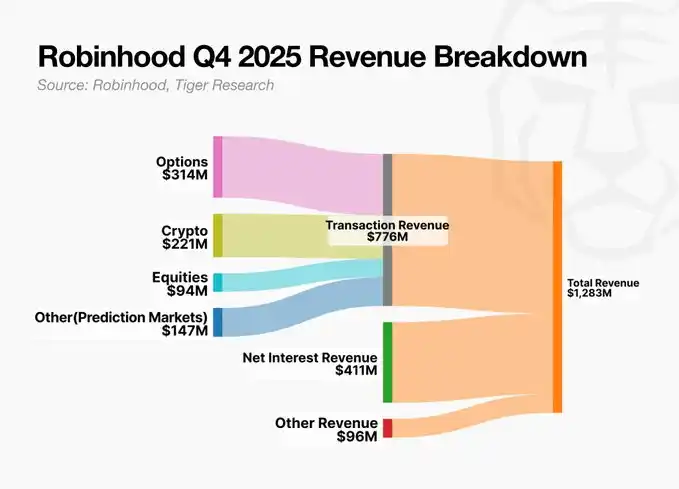
This model has been validated by data. After expanding its crypto business, crypto trading revenue became Robinhood's largest single revenue source in Q4 2024. Although crypto revenue fell 38% year-over-year in Q4 2025, total revenue remained stable, with options, stocks, and prediction markets filling the gap. A structure of resilience through diversification has taken shape.

Polymarket and Kalshi are starting from the opposite direction but heading toward the same endpoint. They originated in prediction markets and are now adding futures trading. The starting points differ, but the destination is the same. As the Robinhood model proves successful, traditional finance is likely exploring the same path.

A Simple Analogy

Smartphones integrated cameras, MP3 players, and navigation into a single device; the era of carrying separate devices for each function is over. The same transformation is happening in finance.

Brokerage accounts, crypto exchanges, and prediction markets are merging into a single platform. Robinhood started as a stock app and gradually added cryptocurrencies and prediction markets; Polymarket started with prediction markets and is now adding crypto perpetual contracts. The starting points differ, but the direction is the same.

The Generalization of the Robinhood Model

As generations shift, this trend will accelerate further. The new generation of users has grown up simultaneously exposed to stocks, cryptocurrencies, and prediction markets. Just as smartphone users would not accept separate devices for a camera, MP3 player, and map, this generation finds the idea of using separate apps for each asset class unfamiliar from the start. The demand for an integrated platform that handles all assets within a familiar interface will grow naturally with each generation.

This is the generalization of the Robinhood model.

Polymarket and Kalshi have a particular advantage in this model. Because collateral in prediction markets is locked until the outcome is determined, how to utilize these idle assets will become a key competitive differentiator.

On December 3, 2025, a developer proposed the concept of PolyAave: depositing Polymarket's outcome tokens into an Aave liquidity pool to earn interest. This was an early attempt to convert prediction market collateral into DeFi yields. Polymarket's launch of perpetual futures is likely an extension of this logic. The strategy of not letting locked capital sit idle is sound.

Polymarket and Kalshi are moving first, but traditional finance faces the same pressure. As the regulatory environment gradually opens up, large financial institutions will directly support crypto spot trading and gradually incorporate new asset classes, including prediction markets.


Domande pertinenti

QWhat is the main trend discussed in the article regarding asset trading platforms?

AThe main trend is the convergence of different asset classes—such as stocks, cryptocurrencies, and prediction markets—into single, integrated platforms, as exemplified by Robinhood, Polymarket, and Kalshi.

QHow did Robinhood validate the integrated platform model according to the article?

ARobinhood validated the model by expanding from stocks to cryptocurrencies in 2018 and prediction markets in 2025, with crypto trading becoming its largest revenue source in Q4 2024. Despite a crypto revenue drop in Q4 2025, total revenue remained stable due to diversification into options, stocks, and prediction markets.

QWhy are Polymarket and Kalshi adding perpetual futures trading?

AThey are adding perpetual futures trading to utilize idle collateral locked in prediction markets, turning it into yield and enhancing their competitive advantage by not letting capital remain idle.

QWhat generational shift is driving the demand for integrated financial platforms?

AYounger generations, who have grown up simultaneously exposed to stocks, cryptocurrencies, and prediction markets, naturally prefer a single platform for all assets, similar to how smartphones integrate multiple devices into one.

QHow might traditional financial institutions respond to this trend?

AAs regulatory environments open up, large financial institutions are likely to gradually adopt crypto spot trading and incorporate new asset classes like prediction markets, following the same convergence path.

Letture associate

MY Group Completes Web4.0 First Stock Listing Layout, SEC Officially Discloses Form 8-K Announcement

MY Group has completed the listing layout for the "Web4.0 First Share," with the U.S. Securities and Exchange Commission (SEC) formally disclosing a Form 8-K report. According to the filing, the company's board has officially appointed Mr. Zhang Dingwen as Chief Executive Officer (CEO) and Executive Director, marking a significant upgrade in management and the entry into a new phase of its global capital market strategy. The disclosure of Form 8-K, used for reporting major corporate events, coincides with market information indicating the company is advancing several key capital market initiatives. These include a global brand system upgrade, corporate strategic restructuring, and a change of its stock ticker symbol. These moves are viewed by industry experts as signals of accelerated internationalization and enhanced global market presence. Concurrently, MY Group's proposed "Web4.0 Ecosystem" is garnering market attention. The company is integrating core capabilities across social traffic portals, global payment systems, public blockchain infrastructure, digital asset trading, and AI-powered financial systems. Analysts suggest that by closing this ecosystem loop, MY Group has the potential to become a next-generation platform merging Web2 user scale with Web3 asset frameworks and AI financial capabilities. With the management upgrade finalized, the global brand strategy launched, and the stock ticker change pending, MY Group is positioning itself as a focal point in the global technology capital market as a potential leading Web4.0 platform enterprise.

marsbit12 h fa

MY Group Completes Web4.0 First Stock Listing Layout, SEC Officially Discloses Form 8-K Announcement

marsbit12 h fa

Trading

Spot
Futures

Articoli Popolari

Come comprare ERA

Benvenuto in HTX.com! Abbiamo reso l'acquisto di Caldera (ERA) semplice e conveniente. Segui la nostra guida passo passo per intraprendere il tuo viaggio nel mondo delle criptovalute.Step 1: Crea il tuo Account HTXUsa la tua email o numero di telefono per registrarti il tuo account gratuito su HTX. Vivi un'esperienza facile e sblocca tutte le funzionalità,Crea il mio accountStep 2: Vai in Acquista crypto e seleziona il tuo metodo di pagamentoCarta di credito/debito: utilizza la tua Visa o Mastercard per acquistare immediatamente CalderaERA.Bilancio: Usa i fondi dal bilancio del tuo account HTX per fare trading senza problemi.Terze parti: abbiamo aggiunto metodi di pagamento molto utilizzati come Google Pay e Apple Pay per maggiore comodità.P2P: Fai trading direttamente con altri utenti HTX.Over-the-Counter (OTC): Offriamo servizi su misura e tassi di cambio competitivi per i trader.Step 3: Conserva Caldera (ERA)Dopo aver acquistato Caldera (ERA), conserva nel tuo account HTX. In alternativa, puoi inviare tramite trasferimento blockchain o scambiare per altre criptovalute.Step 4: Scambia Caldera (ERA)Scambia facilmente Caldera (ERA) nel mercato spot di HTX. Accedi al tuo account, seleziona la tua coppia di trading, esegui le tue operazioni e monitora in tempo reale. Offriamo un'esperienza user-friendly sia per chi ha appena iniziato che per i trader più esperti.

333 Totale visualizzazioniPubblicato il 2025.07.17Aggiornato il 2025.07.17

Come comprare ERA

Discussioni

Benvenuto nella Community HTX. Qui puoi rimanere informato sugli ultimi sviluppi della piattaforma e accedere ad approfondimenti esperti sul mercato. Le opinioni degli utenti sul prezzo di ERA ERA sono presentate come di seguito.

活动图片