Countdown to the AI Bull Market? Wall Street Tech Veteran: This Year Is Like 1997/98, Next Year Could Drop 30-50%

marsbitPubblicato 2026-05-13Pubblicato ultima volta 2026-05-13

Introduzione

"AI Bull Market Countdown? Wall Street Veteran: This Year Feels Like 1997/98, Next Year Could Drop 30-50%" In an interview, veteran tech analyst Dan Niles draws parallels between the current AI boom and the 1997-98 period of the internet boom, suggesting the bull run isn't over yet. The core new driver is identified as "Agentic AI," which performs multi-step tasks and consumes vastly more computing power than conversational AI. This shift is expected to boost demand for cloud infrastructure and benefit CPU makers like Intel and AMD, potentially pressuring GPU leader Nvidia. However, Niles warns of significant short-term overbought conditions in semiconductors. His central warning is for a potential major market correction of 30-50% starting in early 2027. Drivers include a slowdown from high growth comparables, the outsized capital demands of companies like OpenAI, and a wave of massive tech IPOs sucking liquidity from the market. A J.P. Morgan survey of 56 global investors aligns with this view, finding that 54% expect a >30% U.S. stock correction by 2027. Among mega-cap tech, Niles favors Google due to its full-stack AI capabilities and cash flow, expresses concern about Meta's user growth, and sees potential for Apple's AI Siri and foldable iPhone. Niles advises investors to be nimble, hold significant cash, and closely monitor the conflicting signals from equities, oil prices, and bond yields, which he believes cannot all be correct simultaneously.

Original Author: Long Yue

Original Source: Wall Street News

The current market situation is strikingly similar to 1997-1998—a Wall Street tech veteran is already starting the countdown for the AI bull market.

On May 11, Dan Niles, a well-known chip analyst from the dot-com bubble era and founder of Niles Investment Management, gave an in-depth interview on "The Master Investor Podcast," systematically presenting his judgment on the current AI market trend: the AI bull market is not over yet, but he predicts a major correction could occur around early 2027, and investors should start preparing now.

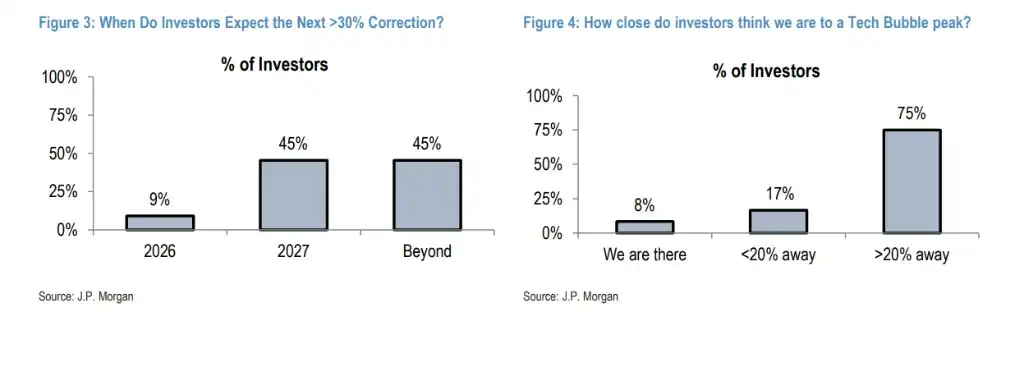
Meanwhile, a JPMorgan survey of 56 global investors found: 54% expect the U.S. stock market to experience a correction of over 30% this year or next, with 45% believing it will happen in 2027—highly aligning with Dan Niles' assessment.
It's 1997-1998, Not 1999, and Certainly Not 2000

Niles compares the current market to 1997-1998, not the peak bubble years of 1999-2000 that many fear.

The logic is as follows: ChatGPT launched at the end of 2022, and AI infrastructure build-out is now entering its fourth year. During the internet era, the Netscape browser debuted in 1994, and 1997-1998 was also the third and fourth years.

In 1997, the Thai currency crisis erupted, the S&P 500 fell up to 11% intra-year but still closed the year up 31%. In 1998, the Russian bond default and Long-Term Capital Management (LTCM) collapse saw the S&P 500 drop up to 19% intra-year, yet it still gained 27% for the full year.

Niles says: "Back then, the overarching theme of internet infrastructure build-out provided a cushion, so every macro shock became a buying opportunity. It's the same today."

He believes the oil price shock triggered by the Iran war is a "man-made event," easier to resolve than the currency crisis or bond defaults of the past, therefore judging this to be another cyclical low.

Agentic AI: The New Fuel Driving This Bull Market Forward

Niles attributes the core driver of this year's market to one term: Agentic AI.

Simply put, previously you would ask ChatGPT a question, and it would give you an answer. This is "conversational AI."

Agentic AI is fundamentally different. Dan Niles gives an example: "You can tell it, 'This is Wilfred, go to the BBC website and get this data, go to Bloomberg for that data, go to CNBC for something else, then compile it all into an Excel spreadsheet.'" This series of operations requires numerous concurrent API calls, consuming 10 to 100 times more compute tokens than a chat-based AI.

Data already proves this: For the two months before OpenAI's release of [presumably a key Agentic AI model/API] on January 30, 2026, token growth was about 20%; in the two months after release, token growth exceeded 120%.

This has directly boosted capital expenditure expectations for hyperscale cloud providers: at the start of the year, the market expected ~30% capex growth for 2026; after Q1 earnings, this rose to 60%; and after the latest round of earnings, it climbed again to 70%.

Niles' conclusion: This is not a small change; it's an order-of-magnitude leap, sufficient to support further gains in AI-related stocks.

Changing Hardware Landscape: CPU Comeback, GPU Under Pressure

The architectural nature of Agentic AI is quietly rewriting the competitive landscape of AI hardware.

Training large models involves repeating the same task, which GPUs excel at; conversational AI inference is also manageable. But Agentic AI requires simultaneously managing multiple applications and coordinating multi-step tasks, which is essentially "orchestration"—a CPU's strong suit.

Dan Niles says: "The ratio used to be roughly 8 GPUs to 1 CPU. As we shift to Agentic, that ratio will move closer to 1 to 1."

This means: Intel and AMD benefit, while Nvidia is "marginally affected in terms of its stock price performance."

But Semiconductors Are Severely Overbought

Dan Niles shifts gears: short-term risks cannot be ignored. "In the short term, the current overbought level in semiconductors is the most severe since just before the 2000 or 1995 crashes. That's certain."

He specifically notes the semiconductor ETF is up about 70% year-to-date, and even the Iran war shock couldn't push it down.

However, he stresses that short-term overbought conditions do not equate to a breakdown in long-term logic—the demand for compute from Agentic AI is real. He is willing to accept the risk of Intel potentially falling 15-20% in the short term because he believes the stock will be even higher by year-end.

2027: Where Will the 30-50% Correction Come From?

Dan Niles is already mapping out scenarios for the next cycle.

The Agentic AI surge began around January 30, 2026. Based on this, by early 2027, growth will start lapping tough high-base comparisons, and growth rates will naturally slow significantly. At that point, what happens to the market?

"I think, from the highs they are at then, these stocks could drop 30% to 50%," he says.

The reference point is recent: in 2022, the "Magnificent 7" tech giants fell an average of 46%—that was just the aftermath of the pandemic-era tech build-out wave receding, far smaller in scale than the current AI frenzy.

Another potential trigger point is OpenAI. Dan Niles points out that OpenAI and Anthropic combined account for about half of the backlog orders at hyperscale cloud vendors. The two companies went from a combined ~$7 billion in annualized revenue in early 2025 to now approaching $70 billion (Anthropic ~$45B, OpenAI ~$24B)—an astonishing growth, but this money must be squeezed out of other companies' budgets.

"When OpenAI's revenue was still $20 billion at year-end, it publicly claimed a commitment of $1.4 trillion in capital expenditure over the next eight years. Where does that money come from? If OpenAI runs into problems, that would significantly accelerate this process."

He also highlights a structural liquidity pressure: IPOs from companies like OpenAI, SpaceX, and Anthropic are coming in succession, each potentially valued in the trillions of dollars. "That money has to come from somewhere else. Fund managers aren't sitting on piles of idle cash; they have to sell something else."

Three Signals Flashing Simultaneously: Stocks, Oil, Bonds—One Must Be Wrong

The first thing Dan Niles does every morning is check oil prices, bond yields, and the stock market simultaneously.

The current combination makes him uneasy: stocks at all-time highs, oil prices up about 60% year-to-date, and both the U.S. 10-year and 30-year Treasury yields hitting yearly highs.

Historically, in 10 out of the past 12 recessions, a sustained rise in oil prices preceded them. If oil stays around $90 for one or two quarters, inflation will pick up, consumer purchasing power will be eroded, and then a major stock market correction becomes inevitable. McDonald's recent earnings mentioned pressure on low-end consumers, with same-store sales missing expectations—when these signals start appearing, you have to worry.

He also notes that the incoming Fed Chair Kevin Warsh is inclined to cut rates and views AI as a deflationary force, "which is a positive factor pushing the market higher in the short term." But he warns that if 10-year or 30-year yields keep climbing, market valuations will face real pressure. His conclusion:

Among stocks, oil, and bonds, one must be wrong. When one of them reprices, it could trigger significant market turmoil.

His advice is concise: "Hold lots of cash now.—Just at the end of March, I thought it was a good time to be aggressive entering the market. But now, I think you should hold lots of cash and be highly vigilant about the eventual resolution."

JPMorgan: 54% of Institutional Investors Expect a Major Correction in 2027

Dan Niles' warning is not an isolated view.

A roadshow feedback report released on May 12, 2026, by JPMorgan's global market strategy team shows that analyst Eduardo Lecubarri led the team to five cities in Latin America, meeting with 56 institutional investors.

The core data from the report is as follows:

  • 92% of surveyed investors believe the stock market return for the full year 2026 will be positive, but not a single one expects gains exceeding 20%;
  • 54% of surveyed investors expect a stock market correction of over 30% sometime between 2026 and 2027 (9% expecting it in 2026, 45% in 2027);
  • 75% of surveyed investors believe there is more than 20% upside remaining before reaching a tech bubble peak;
  • Regarding regional allocation, views on Europe were highly consistent—100% underweight Europe, 100% overweight the U.S.;
  • The sectors most favored by investors are, in order: Technology, Utilities, Industrials.

This highly aligns with Dan Niles' "1998 logic": the bull market is far from over, but the timeline for a major correction is already quietly forming within market consensus.
Quantum Computing: Huge Potential, But Don't Rush

At the end of the interview, Dan Niles also discussed quantum computing. He is a firm long-term believer: "I'm a firm believer in quantum; I think we will get there eventually"—but he cites Bill Gates' famous quote: We tend to overestimate technology in the short term and underestimate it in the long term.

"The earliest AI paper was written over 50 years ago. When did ChatGPT appear? End of 2022. Quantum computing likely follows a similar path. The arrival of quantum computing IPOs will bring back market attention, but truly disruptive applications will take longer to arrive than most people imagine."

Big Tech Company Divergence: Google Out in Front

The recent earnings from tech giants have made Dan Niles' judgment clearer.

Google Cloud: Q4 YoY growth 48%, latest quarter accelerated to 63%, a 15 percentage point acceleration.

AWS: Accelerated from 24% to 28%, a 4 percentage point increase—respectable given its size as the largest cloud provider.

Microsoft Cloud: From 38% to 39%, almost flat.

"These numbers tell you who is truly executing and who is gaining market share," Dan Niles says.

He states his conclusion directly: "Who is the best big tech company to own for the next 3 to 5 years? Clearly Google. They have the full technology stack; you should bet on them. Unless something dramatic happens, they will continue to be winners because they have everything and have massive cash flow to support it."

Google's advantages include: its own large language model Gemini, in-house AI chips (over a decade of history, the longest among the three cloud vendors), strong cash flow supported by its ad business, and the Android ecosystem covering over 75% of global smartphones. Microsoft relies on OpenAI and lacks its own foundational model; Amazon's AI products have limited brand recognition.

Meta's situation is relatively concerning. Dan Niles points out Meta has no public cloud, so it can't sell excess compute to external businesses; its in-house ASIC chip development also started relatively late. More importantly, this quarter Meta saw the first-ever quarterly decline in Family of Apps user numbers—between the two growth engines for its ad monetization model (user count and price per user), the former has now turned, "That is something to worry about."

Regarding Apple, Dan Niles believes the AI-powered Siri and the foldable iPhone will drive a replacement cycle—citing the iPhone 6 as an example: screen size increased from 4 to 5.5 inches, pushing Apple's revenue growth from 7% to 28%.

Stay Nimble, Don't Be Greedy

Dan Niles summarizes his market philosophy in one phrase: "Be Nimble. Hold strong convictions, but hold them loosely."

His assessment framework is: short-term momentum is upward, with Agentic AI and expectations of easier monetary policy still being two key engines; but by early 2027, these growth numbers will start lapping tough comparisons, the explosive growth from Agentic AI will enter a more moderate phase, and combined with the potential risks from OpenAI and the liquidity shock from mega-IPOs, "stock prices could drop 30% to 50% from the highs at that time."

What to do now? Hold more cash, keep a close eye on the three coordinates every morning—oil prices, Treasury yields, and the stock market—and be ready to adjust at any moment.


Domande pertinenti

QAccording to Dan Niles, why is the current AI boom period analogous to 1997-1998 rather than the bubble peak of 1999-2000?

ADan Niles compares the current period to 1997-1998 because, similar to the internet boom where Netscape launched in 1994, we are now in the 3rd/4th year of AI infrastructure build-out following ChatGPT's 2022 launch. He argues that, like in 1997-1998, macroeconomic shocks during this phase of foundational investment present buying opportunities rather than signaling the end of the cycle.

QWhat is Agentic AI and how does it differ from the previous generation of AI, according to the article?

AAgentic AI differs from conversational AI (like ChatGPT) by being capable of performing multi-step, coordinated tasks across different applications based on a single instruction. For example, it can gather data from BBC, Bloomberg, and CNBC, then compile it into an Excel spreadsheet. This requires significantly more concurrent processing, consuming 10 to 100 times more compute tokens than simple chat-based AI.

QHow does Dan Niles expect the rise of Agentic AI to shift the competitive landscape among major hardware companies like Intel, AMD, and Nvidia?

ADan Niles expects Agentic AI to benefit CPU makers like Intel and AMD at the relative expense of GPU leader Nvidia. He explains that while GPUs excel at repetitive tasks like model training, the 'orchestration' of multiple concurrent tasks in Agentic AI is a CPU strength. He predicts the hardware ratio in AI systems will shift from roughly 8 GPUs per 1 CPU toward a 1-to-1 ratio.

QWhat major market risk does Dan Niles predict for around early 2027, and what are two key factors he cites that could trigger it?

ADan Niles predicts a potential market correction of 30-50% around early 2027. Two key triggering factors he cites are: 1) The year-over-year growth rates for AI companies will start to compare against the high base established by the Agentic AI boom that began in early 2026, leading to a natural slowdown. 2) Potential risks from companies like OpenAI, whose massive capital expenditure plans and growth depend on budgets being reallocated from other areas, and a wave of multi-trillion dollar IPOs (e.g., OpenAI, SpaceX) that could drain liquidity from the broader market.

QBased on the recent earnings reports of major cloud providers, which company does Dan Niles identify as the best-positioned 'big tech' company for the next 3-5 years, and why?

ADan Niles identifies Google (Alphabet) as the best-positioned big tech company. He points to Google Cloud's accelerating revenue growth (from 48% to 63% YoY), its complete, in-house technology stack (including the Gemini LLM and over a decade of in-house AI chip development), massive cash flow from its advertising business, and the global reach of its Android ecosystem. In contrast, he notes Microsoft's reliance on OpenAI and Amazon's lower-profile AI products as relative weaknesses.

Letture associate

MY Group Completes Web4.0 First Stock Listing Layout, SEC Officially Discloses Form 8-K Announcement

MY Group has completed the listing layout for the "Web4.0 First Share," with the U.S. Securities and Exchange Commission (SEC) formally disclosing a Form 8-K report. According to the filing, the company's board has officially appointed Mr. Zhang Dingwen as Chief Executive Officer (CEO) and Executive Director, marking a significant upgrade in management and the entry into a new phase of its global capital market strategy. The disclosure of Form 8-K, used for reporting major corporate events, coincides with market information indicating the company is advancing several key capital market initiatives. These include a global brand system upgrade, corporate strategic restructuring, and a change of its stock ticker symbol. These moves are viewed by industry experts as signals of accelerated internationalization and enhanced global market presence. Concurrently, MY Group's proposed "Web4.0 Ecosystem" is garnering market attention. The company is integrating core capabilities across social traffic portals, global payment systems, public blockchain infrastructure, digital asset trading, and AI-powered financial systems. Analysts suggest that by closing this ecosystem loop, MY Group has the potential to become a next-generation platform merging Web2 user scale with Web3 asset frameworks and AI financial capabilities. With the management upgrade finalized, the global brand strategy launched, and the stock ticker change pending, MY Group is positioning itself as a focal point in the global technology capital market as a potential leading Web4.0 platform enterprise.

marsbit7 h fa

MY Group Completes Web4.0 First Stock Listing Layout, SEC Officially Discloses Form 8-K Announcement

marsbit7 h fa

Trading

Spot
Futures

Articoli Popolari

Cosa è $S$

Comprendere SPERO: Una Panoramica Completa Introduzione a SPERO Mentre il panorama dell'innovazione continua a evolversi, l'emergere delle tecnologie web3 e dei progetti di criptovaluta gioca un ruolo fondamentale nel plasmare il futuro digitale. Un progetto che ha attirato l'attenzione in questo campo dinamico è SPERO, denotato come SPERO,$$s$. Questo articolo mira a raccogliere e presentare informazioni dettagliate su SPERO, per aiutare gli appassionati e gli investitori a comprendere le sue basi, obiettivi e innovazioni nei domini web3 e crypto. Che cos'è SPERO,$$s$? SPERO,$$s$ è un progetto unico all'interno dello spazio crypto che cerca di sfruttare i principi della decentralizzazione e della tecnologia blockchain per creare un ecosistema che promuove l'impegno, l'utilità e l'inclusione finanziaria. Il progetto è progettato per facilitare interazioni peer-to-peer in modi nuovi, fornendo agli utenti soluzioni e servizi finanziari innovativi. Al suo interno, SPERO,$$s$ mira a responsabilizzare gli individui fornendo strumenti e piattaforme che migliorano l'esperienza dell'utente nello spazio delle criptovalute. Questo include la possibilità di metodi di transazione più flessibili, la promozione di iniziative guidate dalla comunità e la creazione di percorsi per opportunità finanziarie attraverso applicazioni decentralizzate (dApps). La visione sottostante di SPERO,$$s$ ruota attorno all'inclusività, cercando di colmare le lacune all'interno della finanza tradizionale mentre sfrutta i vantaggi della tecnologia blockchain. Chi è il Creatore di SPERO,$$s$? L'identità del creatore di SPERO,$$s$ rimane piuttosto oscura, poiché ci sono risorse pubblicamente disponibili limitate che forniscono informazioni dettagliate sul suo fondatore o fondatori. Questa mancanza di trasparenza può derivare dall'impegno del progetto per la decentralizzazione—un ethos che molti progetti web3 condividono, dando priorità ai contributi collettivi rispetto al riconoscimento individuale. Centrando le discussioni attorno alla comunità e ai suoi obiettivi collettivi, SPERO,$$s$ incarna l'essenza dell'empowerment senza mettere in evidenza individui specifici. Pertanto, comprendere l'etica e la missione di SPERO rimane più importante che identificare un creatore singolo. Chi sono gli Investitori di SPERO,$$s$? SPERO,$$s$ è supportato da una varietà di investitori che vanno dai capitalisti di rischio agli investitori angelici dedicati a promuovere l'innovazione nel settore crypto. Il focus di questi investitori generalmente si allinea con la missione di SPERO—dando priorità a progetti che promettono avanzamenti tecnologici sociali, inclusività finanziaria e governance decentralizzata. Queste fondazioni di investitori sono tipicamente interessate a progetti che non solo offrono prodotti innovativi, ma contribuiscono anche positivamente alla comunità blockchain e ai suoi ecosistemi. Il supporto di questi investitori rafforza SPERO,$$s$ come un concorrente degno di nota nel dominio in rapida evoluzione dei progetti crypto. Come Funziona SPERO,$$s$? SPERO,$$s$ impiega un framework multifunzionale che lo distingue dai progetti di criptovaluta convenzionali. Ecco alcune delle caratteristiche chiave che sottolineano la sua unicità e innovazione: Governance Decentralizzata: SPERO,$$s$ integra modelli di governance decentralizzati, responsabilizzando gli utenti a partecipare attivamente ai processi decisionali riguardanti il futuro del progetto. Questo approccio favorisce un senso di proprietà e responsabilità tra i membri della comunità. Utilità del Token: SPERO,$$s$ utilizza il proprio token di criptovaluta, progettato per servire varie funzioni all'interno dell'ecosistema. Questi token abilitano transazioni, premi e la facilitazione dei servizi offerti sulla piattaforma, migliorando l'impegno e l'utilità complessivi. Architettura Stratificata: L'architettura tecnica di SPERO,$$s$ supporta la modularità e la scalabilità, consentendo un'integrazione fluida di funzionalità e applicazioni aggiuntive man mano che il progetto evolve. Questa adattabilità è fondamentale per mantenere la rilevanza nel panorama crypto in continua evoluzione. Coinvolgimento della Comunità: Il progetto enfatizza iniziative guidate dalla comunità, impiegando meccanismi che incentivano la collaborazione e il feedback. Nutrendo una comunità forte, SPERO,$$s$ può affrontare meglio le esigenze degli utenti e adattarsi alle tendenze di mercato. Focus sull'Inclusione: Offrendo basse commissioni di transazione e interfacce user-friendly, SPERO,$$s$ mira ad attrarre una base utenti diversificata, inclusi individui che potrebbero non aver precedentemente interagito nello spazio crypto. Questo impegno per l'inclusione si allinea con la sua missione generale di empowerment attraverso l'accessibilità. Cronologia di SPERO,$$s$ Comprendere la storia di un progetto fornisce preziose intuizioni sulla sua traiettoria di sviluppo e sui traguardi. Di seguito è riportata una cronologia suggerita che mappa eventi significativi nell'evoluzione di SPERO,$$s$: Fase di Concettualizzazione e Ideazione: Le idee iniziali che formano la base di SPERO,$$s$ sono state concepite, allineandosi strettamente con i principi di decentralizzazione e focus sulla comunità all'interno dell'industria blockchain. Lancio del Whitepaper del Progetto: Dopo la fase concettuale, è stato rilasciato un whitepaper completo che dettaglia la visione, gli obiettivi e l'infrastruttura tecnologica di SPERO,$$s$ per suscitare interesse e feedback dalla comunità. Costruzione della Comunità e Prime Interazioni: Sono stati effettuati sforzi attivi di outreach per costruire una comunità di early adopters e potenziali investitori, facilitando discussioni attorno agli obiettivi del progetto e ottenendo supporto. Evento di Generazione del Token: SPERO,$$s$ ha condotto un evento di generazione del token (TGE) per distribuire i propri token nativi ai primi sostenitori e stabilire una liquidità iniziale all'interno dell'ecosistema. Lancio della Prima dApp: La prima applicazione decentralizzata (dApp) associata a SPERO,$$s$ è stata attivata, consentendo agli utenti di interagire con le funzionalità principali della piattaforma. Sviluppo Continuo e Partnership: Aggiornamenti e miglioramenti continui alle offerte del progetto, inclusi partnership strategiche con altri attori nello spazio blockchain, hanno plasmato SPERO,$$s$ in un concorrente competitivo e in evoluzione nel mercato crypto. Conclusione SPERO,$$s$ rappresenta una testimonianza del potenziale del web3 e delle criptovalute di rivoluzionare i sistemi finanziari e responsabilizzare gli individui. Con un impegno per la governance decentralizzata, il coinvolgimento della comunità e funzionalità progettate in modo innovativo, apre la strada verso un panorama finanziario più inclusivo. Come per qualsiasi investimento nello spazio crypto in rapida evoluzione, si incoraggiano potenziali investitori e utenti a ricercare approfonditamente e a impegnarsi in modo riflessivo con gli sviluppi in corso all'interno di SPERO,$$s$. Il progetto mostra lo spirito innovativo dell'industria crypto, invitando a ulteriori esplorazioni delle sue innumerevoli possibilità. Mentre il percorso di SPERO,$$s$ è ancora in fase di sviluppo, i suoi principi fondamentali potrebbero effettivamente influenzare il futuro di come interagiamo con la tecnologia, la finanza e tra di noi in ecosistemi digitali interconnessi.

75 Totale visualizzazioniPubblicato il 2024.12.17Aggiornato il 2024.12.17

Cosa è $S$

Cosa è AGENT S

Agent S: Il Futuro dell'Interazione Autonoma in Web3 Introduzione Nel panorama in continua evoluzione di Web3 e criptovalute, le innovazioni stanno costantemente ridefinendo il modo in cui gli individui interagiscono con le piattaforme digitali. Uno di questi progetti pionieristici, Agent S, promette di rivoluzionare l'interazione uomo-computer attraverso il suo framework agentico aperto. Aprendo la strada a interazioni autonome, Agent S mira a semplificare compiti complessi, offrendo applicazioni trasformative nell'intelligenza artificiale (AI). Questa esplorazione dettagliata approfondirà le complessità del progetto, le sue caratteristiche uniche e le implicazioni per il dominio delle criptovalute. Cos'è Agent S? Agent S si presenta come un innovativo framework agentico aperto, progettato specificamente per affrontare tre sfide fondamentali nell'automazione dei compiti informatici: Acquisizione di Conoscenze Specifiche del Dominio: Il framework apprende in modo intelligente da varie fonti di conoscenza esterne ed esperienze interne. Questo approccio duale gli consente di costruire un ricco repository di conoscenze specifiche del dominio, migliorando le sue prestazioni nell'esecuzione dei compiti. Pianificazione su Lungo Orizzonte di Compiti: Agent S impiega una pianificazione gerarchica potenziata dall'esperienza, un approccio strategico che facilita la suddivisione e l'esecuzione efficiente di compiti complessi. Questa caratteristica migliora significativamente la sua capacità di gestire più sottocompiti in modo efficiente ed efficace. Gestione di Interfacce Dinamiche e Non Uniformi: Il progetto introduce l'Interfaccia Agente-Computer (ACI), una soluzione innovativa che migliora l'interazione tra agenti e utenti. Utilizzando Modelli Linguistici Multimodali di Grandi Dimensioni (MLLM), Agent S può navigare e manipolare senza sforzo diverse interfacce grafiche utente. Attraverso queste caratteristiche pionieristiche, Agent S fornisce un framework robusto che affronta le complessità coinvolte nell'automazione dell'interazione umana con le macchine, preparando il terreno per innumerevoli applicazioni nell'AI e oltre. Chi è il Creatore di Agent S? Sebbene il concetto di Agent S sia fondamentalmente innovativo, informazioni specifiche sul suo creatore rimangono elusive. Il creatore è attualmente sconosciuto, il che evidenzia sia la fase embrionale del progetto sia la scelta strategica di mantenere i membri fondatori sotto anonimato. Indipendentemente dall'anonimato, l'attenzione rimane sulle capacità e sul potenziale del framework. Chi sono gli Investitori di Agent S? Poiché Agent S è relativamente nuovo nell'ecosistema crittografico, informazioni dettagliate riguardanti i suoi investitori e sostenitori finanziari non sono documentate esplicitamente. La mancanza di approfondimenti pubblicamente disponibili sulle fondazioni di investimento o sulle organizzazioni che supportano il progetto solleva interrogativi sulla sua struttura di finanziamento e sulla roadmap di sviluppo. Comprendere il supporto è cruciale per valutare la sostenibilità del progetto e il suo potenziale impatto sul mercato. Come Funziona Agent S? Al centro di Agent S si trova una tecnologia all'avanguardia che gli consente di funzionare efficacemente in contesti diversi. Il suo modello operativo è costruito attorno a diverse caratteristiche chiave: Interazione Uomo-Computer Simile a Quella Umana: Il framework offre una pianificazione AI avanzata, cercando di rendere le interazioni con i computer più intuitive. Mimando il comportamento umano nell'esecuzione dei compiti, promette di elevare le esperienze degli utenti. Memoria Narrativa: Utilizzata per sfruttare esperienze di alto livello, Agent S utilizza la memoria narrativa per tenere traccia delle storie dei compiti, migliorando così i suoi processi decisionali. Memoria Episodica: Questa caratteristica fornisce agli utenti una guida passo-passo, consentendo al framework di offrire supporto contestuale mentre i compiti si sviluppano. Supporto per OpenACI: Con la capacità di funzionare localmente, Agent S consente agli utenti di mantenere il controllo sulle proprie interazioni e flussi di lavoro, allineandosi con l'etica decentralizzata di Web3. Facile Integrazione con API Esterne: La sua versatilità e compatibilità con varie piattaforme AI garantiscono che Agent S possa adattarsi senza problemi agli ecosistemi tecnologici esistenti, rendendolo una scelta attraente per sviluppatori e organizzazioni. Queste funzionalità contribuiscono collettivamente alla posizione unica di Agent S all'interno dello spazio crittografico, poiché automatizza compiti complessi e multi-fase con un intervento umano minimo. Man mano che il progetto evolve, le sue potenziali applicazioni in Web3 potrebbero ridefinire il modo in cui si svolgono le interazioni digitali. Cronologia di Agent S Lo sviluppo e le tappe di Agent S possono essere riassunti in una cronologia che evidenzia i suoi eventi significativi: 27 Settembre 2024: Il concetto di Agent S è stato lanciato in un documento di ricerca completo intitolato “Un Framework Agentico Aperto che Usa i Computer Come un Umano”, mostrando le basi per il progetto. 10 Ottobre 2024: Il documento di ricerca è stato reso pubblicamente disponibile su arXiv, offrendo un'esplorazione approfondita del framework e della sua valutazione delle prestazioni basata sul benchmark OSWorld. 12 Ottobre 2024: È stata rilasciata una presentazione video, fornendo un'idea visiva delle capacità e delle caratteristiche di Agent S, coinvolgendo ulteriormente potenziali utenti e investitori. Questi indicatori nella cronologia non solo illustrano i progressi di Agent S, ma indicano anche il suo impegno per la trasparenza e il coinvolgimento della comunità. Punti Chiave su Agent S Man mano che il framework Agent S continua a evolversi, diversi attributi chiave si distinguono, sottolineando la sua natura innovativa e il potenziale: Framework Innovativo: Progettato per fornire un uso intuitivo dei computer simile all'interazione umana, Agent S porta un approccio nuovo all'automazione dei compiti. Interazione Autonoma: La capacità di interagire autonomamente con i computer attraverso GUI segna un passo avanti verso soluzioni informatiche più intelligenti ed efficienti. Automazione di Compiti Complessi: Con la sua metodologia robusta, può automatizzare compiti complessi e multi-fase, rendendo i processi più veloci e meno soggetti a errori. Miglioramento Continuo: I meccanismi di apprendimento consentono ad Agent S di migliorare dalle esperienze passate, migliorando continuamente le sue prestazioni e la sua efficacia. Versatilità: La sua adattabilità attraverso diversi ambienti operativi come OSWorld e WindowsAgentArena garantisce che possa servire un'ampia gamma di applicazioni. Man mano che Agent S si posiziona nel panorama di Web3 e delle criptovalute, il suo potenziale per migliorare le capacità di interazione e automatizzare i processi segna un significativo avanzamento nelle tecnologie AI. Attraverso il suo framework innovativo, Agent S esemplifica il futuro delle interazioni digitali, promettendo un'esperienza più fluida ed efficiente per gli utenti in vari settori. Conclusione Agent S rappresenta un audace passo avanti nell'unione tra AI e Web3, con la capacità di ridefinire il modo in cui interagiamo con la tecnologia. Sebbene sia ancora nelle sue fasi iniziali, le possibilità per la sua applicazione sono vaste e coinvolgenti. Attraverso il suo framework completo che affronta sfide critiche, Agent S mira a portare le interazioni autonome al centro dell'esperienza digitale. Man mano che ci addentriamo nei regni delle criptovalute e della decentralizzazione, progetti come Agent S giocheranno senza dubbio un ruolo cruciale nel plasmare il futuro della tecnologia e della collaborazione uomo-computer.

516 Totale visualizzazioniPubblicato il 2025.01.14Aggiornato il 2025.01.14

Cosa è AGENT S

Come comprare S

Benvenuto in HTX.com! Abbiamo reso l'acquisto di Sonic (S) semplice e conveniente. Segui la nostra guida passo passo per intraprendere il tuo viaggio nel mondo delle criptovalute.Step 1: Crea il tuo Account HTXUsa la tua email o numero di telefono per registrarti il tuo account gratuito su HTX. Vivi un'esperienza facile e sblocca tutte le funzionalità,Crea il mio accountStep 2: Vai in Acquista crypto e seleziona il tuo metodo di pagamentoCarta di credito/debito: utilizza la tua Visa o Mastercard per acquistare immediatamente SonicS.Bilancio: Usa i fondi dal bilancio del tuo account HTX per fare trading senza problemi.Terze parti: abbiamo aggiunto metodi di pagamento molto utilizzati come Google Pay e Apple Pay per maggiore comodità.P2P: Fai trading direttamente con altri utenti HTX.Over-the-Counter (OTC): Offriamo servizi su misura e tassi di cambio competitivi per i trader.Step 3: Conserva Sonic (S)Dopo aver acquistato Sonic (S), conserva nel tuo account HTX. In alternativa, puoi inviare tramite trasferimento blockchain o scambiare per altre criptovalute.Step 4: Scambia Sonic (S)Scambia facilmente Sonic (S) nel mercato spot di HTX. Accedi al tuo account, seleziona la tua coppia di trading, esegui le tue operazioni e monitora in tempo reale. Offriamo un'esperienza user-friendly sia per chi ha appena iniziato che per i trader più esperti.

929 Totale visualizzazioniPubblicato il 2025.01.15Aggiornato il 2025.03.21

Come comprare S

Discussioni

Benvenuto nella Community HTX. Qui puoi rimanere informato sugli ultimi sviluppi della piattaforma e accedere ad approfondimenti esperti sul mercato. Le opinioni degli utenti sul prezzo di S S sono presentate come di seguito.

活动图片