Coinbase ‘cautiously optimistic’ on 2026 as crypto nears institutional inflection point

cointelegraphPubblicato 2025-12-19Pubblicato ultima volta 2025-12-19

Introduzione

Coinbase Institutional's 2026 outlook is cautiously optimistic, forecasting a potential institutional inflection point for crypto driven by regulatory clarity, stablecoin adoption, and an improving macro backdrop. The report highlights key U.S. policy developments, including stablecoin legislation and market structure bills, as crucial for institutional integration. It projects the stablecoin market could grow to $1.2 trillion by 2028. Bitcoin's volatility has moderated, now resembling high-growth tech stocks, with 90-day historical volatility declining to 35-40% by end-2025. Despite 2025's price swings and leverage-induced corrections, Bitcoin is now seen as an established part of the global financial conversation.

After a year of unexpected turbulence for crypto markets, 2026 could mark a turning point driven by regulatory clarity, accelerating stablecoin adoption and an improving macroeconomic backdrop, according to a new outlook from Coinbase Institutional.

In its 70-page report, Coinbase Institutional said digital assets have evolved “from a niche market to an emerging pillar of global market infrastructure,” even as price volatility and uneven liquidity defined much of 2025.

Looking ahead, Coinbase’s institutional arm expects clearer global regulatory frameworks to provide stronger policy guardrails, supporting innovation and long-term market maturation.

Rather than another retail-driven boom-and-bust cycle, 2026 is framed as a year of institutional integration and regulatory maturity, with clearer rules enabling deeper participation from traditional financial players.

In the United States, Coinbase Institutional pointed to landmark policy developments, including progress on stablecoin legislation such as the GENIUS Act and momentum toward a broader crypto market structure bill, as key factors shaping the next phase of adoption.

These efforts are expected to influence everything from risk management and compliance standards to institutional portfolio strategies.
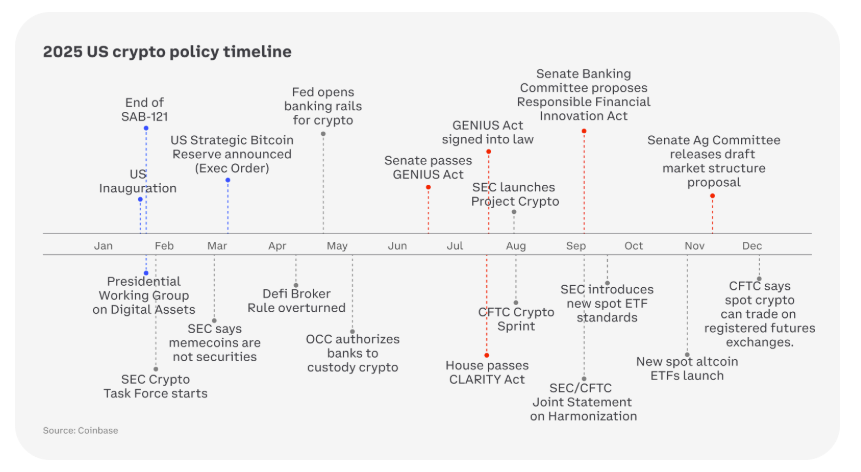
Coinbase Institutional flags the evolution of US crypto policy as a key driver of a potentially transformative 2026. Source: Coinbase Institutional

Stablecoins remain one of crypto’s most established use cases, with Coinbase Institutional projecting significant expansion in the years ahead. Its model forecasts that the stablecoin market could grow to about $1.2 trillion by 2028, driven by increased use in payments, settlement, payroll and cross-border remittances.
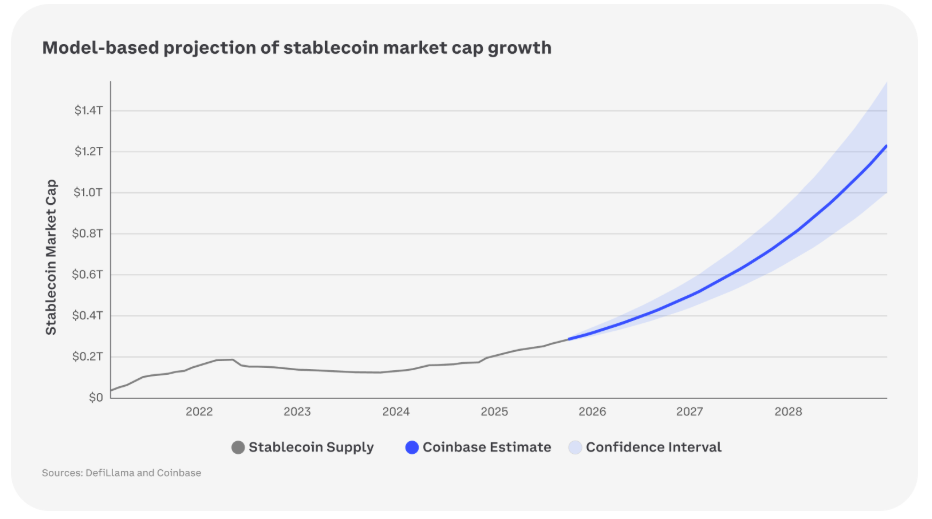
After years of rapid expansion, Coinbase Institutional’s model forecasts that the stablecoin market could reach $1.2 trillion by 2028. Source: Coinbase Institutional

Still, the outlook stops short of outright optimism. Coinbase Institutional described its macroeconomic expectations as “cautiously optimistic,” arguing that while economic growth may remain uneven, the US economy has shown greater resilience than recent data implies.

Persistent inflation risks and the timing of potential interest rate cuts remain key variables that could influence crypto market recovery heading into 2026.

Related: US banks may soon issue stablecoins under FDIC plan to implement GENIUS Act

Bitcoin’s volatility profile is shifting

One of Coinbase Institutional’s key observations is that Bitcoin’s volatility profile has gradually evolved. Rather than standing out as an extreme outlier among major asset classes, Bitcoin’s volatility now resembles that of high-growth technology stocks, the report said.

Coinbase pointed to Bitcoin’s (BTC) 90-day historical volatility, which declined to about 35% to 40% by the end of 2025, down from levels above 60% in mid-2024. The moderation occurred even as the market absorbed major structural changes, including the approval and rollout of spot Bitcoin exchange-traded funds.
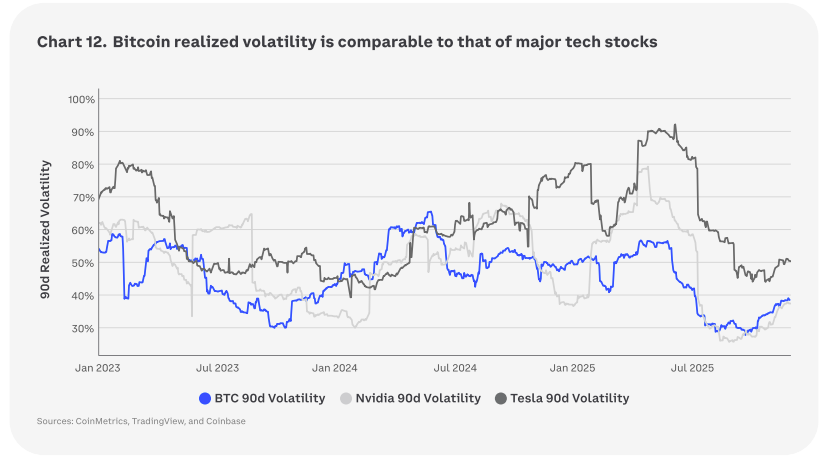
Bitcoin’s volatility profile is now comparable to major technology stocks. Source: Coinbase Institutional

Still, 2025 proved to be a volatile and emotionally charged year for Bitcoin holders. The asset experienced sharp price swings, reaching new cycle highs before undergoing a steep correction later in the year amid elevated leverage and forced liquidations across crypto markets.

While such moves have renewed debate around Bitcoin’s role as a safe-haven asset, Coinbase Institutional said that 2025 ultimately marked a milestone year. The report described Bitcoin as having been “firmly established as a critical component of the global financial conversation,” even as it remains subject to the growing pains of a maturing asset class.

Related: Why the ‘great China Bitcoin mining crackdown’ fell short of early claims

Domande pertinenti

QWhat is Coinbase Institutional's overall outlook for the crypto market in 2026?

ACoinbase Institutional is 'cautiously optimistic' about 2026, framing it as a potential turning point driven by regulatory clarity, accelerating stablecoin adoption, and an improving macroeconomic backdrop, rather than another retail-driven boom-and-bust cycle.

QWhat key US policy developments does the report highlight as factors shaping the next phase of crypto adoption?

AThe report highlights landmark policy developments, including progress on stablecoin legislation such as the GENIUS Act and momentum toward a broader crypto market structure bill.

QWhat is the projected growth for the stablecoin market by 2028 according to Coinbase's model?

ACoinbase Institutional's model forecasts that the stablecoin market could grow to about $1.2 trillion by 2028.

QHow has Bitcoin's volatility profile changed, according to the report?

ABitcoin's volatility profile has evolved to resemble that of high-growth technology stocks, with its 90-day historical volatility declining to about 35% to 40% by the end of 2025, down from levels above 60% in mid-2024.

QWhat are the key macroeconomic variables that could influence the crypto market recovery heading into 2026?

APersistent inflation risks and the timing of potential interest rate cuts remain key variables that could influence the crypto market recovery.

Letture associate

BTC on a Roller Coaster, HYPE Hits New Highs | Guest Analysis

**Market Analysis: BTC Volatility and HYPE's New Highs** This week, markets experienced significant volatility. Macro pressures intensified with a bond market sell-off, rising rate hike expectations, and oil surpassing $110. Bitcoin (BTC) broke below $78K and is currently testing a critical range. The core debate centers on the nature of BTC's rally from its February low: Is it the start of a new uptrend (Path 1: bullish) or merely a B-wave rally within a larger monthly corrective structure (Path 2: bearish)? The outcome of the battle in the $78,500-$79,500 zone is key this week. * **For BTC:** * **Mid-term:** Maintain a neutral, cash position. * **Short-term:** Two contingency plans with ≤30% position size and strict stop-losses: * **Plan A (Bearish):** Sell if price rebounds but faces resistance in the $78,500-$79,500 zone. * **Plan B (Bearish):** Sell if price convincingly breaks below the $73,500-$75,000 support. * A break above $90,000-$93,100 would strongly favor the bullish Path 1 scenario. * **For HYPE:** HYPE continues its independent rally, hitting new highs with over 10% gains this week. The trend remains bullish as long as price holds above the key support at $38.41. * **Short-term Strategies (≤30% position):** * **Plan A (Bullish):** Buy on a confirmed break above $45.76. * **Plan B (Bearish):** Sell short on a confirmed break below $45.76. * **Plan C (Bullish):** Buy on a pullback finding support near $38.41. **Trade Review:** Last week, a disciplined 1x leveraged BTC long trade at $79,812, based on model signals, was closed at $81,426 for a ~2.02% profit. **Important:** Market conditions change rapidly. This analysis is for informational purposes only and does not constitute investment advice. Trade with caution and proper risk management.

marsbit10 min fa

BTC on a Roller Coaster, HYPE Hits New Highs | Guest Analysis

marsbit10 min fa

a16z: How Should Crypto Entrepreneurs Understand the CLARITY Act?

a16z: How Crypto Entrepreneurs Should Understand the CLARITY Act? The U.S. Senate Banking Committee's bipartisan vote to advance crypto market structure legislation, specifically the Digital Asset Market CLARITY Act, marks a historic moment for the industry. For a decade, a lack of clear U.S. regulation has stifled innovation, created consumer risks, and pushed development overseas. CLARITY aims to end this by establishing clear rules for blockchain networks and digital assets, similar to how the 1933 Securities Act shaped capital formation. The current regulatory patchwork has failed, causing legal confusion and enabling bad actors while hindering responsible builders. CLARITY provides a path forward by clarifying the regulatory roles of the SEC and CFTC, defining whether digital assets are securities or commodities, and establishing oversight for crypto exchanges and consumer protections. Crucially, CLARITY recognizes that blockchain networks are fundamentally different from traditional companies. Networks operate through shared rules and decentralized coordination, not centralized control. Applying corporate frameworks distorts them, leading to value extraction by intermediaries. Blockchain enables truly decentralized networks where value can be distributed to participants. CLARITY is designed to make this viable under U.S. law, allowing builders to operate transparently, raise capital domestically, and focus on long-term innovation without structural compromises due to regulatory ambiguity. The bill's progression follows earlier House efforts like FIT21 and the House CLARITY Act, which received strong bipartisan support. If passed, CLARITY could unlock significant innovation within the U.S., similar to the growth seen after the GENIUS Act for stablecoins, helping the U.S. lead in the digital economy while better combating fraud and abuse.

marsbit31 min fa

a16z: How Should Crypto Entrepreneurs Understand the CLARITY Act?

marsbit31 min fa

AI Benefits Senior Staff? 40% of CEOs Plan to Cut Junior Positions, Young People's Jobs Are More at Risk

The traditional assumption that senior employees are first in line during layoffs is being inverted in the AI era. A survey of 415 CEOs by Oliver Wyman and the NYSE reveals 43% plan to cut entry-level positions in the next 1-2 years to shift towards a mid-to-senior talent structure, a sharp rise from 17% last year. The logic is that AI excels at automating routine, cognitive tasks typically handled by junior staff (e.g., coding, data review), while the experience and judgment of senior employees remain harder to replicate. Research indicates this shift primarily manifests as a hiring freeze for junior roles rather than mass layoffs. Goldman Sachs estimates AI currently nets a loss of about 16,000 US jobs monthly, disproportionately impacting Generation Z concentrated in highly automatable white-collar roles. This raises long-term concerns about a broken talent pipeline, as companies risk having no future senior managers trained internally. Despite the dominant trend, a minority of successful AI adopters, like IBM and Salesforce, are expanding junior hiring, arguing these employees are adept at using and building AI tools. However, most companies are still in early AI deployment phases, with 67% in planning/pilot stages and many reporting returns below expectations. The overarching reality is a weakening of job security across all levels, as organizations reshape for an AI-augmented, leaner future.

marsbit1 h fa

AI Benefits Senior Staff? 40% of CEOs Plan to Cut Junior Positions, Young People's Jobs Are More at Risk

marsbit1 h fa

Physical AI is Hot, Some New Thoughts from Me

The term "Physical AI" is gaining significant traction, marking a shift from AI that processes information to AI that understands and interacts with the physical world. Unlike traditional AI confined to screens, Physical AI involves integrating intelligence into robotic bodies to perform tasks in environments governed by gravity, friction, and inertia. The concept, formally defined in a 2020 paper, focuses on creating embodied systems that can complete perception-to-action cycles. 2026 is identified as a pivotal "deployment year," where the focus moves from demonstrations to practical utility. Companies like China's Zhiyuan Robotics have transitioned to live, unscripted factory deployments and announced mass production targets. Internationally, Figure AI, after a major funding round, shifted to its own neural system, while NVIDIA partnered with major industrial robot firms to upgrade millions of existing units with AI capabilities. A key trend is the crossover from the automotive supply chain. Companies like Aptiv and Valeo are entering the Physical AI space, leveraging their expertise in sensors, control systems, and mass production from the autonomous vehicle sector. This "technology spillover" is accelerating development, as seen with Tesla's plans to repurpose automotive production lines for its Optimus robot. The technical breakthrough enabling this progress is the engineering maturity of "world models." Previously theoretical, these AI models can now simulate physical interactions and generate vast, realistic synthetic training data for robots. Innovations from NVIDIA's Cosmos, Ant's LingBot-World, and others have made this capability more accessible, drastically reducing the cost and time needed for real-world data collection. This is driving a fundamental architectural shift in robotics: from the traditional "sense-plan-act" model, reliant on pre-programmed rules, to a "sense-reason-act" paradigm where neural networks reason and make decisions. This change represents a new paradigm where machines understand the world's physics. The competition is intense, with the landscape still forming. While the direction is clear, success will depend not just on AI algorithms but on manufacturing scalability, supply chain resilience, and efficient data strategies, with infrastructure providers potentially capturing significant value in this new era.

marsbit2 h fa

Physical AI is Hot, Some New Thoughts from Me

marsbit2 h fa

Trading

Spot
Futures
活动图片