Tether Urged To Transfer $344M In Frozen USDT To Terror Victims

bitcoinistPubblicato 2026-05-16Pubblicato ultima volta 2026-05-16

Introduzione

A US federal court in Manhattan is being asked to order Tether to transfer $344 million in frozen USDT to victims of Iran-linked terrorist attacks. The plaintiffs, including a Jerusalem family affected by a 1997 Hamas bombing, hold unpaid court judgments against Iran. They target two Tron blockchain wallets, frozen earlier this year by the US Treasury's OFAC as linked to Iran's Islamic Revolutionary Guard Corps. Their lawsuit argues that because Tether, as a centralized issuer, can freeze wallets, it can also be compelled by court order to move the equivalent funds to satisfy the judgments. This case could set a significant legal precedent for centralized stablecoin issuers and is part of a broader legal campaign targeting frozen crypto assets linked to sanctioned entities.

A Jerusalem family that lost relatives in a 1997 Hamas suicide bombing is among the plaintiffs pushing a US federal court to order Tether to hand over hundreds of millions in frozen digital currency.

The case, filed in Manhattan, could set a significant legal precedent for how courts treat centralized stablecoin issuers.

A Decades-Old Debt

The plaintiffs are survivors and family members of victims from Iran-linked terrorist attacks. They hold court judgments against Iran that were awarded years ago — judgments that have never been paid.

Now they are targeting a pile of frozen cryptocurrency as a way to collect what they are owed.

Attorney Charles Gerstein filed the lawsuit Thursday in the US District Court for the Southern District of New York.
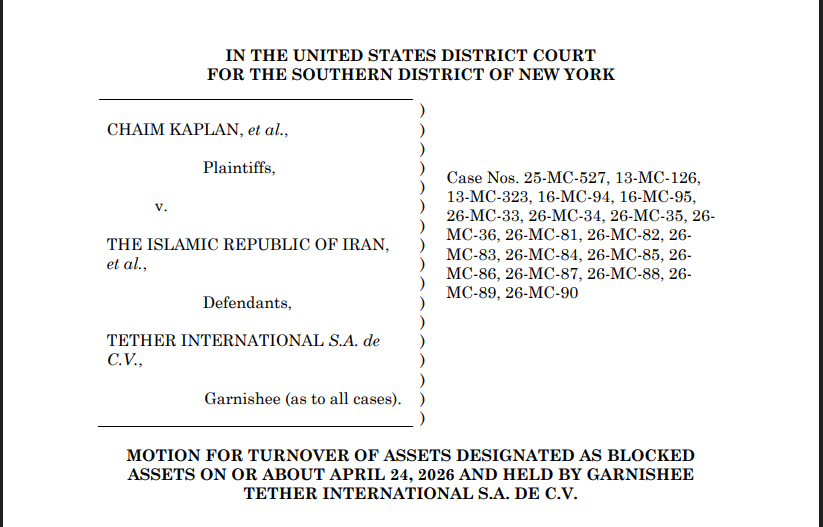
Filing against Tether submitted by Attorney Charles Gerstein.

His clients say they have a legal claim to two Tron blockchain wallet addresses holding roughly 344 million USDT. Those wallets were frozen earlier this year by the US Treasury Department’s Office of Foreign Assets Control, which identified them as linked to Iran’s Islamic Revolutionary Guard Corps.

The plaintiffs are not asking Tether to simply release those specific wallets. According to reports, they want a court order directing Tether to transfer an equivalent amount of USDT to their legal team’s wallet address.

Why Tether Can Be Compelled

Unlike Bitcoin or Ethereum, USDT is controlled by a central company. Tether can freeze wallets, block transactions, and move funds when ordered to do so. That centralized structure is at the heart of Gerstein’s legal argument.

Because a prior order already froze the wallets — something only possible because Tether has direct operational control — he contends the company can also be ordered to move the funds.

BTCUSD trading at $78,115 on the 24-hour chart: TradingView

The ownership question, he argues, is already largely settled: OFAC has already declared the wallets to be IRGC-controlled assets, which clears a path for seizure under US terrorism statutes.

Broader Legal Campaign

This is not Gerstein’s only case of this kind. Based on reports, he has filed similar actions involving North Korea-linked cyber operations against the Arbitrum platform. He is also handling a separate case involving Railgun DAO, a privacy-focused crypto protocol.

The Manhattan filing is part of what appears to be a coordinated legal push to test whether courts can compel crypto platforms with centralized control to act on frozen assets held in sanctioned wallets.

Featured image from CEPA, chart from TradingView

Domande pertinenti

QWhat is the plaintiffs' primary demand to Tether in this case?

AThe plaintiffs are asking the US federal court to order Tether to transfer approximately $344 million worth of frozen USDT (an equivalent amount to the funds in two sanctioned wallet addresses) to a wallet address controlled by their legal team.

QWhat is the legal basis for Attorney Charles Gerstein's argument that Tether can be compelled to move the funds?

AThe argument hinges on Tether's centralized control over USDT. Gerstein contends that because Tether can and has frozen the specific wallets (as ordered by OFAC), demonstrating direct operational control, the company can similarly be ordered by a court to move the funds.

QWhat entity froze the Tron blockchain wallets containing the 344 million USDT, and why were they frozen?

AThe wallets were frozen earlier this year by the US Treasury Department's Office of Foreign Assets Control (OFAC), which identified them as assets linked to Iran's Islamic Revolutionary Guard Corps (IRGC).

QWho are the plaintiffs in this lawsuit against Tether?

AThe plaintiffs are survivors and family members of victims from Iran-linked terrorist attacks, including a Jerusalem family that lost relatives in a 1997 Hamas suicide bombing. They hold unpaid court judgments against Iran.

QWhat potential legal significance does this case hold beyond the immediate dispute?

AThe case could set a significant legal precedent for how US courts treat centralized stablecoin issuers, testing whether courts can compel such platforms to act on frozen assets held in wallets linked to sanctioned entities under terrorism statutes.

Letture associate

Dumping US Bonds, Buying Japanese Bonds: Wall Street Prepares for 'Capital Repatriation to Japan'

Wall Street is bracing for a potential "great repatriation" of Japanese capital as yields on Japanese Government Bonds (JGBs) soar to multi-decade highs. The 10-year JGB yield recently hit 2.73%, its highest since 1997, while the 30-year yield broke 4% for the first time. This dramatic shift is causing global asset managers to reassess a long-ignored risk: that Japanese investors, who hold roughly $1 trillion in U.S. Treasury debt, could start bringing that money home. For decades, Japan's ultra-low interest rates pushed domestic insurers, pension funds, and banks to seek yield overseas, primarily in U.S. Treasuries. Now, with the Bank of Japan hiking rates and JGB yields climbing, the incentive is reversing. Firms like BlueBay Asset Management are preparing for this shift, believing new Japanese investments will be directed domestically rather than to foreign bonds. Early signs of repatriation are emerging, with record monthly inflows into Japanese sovereign bond funds in March. Some managers, like Ruffer's Matt Smith, hold yen as a hedge, anticipating that market stress could trigger a rapid acceleration of capital returning to Japan. However, analysts caution that a mass exodus hasn't begun yet. Japanese investors were still net buyers of foreign bonds over the past year. Uncertainty remains high as Japan's government fiscal plans could push JGB yields even higher, making investors hesitant to buy immediately. Furthermore, the Bank of Japan's withdrawal as a dominant bond buyer has increased market volatility. Nevertheless, the potential scale of Japanese selling poses a tangible risk to the U.S. Treasury market. As the largest foreign holder of U.S. debt, any sustained shift by Japanese institutions could materially impact supply and demand dynamics, pushing U.S. yields higher. Wall Street's current positioning is a forward-looking bet on this logic becoming increasingly compelling as Japanese yields continue to rise.

marsbit34 min fa

Dumping US Bonds, Buying Japanese Bonds: Wall Street Prepares for 'Capital Repatriation to Japan'

marsbit34 min fa

How Did Institutions Adjust Their Crypto Asset Holdings in Q1? Who Increased and Who Exited?

The Q1 2026 13F filings reveal a sharply divided picture of institutional activity in crypto assets. Sovereign wealth funds and bank capital increased exposure, while major endowment funds notably de-risked. The most significant buying came from the Abu Dhabi sovereign wealth fund Mubadala, which expanded its position in the iShares Bitcoin Trust (IBIT). JPMorgan Chase dramatically increased its IBIT exposure by 174%, with other global banks like RBC, Scotiabank, and Barclays also adding to Bitcoin ETF holdings, while using options for asymmetric protection. Conversely, the Harvard Management Company (Harvard University's endowment), once a major academic holder, cut its IBIT position by 43% and fully exited a BlackRock Ethereum ETF. The reallocated capital flowed into traditional assets like TSMC, Microsoft, and gold. Other Ivy League endowments showed varied strategies: Brown and Dartmouth maintained Bitcoin positions, with Dartmouth making a nuanced shift by moving Ethereum exposure to a staking ETF and adding a Solana staking ETF to capture yield. Hedge fund Jane Street significantly reduced Bitcoin ETF holdings, locking in profits, while Wells Fargo increased its Ethereum stake. Overall, institutions are deploying traditional capital market tactics—buying, selling, hedging, and rotating—within crypto via spot ETFs. The Q2 reports will be crucial to determine if Harvard's retreat is an outlier or the start of a broader trend among endowments.

marsbit1 h fa

How Did Institutions Adjust Their Crypto Asset Holdings in Q1? Who Increased and Who Exited?

marsbit1 h fa

Blockchain Capital Partner: Most People Have a Narrow Understanding of the On-Chain Economy

Author Spencer Bogart, a partner at Blockchain Capital, argues that most people have a narrow view of the on-chain economy, seeing it primarily as a faster, cheaper version of existing financial systems. While this represents a significant opportunity, he believes it's only a small part of the story. Bogart compares the current state of crypto to the early internet, where email was the obvious "faster mail" application. The truly transformative categories—like search, social media, and cloud computing—were entirely new and unimaginable beforehand. Similarly, the most profound innovations in crypto will not be incremental improvements but entirely new categories enabled by the core properties of public blockchains: atomic execution, shared global state, programmable custody, and composability. He cites the "flash loan" as a prime example of a "new verb"—a financial action structurally impossible before programmable assets and atomic settlement. It allows for uncollateralized, trustless borrowing of any size, provided repayment occurs within the same transaction, enabling novel strategies like arbitrage and collateral swaps. Bogart admits the difficulty in precisely predicting these future innovations, as human imagination tends to extrapolate from the past. He posits that the most exciting applications in ten years will be things that don't exist today and have no precedent—products only possible in a global, composable, always-on environment with programmable assets. While the exploration of this vast design space will involve many failures, the potential for transformative, category-defining breakthroughs is what makes the next decade so promising.

链捕手1 h fa

Blockchain Capital Partner: Most People Have a Narrow Understanding of the On-Chain Economy

链捕手1 h fa

Trading

Spot
Futures
活动图片