From Gas Limit to Keyed Nonces: How to Understand the Next Stage of Ethereum's Scalability?

marsbitPubblicato 2026-05-14Pubblicato ultima volta 2026-05-14

Introduzione

From Gas Limits to Keyed Nonces: Understanding the Next Phase of Ethereum Scalability This article explores how recent Ethereum developments focus on moving complexity away from end-users, wallets, and DApps to the protocol layer. It discusses the consensus around significantly increasing the Gas Limit to 200 million, a change aimed at reducing fees and improving network capacity. However, it emphasizes that this increase is part of a holistic approach that includes mechanisms like enshrined Proposer-Builder Separation (ePBS) and Block-Level Access Lists to manage state growth and maintain node decentralization. The piece also delves into Keyed Nonces (EIP-8250), a proposed upgrade to Ethereum's transaction ordering. It explains how moving from a single, linear nonce queue per account to multiple independent nonce domains ("channels") can enable parallel transaction streams for different use cases. This is particularly crucial for privacy protocols and smart wallets, reducing transaction conflicts and unlocking new design possibilities. Ultimately, the article argues that these technical upgrades—alongside native account abstraction and cross-L2 interoperability—are converging towards a singular goal: enhancing the overall user experience. This means making on-chain interactions smoother, safer, and more cohesive, with wallets serving as the critical interface translating complex protocol improvements into intuitive user actions.

Author: imToken

Objectively speaking, for some time now, many users' intuitive understanding of Ethereum has often not come from roadmap or developer meetings, but from specific on-chain operations.

For example, in recent years, what everyone has personally felt includes lower Gas during transfers, improved cross-chain interoperability experiences, and so on. This is precisely why Ethereum's scaling has never been a simple 'performance race' problem—for ordinary users, higher TPS, larger blocks, and more complex underlying architectures only make sense when they are truly translated into lower costs, smoother operations, and safer wallet experiences.

And recently, a series of new developments in Ethereum happen to point towards Ethereum's attempt to systematically shift the complexity that was previously borne by wallets, DApps, third-party relayers, and users themselves, forward to the protocol layer.

Among these are Keyed Nonces with Vitalik's involvement, the directional consensus formed around the 200 million Gas Limit floor in the Glamsterdam upgrade, and the series of subtle clues in the 2026 roadmap that continue to emphasize native account abstraction, cross-L2 interoperability, and L1 security strengthening.
I. Gas Limit Increased to 200 Million?

First, let's look at the most easily perceived point for users: Gas Limit.

As is well known, in the Ethereum network, every transaction (whether it's a transfer or a contract interaction) consumes a certain amount of Gas, and the Gas Limit capacity of each Ethereum block is fixed, meaning the number of 'slots' is limited: the more slots, the more 'passengers' can be transported in the same time period; the more slots are tight, people have to bid for the same seat, and Gas fees also rise.

Theoretically, expanding the block Gas limit would indeed directly and significantly improve the performance of the Ethereum mainnet. However, in the past, against the backdrop of significant developments in routes like L2, Ethereum has been relatively cautious and restrained about this. Most of the scaling pressure has been intentionally directed towards the L2 track.

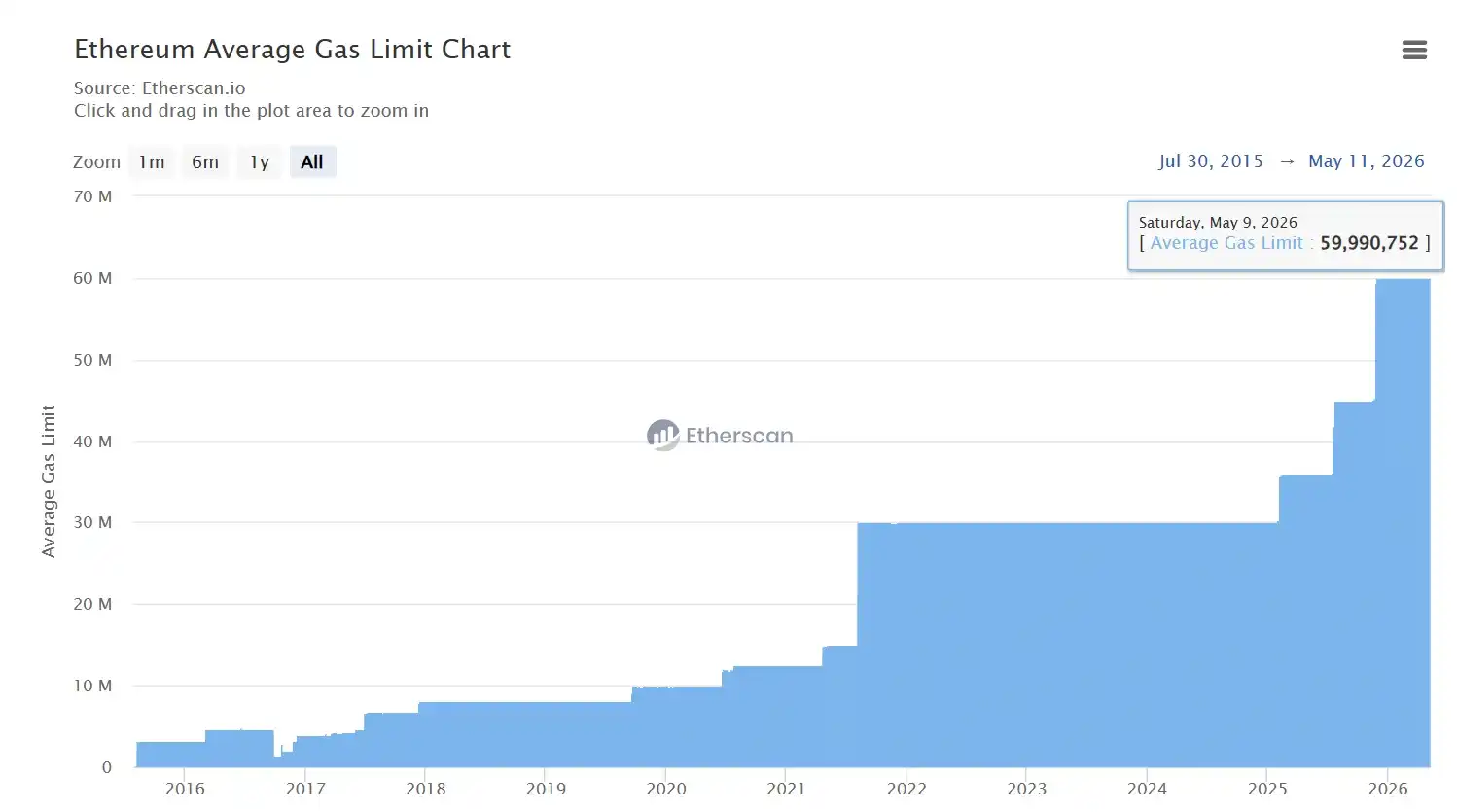
Looking at the expansion curve of Ethereum's Gas Limit reveals that after the Ethereum network's Gas Limit first broke through 10 million from 8 million in September 2019, it wasn't until this year, over 7 years, that the Gas Limit increased from 8 million to 60 million. Especially, it truly entered the acceleration phase only in 2025—from 30 million to 36 million in February, increased again to 45 million in July, and upgraded to 60 million after the Fusaka upgrade in December.

It can be said that most of the expansion was squeezed into the year 2025. Of course, as we mentioned earlier, 2025 is also a crucial year in Ethereum's development history. The Fusaka upgrade, just 7 months after the May Pectra upgrade, proved that the EF, despite undergoing significant leadership changes, still has the ability to drive major updates. It also marked Ethereum's formal entry into an accelerated development rhythm of 'two hard forks per year' (See Extended Reading《Ethereum 2026: Interpreting EF's Latest Protocol Roadmap, Officially Entering the Era of 'Engineering Upgrades'?》).
Source: Etherscan

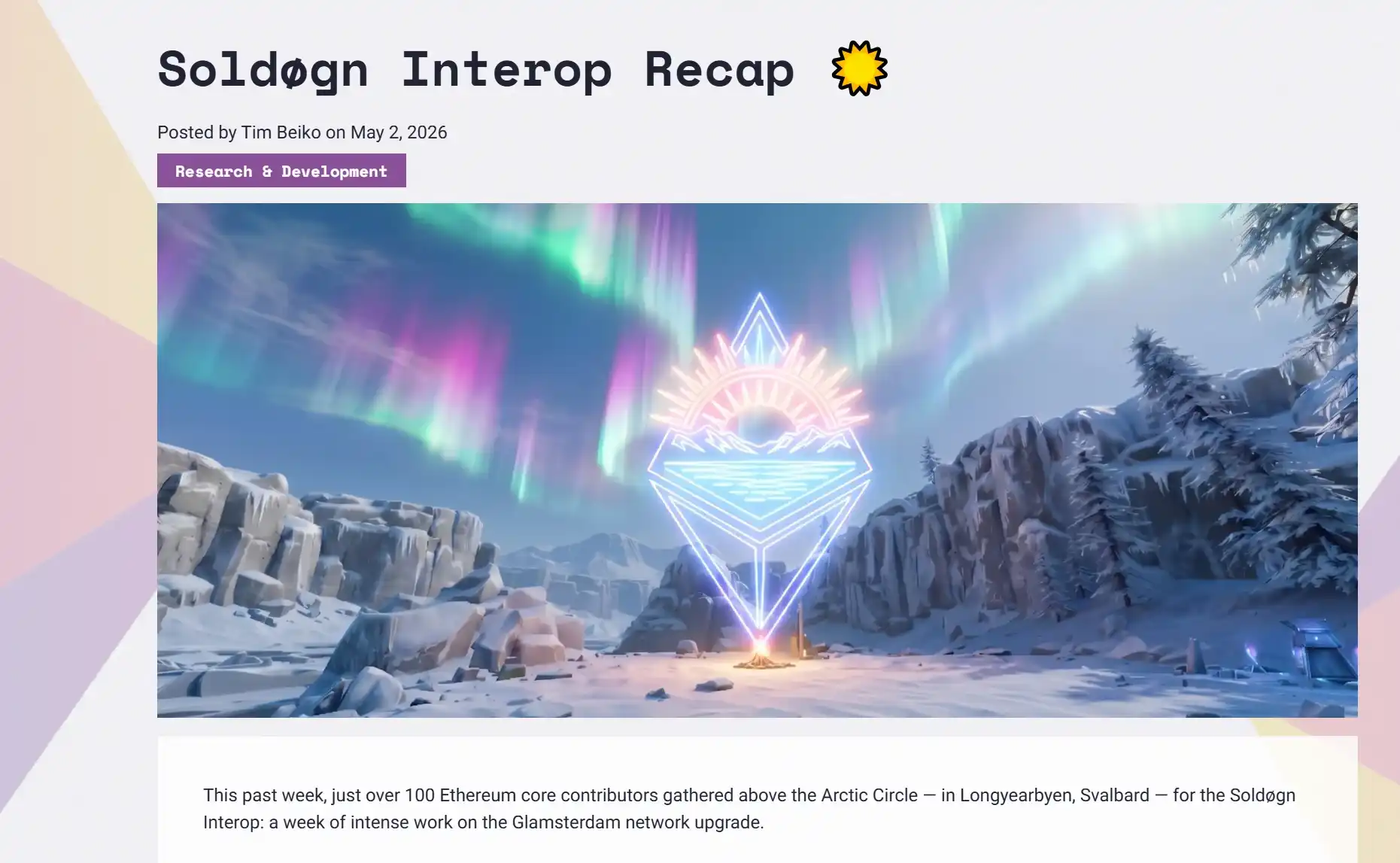
According to the Ethereum Foundation's Soldøgn Interop Recap released on May 2nd, over 100 core Ethereum contributors participated in an interoperability conference in Svalbard, Norway, focusing on the Glamsterdam upgrade. The key goals were to advance the multi-client implementation, testing, and parameter alignment for Glamsterdam. At the end of the conference, developers had formed a directional consensus around a 200 million Gas Limit after Glamsterdam.

This means that if subsequent processes go smoothly, the execution capacity of Ethereum L1 is expected to increase from the current approximately 60 million Gas Limit to a magnitude of 200 million. On a longer time scale, the Ethereum ecosystem's publicly discussable attitude towards Gas Limit has clearly become much more 'radical'. The EIP-9698 proposal even suggests 'increasing tenfold every two years', raising the Gas Limit to 3.6 billion by 2029, which is 50 times the current level.

However, it needs to be emphasized here that increasing the Gas Limit is not simply about making blocks bigger.

If it only roughly increases the computational capacity each block can hold, it might lower fees in the short term, but in the long run, it would burden nodes more heavily, cause state data inflation, and also mean it becomes more difficult for ordinary users to run nodes, ultimately weakening Ethereum's most core decentralized foundation.

Therefore, Glamsterdam's scaling approach is a combination punch:

  • ePBS (enshrined Proposer-Builder Separation) more clearly incorporates the block building and verification process into protocol rules, allowing validators to more securely handle larger blocks;
  • Block-Level Access Lists (BAL) pre-record the accounts and storage locations to be accessed during block execution, thereby supporting parallel disk reads, parallel transaction verification, and parallel state root calculation;
  • And EIP-8037 increases the cost of state creation-related operations to avoid excessive state growth after the Gas Limit is increased.

Ultimately, Ethereum doesn't just want to 'fit more transactions'; it's also thinking about how to not make node operation thresholds increasingly higher while fitting more transactions.

This is also the fundamental difference between Ethereum's scaling roadmap and many high-performance chain narratives. It has always pursued not sacrificing verification cost for superficial throughput, but rather increasing the mainnet's own carrying capacity while trying to maintain ordinary node participation and system verifiability.

II. Keyed Nonces: Turning 'One Queue' into 'Multiple Lanes'

If Gas Limit solves 'how much a block can hold', then Keyed Nonces focuses on another more detailed but crucial question: how should a transaction be queued?

As is well known, in Ethereum, a nonce can be simply understood as the 'sequence number' of an account's transaction. Its role is to prevent the same transaction from being executed repeatedly and to ensure transactions from the same account are processed in order.

This mechanism is easy to understand in ordinary transfer scenarios: it's the first transaction, second transaction, third transaction in sequence, queued one after another.

However, the problem is that when account capabilities become more complex, such as involving private transactions, smart wallets, session keys, batch operations, third-party payment, etc., a single linear nonce can become a bottleneck. Therefore, the core idea of Keyed Nonces, proposed in EIP-8250, is to change from an account having only one nonce queue to being able to have multiple nonce domains.

Specifically, it replaces the single sender nonce in EIP-8141 Frame Transaction with a (nonce_key, nonce_seq) structure, where nonce_key == 0 corresponds to the traditional account nonce, while non-zero keys can choose independent protocol-managed nonce sequences. Transactions under different keys are independent of each other, and replay protection does not interfere between them.

This sounds technical, but it can be understood with a life analogy: In the past, an account was like having only one window at a bank, all business had to queue in the same line; Keyed Nonces is like assigning different businesses to different windows. Transfers, private withdrawals, session authorizations, batch executions can each take their own lane.
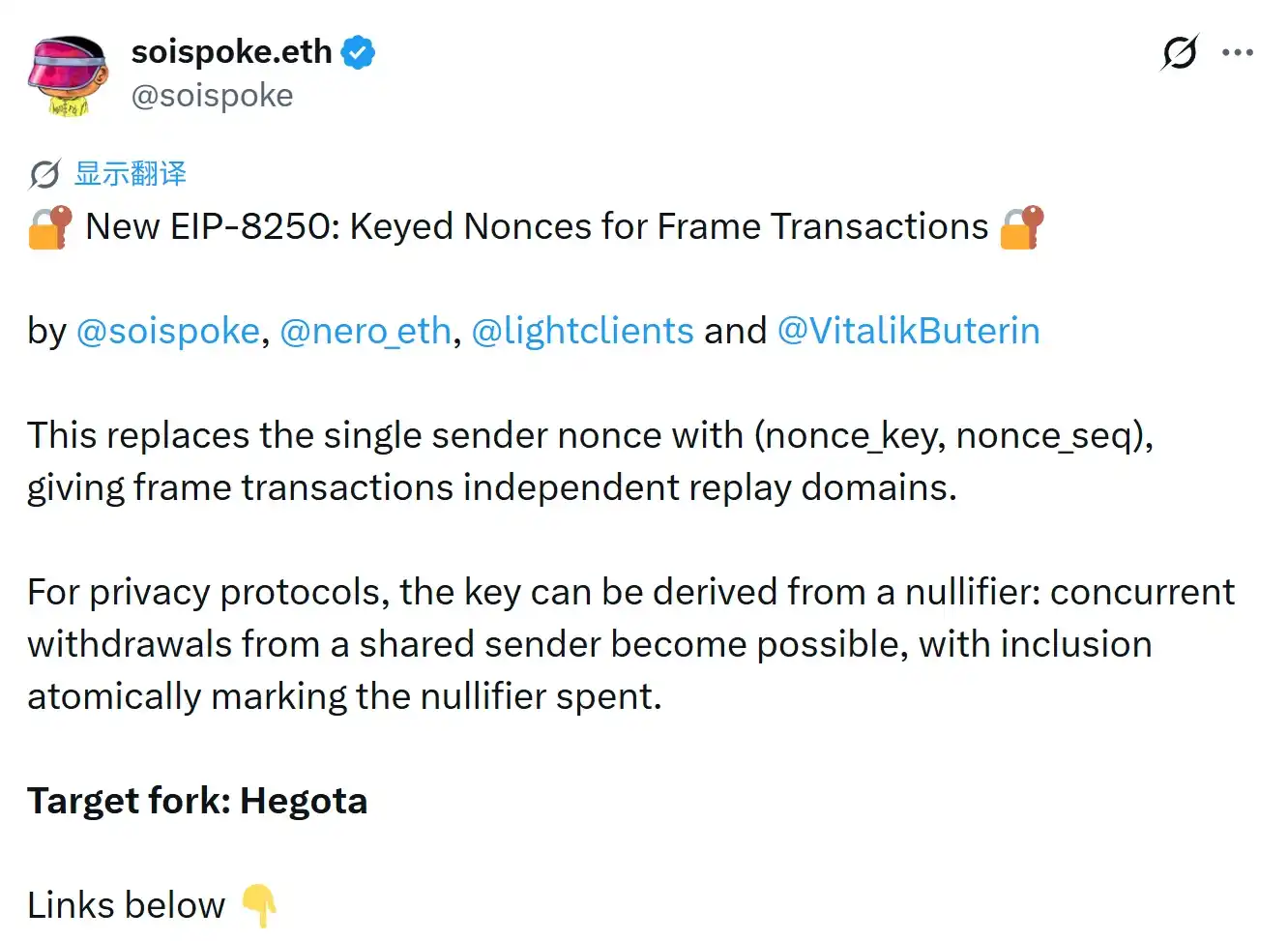
This is especially important for privacy protocols because, to avoid directly binding users' on-chain activities to a single public address, privacy protocols might have multiple users initiate transactions through the same shared sender address. However, under a single nonce mechanism, once one user's transaction is packaged, it could cause other users' waiting transactions to become invalid or blocked.

Whereas Keyed Nonces allows each withdrawal to choose its own nonce domain, for example, derived from a privacy nullifier, reducing this queuing conflict from the protocol layer.

Vitalik's own positioning of it is even more ambitious. When introducing EIP-8250, he clearly stated that Keyed Nonces 'not only provides stronger support for protocol-layer privacy solutions, but may also be the first step in Ethereum's new state scaling strategy—by creating storage types specifically optimized for different use cases, achieving ultimate scalability while maintaining protocol decentralization.'

In other words, it can be simply understood as: Gas Limit solves the 'size of the block', while Keyed Nonces explores the 'shape of the state'—what Ethereum needs to carry in the future is not just more transactions, but more types of transactions.

III. How Will This Affect Ordinary Users?

For the Ethereum ecosystem, many protocol upgrades seem far from ordinary users, but ultimately they all land on the wallet experience.

Because the real entry point for users to interact with Ethereum is not EIPs, clients, or developer meetings, but every transfer, authorization, signature, cross-chain, and DApp interaction within the wallet. That is to say, changes at the protocol layer only truly complete the transformation from technical upgrade to user experience upgrade when they are translated into clearer, smoother, and safer operational experiences at the wallet layer.

For example, the now familiar account abstraction is not meant to make users understand more technical terms, but to allow users to more naturally use on-chain accounts in the future. Therefore, in recent years, batch transactions, Gas payment by others, recovery mechanisms, different signature methods, session authorizations, and more flexible security strategies have gradually become basic capabilities in wallets.

Similarly, taking Keyed Nonces as an example, it sounds like a very low-level optimization of the account queuing mechanism. But on the user side, its potential impact is not abstract. Because today, many users may have encountered similar scenarios during on-chain operations: a transaction is not confirmed for a long time, subsequent transactions get stuck; wanting to cancel or speed up a transaction but not understanding the relationship between nonce, Gas, and replacement transactions; especially during parallel multi-step operations, one failed step affects all subsequent processes.

For ordinary users, these problems seem like 'the wallet isn't easy to use' or 'the chain isn't easy to use'. But behind them is actually related to the design of the single linear nonce in the Ethereum account model. The direction represented by Keyed Nonces is to allow accounts to no longer have to execute all operations in order through one queue, but to split into multiple parallel lanes according to different usage scenarios.

In the future, ordinary transfers, DApp authorizations, private transactions, batch transactions, Gas payment by others, and other operations could theoretically have more independent execution spaces, reducing the probability of blocking and conflicts with each other.

This will undoubtedly further expand the design space for smart wallets.

More importantly, in the past, these capabilities often required the complexity to be shared among wallets, DApps, relay services, and users. Users needed to understand authorization scopes, judge whether Gas was reasonable, know exactly what they were signing, and repeatedly confirm in multi-step operations like cross-chain, swapping, staking, and claiming rewards. Any misunderstanding at any step could lead to operational failure and asset loss risk.

What Ethereum is now trying to do is to move part of this complexity forward to the protocol layer, allowing wallets to provide better interaction abstraction for users based on more standardized, more native underlying capabilities.

This is also why Gas Limit, BAL, ePBS, Keyed Nonces, Frame Transactions, native account abstraction, and cross-L2 interoperability, seemingly belonging to different technical modules, are actually all serving the same thing: enabling Ethereum to carry more complex on-chain usage scenarios without sacrificing decentralization and security.

Looking specifically, putting these dynamics together reveals that Ethereum's recent focus is not scattered:

  • Gas Limit increase addresses mainnet execution capacity and fee pressure;
  • BAL, ePBS, EIP-8037 address how to maintain node verifiability and controlled state growth during scaling;
  • Keyed Nonces and Frame Transactions address bottlenecks in account models, privacy protocols, and smart wallets at the protocol layer;
  • Native account abstraction and cross-L2 interoperability further point towards the experience improvements that ordinary users can truly feel.

This also means Ethereum is entering a new stage.

After all, in the past few years, the market paid more attention to L2 scaling, Blob fee reduction, and modular narratives. Users also gradually got used to transferring assets between different L2s and finding lower-cost interaction environments. However, as the mainnet Gas Limit continues to increase, upgrades like Glamsterdam progress, and account abstraction and interoperability solutions continue to evolve, the question Ethereum is answering is no longer just 'how to make transactions cheaper', but 'how to make the on-chain experience more like a whole'.

In this process, the importance of wallets will undoubtedly be further amplified.

Because wallets are not only the entry point for users into Ethereum, but also the interface through which protocol capabilities are truly understood and used by users. In the future, the more complex the underlying upgrades, the more they need to be translated by wallets into clearer signature prompts, more understandable transaction paths, more upfront risk identification, and smoother on-chain interaction experiences.

Let's encourage each other.

Domande pertinenti

QWhat is the core purpose of increasing the Gas Limit to 200 million in the context of the Glamsterdam upgrade, and what are the associated technical measures?

AThe core purpose is to significantly increase the execution capacity of the Ethereum mainnet, potentially lowering transaction fees for users in the short term. However, it is not a simple block size increase. To prevent negative long-term impacts like increased node burden and state data bloat, the Glamsterdam upgrade employs a combination of technical measures including ePBS (enshrined Proposer-Builder Separation) to securely handle larger blocks, Block-Level Access Lists (BAL) to enable parallel processing, and EIP-8037 to control the cost and growth of state creation operations.

QHow does the Keyed Nonces mechanism (EIP-8250) improve upon the traditional single linear nonce system in Ethereum?

AKeyed Nonces replaces the traditional single nonce queue for an account with multiple independent nonce domains, structured as (nonce_key, nonce_seq). A nonce_key of 0 corresponds to the traditional account nonce, while non-zero keys can manage independent nonce sequences. This allows different types of transactions (e.g., regular transfers, privacy transactions, session authorizations, batch operations) to proceed on separate, parallel channels without blocking or interfering with each other, thus solving bottlenecks for complex account scenarios involving privacy protocols, smart wallets, and third-party gas payment.

QAccording to the article, why is the wallet's role becoming increasingly important in Ethereum's evolving landscape?

AThe wallet is the primary interface through which users interact with Ethereum. As protocol-layer upgrades (like Gas Limit increases, Keyed Nonces, native account abstraction) introduce more complex underlying capabilities, the wallet's role is crucial in translating these technical advancements into clear, safe, and smooth user experiences. This includes providing clearer signature prompts, understandable transaction paths, proactive risk identification, and seamless cross-L2 interactions, thereby completing the transformation from technical upgrade to user experience upgrade.

QWhat fundamental distinction does the article highlight between Ethereum's scaling approach and that of other high-performance blockchains?

AThe article emphasizes that Ethereum's scaling approach fundamentally differs from many high-performance chain narratives. Ethereum does not pursue superficial throughput at the cost of verification costs or node decentralization. Instead, it aims to increase the mainnet's carrying capacity while striving to maintain accessibility for ordinary node operators and preserving the system's verifiability and security. This is a core principle behind its combined technical measures like ePBS and BAL alongside Gas Limit increases.

QWhat broader question is Ethereum now attempting to address, moving beyond just making transactions cheaper?

ABeyond simply making transactions cheaper, Ethereum is now focusing on answering the question of 'how to make the on-chain experience more like a cohesive whole.' This involves integrating improvements across execution capacity (Gas Limit), node verifiability (ePBS, BAL), account models (Keyed Nonces), and user experience (native account abstraction, cross-L2 interoperability) to create a more unified, seamless, and capable on-chain ecosystem for diverse and complex use cases.

Letture associate

MY Group Completes Web4.0 First Stock Listing Layout, SEC Officially Discloses Form 8-K Announcement

MY Group has completed the listing layout for the "Web4.0 First Share," with the U.S. Securities and Exchange Commission (SEC) formally disclosing a Form 8-K report. According to the filing, the company's board has officially appointed Mr. Zhang Dingwen as Chief Executive Officer (CEO) and Executive Director, marking a significant upgrade in management and the entry into a new phase of its global capital market strategy. The disclosure of Form 8-K, used for reporting major corporate events, coincides with market information indicating the company is advancing several key capital market initiatives. These include a global brand system upgrade, corporate strategic restructuring, and a change of its stock ticker symbol. These moves are viewed by industry experts as signals of accelerated internationalization and enhanced global market presence. Concurrently, MY Group's proposed "Web4.0 Ecosystem" is garnering market attention. The company is integrating core capabilities across social traffic portals, global payment systems, public blockchain infrastructure, digital asset trading, and AI-powered financial systems. Analysts suggest that by closing this ecosystem loop, MY Group has the potential to become a next-generation platform merging Web2 user scale with Web3 asset frameworks and AI financial capabilities. With the management upgrade finalized, the global brand strategy launched, and the stock ticker change pending, MY Group is positioning itself as a focal point in the global technology capital market as a potential leading Web4.0 platform enterprise.

marsbit11 h fa

MY Group Completes Web4.0 First Stock Listing Layout, SEC Officially Discloses Form 8-K Announcement

marsbit11 h fa

Trading

Spot
Futures

Articoli Popolari

Cosa è $S$

Comprendere SPERO: Una Panoramica Completa Introduzione a SPERO Mentre il panorama dell'innovazione continua a evolversi, l'emergere delle tecnologie web3 e dei progetti di criptovaluta gioca un ruolo fondamentale nel plasmare il futuro digitale. Un progetto che ha attirato l'attenzione in questo campo dinamico è SPERO, denotato come SPERO,$$s$. Questo articolo mira a raccogliere e presentare informazioni dettagliate su SPERO, per aiutare gli appassionati e gli investitori a comprendere le sue basi, obiettivi e innovazioni nei domini web3 e crypto. Che cos'è SPERO,$$s$? SPERO,$$s$ è un progetto unico all'interno dello spazio crypto che cerca di sfruttare i principi della decentralizzazione e della tecnologia blockchain per creare un ecosistema che promuove l'impegno, l'utilità e l'inclusione finanziaria. Il progetto è progettato per facilitare interazioni peer-to-peer in modi nuovi, fornendo agli utenti soluzioni e servizi finanziari innovativi. Al suo interno, SPERO,$$s$ mira a responsabilizzare gli individui fornendo strumenti e piattaforme che migliorano l'esperienza dell'utente nello spazio delle criptovalute. Questo include la possibilità di metodi di transazione più flessibili, la promozione di iniziative guidate dalla comunità e la creazione di percorsi per opportunità finanziarie attraverso applicazioni decentralizzate (dApps). La visione sottostante di SPERO,$$s$ ruota attorno all'inclusività, cercando di colmare le lacune all'interno della finanza tradizionale mentre sfrutta i vantaggi della tecnologia blockchain. Chi è il Creatore di SPERO,$$s$? L'identità del creatore di SPERO,$$s$ rimane piuttosto oscura, poiché ci sono risorse pubblicamente disponibili limitate che forniscono informazioni dettagliate sul suo fondatore o fondatori. Questa mancanza di trasparenza può derivare dall'impegno del progetto per la decentralizzazione—un ethos che molti progetti web3 condividono, dando priorità ai contributi collettivi rispetto al riconoscimento individuale. Centrando le discussioni attorno alla comunità e ai suoi obiettivi collettivi, SPERO,$$s$ incarna l'essenza dell'empowerment senza mettere in evidenza individui specifici. Pertanto, comprendere l'etica e la missione di SPERO rimane più importante che identificare un creatore singolo. Chi sono gli Investitori di SPERO,$$s$? SPERO,$$s$ è supportato da una varietà di investitori che vanno dai capitalisti di rischio agli investitori angelici dedicati a promuovere l'innovazione nel settore crypto. Il focus di questi investitori generalmente si allinea con la missione di SPERO—dando priorità a progetti che promettono avanzamenti tecnologici sociali, inclusività finanziaria e governance decentralizzata. Queste fondazioni di investitori sono tipicamente interessate a progetti che non solo offrono prodotti innovativi, ma contribuiscono anche positivamente alla comunità blockchain e ai suoi ecosistemi. Il supporto di questi investitori rafforza SPERO,$$s$ come un concorrente degno di nota nel dominio in rapida evoluzione dei progetti crypto. Come Funziona SPERO,$$s$? SPERO,$$s$ impiega un framework multifunzionale che lo distingue dai progetti di criptovaluta convenzionali. Ecco alcune delle caratteristiche chiave che sottolineano la sua unicità e innovazione: Governance Decentralizzata: SPERO,$$s$ integra modelli di governance decentralizzati, responsabilizzando gli utenti a partecipare attivamente ai processi decisionali riguardanti il futuro del progetto. Questo approccio favorisce un senso di proprietà e responsabilità tra i membri della comunità. Utilità del Token: SPERO,$$s$ utilizza il proprio token di criptovaluta, progettato per servire varie funzioni all'interno dell'ecosistema. Questi token abilitano transazioni, premi e la facilitazione dei servizi offerti sulla piattaforma, migliorando l'impegno e l'utilità complessivi. Architettura Stratificata: L'architettura tecnica di SPERO,$$s$ supporta la modularità e la scalabilità, consentendo un'integrazione fluida di funzionalità e applicazioni aggiuntive man mano che il progetto evolve. Questa adattabilità è fondamentale per mantenere la rilevanza nel panorama crypto in continua evoluzione. Coinvolgimento della Comunità: Il progetto enfatizza iniziative guidate dalla comunità, impiegando meccanismi che incentivano la collaborazione e il feedback. Nutrendo una comunità forte, SPERO,$$s$ può affrontare meglio le esigenze degli utenti e adattarsi alle tendenze di mercato. Focus sull'Inclusione: Offrendo basse commissioni di transazione e interfacce user-friendly, SPERO,$$s$ mira ad attrarre una base utenti diversificata, inclusi individui che potrebbero non aver precedentemente interagito nello spazio crypto. Questo impegno per l'inclusione si allinea con la sua missione generale di empowerment attraverso l'accessibilità. Cronologia di SPERO,$$s$ Comprendere la storia di un progetto fornisce preziose intuizioni sulla sua traiettoria di sviluppo e sui traguardi. Di seguito è riportata una cronologia suggerita che mappa eventi significativi nell'evoluzione di SPERO,$$s$: Fase di Concettualizzazione e Ideazione: Le idee iniziali che formano la base di SPERO,$$s$ sono state concepite, allineandosi strettamente con i principi di decentralizzazione e focus sulla comunità all'interno dell'industria blockchain. Lancio del Whitepaper del Progetto: Dopo la fase concettuale, è stato rilasciato un whitepaper completo che dettaglia la visione, gli obiettivi e l'infrastruttura tecnologica di SPERO,$$s$ per suscitare interesse e feedback dalla comunità. Costruzione della Comunità e Prime Interazioni: Sono stati effettuati sforzi attivi di outreach per costruire una comunità di early adopters e potenziali investitori, facilitando discussioni attorno agli obiettivi del progetto e ottenendo supporto. Evento di Generazione del Token: SPERO,$$s$ ha condotto un evento di generazione del token (TGE) per distribuire i propri token nativi ai primi sostenitori e stabilire una liquidità iniziale all'interno dell'ecosistema. Lancio della Prima dApp: La prima applicazione decentralizzata (dApp) associata a SPERO,$$s$ è stata attivata, consentendo agli utenti di interagire con le funzionalità principali della piattaforma. Sviluppo Continuo e Partnership: Aggiornamenti e miglioramenti continui alle offerte del progetto, inclusi partnership strategiche con altri attori nello spazio blockchain, hanno plasmato SPERO,$$s$ in un concorrente competitivo e in evoluzione nel mercato crypto. Conclusione SPERO,$$s$ rappresenta una testimonianza del potenziale del web3 e delle criptovalute di rivoluzionare i sistemi finanziari e responsabilizzare gli individui. Con un impegno per la governance decentralizzata, il coinvolgimento della comunità e funzionalità progettate in modo innovativo, apre la strada verso un panorama finanziario più inclusivo. Come per qualsiasi investimento nello spazio crypto in rapida evoluzione, si incoraggiano potenziali investitori e utenti a ricercare approfonditamente e a impegnarsi in modo riflessivo con gli sviluppi in corso all'interno di SPERO,$$s$. Il progetto mostra lo spirito innovativo dell'industria crypto, invitando a ulteriori esplorazioni delle sue innumerevoli possibilità. Mentre il percorso di SPERO,$$s$ è ancora in fase di sviluppo, i suoi principi fondamentali potrebbero effettivamente influenzare il futuro di come interagiamo con la tecnologia, la finanza e tra di noi in ecosistemi digitali interconnessi.

75 Totale visualizzazioniPubblicato il 2024.12.17Aggiornato il 2024.12.17

Cosa è $S$

Cosa è AGENT S

Agent S: Il Futuro dell'Interazione Autonoma in Web3 Introduzione Nel panorama in continua evoluzione di Web3 e criptovalute, le innovazioni stanno costantemente ridefinendo il modo in cui gli individui interagiscono con le piattaforme digitali. Uno di questi progetti pionieristici, Agent S, promette di rivoluzionare l'interazione uomo-computer attraverso il suo framework agentico aperto. Aprendo la strada a interazioni autonome, Agent S mira a semplificare compiti complessi, offrendo applicazioni trasformative nell'intelligenza artificiale (AI). Questa esplorazione dettagliata approfondirà le complessità del progetto, le sue caratteristiche uniche e le implicazioni per il dominio delle criptovalute. Cos'è Agent S? Agent S si presenta come un innovativo framework agentico aperto, progettato specificamente per affrontare tre sfide fondamentali nell'automazione dei compiti informatici: Acquisizione di Conoscenze Specifiche del Dominio: Il framework apprende in modo intelligente da varie fonti di conoscenza esterne ed esperienze interne. Questo approccio duale gli consente di costruire un ricco repository di conoscenze specifiche del dominio, migliorando le sue prestazioni nell'esecuzione dei compiti. Pianificazione su Lungo Orizzonte di Compiti: Agent S impiega una pianificazione gerarchica potenziata dall'esperienza, un approccio strategico che facilita la suddivisione e l'esecuzione efficiente di compiti complessi. Questa caratteristica migliora significativamente la sua capacità di gestire più sottocompiti in modo efficiente ed efficace. Gestione di Interfacce Dinamiche e Non Uniformi: Il progetto introduce l'Interfaccia Agente-Computer (ACI), una soluzione innovativa che migliora l'interazione tra agenti e utenti. Utilizzando Modelli Linguistici Multimodali di Grandi Dimensioni (MLLM), Agent S può navigare e manipolare senza sforzo diverse interfacce grafiche utente. Attraverso queste caratteristiche pionieristiche, Agent S fornisce un framework robusto che affronta le complessità coinvolte nell'automazione dell'interazione umana con le macchine, preparando il terreno per innumerevoli applicazioni nell'AI e oltre. Chi è il Creatore di Agent S? Sebbene il concetto di Agent S sia fondamentalmente innovativo, informazioni specifiche sul suo creatore rimangono elusive. Il creatore è attualmente sconosciuto, il che evidenzia sia la fase embrionale del progetto sia la scelta strategica di mantenere i membri fondatori sotto anonimato. Indipendentemente dall'anonimato, l'attenzione rimane sulle capacità e sul potenziale del framework. Chi sono gli Investitori di Agent S? Poiché Agent S è relativamente nuovo nell'ecosistema crittografico, informazioni dettagliate riguardanti i suoi investitori e sostenitori finanziari non sono documentate esplicitamente. La mancanza di approfondimenti pubblicamente disponibili sulle fondazioni di investimento o sulle organizzazioni che supportano il progetto solleva interrogativi sulla sua struttura di finanziamento e sulla roadmap di sviluppo. Comprendere il supporto è cruciale per valutare la sostenibilità del progetto e il suo potenziale impatto sul mercato. Come Funziona Agent S? Al centro di Agent S si trova una tecnologia all'avanguardia che gli consente di funzionare efficacemente in contesti diversi. Il suo modello operativo è costruito attorno a diverse caratteristiche chiave: Interazione Uomo-Computer Simile a Quella Umana: Il framework offre una pianificazione AI avanzata, cercando di rendere le interazioni con i computer più intuitive. Mimando il comportamento umano nell'esecuzione dei compiti, promette di elevare le esperienze degli utenti. Memoria Narrativa: Utilizzata per sfruttare esperienze di alto livello, Agent S utilizza la memoria narrativa per tenere traccia delle storie dei compiti, migliorando così i suoi processi decisionali. Memoria Episodica: Questa caratteristica fornisce agli utenti una guida passo-passo, consentendo al framework di offrire supporto contestuale mentre i compiti si sviluppano. Supporto per OpenACI: Con la capacità di funzionare localmente, Agent S consente agli utenti di mantenere il controllo sulle proprie interazioni e flussi di lavoro, allineandosi con l'etica decentralizzata di Web3. Facile Integrazione con API Esterne: La sua versatilità e compatibilità con varie piattaforme AI garantiscono che Agent S possa adattarsi senza problemi agli ecosistemi tecnologici esistenti, rendendolo una scelta attraente per sviluppatori e organizzazioni. Queste funzionalità contribuiscono collettivamente alla posizione unica di Agent S all'interno dello spazio crittografico, poiché automatizza compiti complessi e multi-fase con un intervento umano minimo. Man mano che il progetto evolve, le sue potenziali applicazioni in Web3 potrebbero ridefinire il modo in cui si svolgono le interazioni digitali. Cronologia di Agent S Lo sviluppo e le tappe di Agent S possono essere riassunti in una cronologia che evidenzia i suoi eventi significativi: 27 Settembre 2024: Il concetto di Agent S è stato lanciato in un documento di ricerca completo intitolato “Un Framework Agentico Aperto che Usa i Computer Come un Umano”, mostrando le basi per il progetto. 10 Ottobre 2024: Il documento di ricerca è stato reso pubblicamente disponibile su arXiv, offrendo un'esplorazione approfondita del framework e della sua valutazione delle prestazioni basata sul benchmark OSWorld. 12 Ottobre 2024: È stata rilasciata una presentazione video, fornendo un'idea visiva delle capacità e delle caratteristiche di Agent S, coinvolgendo ulteriormente potenziali utenti e investitori. Questi indicatori nella cronologia non solo illustrano i progressi di Agent S, ma indicano anche il suo impegno per la trasparenza e il coinvolgimento della comunità. Punti Chiave su Agent S Man mano che il framework Agent S continua a evolversi, diversi attributi chiave si distinguono, sottolineando la sua natura innovativa e il potenziale: Framework Innovativo: Progettato per fornire un uso intuitivo dei computer simile all'interazione umana, Agent S porta un approccio nuovo all'automazione dei compiti. Interazione Autonoma: La capacità di interagire autonomamente con i computer attraverso GUI segna un passo avanti verso soluzioni informatiche più intelligenti ed efficienti. Automazione di Compiti Complessi: Con la sua metodologia robusta, può automatizzare compiti complessi e multi-fase, rendendo i processi più veloci e meno soggetti a errori. Miglioramento Continuo: I meccanismi di apprendimento consentono ad Agent S di migliorare dalle esperienze passate, migliorando continuamente le sue prestazioni e la sua efficacia. Versatilità: La sua adattabilità attraverso diversi ambienti operativi come OSWorld e WindowsAgentArena garantisce che possa servire un'ampia gamma di applicazioni. Man mano che Agent S si posiziona nel panorama di Web3 e delle criptovalute, il suo potenziale per migliorare le capacità di interazione e automatizzare i processi segna un significativo avanzamento nelle tecnologie AI. Attraverso il suo framework innovativo, Agent S esemplifica il futuro delle interazioni digitali, promettendo un'esperienza più fluida ed efficiente per gli utenti in vari settori. Conclusione Agent S rappresenta un audace passo avanti nell'unione tra AI e Web3, con la capacità di ridefinire il modo in cui interagiamo con la tecnologia. Sebbene sia ancora nelle sue fasi iniziali, le possibilità per la sua applicazione sono vaste e coinvolgenti. Attraverso il suo framework completo che affronta sfide critiche, Agent S mira a portare le interazioni autonome al centro dell'esperienza digitale. Man mano che ci addentriamo nei regni delle criptovalute e della decentralizzazione, progetti come Agent S giocheranno senza dubbio un ruolo cruciale nel plasmare il futuro della tecnologia e della collaborazione uomo-computer.

516 Totale visualizzazioniPubblicato il 2025.01.14Aggiornato il 2025.01.14

Cosa è AGENT S

Come comprare S

Benvenuto in HTX.com! Abbiamo reso l'acquisto di Sonic (S) semplice e conveniente. Segui la nostra guida passo passo per intraprendere il tuo viaggio nel mondo delle criptovalute.Step 1: Crea il tuo Account HTXUsa la tua email o numero di telefono per registrarti il tuo account gratuito su HTX. Vivi un'esperienza facile e sblocca tutte le funzionalità,Crea il mio accountStep 2: Vai in Acquista crypto e seleziona il tuo metodo di pagamentoCarta di credito/debito: utilizza la tua Visa o Mastercard per acquistare immediatamente SonicS.Bilancio: Usa i fondi dal bilancio del tuo account HTX per fare trading senza problemi.Terze parti: abbiamo aggiunto metodi di pagamento molto utilizzati come Google Pay e Apple Pay per maggiore comodità.P2P: Fai trading direttamente con altri utenti HTX.Over-the-Counter (OTC): Offriamo servizi su misura e tassi di cambio competitivi per i trader.Step 3: Conserva Sonic (S)Dopo aver acquistato Sonic (S), conserva nel tuo account HTX. In alternativa, puoi inviare tramite trasferimento blockchain o scambiare per altre criptovalute.Step 4: Scambia Sonic (S)Scambia facilmente Sonic (S) nel mercato spot di HTX. Accedi al tuo account, seleziona la tua coppia di trading, esegui le tue operazioni e monitora in tempo reale. Offriamo un'esperienza user-friendly sia per chi ha appena iniziato che per i trader più esperti.

929 Totale visualizzazioniPubblicato il 2025.01.15Aggiornato il 2025.03.21

Come comprare S

Discussioni

Benvenuto nella Community HTX. Qui puoi rimanere informato sugli ultimi sviluppi della piattaforma e accedere ad approfondimenti esperti sul mercato. Le opinioni degli utenti sul prezzo di S S sono presentate come di seguito.

活动图片