South Korea To Unveil Tokenized Securities Rules In July As Crypto Regulation Advances

bitcoinistPublicado a 2026-05-16Actualizado a 2026-05-16

Resumen

South Korea's Financial Services Commission (FSC) plans to release a detailed framework for tokenized securities in July. This initiative follows the passage of the Token Securities Institutionalization Act, which will take effect in February 2027. The regulations aim to allow qualified issuers to launch and trade tokenized securities using distributed ledger technology through licensed intermediaries. FSC Vice Chairman Kwon Dae-young emphasized balancing innovation with trust, market order, and investor protection. The framework will include rules for issuance, infrastructure, and distribution, and permit fractional investment securities. This move is part of South Korea's broader push to regulate digital assets. Concurrently, the country is preparing to implement a 20% income tax on crypto assets starting in 2027, despite some public and political opposition. Lawmakers are also urging the government to prioritize delayed stablecoin legislation.

South Korean authorities are set to release detailed rules for the issuance, infrastructure, and distribution of tokenized securities, as the country advances its efforts to implement crypto market regulations in 2027.

FSC Eyes July Tokenized Securities Framework

On Friday, South Korea’s Financial Services Commission (FSC) revealed it is preparing to publish its framework for tokenized securities in July during the second meeting of the public-private joint “Token Securities Council,” launched in March.

Earlier this year, the National Assembly passed the Token Securities Institutionalization Act, which will take effect on February 4, 2027, to amend the Electronic Securities Act and the Capital Markets Act.

The changes are set to allow qualified issuers to launch tokenized securities using distributed ledger technology and enable the products to be traded as investment contract securities on brokerages and other licensed intermediaries.

FSC’s Vice Chairman Kwon Dae-young highlighted that the “upcoming token securities ecosystem must strike a balance between innovation and trust.” Therefore, the regulatory agency is reviewing measures to subordinate regulations and guidelines for the Tokenized Securities Act.

In addition, the regulator is expected to develop a phased roadmap for tokenizing existing standardized securities, such as stocks and bonds, as well as for on-chain settlements, drawing on international practices.

Discussing the best practices for eligibility and underlying assets, Kwon stated that the FSC will “We will uphold the fundamental principles of market order and investor protection, but we will not take a one-sided regulatory approach.” Notably, the regulator plans to allow the issuance of fractional investment securities by pooling underlying assets of the same type within a certain range.

He also explained that the government’s stance was to design a market structure that enhances trading efficiency, ensures fair competition, and protects users. The FSC’s Vice Chairman added that the regulator will add trading limits on OTC exchanges “in a way that allows the expansion of initial market liquidity while systematizing investor protection, so that the limits do not become a barrier stifling innovation.”

South Korea Prepares For Crypto Rules Implementation

The upcoming rules for tokenized securities come amid South Korea’s push to regulate digital assets and the local crypto market. Over the past few years, the country has worked to develop a framework to supervise the crypto industry and protect users.

Alongside the Token Securities Institutionalization Act, the government is expected to implement the Income Tax Act in 2027, with the tax authority fast-tracking the development of a tax base and tracking system to end years of delays.

As reported by Bitcoinist, South Korea’s National Tax Service (NTS) announced last month that it had begun “full-scale preparations” to implement the long-delayed crypto legislation in January of next year.

Under the Income Tax Act, crypto assets will be subject to a 20% income tax rate, up to 22% including local taxes, starting January 1, 2027. The financial authority plans to create a tax base by formally receiving pertinent data from crypto exchanges, establish a guidance framework for taxpayers subject to virtual asset income tax, and outline criteria for capital gains calculations.

Despite some efforts to abolish the crypto tax, including a People Power Party (PPP)-led bill and a petition with over 30,000 signatures, recent reports noted that the odds of abolishing or delaying it seem slim, as parliamentary petitions rarely lead to legislative action and authorities are committed to the 2027 rollout.

Meanwhile, South Korean lawmakers have repeatedly urged the government to prioritize stablecoin legislation, which has been delayed since late 2025 due to a disagreement between the Bank of Korea (BOK) and the FSC.
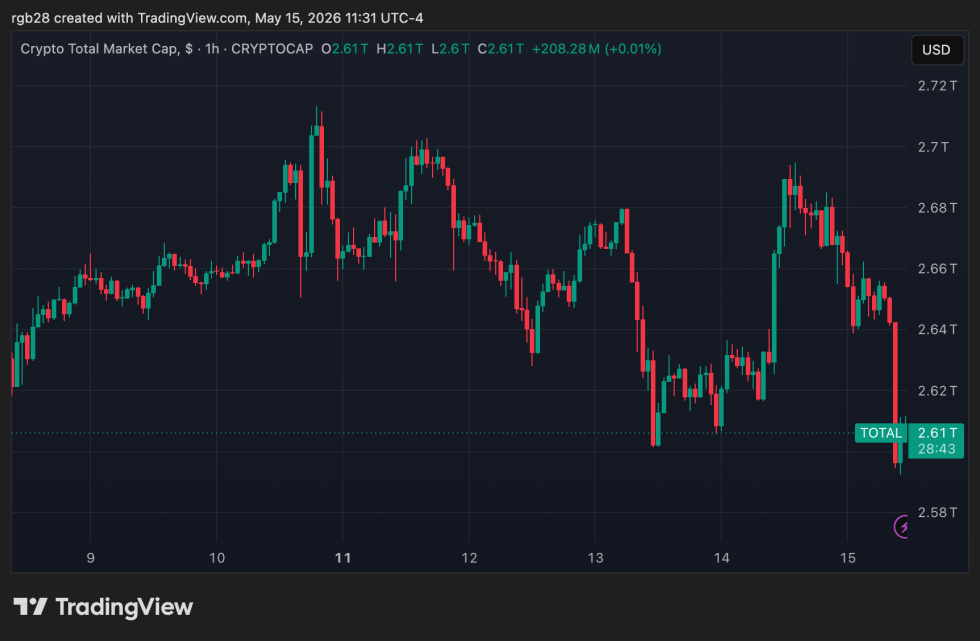
The total crypto market capitalization is at $2.61 trillion in the one-week chart. Source: TOTAL on TradingView


Preguntas relacionadas

QWhen will South Korea release detailed rules for tokenized securities, and under which legislative act are these rules being developed?

ASouth Korea's Financial Services Commission (FSC) plans to release its framework for tokenized securities in July 2026. These rules are being developed under the Token Securities Institutionalization Act, which was passed earlier in 2026 and amends the Electronic Securities Act and the Capital Markets Act. This legislation is set to take effect on February 4, 2027.

QAccording to FSC Vice Chairman Kwon Dae-young, what key principles will guide the upcoming token securities ecosystem?

AFSC Vice Chairman Kwon Dae-young stated that the upcoming token securities ecosystem must strike a balance between innovation and trust. He emphasized that the regulator will uphold the fundamental principles of market order and investor protection while avoiding a one-sided regulatory approach. The goal is to design a market structure that enhances trading efficiency, ensures fair competition, and protects users.

QWhat are the two main components of South Korea's crypto regulations scheduled for implementation in 2027?

ASouth Korea's crypto regulations scheduled for full implementation in 2027 consist of two main components: the Token Securities Institutionalization Act, which governs the issuance and trading of tokenized securities, and the Income Tax Act, which imposes a tax on crypto asset income. The tax will be levied at a 20% income tax rate, potentially up to 22% including local taxes, starting January 1, 2027.

QWhat preparations is South Korea's National Tax Service (NTS) making for the 2027 crypto tax implementation, and what data will be used?

ASouth Korea's National Tax Service (NTS) has begun 'full-scale preparations' to implement the crypto income tax legislation in January 2027. To create the tax base, the authority plans to formally receive pertinent transaction and user data from crypto exchanges. This data will be used to establish a guidance framework for taxpayers and outline criteria for calculating capital gains on virtual asset transactions.

QWhat is the current status of stablecoin legislation in South Korea, and what has been the primary cause of its delay?

AStablecoin legislation in South Korea has been delayed and has not been prioritized by the government despite urging from lawmakers. The primary cause of the delay is a reported disagreement between the Bank of Korea (BOK) and the Financial Services Commission (FSC) over regulatory responsibilities, which has stalled the process since late 2025.

Lecturas Relacionadas

MY Group Completes Web4.0 First Stock Listing Layout, SEC Officially Discloses Form 8-K Announcement

MY Group has completed the listing layout for the "Web4.0 First Share," with the U.S. Securities and Exchange Commission (SEC) formally disclosing a Form 8-K report. According to the filing, the company's board has officially appointed Mr. Zhang Dingwen as Chief Executive Officer (CEO) and Executive Director, marking a significant upgrade in management and the entry into a new phase of its global capital market strategy. The disclosure of Form 8-K, used for reporting major corporate events, coincides with market information indicating the company is advancing several key capital market initiatives. These include a global brand system upgrade, corporate strategic restructuring, and a change of its stock ticker symbol. These moves are viewed by industry experts as signals of accelerated internationalization and enhanced global market presence. Concurrently, MY Group's proposed "Web4.0 Ecosystem" is garnering market attention. The company is integrating core capabilities across social traffic portals, global payment systems, public blockchain infrastructure, digital asset trading, and AI-powered financial systems. Analysts suggest that by closing this ecosystem loop, MY Group has the potential to become a next-generation platform merging Web2 user scale with Web3 asset frameworks and AI financial capabilities. With the management upgrade finalized, the global brand strategy launched, and the stock ticker change pending, MY Group is positioning itself as a focal point in the global technology capital market as a potential leading Web4.0 platform enterprise.

marsbitHace 5 hora(s)

MY Group Completes Web4.0 First Stock Listing Layout, SEC Officially Discloses Form 8-K Announcement

marsbitHace 5 hora(s)

3 People with 100 AI Programmers, Burning Through $1.3 Million a Month! OpenAI: I'll Foot the Bill

In a striking demonstration of AI-powered development, Peter Steinberger (creator of OpenClaw) shared that his three-person team spent $1.3 million in one month to run approximately 100 AI agents (primarily Codex instances). OpenAI covered the cost. The expenditure consumed 6.03 trillion tokens across 7.6 million requests. Steinberger argues that, with "fast mode" disabled, the cost falls below that of a single engineer while providing significantly greater output. This "cloud programmer army" handles core but tedious software engineering tasks: reviewing pull requests, finding security vulnerabilities, deduplicating issues, fixing bugs, monitoring benchmarks, and even generating PRs after meetings. This shifts AI's role from merely writing code to maintaining the entire collaborative fabric of a project. Steinberger's tool, CodexBar (a macOS menu bar app), tracks usage and costs across various AI coding services, highlighting how token consumption is becoming a key metric—a new "means of production." The experiment poses a profound question: if token cost ceases to be a barrier, how will software development transform? As model prices fall, the capability for small teams to leverage large numbers of AI agents could become commonplace, fundamentally altering the scale and speed of development. The future, Steinberger suggests, is arriving rapidly.

marsbitHace 6 hora(s)

3 People with 100 AI Programmers, Burning Through $1.3 Million a Month! OpenAI: I'll Foot the Bill

marsbitHace 6 hora(s)

Trading

Spot
Futuros
活动图片