Countdown to the AI Bull Market? Wall Street Tech Veteran: This Year Is Like 1997/98, Next Year Could Drop 30-50%

marsbitPublicado a 2026-05-13Actualizado a 2026-05-13

Resumen

"AI Bull Market Countdown? Wall Street Veteran: This Year Feels Like 1997/98, Next Year Could Drop 30-50%" In an interview, veteran tech analyst Dan Niles draws parallels between the current AI boom and the 1997-98 period of the internet boom, suggesting the bull run isn't over yet. The core new driver is identified as "Agentic AI," which performs multi-step tasks and consumes vastly more computing power than conversational AI. This shift is expected to boost demand for cloud infrastructure and benefit CPU makers like Intel and AMD, potentially pressuring GPU leader Nvidia. However, Niles warns of significant short-term overbought conditions in semiconductors. His central warning is for a potential major market correction of 30-50% starting in early 2027. Drivers include a slowdown from high growth comparables, the outsized capital demands of companies like OpenAI, and a wave of massive tech IPOs sucking liquidity from the market. A J.P. Morgan survey of 56 global investors aligns with this view, finding that 54% expect a >30% U.S. stock correction by 2027. Among mega-cap tech, Niles favors Google due to its full-stack AI capabilities and cash flow, expresses concern about Meta's user growth, and sees potential for Apple's AI Siri and foldable iPhone. Niles advises investors to be nimble, hold significant cash, and closely monitor the conflicting signals from equities, oil prices, and bond yields, which he believes cannot all be correct simultaneously.

Original Author: Long Yue

Original Source: Wall Street News

The current market situation is strikingly similar to 1997-1998—a Wall Street tech veteran is already starting the countdown for the AI bull market.

On May 11, Dan Niles, a well-known chip analyst from the dot-com bubble era and founder of Niles Investment Management, gave an in-depth interview on "The Master Investor Podcast," systematically presenting his judgment on the current AI market trend: the AI bull market is not over yet, but he predicts a major correction could occur around early 2027, and investors should start preparing now.

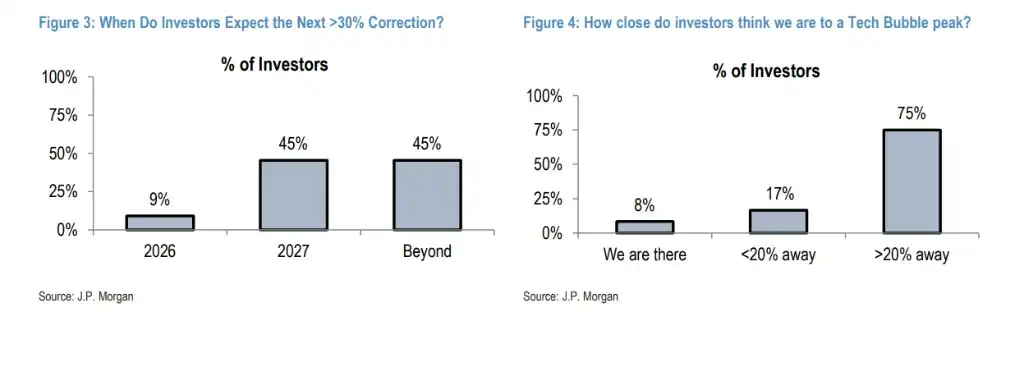
Meanwhile, a JPMorgan survey of 56 global investors found: 54% expect the U.S. stock market to experience a correction of over 30% this year or next, with 45% believing it will happen in 2027—highly aligning with Dan Niles' assessment.
It's 1997-1998, Not 1999, and Certainly Not 2000

Niles compares the current market to 1997-1998, not the peak bubble years of 1999-2000 that many fear.

The logic is as follows: ChatGPT launched at the end of 2022, and AI infrastructure build-out is now entering its fourth year. During the internet era, the Netscape browser debuted in 1994, and 1997-1998 was also the third and fourth years.

In 1997, the Thai currency crisis erupted, the S&P 500 fell up to 11% intra-year but still closed the year up 31%. In 1998, the Russian bond default and Long-Term Capital Management (LTCM) collapse saw the S&P 500 drop up to 19% intra-year, yet it still gained 27% for the full year.

Niles says: "Back then, the overarching theme of internet infrastructure build-out provided a cushion, so every macro shock became a buying opportunity. It's the same today."

He believes the oil price shock triggered by the Iran war is a "man-made event," easier to resolve than the currency crisis or bond defaults of the past, therefore judging this to be another cyclical low.

Agentic AI: The New Fuel Driving This Bull Market Forward

Niles attributes the core driver of this year's market to one term: Agentic AI.

Simply put, previously you would ask ChatGPT a question, and it would give you an answer. This is "conversational AI."

Agentic AI is fundamentally different. Dan Niles gives an example: "You can tell it, 'This is Wilfred, go to the BBC website and get this data, go to Bloomberg for that data, go to CNBC for something else, then compile it all into an Excel spreadsheet.'" This series of operations requires numerous concurrent API calls, consuming 10 to 100 times more compute tokens than a chat-based AI.

Data already proves this: For the two months before OpenAI's release of [presumably a key Agentic AI model/API] on January 30, 2026, token growth was about 20%; in the two months after release, token growth exceeded 120%.

This has directly boosted capital expenditure expectations for hyperscale cloud providers: at the start of the year, the market expected ~30% capex growth for 2026; after Q1 earnings, this rose to 60%; and after the latest round of earnings, it climbed again to 70%.

Niles' conclusion: This is not a small change; it's an order-of-magnitude leap, sufficient to support further gains in AI-related stocks.

Changing Hardware Landscape: CPU Comeback, GPU Under Pressure

The architectural nature of Agentic AI is quietly rewriting the competitive landscape of AI hardware.

Training large models involves repeating the same task, which GPUs excel at; conversational AI inference is also manageable. But Agentic AI requires simultaneously managing multiple applications and coordinating multi-step tasks, which is essentially "orchestration"—a CPU's strong suit.

Dan Niles says: "The ratio used to be roughly 8 GPUs to 1 CPU. As we shift to Agentic, that ratio will move closer to 1 to 1."

This means: Intel and AMD benefit, while Nvidia is "marginally affected in terms of its stock price performance."

But Semiconductors Are Severely Overbought

Dan Niles shifts gears: short-term risks cannot be ignored. "In the short term, the current overbought level in semiconductors is the most severe since just before the 2000 or 1995 crashes. That's certain."

He specifically notes the semiconductor ETF is up about 70% year-to-date, and even the Iran war shock couldn't push it down.

However, he stresses that short-term overbought conditions do not equate to a breakdown in long-term logic—the demand for compute from Agentic AI is real. He is willing to accept the risk of Intel potentially falling 15-20% in the short term because he believes the stock will be even higher by year-end.

2027: Where Will the 30-50% Correction Come From?

Dan Niles is already mapping out scenarios for the next cycle.

The Agentic AI surge began around January 30, 2026. Based on this, by early 2027, growth will start lapping tough high-base comparisons, and growth rates will naturally slow significantly. At that point, what happens to the market?

"I think, from the highs they are at then, these stocks could drop 30% to 50%," he says.

The reference point is recent: in 2022, the "Magnificent 7" tech giants fell an average of 46%—that was just the aftermath of the pandemic-era tech build-out wave receding, far smaller in scale than the current AI frenzy.

Another potential trigger point is OpenAI. Dan Niles points out that OpenAI and Anthropic combined account for about half of the backlog orders at hyperscale cloud vendors. The two companies went from a combined ~$7 billion in annualized revenue in early 2025 to now approaching $70 billion (Anthropic ~$45B, OpenAI ~$24B)—an astonishing growth, but this money must be squeezed out of other companies' budgets.

"When OpenAI's revenue was still $20 billion at year-end, it publicly claimed a commitment of $1.4 trillion in capital expenditure over the next eight years. Where does that money come from? If OpenAI runs into problems, that would significantly accelerate this process."

He also highlights a structural liquidity pressure: IPOs from companies like OpenAI, SpaceX, and Anthropic are coming in succession, each potentially valued in the trillions of dollars. "That money has to come from somewhere else. Fund managers aren't sitting on piles of idle cash; they have to sell something else."

Three Signals Flashing Simultaneously: Stocks, Oil, Bonds—One Must Be Wrong

The first thing Dan Niles does every morning is check oil prices, bond yields, and the stock market simultaneously.

The current combination makes him uneasy: stocks at all-time highs, oil prices up about 60% year-to-date, and both the U.S. 10-year and 30-year Treasury yields hitting yearly highs.

Historically, in 10 out of the past 12 recessions, a sustained rise in oil prices preceded them. If oil stays around $90 for one or two quarters, inflation will pick up, consumer purchasing power will be eroded, and then a major stock market correction becomes inevitable. McDonald's recent earnings mentioned pressure on low-end consumers, with same-store sales missing expectations—when these signals start appearing, you have to worry.

He also notes that the incoming Fed Chair Kevin Warsh is inclined to cut rates and views AI as a deflationary force, "which is a positive factor pushing the market higher in the short term." But he warns that if 10-year or 30-year yields keep climbing, market valuations will face real pressure. His conclusion:

Among stocks, oil, and bonds, one must be wrong. When one of them reprices, it could trigger significant market turmoil.

His advice is concise: "Hold lots of cash now.—Just at the end of March, I thought it was a good time to be aggressive entering the market. But now, I think you should hold lots of cash and be highly vigilant about the eventual resolution."

JPMorgan: 54% of Institutional Investors Expect a Major Correction in 2027

Dan Niles' warning is not an isolated view.

A roadshow feedback report released on May 12, 2026, by JPMorgan's global market strategy team shows that analyst Eduardo Lecubarri led the team to five cities in Latin America, meeting with 56 institutional investors.

The core data from the report is as follows:

  • 92% of surveyed investors believe the stock market return for the full year 2026 will be positive, but not a single one expects gains exceeding 20%;
  • 54% of surveyed investors expect a stock market correction of over 30% sometime between 2026 and 2027 (9% expecting it in 2026, 45% in 2027);
  • 75% of surveyed investors believe there is more than 20% upside remaining before reaching a tech bubble peak;
  • Regarding regional allocation, views on Europe were highly consistent—100% underweight Europe, 100% overweight the U.S.;
  • The sectors most favored by investors are, in order: Technology, Utilities, Industrials.

This highly aligns with Dan Niles' "1998 logic": the bull market is far from over, but the timeline for a major correction is already quietly forming within market consensus.
Quantum Computing: Huge Potential, But Don't Rush

At the end of the interview, Dan Niles also discussed quantum computing. He is a firm long-term believer: "I'm a firm believer in quantum; I think we will get there eventually"—but he cites Bill Gates' famous quote: We tend to overestimate technology in the short term and underestimate it in the long term.

"The earliest AI paper was written over 50 years ago. When did ChatGPT appear? End of 2022. Quantum computing likely follows a similar path. The arrival of quantum computing IPOs will bring back market attention, but truly disruptive applications will take longer to arrive than most people imagine."

Big Tech Company Divergence: Google Out in Front

The recent earnings from tech giants have made Dan Niles' judgment clearer.

Google Cloud: Q4 YoY growth 48%, latest quarter accelerated to 63%, a 15 percentage point acceleration.

AWS: Accelerated from 24% to 28%, a 4 percentage point increase—respectable given its size as the largest cloud provider.

Microsoft Cloud: From 38% to 39%, almost flat.

"These numbers tell you who is truly executing and who is gaining market share," Dan Niles says.

He states his conclusion directly: "Who is the best big tech company to own for the next 3 to 5 years? Clearly Google. They have the full technology stack; you should bet on them. Unless something dramatic happens, they will continue to be winners because they have everything and have massive cash flow to support it."

Google's advantages include: its own large language model Gemini, in-house AI chips (over a decade of history, the longest among the three cloud vendors), strong cash flow supported by its ad business, and the Android ecosystem covering over 75% of global smartphones. Microsoft relies on OpenAI and lacks its own foundational model; Amazon's AI products have limited brand recognition.

Meta's situation is relatively concerning. Dan Niles points out Meta has no public cloud, so it can't sell excess compute to external businesses; its in-house ASIC chip development also started relatively late. More importantly, this quarter Meta saw the first-ever quarterly decline in Family of Apps user numbers—between the two growth engines for its ad monetization model (user count and price per user), the former has now turned, "That is something to worry about."

Regarding Apple, Dan Niles believes the AI-powered Siri and the foldable iPhone will drive a replacement cycle—citing the iPhone 6 as an example: screen size increased from 4 to 5.5 inches, pushing Apple's revenue growth from 7% to 28%.

Stay Nimble, Don't Be Greedy

Dan Niles summarizes his market philosophy in one phrase: "Be Nimble. Hold strong convictions, but hold them loosely."

His assessment framework is: short-term momentum is upward, with Agentic AI and expectations of easier monetary policy still being two key engines; but by early 2027, these growth numbers will start lapping tough comparisons, the explosive growth from Agentic AI will enter a more moderate phase, and combined with the potential risks from OpenAI and the liquidity shock from mega-IPOs, "stock prices could drop 30% to 50% from the highs at that time."

What to do now? Hold more cash, keep a close eye on the three coordinates every morning—oil prices, Treasury yields, and the stock market—and be ready to adjust at any moment.


Preguntas relacionadas

QAccording to Dan Niles, why is the current AI boom period analogous to 1997-1998 rather than the bubble peak of 1999-2000?

ADan Niles compares the current period to 1997-1998 because, similar to the internet boom where Netscape launched in 1994, we are now in the 3rd/4th year of AI infrastructure build-out following ChatGPT's 2022 launch. He argues that, like in 1997-1998, macroeconomic shocks during this phase of foundational investment present buying opportunities rather than signaling the end of the cycle.

QWhat is Agentic AI and how does it differ from the previous generation of AI, according to the article?

AAgentic AI differs from conversational AI (like ChatGPT) by being capable of performing multi-step, coordinated tasks across different applications based on a single instruction. For example, it can gather data from BBC, Bloomberg, and CNBC, then compile it into an Excel spreadsheet. This requires significantly more concurrent processing, consuming 10 to 100 times more compute tokens than simple chat-based AI.

QHow does Dan Niles expect the rise of Agentic AI to shift the competitive landscape among major hardware companies like Intel, AMD, and Nvidia?

ADan Niles expects Agentic AI to benefit CPU makers like Intel and AMD at the relative expense of GPU leader Nvidia. He explains that while GPUs excel at repetitive tasks like model training, the 'orchestration' of multiple concurrent tasks in Agentic AI is a CPU strength. He predicts the hardware ratio in AI systems will shift from roughly 8 GPUs per 1 CPU toward a 1-to-1 ratio.

QWhat major market risk does Dan Niles predict for around early 2027, and what are two key factors he cites that could trigger it?

ADan Niles predicts a potential market correction of 30-50% around early 2027. Two key triggering factors he cites are: 1) The year-over-year growth rates for AI companies will start to compare against the high base established by the Agentic AI boom that began in early 2026, leading to a natural slowdown. 2) Potential risks from companies like OpenAI, whose massive capital expenditure plans and growth depend on budgets being reallocated from other areas, and a wave of multi-trillion dollar IPOs (e.g., OpenAI, SpaceX) that could drain liquidity from the broader market.

QBased on the recent earnings reports of major cloud providers, which company does Dan Niles identify as the best-positioned 'big tech' company for the next 3-5 years, and why?

ADan Niles identifies Google (Alphabet) as the best-positioned big tech company. He points to Google Cloud's accelerating revenue growth (from 48% to 63% YoY), its complete, in-house technology stack (including the Gemini LLM and over a decade of in-house AI chip development), massive cash flow from its advertising business, and the global reach of its Android ecosystem. In contrast, he notes Microsoft's reliance on OpenAI and Amazon's lower-profile AI products as relative weaknesses.

Lecturas Relacionadas

MY Group Completes Web4.0 First Stock Listing Layout, SEC Officially Discloses Form 8-K Announcement

MY Group has completed the listing layout for the "Web4.0 First Share," with the U.S. Securities and Exchange Commission (SEC) formally disclosing a Form 8-K report. According to the filing, the company's board has officially appointed Mr. Zhang Dingwen as Chief Executive Officer (CEO) and Executive Director, marking a significant upgrade in management and the entry into a new phase of its global capital market strategy. The disclosure of Form 8-K, used for reporting major corporate events, coincides with market information indicating the company is advancing several key capital market initiatives. These include a global brand system upgrade, corporate strategic restructuring, and a change of its stock ticker symbol. These moves are viewed by industry experts as signals of accelerated internationalization and enhanced global market presence. Concurrently, MY Group's proposed "Web4.0 Ecosystem" is garnering market attention. The company is integrating core capabilities across social traffic portals, global payment systems, public blockchain infrastructure, digital asset trading, and AI-powered financial systems. Analysts suggest that by closing this ecosystem loop, MY Group has the potential to become a next-generation platform merging Web2 user scale with Web3 asset frameworks and AI financial capabilities. With the management upgrade finalized, the global brand strategy launched, and the stock ticker change pending, MY Group is positioning itself as a focal point in the global technology capital market as a potential leading Web4.0 platform enterprise.

marsbitHace 12 hora(s)

MY Group Completes Web4.0 First Stock Listing Layout, SEC Officially Discloses Form 8-K Announcement

marsbitHace 12 hora(s)

Trading

Spot
Futuros

Artículos destacados

Qué es $S$

Entendiendo SPERO: Una Visión General Completa Introducción a SPERO A medida que el panorama de la innovación continúa evolucionando, la aparición de tecnologías web3 y proyectos de criptomonedas juega un papel fundamental en la configuración del futuro digital. Un proyecto que ha atraído la atención en este campo dinámico es SPERO, denotado como SPERO,$$s$. Este artículo tiene como objetivo reunir y presentar información detallada sobre SPERO, para ayudar a entusiastas e inversores a comprender sus fundamentos, objetivos e innovaciones dentro de los dominios web3 y cripto. ¿Qué es SPERO,$$s$? SPERO,$$s$ es un proyecto único dentro del espacio cripto que busca aprovechar los principios de descentralización y tecnología blockchain para crear un ecosistema que promueva la participación, la utilidad y la inclusión financiera. El proyecto está diseñado para facilitar interacciones de igual a igual de nuevas maneras, proporcionando a los usuarios soluciones y servicios financieros innovadores. En su esencia, SPERO,$$s$ tiene como objetivo empoderar a los individuos al proporcionar herramientas y plataformas que mejoren la experiencia del usuario en el espacio de las criptomonedas. Esto incluye habilitar métodos de transacción más flexibles, fomentar iniciativas impulsadas por la comunidad y crear caminos para oportunidades financieras a través de aplicaciones descentralizadas (dApps). La visión subyacente de SPERO,$$s$ gira en torno a la inclusividad, buscando cerrar brechas dentro de las finanzas tradicionales mientras aprovecha los beneficios de la tecnología blockchain. ¿Quién es el Creador de SPERO,$$s$? La identidad del creador de SPERO,$$s$ sigue siendo algo oscura, ya que hay recursos públicos limitados que proporcionan información de fondo detallada sobre su(s) fundador(es). Esta falta de transparencia puede derivarse del compromiso del proyecto con la descentralización, una ética que muchos proyectos web3 comparten, priorizando las contribuciones colectivas sobre el reconocimiento individual. Al centrar las discusiones en torno a la comunidad y sus objetivos colectivos, SPERO,$$s$ encarna la esencia del empoderamiento sin señalar a individuos específicos. Como tal, comprender la ética y la misión de SPERO sigue siendo más importante que identificar a un creador singular. ¿Quiénes son los Inversores de SPERO,$$s$? SPERO,$$s$ cuenta con el apoyo de una diversa gama de inversores que van desde capitalistas de riesgo hasta inversores ángeles dedicados a fomentar la innovación en el sector cripto. El enfoque de estos inversores generalmente se alinea con la misión de SPERO, priorizando proyectos que prometen avances tecnológicos sociales, inclusión financiera y gobernanza descentralizada. Estas fundaciones de inversores suelen estar interesadas en proyectos que no solo ofrecen productos innovadores, sino que también contribuyen positivamente a la comunidad blockchain y sus ecosistemas. El respaldo de estos inversores refuerza a SPERO,$$s$ como un contendiente notable en el dominio de proyectos cripto que evoluciona rápidamente. ¿Cómo Funciona SPERO,$$s$? SPERO,$$s$ emplea un marco multifacético que lo distingue de los proyectos de criptomonedas convencionales. Aquí hay algunas de las características clave que subrayan su singularidad e innovación: Gobernanza Descentralizada: SPERO,$$s$ integra modelos de gobernanza descentralizada, empoderando a los usuarios para participar activamente en los procesos de toma de decisiones sobre el futuro del proyecto. Este enfoque fomenta un sentido de propiedad y responsabilidad entre los miembros de la comunidad. Utilidad del Token: SPERO,$$s$ utiliza su propio token de criptomoneda, diseñado para servir diversas funciones dentro del ecosistema. Estos tokens permiten transacciones, recompensas y la facilitación de servicios ofrecidos en la plataforma, mejorando la participación y la utilidad general. Arquitectura en Capas: La arquitectura técnica de SPERO,$$s$ apoya la modularidad y escalabilidad, permitiendo la integración fluida de características y aplicaciones adicionales a medida que el proyecto evoluciona. Esta adaptabilidad es fundamental para mantener la relevancia en el cambiante paisaje cripto. Participación de la Comunidad: El proyecto enfatiza iniciativas impulsadas por la comunidad, empleando mecanismos que incentivan la colaboración y la retroalimentación. Al nutrir una comunidad sólida, SPERO,$$s$ puede abordar mejor las necesidades de los usuarios y adaptarse a las tendencias del mercado. Enfoque en la Inclusión: Al ofrecer tarifas de transacción bajas e interfaces amigables para el usuario, SPERO,$$s$ busca atraer a una base de usuarios diversa, incluyendo a individuos que anteriormente pueden no haber participado en el espacio cripto. Este compromiso con la inclusión se alinea con su misión general de empoderamiento a través de la accesibilidad. Cronología de SPERO,$$s$ Entender la historia de un proyecto proporciona información crucial sobre su trayectoria de desarrollo y hitos. A continuación se presenta una cronología sugerida que mapea eventos significativos en la evolución de SPERO,$$s$: Fase de Conceptualización e Ideación: Las ideas iniciales que forman la base de SPERO,$$s$ fueron concebidas, alineándose estrechamente con los principios de descentralización y enfoque comunitario dentro de la industria blockchain. Lanzamiento del Whitepaper del Proyecto: Tras la fase conceptual, se lanzó un whitepaper completo que detalla la visión, los objetivos y la infraestructura tecnológica de SPERO,$$s$ para generar interés y retroalimentación de la comunidad. Construcción de Comunidad y Primeras Interacciones: Se realizaron esfuerzos de divulgación activa para construir una comunidad de primeros adoptantes y posibles inversores, facilitando discusiones en torno a los objetivos del proyecto y obteniendo apoyo. Evento de Generación de Tokens: SPERO,$$s$ llevó a cabo un evento de generación de tokens (TGE) para distribuir sus tokens nativos a los primeros seguidores y establecer liquidez inicial dentro del ecosistema. Lanzamiento de la dApp Inicial: La primera aplicación descentralizada (dApp) asociada con SPERO,$$s$ se puso en marcha, permitiendo a los usuarios interactuar con las funcionalidades centrales de la plataforma. Desarrollo Continuo y Alianzas: Actualizaciones y mejoras continuas a las ofertas del proyecto, incluyendo alianzas estratégicas con otros actores en el espacio blockchain, han moldeado a SPERO,$$s$ en un jugador competitivo y en evolución en el mercado cripto. Conclusión SPERO,$$s$ se erige como un testimonio del potencial de web3 y las criptomonedas para revolucionar los sistemas financieros y empoderar a los individuos. Con un compromiso con la gobernanza descentralizada, la participación comunitaria y funcionalidades diseñadas de manera innovadora, allana el camino hacia un paisaje financiero más inclusivo. Como con cualquier inversión en el espacio cripto que evoluciona rápidamente, se anima a los posibles inversores y usuarios a investigar a fondo y participar de manera reflexiva con los desarrollos en curso dentro de SPERO,$$s$. El proyecto muestra el espíritu innovador de la industria cripto, invitando a una mayor exploración de sus innumerables posibilidades. Mientras el viaje de SPERO,$$s$ aún se desarrolla, sus principios fundamentales pueden, de hecho, influir en el futuro de cómo interactuamos con la tecnología, las finanzas y entre nosotros en ecosistemas digitales interconectados.

72 Vistas totalesPublicado en 2024.12.17Actualizado en 2024.12.17

Qué es $S$

Qué es AGENT S

Agent S: El Futuro de la Interacción Autónoma en Web3 Introducción En el paisaje en constante evolución de Web3 y las criptomonedas, las innovaciones están redefiniendo constantemente cómo los individuos interactúan con las plataformas digitales. Uno de estos proyectos pioneros, Agent S, promete revolucionar la interacción humano-computadora a través de su marco agente abierto. Al allanar el camino para interacciones autónomas, Agent S busca simplificar tareas complejas, ofreciendo aplicaciones transformadoras en inteligencia artificial (IA). Esta exploración detallada profundizará en las complejidades del proyecto, sus características únicas y las implicaciones para el dominio de las criptomonedas. ¿Qué es Agent S? Agent S se presenta como un marco agente abierto innovador, diseñado específicamente para abordar tres desafíos fundamentales en la automatización de tareas informáticas: Adquisición de Conocimiento Específico del Dominio: El marco aprende inteligentemente de diversas fuentes de conocimiento externas y experiencias internas. Este enfoque dual le permite construir un rico repositorio de conocimiento específico del dominio, mejorando su rendimiento en la ejecución de tareas. Planificación a Largo Plazo de Tareas: Agent S emplea planificación jerárquica aumentada por la experiencia, un enfoque estratégico que facilita la descomposición y ejecución eficiente de tareas complejas. Esta característica mejora significativamente su capacidad para gestionar múltiples subtareas de manera eficiente y efectiva. Manejo de Interfaces Dinámicas y No Uniformes: El proyecto introduce la Interfaz Agente-Computadora (ACI), una solución innovadora que mejora la interacción entre agentes y usuarios. Utilizando Modelos de Lenguaje Multimodal de Gran Escala (MLLMs), Agent S puede navegar y manipular diversas interfaces gráficas de usuario sin problemas. A través de estas características pioneras, Agent S proporciona un marco robusto que aborda las complejidades involucradas en la automatización de la interacción humana con las máquinas, preparando el terreno para una multitud de aplicaciones en IA y más allá. ¿Quién es el Creador de Agent S? Si bien el concepto de Agent S es fundamentalmente innovador, la información específica sobre su creador sigue siendo elusiva. El creador es actualmente desconocido, lo que resalta ya sea la etapa incipiente del proyecto o la elección estratégica de mantener a los miembros fundadores en el anonimato. Independientemente de la anonimidad, el enfoque sigue siendo en las capacidades y el potencial del marco. ¿Quiénes son los Inversores de Agent S? Dado que Agent S es relativamente nuevo en el ecosistema criptográfico, la información detallada sobre sus inversores y patrocinadores financieros no está documentada explícitamente. La falta de información disponible públicamente sobre las bases de inversión u organizaciones que apoyan el proyecto plantea preguntas sobre su estructura de financiamiento y hoja de ruta de desarrollo. Comprender el respaldo es crucial para evaluar la sostenibilidad del proyecto y su posible impacto en el mercado. ¿Cómo Funciona Agent S? En el núcleo de Agent S se encuentra una tecnología de vanguardia que le permite funcionar de manera efectiva en diversos entornos. Su modelo operativo se basa en varias características clave: Interacción Humano-Computadora Similar a la Humana: El marco ofrece planificación avanzada de IA, esforzándose por hacer que las interacciones con las computadoras sean más intuitivas. Al imitar el comportamiento humano en la ejecución de tareas, promete elevar las experiencias de los usuarios. Memoria Narrativa: Empleada para aprovechar experiencias de alto nivel, Agent S utiliza memoria narrativa para hacer un seguimiento de las historias de tareas, mejorando así sus procesos de toma de decisiones. Memoria Episódica: Esta característica proporciona a los usuarios una guía paso a paso, permitiendo que el marco ofrezca apoyo contextual a medida que se desarrollan las tareas. Soporte para OpenACI: Con la capacidad de ejecutarse localmente, Agent S permite a los usuarios mantener el control sobre sus interacciones y flujos de trabajo, alineándose con la ética descentralizada de Web3. Fácil Integración con APIs Externas: Su versatilidad y compatibilidad con varias plataformas de IA aseguran que Agent S pueda encajar sin problemas en ecosistemas tecnológicos existentes, convirtiéndolo en una opción atractiva para desarrolladores y organizaciones. Estas funcionalidades contribuyen colectivamente a la posición única de Agent S dentro del espacio cripto, ya que automatiza tareas complejas y de múltiples pasos con una intervención humana mínima. A medida que el proyecto evoluciona, sus posibles aplicaciones en Web3 podrían redefinir cómo se desarrollan las interacciones digitales. Cronología de Agent S El desarrollo y los hitos de Agent S pueden encapsularse en una cronología que resalta sus eventos significativos: 27 de septiembre de 2024: El concepto de Agent S fue lanzado en un documento de investigación integral titulado “Un Marco Agente Abierto que Usa Computadoras Como un Humano”, mostrando las bases del proyecto. 10 de octubre de 2024: El documento de investigación fue puesto a disposición del público en arXiv, ofreciendo una exploración profunda del marco y su evaluación de rendimiento basada en el benchmark OSWorld. 12 de octubre de 2024: Se lanzó una presentación en video, proporcionando una visión visual de las capacidades y características de Agent S, involucrando aún más a posibles usuarios e inversores. Estos marcadores en la cronología no solo ilustran el progreso de Agent S, sino que también indican su compromiso con la transparencia y la participación comunitaria. Puntos Clave Sobre Agent S A medida que el marco Agent S continúa evolucionando, varios atributos clave destacan, subrayando su naturaleza innovadora y potencial: Marco Innovador: Diseñado para proporcionar un uso intuitivo de las computadoras similar a la interacción humana, Agent S aporta un enfoque novedoso a la automatización de tareas. Interacción Autónoma: La capacidad de interactuar de manera autónoma con las computadoras a través de GUI significa un salto hacia soluciones informáticas más inteligentes y eficientes. Automatización de Tareas Complejas: Con su metodología robusta, puede automatizar tareas complejas y de múltiples pasos, haciendo que los procesos sean más rápidos y menos propensos a errores. Mejora Continua: Los mecanismos de aprendizaje permiten a Agent S mejorar a partir de experiencias pasadas, mejorando continuamente su rendimiento y eficacia. Versatilidad: Su adaptabilidad en diferentes entornos operativos como OSWorld y WindowsAgentArena asegura que pueda servir a una amplia gama de aplicaciones. A medida que Agent S se posiciona en el paisaje de Web3 y criptomonedas, su potencial para mejorar las capacidades de interacción y automatizar procesos significa un avance significativo en las tecnologías de IA. A través de su marco innovador, Agent S ejemplifica el futuro de las interacciones digitales, prometiendo una experiencia más fluida y eficiente para los usuarios en diversas industrias. Conclusión Agent S representa un audaz avance en la unión de la IA y Web3, con la capacidad de redefinir cómo interactuamos con la tecnología. Aunque aún se encuentra en sus primeras etapas, las posibilidades para su aplicación son vastas y atractivas. A través de su marco integral que aborda desafíos críticos, Agent S busca llevar las interacciones autónomas al primer plano de la experiencia digital. A medida que nos adentramos más en los reinos de las criptomonedas y la descentralización, proyectos como Agent S sin duda desempeñarán un papel crucial en la configuración del futuro de la tecnología y la colaboración humano-computadora.

442 Vistas totalesPublicado en 2025.01.14Actualizado en 2025.01.14

Qué es AGENT S

Cómo comprar S

¡Bienvenido a HTX.com! Hemos hecho que comprar Sonic (S) sea simple y conveniente. Sigue nuestra guía paso a paso para iniciar tu viaje de criptos.Paso 1: crea tu cuenta HTXUtiliza tu correo electrónico o número de teléfono para registrarte y obtener una cuenta gratuita en HTX. Experimenta un proceso de registro sin complicaciones y desbloquea todas las funciones.Obtener mi cuentaPaso 2: ve a Comprar cripto y elige tu método de pagoTarjeta de crédito/débito: usa tu Visa o Mastercard para comprar Sonic (S) al instante.Saldo: utiliza fondos del saldo de tu cuenta HTX para tradear sin problemas.Terceros: hemos agregado métodos de pago populares como Google Pay y Apple Pay para mejorar la comodidad.P2P: tradear directamente con otros usuarios en HTX.Over-the-Counter (OTC): ofrecemos servicios personalizados y tipos de cambio competitivos para los traders.Paso 3: guarda tu Sonic (S)Después de comprar tu Sonic (S), guárdalo en tu cuenta HTX. Alternativamente, puedes enviarlo a otro lugar mediante transferencia blockchain o utilizarlo para tradear otras criptomonedas.Paso 4: tradear Sonic (S)Tradear fácilmente con Sonic (S) en HTX's mercado spot. Simplemente accede a tu cuenta, selecciona tu par de trading, ejecuta tus trades y monitorea en tiempo real. Ofrecemos una experiencia fácil de usar tanto para principiantes como para traders experimentados.

861 Vistas totalesPublicado en 2025.01.15Actualizado en 2025.03.21

Cómo comprar S

Discusiones

Bienvenido a la comunidad de HTX. Aquí puedes mantenerte informado sobre los últimos desarrollos de la plataforma y acceder a análisis profesionales del mercado. A continuación se presentan las opiniones de los usuarios sobre el precio de S (S).

活动图片