Bezos, Schmidt, Powell Jobs: The Three AI Investment Philosophies of Silicon Valley's Old Money

marsbitPublicado a 2026-05-14Actualizado a 2026-05-14

Resumen

Jeff Bezos, Eric Schmidt, and Laurene Powell Jobs, three prominent figures from Silicon Valley's "old money," are deploying massive personal fortunes into AI, but with distinctly different investment philosophies reflecting their visions for the future. Eric Schmidt, the former Google CEO, approaches AI as a geopolitical and infrastructural arms race. Through his family office, Hillspire, he invests heavily in defense AI companies, energy infrastructure (like Bolt Data & Energy to power data centers), and space launch capabilities (Relativity Space). For Schmidt, the ultimate AI advantage lies in physical resources—energy, transport, and military application—framing it as a national competition requiring state-level strategy and endurance. Jeff Bezos is building a vertically integrated, full-stack AI empire. His bets span the model layer (via Amazon's massive investment in Anthropic), the application layer (through investments like Perplexity), and now, the physical execution layer. His new venture, Project Prometheus, with $6.2 billion, aims to inject AI into manufacturing, creating a closed loop from AI chips and cloud compute (AWS) to real-world production, potentially for Amazon's own ventures like the Kuiper satellite network. In contrast, Laurene Powell Jobs adopts a more subtle, human-centric approach through her Emerson Collective. Her AI investments focus on specific, positive-impact applications—such as AI for healthcare (Proximie, Atropos Health), education (Cur...

Author: Deep Chao TechFlow

On November 17, 2025, 61-year-old Jeff Bezos once again became the CEO of a company. It was the first time he returned to an operational role since stepping down from Amazon in 2021. The new company is called Project Prometheus, with a startup fund of $6.2 billion, focusing on "Physical AI" and targeting the manufacturing industry.

Seven months earlier, 70-year-old Eric Schmidt took control of a rocket company called Relativity Space and appointed himself as CEO. He didn't explain why he needed to step in at his age, perhaps "every day matters in the AI era" was the default answer.

In June of the same year, Steve Jobs' widow, Laurene Powell Jobs, gave a rare public interview. She sat next to Jony Ive, talking about the prototype she saw at the company io. It was an "AI device" acquired by OpenAI with $6.4 billion in stock, reportedly screenless and shaped like a player hanging around the neck. Her evaluation of the prototype was: "It's an incredible thing to see an idea become reality."

Three people, three different postures. But they are all placing bets at the same casino.

Over the past three years, top moneybags in Silicon Valley have almost all been doing the same thing: pouring money from family offices, venture capital, and charitable foundations into AI. Schmidt, Bezos, and Powell Jobs are just the three most prominent examples. But a closer look at their target lists reveals that this is not the same game; they are betting on three completely different futures.

Schmidt: Treating AI as the Next Cold War
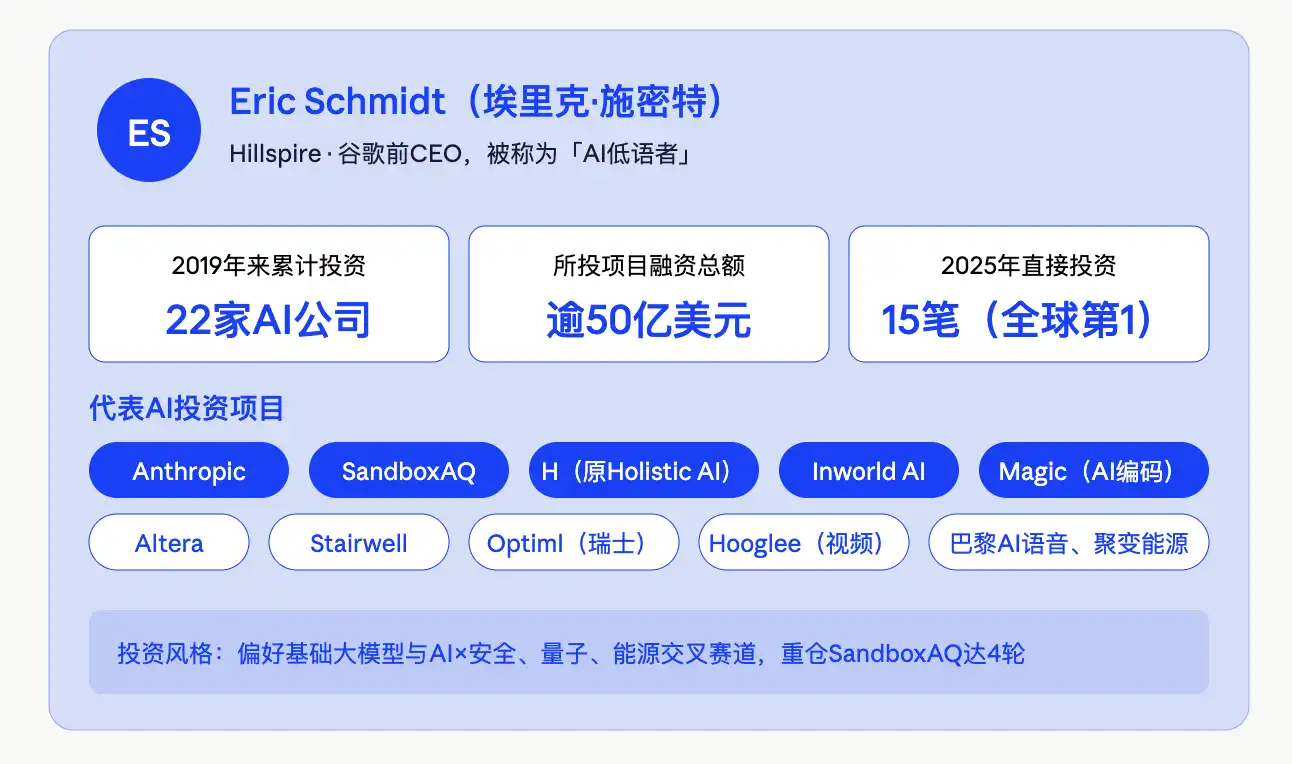
According to data cited by Wikipedia and The AI Insider, Schmidt's family office Hillspire has invested in over 22 AI companies since 2019, totaling more than $5 billion. The list includes Anthropic, SandboxAQ (a quantum+AI company spun off from Alphabet), Inworld AI, Holistic AI, and Altera. These are the targets that "insiders in the industry" would list.

But what truly reveals his underlying approach is another list.

White Stork: A company producing AI drones in Ukraine. Rebellion Defense: Defense AI. Istari: Simulation. Swift Beat: Military software. This is a family office that treats AI as the next generation of military equipment.

Schmidt has served as Chairman of the Defense Innovation Board since 2016 and co-led the National Security Commission on Artificial Intelligence from 2019 to 2021. He is a player who treats AI policy, defense procurement, and energy infrastructure as one and the same. In January 2024, Forbes disclosed that he simultaneously launched White Stork's drone projects in the U.S. and Ukraine, treating the Ukrainian battlefield as a "laboratory for AI weapons."

Then there's infrastructure.

In January 2026, he co-founded a company called Bolt Data & Energy with Texas Pacific Land, serving as its chairman. This company doesn't rent server rooms or buy electricity from the grid; it aims to build its own natural gas power plants in the West Texas wilderness, directly pumping electricity into data centers. The plan is to first reach 1 gigawatt, eventually scaling to 10 gigawatts, equivalent to the electricity consumption of 7 million households. Texas Pacific Land contributed $50 million, plus priority water supply rights. In an email reply to Fortune, Schmidt said: "The biggest bottleneck for AI is not algorithms, it's energy."

In March of the same year, he took control of Relativity Space. This company is developing a reusable rocket called Terran R, aiming to challenge SpaceX's monopoly in medium-to-low orbit launches. By that time, it had $2.9 billion in orders.

Putting these pieces together, the logic becomes clear.

Schmidt doesn't believe in the approach of "investing in a basket of large model companies." He believes the outcome of AI will ultimately depend on three things: computing power (data centers and electricity), transport (rockets, satellites, drones), and policy (defense committees and congressional hearings). He also invests in model companies, and even publicly wrote an article calling for the U.S. to increase open-source investment after DeepSeek emerged, but that's just one piece on his chessboard, not the whole game.

His reaction to DeepSeek is very telling. After DeepSeek's release in early 2025, Schmidt immediately wrote an article in The Washington Post, calling it a "turning point in the global AI race." His prescription wasn't retreat, but escalation, including more open source, more Stargate-style infrastructure, and more sharing of training methods between model labs.

In other words, he sees AI as an endurance race between nations, and he has already positioned himself on the sidelines while also serving as a committee member. At 70, stepping out to become CEO of Relativity might seem like a struggle to outsiders. He explains it himself: Kissinger worked until he was 100, "times of major transformation require responsibility, not withdrawal."

Bezos: The Full-Stack Control Freak
Bezos's approach is completely different from Schmidt's.

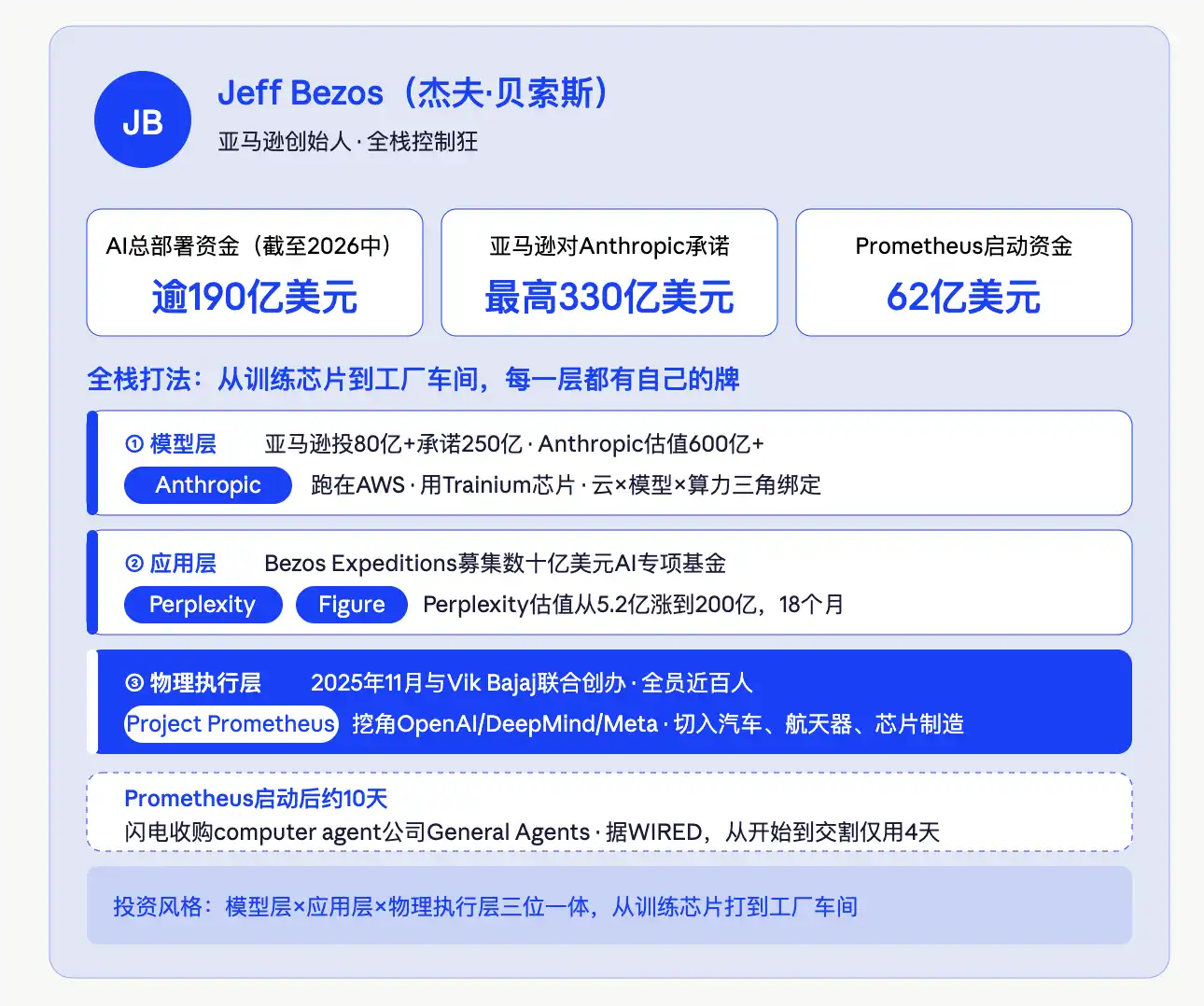
According to data cited by StartupHub from TechCrunch, The Information, and the Bezos Earth Fund, as of mid-2026, Bezos had deployed over $19 billion into AI. This number is still rising.

Breaking it down, it's mainly divided into three parts.

The first part is Anthropic. Amazon started investing in September 2023, eventually reaching $8 billion, and in April 2026, committed to adding up to $25 billion more. Anthropic runs on AWS, using Amazon's Trainium chips. This binds Amazon's cloud infrastructure, Bezos's model-layer bet, and Anthropic's research capacity into a triangle, going far beyond a mere financial investment. When Anthropic's valuation soared above $60 billion, Amazon had already captured the largest external slice of the pie.

The second part is the scattered investments of Bezos Expeditions. Bezos Expeditions is raising a multi-billion dollar AI-specific fund, upgrading "Bezos's personal angel investments" into "institutional investor." Among them, its investment in Perplexity, an AI search company, rose from a $520 million valuation in January 2024 to $20 billion in September 2025.

The third part is Project Prometheus.

In November 2025, Bezos and former Google X executive Vik Bajaj jointly announced the founding of this company, with a startup fund of $6.2 billion, nearly 100 employees. The team was recruited from OpenAI, DeepMind, and Meta. The founding advisor list included Ashish Vaswani and Jakob Uszkoreit, two of the authors of the 2017 paper "Attention Is All You Need." The company's goal is to apply AI to manufacturing, including cars, spacecraft, and chips.

Why manufacturing? Because this neatly meshes with Bezos's other businesses. Amazon has the Kuiper satellite constellation; once manufacturing AI is realized, its first batch of customers will be right in his own backyard.

Musk called Project Prometheus a "copycat" on X.

But structurally, this is not copying.

Bezos holds the model layer through Anthropic, the application layer through Perplexity and Figure, and the computing layer through Amazon. Now, by creating Prometheus, he's integrating AI into manufacturing, taking on the "physical world execution layer" as well. This is a full-stack approach, with his own cards at every layer, from training chips to deployment on the factory floor.

About 10 days after Project Prometheus launched, it quietly acquired a company called General Agents. This company developed "computer agents," AI agents capable of directly operating an entire computer. WIRED later disclosed that this acquisition, from start to closing, took only four days.

Donely's CEO Harsha Abegunasekara commented: "What General Agents truly cracked is speed; Ace runs on your computer almost instantaneously." His company was originally a competitor of General Agents.

From angel investing to forming a specialized fund, to personally taking the CEO role, Bezos only needed 18 months. He is essentially building a system larger than Amazon.

Powell Jobs: The Low-Key Camp
Looking at these three individuals together, Powell Jobs is the one who least resembles an "AI investor."

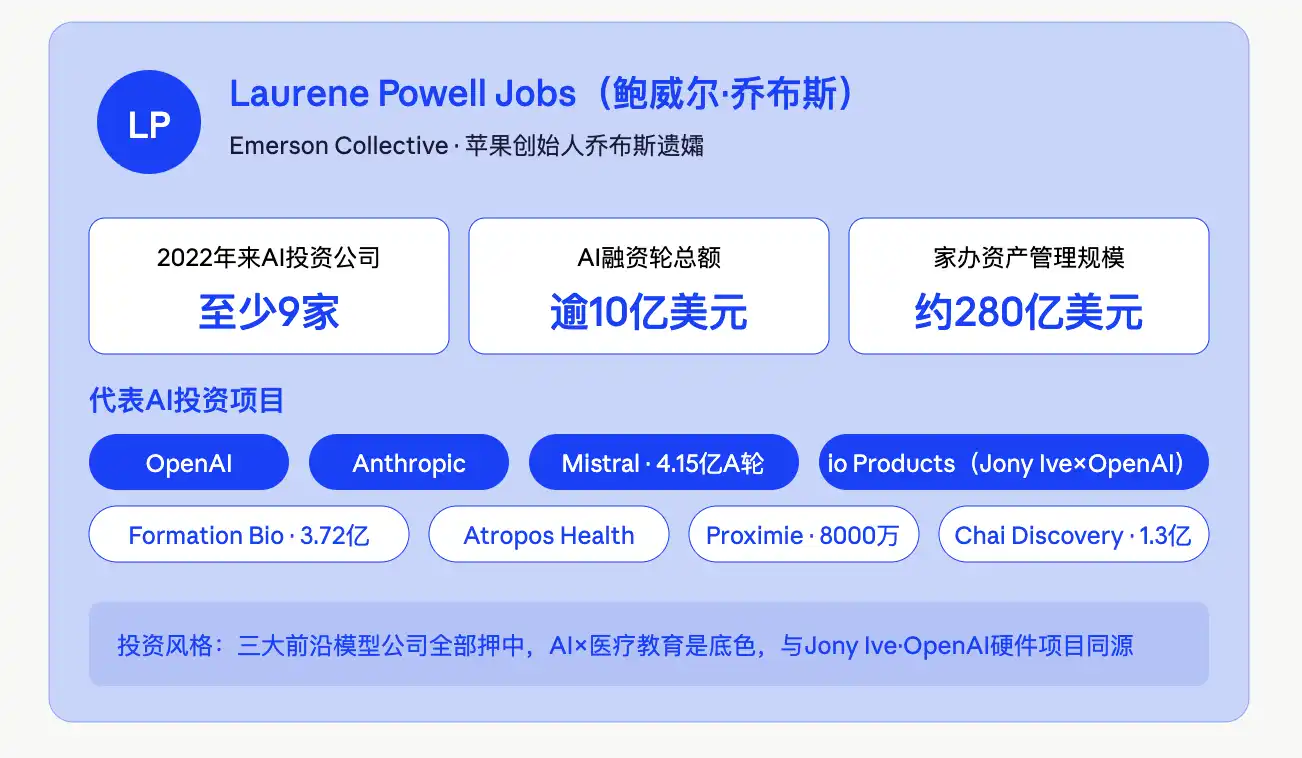
According to CNBC citing data from the private wealth platform Fintrx, her family office, Emerson Collective, has invested in at least 9 AI-related startups since 2022, participating in funding rounds totaling over $1 billion. This figure is not on the same scale as Schmidt's or Bezos's.

But the interesting part is the list itself.

Proximie: A remote surgical connection platform; Atropos Health: Clinical data AI; Formation Bio: AI drug discovery; Curipod: A Norwegian AI teaching tool; Mistral: The French large model company, Europe's sole contender against OpenAI.

No defense, no data centers, no rockets.

Emerson Collective's website clearly states its investment directions: Education, Energy & Environment, Digital Health, Fintech, Media. AI is just a tool woven into these themes. She holds a majority stake in The Atlantic and is very adept at Columbia-style "soft power" investments.

But the one investment she truly nailed is not on the same line as the ones mentioned above.

After Jony Ive left Apple in 2019, Powell Jobs invested in his design firm LoveFrom through Emerson Collective. Ive later said in a Financial Times interview: "If it weren't for Laurene, LoveFrom wouldn't exist at all." A few years later, Ive founded another hardware company called io, specializing in AI devices, and Powell Jobs invested again. In May 2025, OpenAI acquired io in an all-stock transaction worth $6.4 billion, making Ive a billionaire on paper. Emerson Collective also cashed out.

Another key investment: Emerson Collective was one of the early investors in Mistral AI when this French company was still Europe's last remaining contender in large models.

Putting these together, her AI bets are concentrated in two directions: either "using AI to solve specific human problems" or "reshaping the way humans and machines interact" (io's devices, Ive's design).

VC Sheet described Emerson Collective in an assessment: "An intentionally opaque LLC that houses venture capital, philanthropy, policy advocacy, art, and media ownership under one roof, able to use whichever tool—grants, policy lobbying, or investment—is most effective."

Philosophically, she is closer to the older generation of East Coast family offices: influence is more important than returns, the long term more important than the short term, having the microphone more important than the spotlight.

Three Investment Philosophies

Placing the three lists side by side, you see three sets of judgments about AI's future.

Schmidt is betting on national competition and infrastructure bottlenecks. In his world, AI will ultimately be determined by "who has the most electricity, the fastest rockets, the strongest drones." Models are just the entry ticket; the real moat is in the physical layer. That's why he personally steps in to lead Relativity and Bolt. What he wants is not returns, but control.

Bezos is betting on application diffusion at an industrial revolution scale. He believes AI will eventually permeate every machine tool, every airplane, every satellite like electricity. So he locks down the model layer through Amazon, the manufacturing layer through Prometheus, and embeds into the consumer application layer through Expeditions. He's not betting on whether a specific company will win, but whether this entire "full-stack" structure can win.

Powell Jobs is betting on something else. She's betting that humans will ultimately be unable to tolerate the current human-machine interaction model. She and Ive repeatedly emphasized in the Financial Times interview that "humans deserve better." Her investments in io, LoveFrom, medical AI, and educational AI are based on the same judgment: the biggest market of the next decade will be "fixing the side effects caused by the internet in the last decade."

Three sets of judgments, three different approaches.

Which one is right? No one knows. Schmidt might overestimate the weight of geopolitics in the AI economy. Bezos might underestimate the capital consumption of the "full-stack" heavy-asset model—a typical example is that Prometheus hasn't shipped anything yet, and there's already talk of needing to raise another $10 billion. Powell Jobs faces an even more awkward question: io's devices won't go into mass production until 2027, and OpenAI's own financial model has been repeatedly questioned by the market.

But one thing is certain. When the winners of the last internet generation collectively turn their family funds toward AI, this is no longer a small hype cycle in a certain sector. Bolt has already raised $150 million in startup funds; Anthropic alone is set to receive Amazon's committed $33 billion. Capital flows of this magnitude will shape the industrial geography of the next decade on their own.

As for who will have the last laugh, we'll have to look back in 2030. Until then, the three old-timers are still at the table, and the chips are still being added.


Preguntas relacionadas

QAccording to the article, what are the three distinct AI investment philosophies of Jeff Bezos, Eric Schmidt, and Laurene Powell Jobs?

AJeff Bezos's philosophy is an 'all-stack control freak' approach, aiming to build a system controlling everything from chips to factory floors through model layers (Anthropic), application layers (Perplexity, Figure), computing power (AWS), and manufacturing (Project Prometheus). Eric Schmidt views AI as the next Cold War, focusing on national competition and physical infrastructure like energy, rockets, drones, and defense policy. Laurene Powell Jobs focuses on human-centered applications, investing in using AI to solve specific human problems or reshape human-machine interaction through hardware and design.

QWhat specific company did Eric Schmidt personally become the CEO of to support his AI investment strategy, and what is its business?

AEric Schmidt became the CEO of Relativity Space, a rocket company developing a reusable rocket called Terran R to challenge SpaceX's monopoly in low-Earth orbit launch services. This is part of his strategy to secure the 'transportation' layer for AI's future.

QHow does Jeff Bezos's Project Prometheus connect to his broader business ecosystem?

AProject Prometheus focuses on applying AI to manufacturing (cars, spacecraft, chips). This aligns with Bezos's other businesses, as its first major clients could be internal. For example, Amazon has the Kuiper satellite constellation, and Project Prometheus's manufacturing AI could directly support its production.

QWhat is Laurene Powell Jobs's significant investment connection to Apple's former design chief Jony Ive?

ALaurene Powell Jobs's Emerson Collective invested in Jony Ive's design firm LoveFrom and later in his AI hardware company io. In 2025, OpenAI acquired io in a $6.4 billion all-stock deal, resulting in a significant financial return for both Ive and Emerson Collective.

QWhat common move have these three Silicon Valley figures made in the past three years regarding AI?

AIn the past three years, these top Silicon Valley figures have directed substantial capital from their family offices, venture capital, and charitable foundations into AI. While their specific strategies differ, they are all heavily betting on AI as a defining technology for the next decade, driving massive capital flows that will shape the future industry landscape.

Lecturas Relacionadas

MY Group Completes Web4.0 First Stock Listing Layout, SEC Officially Discloses Form 8-K Announcement

MY Group has completed the listing layout for the "Web4.0 First Share," with the U.S. Securities and Exchange Commission (SEC) formally disclosing a Form 8-K report. According to the filing, the company's board has officially appointed Mr. Zhang Dingwen as Chief Executive Officer (CEO) and Executive Director, marking a significant upgrade in management and the entry into a new phase of its global capital market strategy. The disclosure of Form 8-K, used for reporting major corporate events, coincides with market information indicating the company is advancing several key capital market initiatives. These include a global brand system upgrade, corporate strategic restructuring, and a change of its stock ticker symbol. These moves are viewed by industry experts as signals of accelerated internationalization and enhanced global market presence. Concurrently, MY Group's proposed "Web4.0 Ecosystem" is garnering market attention. The company is integrating core capabilities across social traffic portals, global payment systems, public blockchain infrastructure, digital asset trading, and AI-powered financial systems. Analysts suggest that by closing this ecosystem loop, MY Group has the potential to become a next-generation platform merging Web2 user scale with Web3 asset frameworks and AI financial capabilities. With the management upgrade finalized, the global brand strategy launched, and the stock ticker change pending, MY Group is positioning itself as a focal point in the global technology capital market as a potential leading Web4.0 platform enterprise.

marsbitHace 8 hora(s)

MY Group Completes Web4.0 First Stock Listing Layout, SEC Officially Discloses Form 8-K Announcement

marsbitHace 8 hora(s)

Trading

Spot
Futuros

Artículos destacados

Qué es $S$

Entendiendo SPERO: Una Visión General Completa Introducción a SPERO A medida que el panorama de la innovación continúa evolucionando, la aparición de tecnologías web3 y proyectos de criptomonedas juega un papel fundamental en la configuración del futuro digital. Un proyecto que ha atraído la atención en este campo dinámico es SPERO, denotado como SPERO,$$s$. Este artículo tiene como objetivo reunir y presentar información detallada sobre SPERO, para ayudar a entusiastas e inversores a comprender sus fundamentos, objetivos e innovaciones dentro de los dominios web3 y cripto. ¿Qué es SPERO,$$s$? SPERO,$$s$ es un proyecto único dentro del espacio cripto que busca aprovechar los principios de descentralización y tecnología blockchain para crear un ecosistema que promueva la participación, la utilidad y la inclusión financiera. El proyecto está diseñado para facilitar interacciones de igual a igual de nuevas maneras, proporcionando a los usuarios soluciones y servicios financieros innovadores. En su esencia, SPERO,$$s$ tiene como objetivo empoderar a los individuos al proporcionar herramientas y plataformas que mejoren la experiencia del usuario en el espacio de las criptomonedas. Esto incluye habilitar métodos de transacción más flexibles, fomentar iniciativas impulsadas por la comunidad y crear caminos para oportunidades financieras a través de aplicaciones descentralizadas (dApps). La visión subyacente de SPERO,$$s$ gira en torno a la inclusividad, buscando cerrar brechas dentro de las finanzas tradicionales mientras aprovecha los beneficios de la tecnología blockchain. ¿Quién es el Creador de SPERO,$$s$? La identidad del creador de SPERO,$$s$ sigue siendo algo oscura, ya que hay recursos públicos limitados que proporcionan información de fondo detallada sobre su(s) fundador(es). Esta falta de transparencia puede derivarse del compromiso del proyecto con la descentralización, una ética que muchos proyectos web3 comparten, priorizando las contribuciones colectivas sobre el reconocimiento individual. Al centrar las discusiones en torno a la comunidad y sus objetivos colectivos, SPERO,$$s$ encarna la esencia del empoderamiento sin señalar a individuos específicos. Como tal, comprender la ética y la misión de SPERO sigue siendo más importante que identificar a un creador singular. ¿Quiénes son los Inversores de SPERO,$$s$? SPERO,$$s$ cuenta con el apoyo de una diversa gama de inversores que van desde capitalistas de riesgo hasta inversores ángeles dedicados a fomentar la innovación en el sector cripto. El enfoque de estos inversores generalmente se alinea con la misión de SPERO, priorizando proyectos que prometen avances tecnológicos sociales, inclusión financiera y gobernanza descentralizada. Estas fundaciones de inversores suelen estar interesadas en proyectos que no solo ofrecen productos innovadores, sino que también contribuyen positivamente a la comunidad blockchain y sus ecosistemas. El respaldo de estos inversores refuerza a SPERO,$$s$ como un contendiente notable en el dominio de proyectos cripto que evoluciona rápidamente. ¿Cómo Funciona SPERO,$$s$? SPERO,$$s$ emplea un marco multifacético que lo distingue de los proyectos de criptomonedas convencionales. Aquí hay algunas de las características clave que subrayan su singularidad e innovación: Gobernanza Descentralizada: SPERO,$$s$ integra modelos de gobernanza descentralizada, empoderando a los usuarios para participar activamente en los procesos de toma de decisiones sobre el futuro del proyecto. Este enfoque fomenta un sentido de propiedad y responsabilidad entre los miembros de la comunidad. Utilidad del Token: SPERO,$$s$ utiliza su propio token de criptomoneda, diseñado para servir diversas funciones dentro del ecosistema. Estos tokens permiten transacciones, recompensas y la facilitación de servicios ofrecidos en la plataforma, mejorando la participación y la utilidad general. Arquitectura en Capas: La arquitectura técnica de SPERO,$$s$ apoya la modularidad y escalabilidad, permitiendo la integración fluida de características y aplicaciones adicionales a medida que el proyecto evoluciona. Esta adaptabilidad es fundamental para mantener la relevancia en el cambiante paisaje cripto. Participación de la Comunidad: El proyecto enfatiza iniciativas impulsadas por la comunidad, empleando mecanismos que incentivan la colaboración y la retroalimentación. Al nutrir una comunidad sólida, SPERO,$$s$ puede abordar mejor las necesidades de los usuarios y adaptarse a las tendencias del mercado. Enfoque en la Inclusión: Al ofrecer tarifas de transacción bajas e interfaces amigables para el usuario, SPERO,$$s$ busca atraer a una base de usuarios diversa, incluyendo a individuos que anteriormente pueden no haber participado en el espacio cripto. Este compromiso con la inclusión se alinea con su misión general de empoderamiento a través de la accesibilidad. Cronología de SPERO,$$s$ Entender la historia de un proyecto proporciona información crucial sobre su trayectoria de desarrollo y hitos. A continuación se presenta una cronología sugerida que mapea eventos significativos en la evolución de SPERO,$$s$: Fase de Conceptualización e Ideación: Las ideas iniciales que forman la base de SPERO,$$s$ fueron concebidas, alineándose estrechamente con los principios de descentralización y enfoque comunitario dentro de la industria blockchain. Lanzamiento del Whitepaper del Proyecto: Tras la fase conceptual, se lanzó un whitepaper completo que detalla la visión, los objetivos y la infraestructura tecnológica de SPERO,$$s$ para generar interés y retroalimentación de la comunidad. Construcción de Comunidad y Primeras Interacciones: Se realizaron esfuerzos de divulgación activa para construir una comunidad de primeros adoptantes y posibles inversores, facilitando discusiones en torno a los objetivos del proyecto y obteniendo apoyo. Evento de Generación de Tokens: SPERO,$$s$ llevó a cabo un evento de generación de tokens (TGE) para distribuir sus tokens nativos a los primeros seguidores y establecer liquidez inicial dentro del ecosistema. Lanzamiento de la dApp Inicial: La primera aplicación descentralizada (dApp) asociada con SPERO,$$s$ se puso en marcha, permitiendo a los usuarios interactuar con las funcionalidades centrales de la plataforma. Desarrollo Continuo y Alianzas: Actualizaciones y mejoras continuas a las ofertas del proyecto, incluyendo alianzas estratégicas con otros actores en el espacio blockchain, han moldeado a SPERO,$$s$ en un jugador competitivo y en evolución en el mercado cripto. Conclusión SPERO,$$s$ se erige como un testimonio del potencial de web3 y las criptomonedas para revolucionar los sistemas financieros y empoderar a los individuos. Con un compromiso con la gobernanza descentralizada, la participación comunitaria y funcionalidades diseñadas de manera innovadora, allana el camino hacia un paisaje financiero más inclusivo. Como con cualquier inversión en el espacio cripto que evoluciona rápidamente, se anima a los posibles inversores y usuarios a investigar a fondo y participar de manera reflexiva con los desarrollos en curso dentro de SPERO,$$s$. El proyecto muestra el espíritu innovador de la industria cripto, invitando a una mayor exploración de sus innumerables posibilidades. Mientras el viaje de SPERO,$$s$ aún se desarrolla, sus principios fundamentales pueden, de hecho, influir en el futuro de cómo interactuamos con la tecnología, las finanzas y entre nosotros en ecosistemas digitales interconectados.

72 Vistas totalesPublicado en 2024.12.17Actualizado en 2024.12.17

Qué es $S$

Qué es AGENT S

Agent S: El Futuro de la Interacción Autónoma en Web3 Introducción En el paisaje en constante evolución de Web3 y las criptomonedas, las innovaciones están redefiniendo constantemente cómo los individuos interactúan con las plataformas digitales. Uno de estos proyectos pioneros, Agent S, promete revolucionar la interacción humano-computadora a través de su marco agente abierto. Al allanar el camino para interacciones autónomas, Agent S busca simplificar tareas complejas, ofreciendo aplicaciones transformadoras en inteligencia artificial (IA). Esta exploración detallada profundizará en las complejidades del proyecto, sus características únicas y las implicaciones para el dominio de las criptomonedas. ¿Qué es Agent S? Agent S se presenta como un marco agente abierto innovador, diseñado específicamente para abordar tres desafíos fundamentales en la automatización de tareas informáticas: Adquisición de Conocimiento Específico del Dominio: El marco aprende inteligentemente de diversas fuentes de conocimiento externas y experiencias internas. Este enfoque dual le permite construir un rico repositorio de conocimiento específico del dominio, mejorando su rendimiento en la ejecución de tareas. Planificación a Largo Plazo de Tareas: Agent S emplea planificación jerárquica aumentada por la experiencia, un enfoque estratégico que facilita la descomposición y ejecución eficiente de tareas complejas. Esta característica mejora significativamente su capacidad para gestionar múltiples subtareas de manera eficiente y efectiva. Manejo de Interfaces Dinámicas y No Uniformes: El proyecto introduce la Interfaz Agente-Computadora (ACI), una solución innovadora que mejora la interacción entre agentes y usuarios. Utilizando Modelos de Lenguaje Multimodal de Gran Escala (MLLMs), Agent S puede navegar y manipular diversas interfaces gráficas de usuario sin problemas. A través de estas características pioneras, Agent S proporciona un marco robusto que aborda las complejidades involucradas en la automatización de la interacción humana con las máquinas, preparando el terreno para una multitud de aplicaciones en IA y más allá. ¿Quién es el Creador de Agent S? Si bien el concepto de Agent S es fundamentalmente innovador, la información específica sobre su creador sigue siendo elusiva. El creador es actualmente desconocido, lo que resalta ya sea la etapa incipiente del proyecto o la elección estratégica de mantener a los miembros fundadores en el anonimato. Independientemente de la anonimidad, el enfoque sigue siendo en las capacidades y el potencial del marco. ¿Quiénes son los Inversores de Agent S? Dado que Agent S es relativamente nuevo en el ecosistema criptográfico, la información detallada sobre sus inversores y patrocinadores financieros no está documentada explícitamente. La falta de información disponible públicamente sobre las bases de inversión u organizaciones que apoyan el proyecto plantea preguntas sobre su estructura de financiamiento y hoja de ruta de desarrollo. Comprender el respaldo es crucial para evaluar la sostenibilidad del proyecto y su posible impacto en el mercado. ¿Cómo Funciona Agent S? En el núcleo de Agent S se encuentra una tecnología de vanguardia que le permite funcionar de manera efectiva en diversos entornos. Su modelo operativo se basa en varias características clave: Interacción Humano-Computadora Similar a la Humana: El marco ofrece planificación avanzada de IA, esforzándose por hacer que las interacciones con las computadoras sean más intuitivas. Al imitar el comportamiento humano en la ejecución de tareas, promete elevar las experiencias de los usuarios. Memoria Narrativa: Empleada para aprovechar experiencias de alto nivel, Agent S utiliza memoria narrativa para hacer un seguimiento de las historias de tareas, mejorando así sus procesos de toma de decisiones. Memoria Episódica: Esta característica proporciona a los usuarios una guía paso a paso, permitiendo que el marco ofrezca apoyo contextual a medida que se desarrollan las tareas. Soporte para OpenACI: Con la capacidad de ejecutarse localmente, Agent S permite a los usuarios mantener el control sobre sus interacciones y flujos de trabajo, alineándose con la ética descentralizada de Web3. Fácil Integración con APIs Externas: Su versatilidad y compatibilidad con varias plataformas de IA aseguran que Agent S pueda encajar sin problemas en ecosistemas tecnológicos existentes, convirtiéndolo en una opción atractiva para desarrolladores y organizaciones. Estas funcionalidades contribuyen colectivamente a la posición única de Agent S dentro del espacio cripto, ya que automatiza tareas complejas y de múltiples pasos con una intervención humana mínima. A medida que el proyecto evoluciona, sus posibles aplicaciones en Web3 podrían redefinir cómo se desarrollan las interacciones digitales. Cronología de Agent S El desarrollo y los hitos de Agent S pueden encapsularse en una cronología que resalta sus eventos significativos: 27 de septiembre de 2024: El concepto de Agent S fue lanzado en un documento de investigación integral titulado “Un Marco Agente Abierto que Usa Computadoras Como un Humano”, mostrando las bases del proyecto. 10 de octubre de 2024: El documento de investigación fue puesto a disposición del público en arXiv, ofreciendo una exploración profunda del marco y su evaluación de rendimiento basada en el benchmark OSWorld. 12 de octubre de 2024: Se lanzó una presentación en video, proporcionando una visión visual de las capacidades y características de Agent S, involucrando aún más a posibles usuarios e inversores. Estos marcadores en la cronología no solo ilustran el progreso de Agent S, sino que también indican su compromiso con la transparencia y la participación comunitaria. Puntos Clave Sobre Agent S A medida que el marco Agent S continúa evolucionando, varios atributos clave destacan, subrayando su naturaleza innovadora y potencial: Marco Innovador: Diseñado para proporcionar un uso intuitivo de las computadoras similar a la interacción humana, Agent S aporta un enfoque novedoso a la automatización de tareas. Interacción Autónoma: La capacidad de interactuar de manera autónoma con las computadoras a través de GUI significa un salto hacia soluciones informáticas más inteligentes y eficientes. Automatización de Tareas Complejas: Con su metodología robusta, puede automatizar tareas complejas y de múltiples pasos, haciendo que los procesos sean más rápidos y menos propensos a errores. Mejora Continua: Los mecanismos de aprendizaje permiten a Agent S mejorar a partir de experiencias pasadas, mejorando continuamente su rendimiento y eficacia. Versatilidad: Su adaptabilidad en diferentes entornos operativos como OSWorld y WindowsAgentArena asegura que pueda servir a una amplia gama de aplicaciones. A medida que Agent S se posiciona en el paisaje de Web3 y criptomonedas, su potencial para mejorar las capacidades de interacción y automatizar procesos significa un avance significativo en las tecnologías de IA. A través de su marco innovador, Agent S ejemplifica el futuro de las interacciones digitales, prometiendo una experiencia más fluida y eficiente para los usuarios en diversas industrias. Conclusión Agent S representa un audaz avance en la unión de la IA y Web3, con la capacidad de redefinir cómo interactuamos con la tecnología. Aunque aún se encuentra en sus primeras etapas, las posibilidades para su aplicación son vastas y atractivas. A través de su marco integral que aborda desafíos críticos, Agent S busca llevar las interacciones autónomas al primer plano de la experiencia digital. A medida que nos adentramos más en los reinos de las criptomonedas y la descentralización, proyectos como Agent S sin duda desempeñarán un papel crucial en la configuración del futuro de la tecnología y la colaboración humano-computadora.

442 Vistas totalesPublicado en 2025.01.14Actualizado en 2025.01.14

Qué es AGENT S

Cómo comprar S

¡Bienvenido a HTX.com! Hemos hecho que comprar Sonic (S) sea simple y conveniente. Sigue nuestra guía paso a paso para iniciar tu viaje de criptos.Paso 1: crea tu cuenta HTXUtiliza tu correo electrónico o número de teléfono para registrarte y obtener una cuenta gratuita en HTX. Experimenta un proceso de registro sin complicaciones y desbloquea todas las funciones.Obtener mi cuentaPaso 2: ve a Comprar cripto y elige tu método de pagoTarjeta de crédito/débito: usa tu Visa o Mastercard para comprar Sonic (S) al instante.Saldo: utiliza fondos del saldo de tu cuenta HTX para tradear sin problemas.Terceros: hemos agregado métodos de pago populares como Google Pay y Apple Pay para mejorar la comodidad.P2P: tradear directamente con otros usuarios en HTX.Over-the-Counter (OTC): ofrecemos servicios personalizados y tipos de cambio competitivos para los traders.Paso 3: guarda tu Sonic (S)Después de comprar tu Sonic (S), guárdalo en tu cuenta HTX. Alternativamente, puedes enviarlo a otro lugar mediante transferencia blockchain o utilizarlo para tradear otras criptomonedas.Paso 4: tradear Sonic (S)Tradear fácilmente con Sonic (S) en HTX's mercado spot. Simplemente accede a tu cuenta, selecciona tu par de trading, ejecuta tus trades y monitorea en tiempo real. Ofrecemos una experiencia fácil de usar tanto para principiantes como para traders experimentados.

861 Vistas totalesPublicado en 2025.01.15Actualizado en 2025.03.21

Cómo comprar S

Discusiones

Bienvenido a la comunidad de HTX. Aquí puedes mantenerte informado sobre los últimos desarrollos de la plataforma y acceder a análisis profesionales del mercado. A continuación se presentan las opiniones de los usuarios sobre el precio de S (S).

活动图片