Author: Claude, Shenchao TechFlow
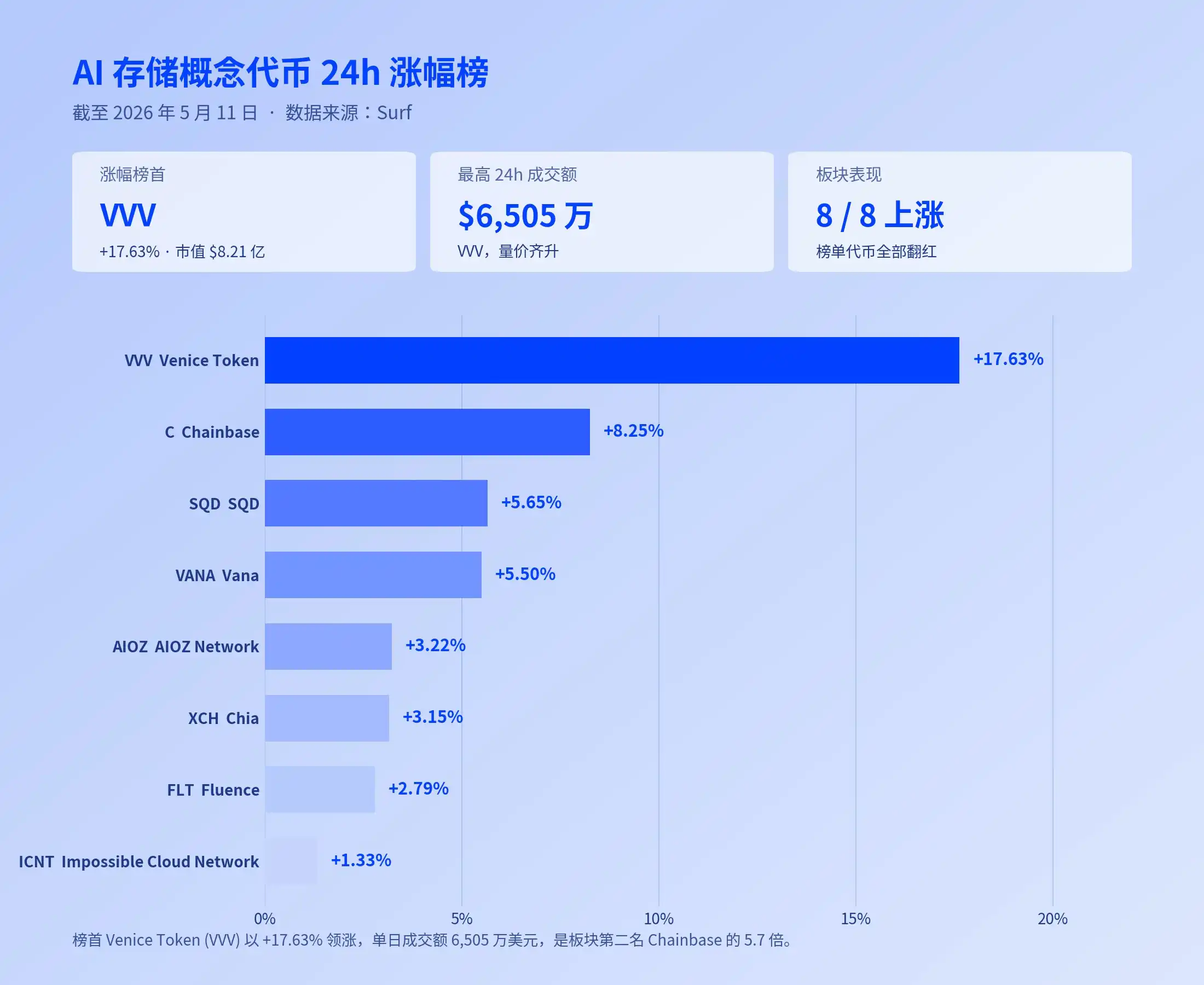
Shenchao Insight: The capital spillover effect of the US stock market's storage chip "super cycle" is recurring in the crypto market with a frequency of three times a week. On May 11, the 'AI Data Infrastructure' sector token Venice Token (VVV) surged 17.63% in a single day, leading the gains with a trading volume of $65.05 million; Chainbase, SQD, and Vana followed with gains between 5% and 8%. Meanwhile, the fuel hasn't died down on the US stock end. On May 8, SanDisk skyrocketed 16.60%, Micron Technology rose 15.49%, pushing its market cap past $842.2 billion, and accumulated a nearly 38% gain for the week. From FIL breaking out of its range on May 6, to IO soaring 69% in a single day on May 7, and VVV taking the baton this Monday, the market trend has extended from single storage leaders to the entire "AI Data + Inference Compute" infrastructure sector.
The crypto AI sector is up again today, but the narrative is quietly shifting.
If the story a week ago was "the three major storage leaders FIL, AR, and STORJ rising in tandem with US stocks SanDisk and Micron," then entering this week, the main market trend has spread from pure storage to a broader "AI infrastructure": AI inference compute (VVV), on-chain data networks (Chainbase), data indexing (SQD), user data DAOs (Vana) are taking turns leading the charge. However, the driving source behind all this remains unchanged: the still-burning storage chip frenzy in US stocks.
First Wave of Transmission: May 6, FIL/AR/STORJ Triple Rise
The first instance of follow-on gains in the crypto market occurred on May 6.
According to a BanklessTimes report on May 6, Filecoin (FIL) opened at $0.975 that day, reaching an intraday high of $1.161 and closing at $1.122, marking a single-day gain of 15.08%, breaking out of a sideways consolidation range that had lasted over three months since early February. FIL's spot trading volume for the day reached $372 million, a sharp 260.22% increase from the previous day; futures trading volume hit $816 million, up 213.63% sequentially. In the same sector, Storj gained 40% and Arweave rose 20% for the day.
Chinese crypto information channel Followin that day forwarded analyst Ao Ying's viewpoint, directly attributing this round of gains to capital spillover from US stock storage trading, stating "funds from equity market storage trading are repricing FIL." The logic chain is that AI infrastructure's consumption of storage capacity has already booked capacity through 2026; this supply-demand logic first gets priced in the US stock market, then transmits to crypto tokens pegged as "on-chain storage."
Second Wave Continuation: May 7, IO Soars 69% in a Day, DePIN Sector Follows Suit and Spreads
The market movement didn't stop after a single day. According to TradingView data cited by CoinMarketCap CMC AI, FIL rose another 15.5% on May 7, breaking through the key resistance level of $1.08 that it had failed to breach since February.
The sector's diffusion was even more dramatic, with IO surging 69% and STORJ rising another 30% on the same day. The second wave of gains indicates this is no longer a localized rally of "leaders rising alone while the long tail remains calm," but rather the DePIN (Decentralized Physical Infrastructure Networks) sector being systematically repriced by the market.
However, CoinMarketCap CMC AI also cited a bearish analysis on the same day, labeling FIL a "dead asset," citing the token's cumulative decline of 99% from its all-time high. This contradiction precisely reflects the current rift in the crypto storage sector: short-term beta-driven gains from capital spillover coexist with medium-to-long-term skepticism about business models.
Third Wave Diffusion: May 11, VVV Leads 'AI Data + Inference Compute' Gains
This Monday's rally saw the main theme shift from "pure storage" to broader "AI infrastructure."
Data shows VVV's current price is $17.83, with a market cap of $821 million and a single-day trading volume of $65.05 million, 5.7 times that of the second-ranked project in the sector, Chainbase. Ranks two through four in the sector were Chainbase (C, +8.25%), SQD (+5.65%), and Vana (VANA, +5.50%), with market caps ranging between $14 million and $54 million.
However, VVV is not strictly a storage token. According to a January 2025 report by The Block and Venice's official documentation, VVV is the native token of Venice, a decentralized AI inference platform founded by Erik Voorhees, positioned to "provide private, uncensorable inference services for AI Agents." Staking VVV allows users to proportionally share in the compute power revenue from the Venice API, without needing to pay per request.
VVV's leading gains have their own fundamental catalysts. According to a Phemex analysis on April 7, Venice permanently reduced its annual token inflation by 25% on February 10, 2026 (from 80 million to 60 million). On March 2, it surged 20% in a single day after OpenClaw announced selecting Venice as its primary inference model supplier. According to Messari data, Venice officially launched a "programmatic VVV buyback and burn" mechanism on April 15, where every Venice Pro subscription triggers a $1 on-chain token buyback and burn. CMC AI data shows that as of March, approximately 33 million VVV (42% of the initial supply) had been burned.
At this point, the crypto AI sector's story can be broken into two layers: the external factor is the spillover from the US stock storage frenzy, while the internal factor is that tokens like VVV, which have real deflation mechanisms and concrete partnership developments, are catalyzing themselves. The tokens that have delivered outsized gains in this rally almost all possess both layers of logic.
Four Genuine Storage Tokens Gained Less Than 4% Today
It's worth noting that the genuine storage projects are not among the top gainers on today's Surf list. Four traditional decentralized storage projects—AIOZ Network (+3.22%), Chia (+3.15%), Fluence (+2.79%), and Impossible Cloud Network (+1.33%)—all gained less than 4%. Last week's leaders, FIL, AR, and STORJ, don't even appear on this list.
This structural difference signals that the pure "storage beta transmission" rally might have entered its second stage. The first stage (May 6-7) was the catch-up rally of storage leaders. The second stage (this week) sees tokens with their own narrative catalysts taking the baton: VVV has its buy-and-burn mechanism, Chainbase carries the "AI data" label, while SQD and Vana belong to the "data network" concept. Capital is picking "tokens with a story" within the sector, rather than indiscriminately deploying funds.
Historically, this three-phase pattern of "leader catch-up → concept diffusion → capital cherry-picking" often signifies that a sector rally has entered its latter half. Future sustainability will depend on whether the US stock storage chip frenzy can maintain momentum. Based on the current supply-demand landscape of DRAM contract prices rising 58% to 63% and HBM capacity sold out through 2026, the story, at least from a fundamental perspective, is not over yet.