Buying BTC is Not as Good as Buying Nasdaq, and This Statement Has an Expiration Date

marsbitPublished on 2026-05-14Last updated on 2026-05-14

Abstract

The article, titled "Investing in Bitcoin Has an Expiration Date", discusses the recent narrative on social media that investing in U.S. tech stocks (like the Nasdaq 100) has been far superior to investing in Bitcoin. This sentiment is fueled by performance comparisons showing the Nasdaq 100 significantly outperforming Bitcoin over a specific five-year window starting in late 2021. However, the author argues that such comparisons are highly sensitive to the chosen timeframe. By shifting the starting point to other key market moments—like the COVID-19 bottom (March 2020), the FTX collapse bottom (November 2022), or the pre-Bitcoin ETF approval period (January 2024)—Bitcoin's returns often match or dramatically exceed those of the Nasdaq 100. The popular Reddit chart essentially cherry-picks a period that started near a Bitcoin cycle high and just before the massive AI-driven rally in tech stocks. The core difference lies in their asset structures. The Nasdaq 100, backed by corporate earnings, exhibits a steadier long-term upward trend. Bitcoin is a highly cyclical asset with extreme volatility, where returns are drastically different depending on where in its bull/bear cycle an investment is made. The article notes Bitcoin often acts like a leveraged version of the S&P 500, magnifying both gains and losses. Currently, Bitcoin is in a "cyclically undervalued zone," having corrected ~37% from its October 2025 peak while the Nasdaq hits new highs. Historically, peak narratives...

Author: Curry, TechFlow

Respected U.S. stock traders have been living quite comfortably over the past half year.

The S&P 500 and Nasdaq 100 have taken turns hitting record highs, the story of AI capital expenditure keeps getting bigger, and net account values have risen accordingly. In contrast, Bitcoin has retreated from about $126,000 in October last year to around $80,000, a drop of 37%. The feeling for coin holders can probably be summed up in two words:

Agony.

This emotional gap is fermenting into a new narrative on social media: Buying U.S. tech stocks is better than buying Bitcoin, and has been for most of the time.

In today's crypto subreddit, a post even gave this sentiment a concrete form. A user posted a comparison chart showing that over the past 5 years, the Nasdaq 100 rose by 132.8%, while Bitcoin rose by only 43.8%.

It is important to note that this chart uses the European DD/MM/YYYY date format. The actual window is from May 12, 2021, to May 12, 2026, and it is based on Euro-denominated ETFs.

The US dollar has appreciated about 18% against the Euro since 2021, further amplifying the gains of USD assets from a Euro perspective due to exchange rate effects. Converted to USD spot prices, the Nasdaq 100's gain over the same period is about 121%, and Bitcoin's is about 43%. The gap remains significant.
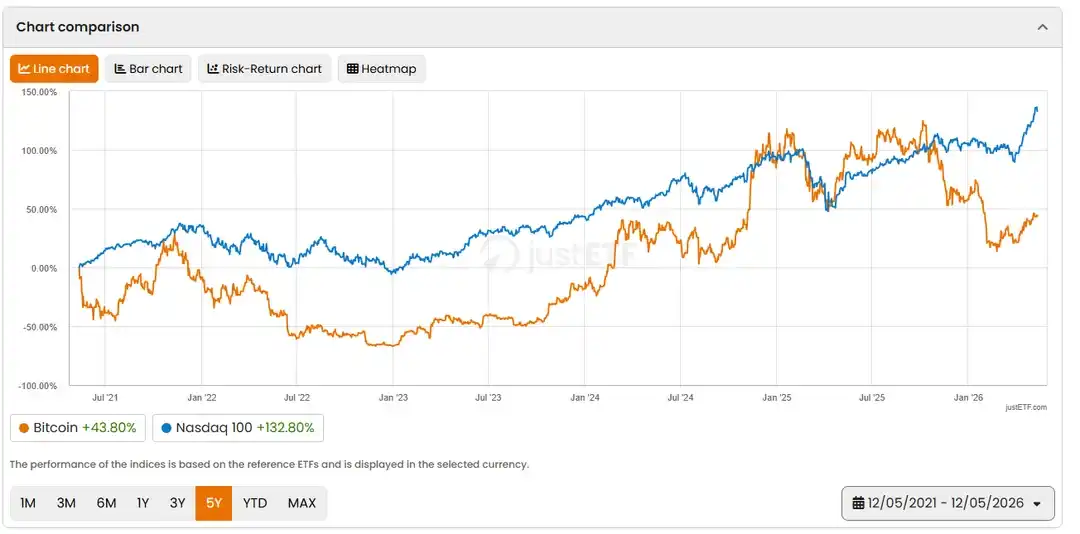
The poster's own summary is even more poignant: "What exactly is going on? I guess the answer is that AI has changed everything."

Bloomberg published a similar report in February this year with an even more merciless title: "Bitcoin's Five-Year Return Lags S&P 500, Nasdaq 100, and Gold."

Investments Have an Expiration Date

The starting point for the 5-year window in the above chart is December 2021.

At that time, Bitcoin had just retreated from its cycle high of $69,000 to around $48,000, while the Nasdaq 100 was around 16,300 points, and the AI narrative had not yet taken off. This means Bitcoin's starting line was set on a high plateau at the end of a bull market, while Nasdaq's starting line was set on the eve of the AI super rally.

Emotionally, it's understandable to promote that U.S. stocks are better than BTC; but is it really the case when looking at longer-term data? If we shift the starting point forward or backward by a few months or years, the winning relationship flips dramatically.

We conducted a simple small analysis. For the following five time windows, with the end point uniformly set as May 2026 (BTC ~$80,000, Nasdaq 100 ~29,000 points), the starting points correspond to five key nodes in crypto and macro markets:
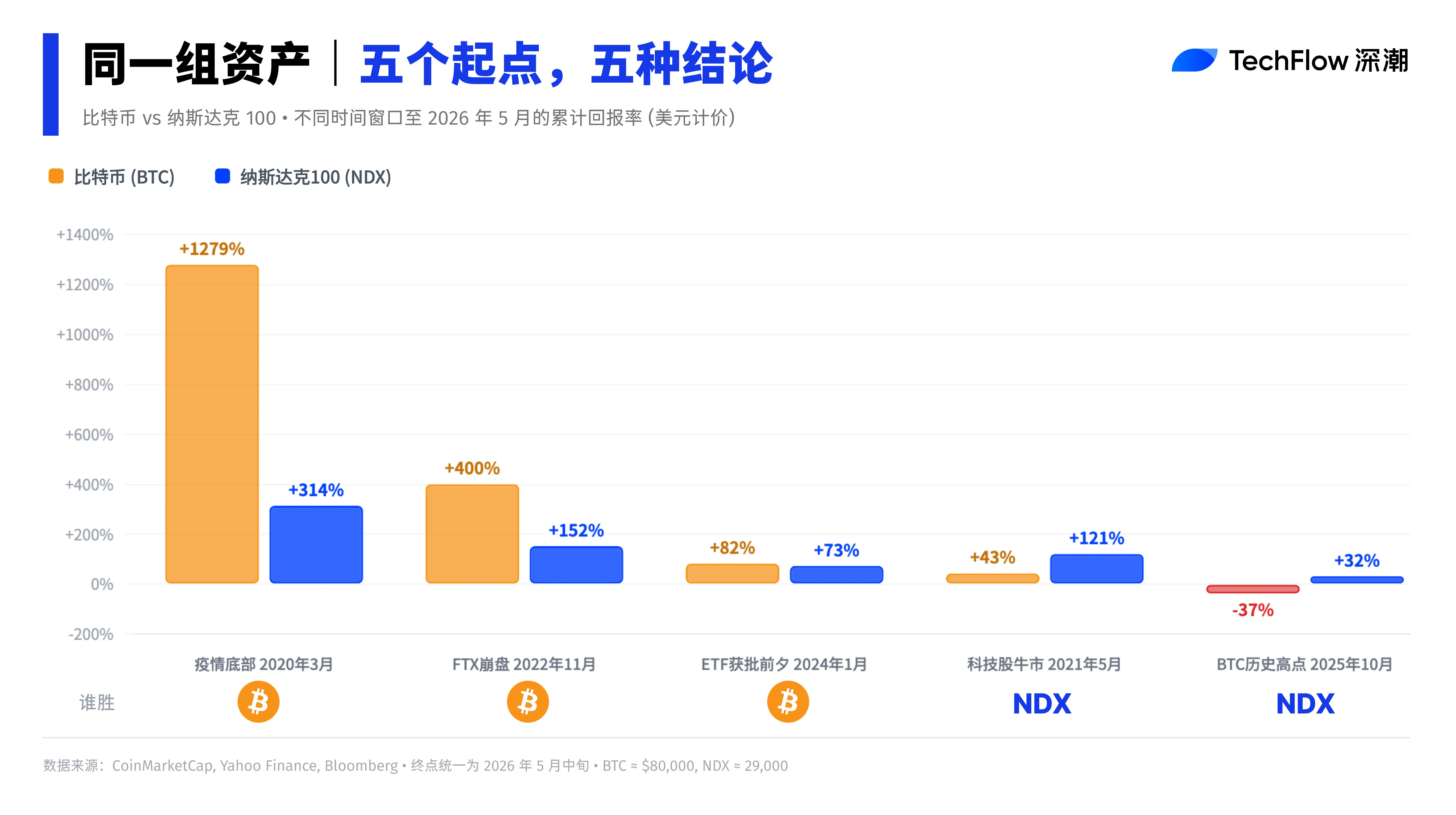
COVID-19 Bottom (March 2020) → Now:

Bitcoin rose from ~$5,800 to $80,000, a gain of ~1,279%. Nasdaq 100 rose from ~7,000 points to 29,000 points, a gain of ~314%. Bitcoin's return was over 4 times that of Nasdaq.

FTX Collapse Bottom (November 2022) → Now:

Bitcoin rose from ~$16,000 to $80,000, a gain of ~400%. Nasdaq 100 rose from ~11,500 points to 29,000 points, a gain of ~152%. Bitcoin's return was still 2.6 times that of Nasdaq.

On the Eve of Bitcoin ETF Approval (January 2024) → Now:

Bitcoin rose from ~$44,000 to $80,000, a gain of ~82%. Nasdaq 100 rose from ~16,800 points to 29,000 points, a gain of ~73%. They were basically tied, with Bitcoin slightly ahead.

This Tech Stock Cycle (May 2021) → Now:

Bitcoin rose from ~$48,000 to $80,000, a gain of ~67%. Nasdaq 100 rose from ~16,300 points to 29,000 points, a gain of ~78%. Nasdaq led.

Bitcoin's All-Time High (October 2025) → Now:

Bitcoin fell from ~$126,000 to $80,000, a loss of ~37%. Nasdaq 100 rose from ~22,000 points to 29,000 points, a gain of ~32%. Nasdaq led significantly, and the directions were completely opposite.

Therefore, the conclusion is: Out of five windows, Bitcoin wins in three, Nasdaq wins in two. The Reddit post happened to select one of the windows where Nasdaq has the biggest advantage.

Cyclical Asset vs. Trend Asset

The difference in sensitivity to the starting point between Bitcoin and the Nasdaq 100 stems from the two assets' fundamentally different volatility structures.

The Nasdaq 100 is composed of 500 large non-financial companies, backed by cash flows and earnings, exhibiting a long-term upward trend. Even after the 33% pullback in 2022, its recovery was relatively steady.

Choosing any non-extreme starting point results in long-term returns falling within a relatively stable range.

Bitcoin is a typical cyclical asset. Historically, in each bull-bear cycle, the drawdown from peak to trough has ranged between 75% and 85% (as seen in 2014, 2018, and 2022). The pullback from October 2025 to early 2026 also reached about 50%.

This intense volatility means that where the starting point falls within the cycle almost determines the final return figure.

A Nasdaq.com analysis put it more bluntly: Bitcoin is essentially a leveraged version of the S&P 500.

In 2024, the S&P rose 24%, Bitcoin rose 135%; in 2023, the S&P rose 26%, Bitcoin rose 147%; in 2022, the S&P fell 19%, Bitcoin fell 65%. Same direction, magnitude amplified 3 to 5 times.

This means that choosing a starting point that coincides exactly with a Bitcoin cycle peak for comparison, and concluding that "stocks completely beat Bitcoin," is almost statistically inevitable. The opposite is also true.

The Current BTC is Possibly in a "Cyclical Undervaluation Zone"

Setting aside the starting point game, the current market structure itself warrants attention.

After peaking in October 2025, Bitcoin underwent a typical cyclical correction. It fell to around $65,000 in February 2026, then rebounded to around $80,000, still down about 37% from its high. Meanwhile, the Nasdaq 100 repeatedly hit new highs driven by continued expansion in AI capital expenditure.

This divergence is not uncommon in history. In 2019, while Bitcoin rallied from $3,000 to $12,000, it was almost decoupled from the S&P 500. In 2022, both plummeted in sync, with correlation once soaring to 0.92. The correlation between the crypto market and U.S. stocks is dynamic and cyclical, not a fixed positive correlation.

Galaxy Digital's Head of Research, Alex Thorn, proposed an interesting perspective in December 2025:

If measured in terms of 2020 US dollar purchasing power, Bitcoin's nominal high of $126,000 never actually broke through $100,000. Cumulative inflation from 2020 to 2025 is about 24%, which introduces a systematic bias in cross-year nominal price comparisons.

At a time when Bitcoin is down 37% from its all-time high while U.S. stock indices are simultaneously hitting record highs, the narrative of "stocks outperforming Bitcoin" naturally dominates social media.

However, in the past, every time this narrative was loudest, it usually coincided with Bitcoin nearing the bottom of its cycle. After the FTX collapse in late 2022, similar "Bitcoin is dead" rhetoric was also rampant, yet Bitcoin subsequently rose from $16,000 to $126,000 over the next 18 months.

Hindsight is easy; placing bets ahead of time is hard. Arguing about which asset has higher returns has little practical meaning at the micro level. Any conclusion based on a single time window that "A is forever superior to B" cannot withstand the test of shifting the starting point.

Each era has its champion. The difficult part across all eras is timing the market and taking profits.


Related Questions

QBased on the article, why does the claim 'Buying Nasdaq is better than buying BTC' have a 'shelf life'?

ABecause the comparison outcome heavily depends on the selected starting point due to Bitcoin's extreme cyclical volatility and Nasdaq's steadier trend. Choosing a starting point near a Bitcoin cycle peak makes Nasdaq look better, while starting near a Bitcoin cycle low makes Bitcoin's returns vastly superior. The conclusion is not universally true across all timeframes.

QHow did Bitcoin's performance compare to Nasdaq 100 from the COVID-19 market bottom in March 2020 to May 2026, according to the article's data?

AFrom March 2020 to May 2026, Bitcoin rose from approximately $5,800 to $80,000, a gain of about 1,279%. The Nasdaq 100 rose from about 7,000 points to 29,000 points, a gain of about 314%. Bitcoin's return was over 4 times that of the Nasdaq 100.

QWhat is the fundamental difference in the 'volatility structure' between Bitcoin and the Nasdaq 100 as explained in the article?

AThe Nasdaq 100, backed by company cash flows and earnings, exhibits a long-term upward trend with relatively stable returns from most non-extreme starting points. Bitcoin is a typical cyclical asset with extreme volatility, experiencing drawdowns of 75-85% in past bear markets. Its final return is almost entirely determined by the cycle phase at the starting point.

QAccording to the article, what is one reason the current narrative of 'stocks outperforming Bitcoin' is so prevalent in mid-2026?

AIn mid-2026, Bitcoin is down about 37% from its October 2025 all-time high of $126,000, trading around $80,000. Meanwhile, the Nasdaq 100 is hitting new all-time highs driven by AI capital expenditure stories. This significant performance divergence makes the 'stocks are better' narrative naturally dominate social media.

QWhat historical pattern does the article suggest often occurs when the 'Bitcoin is dead' or 'stocks outperform Bitcoin' narrative is loudest?

AThe article suggests that in the past, when narratives claiming 'Bitcoin is dead' or that stocks are definitively better than Bitcoin were at their loudest (e.g., after the FTX crash in late 2022), it often coincided with Bitcoin being near a cyclical bottom region. Subsequently, Bitcoin experienced massive rallies, such as rising from $16,000 to $126,000 in the 18 months following the FTX collapse.

Related Reads

MY Group Completes Web4.0 First Stock Listing Layout, SEC Officially Discloses Form 8-K Announcement

MY Group has completed the listing layout for the "Web4.0 First Share," with the U.S. Securities and Exchange Commission (SEC) formally disclosing a Form 8-K report. According to the filing, the company's board has officially appointed Mr. Zhang Dingwen as Chief Executive Officer (CEO) and Executive Director, marking a significant upgrade in management and the entry into a new phase of its global capital market strategy. The disclosure of Form 8-K, used for reporting major corporate events, coincides with market information indicating the company is advancing several key capital market initiatives. These include a global brand system upgrade, corporate strategic restructuring, and a change of its stock ticker symbol. These moves are viewed by industry experts as signals of accelerated internationalization and enhanced global market presence. Concurrently, MY Group's proposed "Web4.0 Ecosystem" is garnering market attention. The company is integrating core capabilities across social traffic portals, global payment systems, public blockchain infrastructure, digital asset trading, and AI-powered financial systems. Analysts suggest that by closing this ecosystem loop, MY Group has the potential to become a next-generation platform merging Web2 user scale with Web3 asset frameworks and AI financial capabilities. With the management upgrade finalized, the global brand strategy launched, and the stock ticker change pending, MY Group is positioning itself as a focal point in the global technology capital market as a potential leading Web4.0 platform enterprise.

marsbit12h ago

MY Group Completes Web4.0 First Stock Listing Layout, SEC Officially Discloses Form 8-K Announcement

marsbit12h ago

Trading

Spot
Futures

Hot Articles

What is $BITCOIN

DIGITAL GOLD ($BITCOIN): A Comprehensive Analysis Introduction to DIGITAL GOLD ($BITCOIN) DIGITAL GOLD ($BITCOIN) is a blockchain-based project operating on the Solana network, which aims to combine the characteristics of traditional precious metals with the innovation of decentralized technologies. While it shares a name with Bitcoin, often referred to as “digital gold” due to its perception as a store of value, DIGITAL GOLD is a separate token designed to create a unique ecosystem within the Web3 landscape. Its goal is to position itself as a viable alternative digital asset, although specifics regarding its applications and functionalities are still developing. What is DIGITAL GOLD ($BITCOIN)? DIGITAL GOLD ($BITCOIN) is a cryptocurrency token explicitly designed for use on the Solana blockchain. In contrast to Bitcoin, which provides a widely recognized value storage role, this token appears to focus on broader applications and characteristics. Notable aspects include: Blockchain Infrastructure: The token is built on the Solana blockchain, known for its capacity to handle high-speed and low-cost transactions. Supply Dynamics: DIGITAL GOLD has a maximum supply capped at 100 quadrillion tokens (100P $BITCOIN), although details regarding its circulating supply are currently undisclosed. Utility: While precise functionalities are not explicitly outlined, there are indications that the token could be utilized for various applications, potentially involving decentralized applications (dApps) or asset tokenization strategies. Who is the Creator of DIGITAL GOLD ($BITCOIN)? At present, the identity of the creators and development team behind DIGITAL GOLD ($BITCOIN) remains unknown. This situation is typical among many innovative projects within the blockchain space, particularly those aligning with decentralized finance and meme coin phenomena. While such anonymity may foster a community-driven culture, it intensifies concerns about governance and accountability. Who are the Investors of DIGITAL GOLD ($BITCOIN)? The available information indicates that DIGITAL GOLD ($BITCOIN) does not have any known institutional backers or prominent venture capital investments. The project seems to operate on a peer-to-peer model focused on community support and adoption rather than traditional funding routes. Its activity and liquidity are primarily situated on decentralized exchanges (DEXs), such as PumpSwap, rather than established centralized trading platforms, further highlighting its grassroots approach. How DIGITAL GOLD ($BITCOIN) Works The operational mechanics of DIGITAL GOLD ($BITCOIN) can be elaborated on based on its blockchain design and network attributes: Consensus Mechanism: By leveraging Solana’s unique proof-of-history (PoH) combined with a proof-of-stake (PoS) model, the project ensures efficient transaction validation contributing to the network's high performance. Tokenomics: While specific deflationary mechanisms have not been extensively detailed, the vast maximum token supply implies that it may cater to microtransactions or niche use cases that are still to be defined. Interoperability: There exists the potential for integration with Solana’s broader ecosystem, including various decentralized finance (DeFi) platforms. However, the details regarding specific integrations remain unspecified. Timeline of Key Events Here is a timeline that highlights significant milestones concerning DIGITAL GOLD ($BITCOIN): 2023: The initial deployment of the token occurs on the Solana blockchain, marked by its contract address. 2024: DIGITAL GOLD gains visibility as it becomes available for trading on decentralized exchanges like PumpSwap, allowing users to trade it against SOL. 2025: The project witnesses sporadic trading activity and potential interest in community-led engagements, although no noteworthy partnerships or technical advancements have been documented as of yet. Critical Analysis Strengths Scalability: The underlying Solana infrastructure supports high transaction volumes, which could enhance the utility of $BITCOIN in various transaction scenarios. Accessibility: The potential low trading price per token could attract retail investors, facilitating wider participation due to fractional ownership opportunities. Risks Lack of Transparency: The absence of publicly known backers, developers, or an audit process may yield skepticism regarding the project's sustainability and trustworthiness. Market Volatility: The trading activity is heavily reliant on speculative behavior, which can result in significant price volatility and uncertainty for investors. Conclusion DIGITAL GOLD ($BITCOIN) emerges as an intriguing yet ambiguous project within the rapidly evolving Solana ecosystem. While it attempts to leverage the “digital gold” narrative, its departure from Bitcoin's established role as a store of value underscores the need for a clearer differentiation of its intended utility and governance structure. Future acceptance and adoption will likely depend on addressing the current opacity and defining its operational and economic strategies more explicitly. Note: This report encompasses synthesised information available as of October 2023, and developments may have transpired beyond the research period.

363 Total ViewsPublished 2025.05.13Updated 2025.05.13

What is $BITCOIN

Discussions

Welcome to the HTX Community. Here, you can stay informed about the latest platform developments and gain access to professional market insights. Users' opinions on the price of BTC (BTC) are presented below.

活动图片