【研报精选】下周CPI可能将决定美联储5月是否加息

投研第一线Published on 2023-04-09Last updated on 2023-04-10

Abstract

即将到来的通胀数据是美联储5月会议的最终决定因素。

尽管3月非农新增就业低于预期,但失业率出现下滑,劳动参与率提升,使市场认为美国劳动力市场仍然坚韧,对美联储5月继续加息的预期上升,交易员的注意力转向CPI。

本周五,随着非农就业数据公布,美联储最关注的两项指标——就业与通胀——其中之一表现坚韧,美债收益率全线抬升,互换协议显示美联储在5月份的下次FOMC会议上再次加息25基点的可能性约为75%。
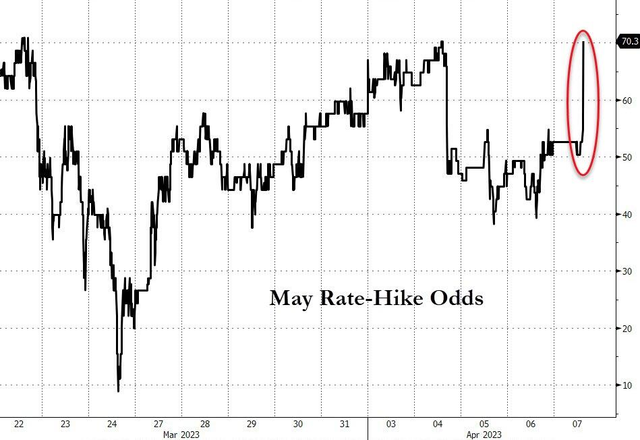
紧接着,人们现在开始关注下周的CPI数据,以评估美联储的措施是否有明显成效,以及接下来还需要什么措施。道明证券全球利率策略主管Priya Misra表示:

美国就业报告“全面走强”,将提高5月份加息25个基点的可能性。它还应该推迟降息的时间。

但市场仍将关注其他不那么滞后的数据和银行业绩。

非农就业数据公布后,市场缩减了对2023年底降息的预期,掉期表明联邦基准利率到12月底约为4.38%,而数据公布前为4.18%。

智树投资(Wisdom Tree Investments)固定收益策略主管Kevin Flanagan表示:

即将到来的美国通胀数据是美联储5月会议的最终决定因素,一致或更强劲的CPI读数将对美债市场构成挑战。

彭博社调查经济学家的预估中值显示,3月份CPI的年化率整体涨幅将从6%放缓至5.2%。相比之下,核心CPI年化预计将从5.5%升至5.6%。

未来一周还将公布包括生产者价格指数(PPI)和零售销售在内的其他关键数据,这些数据都在一定程度上反映美国通胀情况,帮助市场调整对加息的预期。

过去一个月,由于对银行体系的担忧,美国国债收益率明显走低。金融机构的动荡引发了投资者对相对安全的美国国债的抢购,并迫使市场重新思考,在通胀仍处于高位的情况下,面对衰退风险上升,美联储能在多大程度上继续保持紧缩政策。

Flanagan说:

美债市场正在告诉你他们希望走向什么方向,那就是收益率下降,但它看起来容易受到任何类型的经济数据的影响,这些数据没有告诉我们衰退即将到来。

如果通货膨胀指数持续上升,美债收益率将很难维持目前的水平。
Related Reads

Dumping US Bonds, Buying Japanese Bonds: Wall Street Prepares for 'Capital Repatriation to Japan'

Wall Street is bracing for a potential "great repatriation" of Japanese capital as yields on Japanese Government Bonds (JGBs) soar to multi-decade highs. The 10-year JGB yield recently hit 2.73%, its highest since 1997, while the 30-year yield broke 4% for the first time. This dramatic shift is causing global asset managers to reassess a long-ignored risk: that Japanese investors, who hold roughly $1 trillion in U.S. Treasury debt, could start bringing that money home. For decades, Japan's ultra-low interest rates pushed domestic insurers, pension funds, and banks to seek yield overseas, primarily in U.S. Treasuries. Now, with the Bank of Japan hiking rates and JGB yields climbing, the incentive is reversing. Firms like BlueBay Asset Management are preparing for this shift, believing new Japanese investments will be directed domestically rather than to foreign bonds. Early signs of repatriation are emerging, with record monthly inflows into Japanese sovereign bond funds in March. Some managers, like Ruffer's Matt Smith, hold yen as a hedge, anticipating that market stress could trigger a rapid acceleration of capital returning to Japan. However, analysts caution that a mass exodus hasn't begun yet. Japanese investors were still net buyers of foreign bonds over the past year. Uncertainty remains high as Japan's government fiscal plans could push JGB yields even higher, making investors hesitant to buy immediately. Furthermore, the Bank of Japan's withdrawal as a dominant bond buyer has increased market volatility. Nevertheless, the potential scale of Japanese selling poses a tangible risk to the U.S. Treasury market. As the largest foreign holder of U.S. debt, any sustained shift by Japanese institutions could materially impact supply and demand dynamics, pushing U.S. yields higher. Wall Street's current positioning is a forward-looking bet on this logic becoming increasingly compelling as Japanese yields continue to rise.

marsbit24m ago

Dumping US Bonds, Buying Japanese Bonds: Wall Street Prepares for 'Capital Repatriation to Japan'

marsbit24m ago

How Did Institutions Adjust Their Crypto Asset Holdings in Q1? Who Increased and Who Exited?

The Q1 2026 13F filings reveal a sharply divided picture of institutional activity in crypto assets. Sovereign wealth funds and bank capital increased exposure, while major endowment funds notably de-risked. The most significant buying came from the Abu Dhabi sovereign wealth fund Mubadala, which expanded its position in the iShares Bitcoin Trust (IBIT). JPMorgan Chase dramatically increased its IBIT exposure by 174%, with other global banks like RBC, Scotiabank, and Barclays also adding to Bitcoin ETF holdings, while using options for asymmetric protection. Conversely, the Harvard Management Company (Harvard University's endowment), once a major academic holder, cut its IBIT position by 43% and fully exited a BlackRock Ethereum ETF. The reallocated capital flowed into traditional assets like TSMC, Microsoft, and gold. Other Ivy League endowments showed varied strategies: Brown and Dartmouth maintained Bitcoin positions, with Dartmouth making a nuanced shift by moving Ethereum exposure to a staking ETF and adding a Solana staking ETF to capture yield. Hedge fund Jane Street significantly reduced Bitcoin ETF holdings, locking in profits, while Wells Fargo increased its Ethereum stake. Overall, institutions are deploying traditional capital market tactics—buying, selling, hedging, and rotating—within crypto via spot ETFs. The Q2 reports will be crucial to determine if Harvard's retreat is an outlier or the start of a broader trend among endowments.

marsbit56m ago

How Did Institutions Adjust Their Crypto Asset Holdings in Q1? Who Increased and Who Exited?

marsbit56m ago

Blockchain Capital Partner: Most People Have a Narrow Understanding of the On-Chain Economy

Author Spencer Bogart, a partner at Blockchain Capital, argues that most people have a narrow view of the on-chain economy, seeing it primarily as a faster, cheaper version of existing financial systems. While this represents a significant opportunity, he believes it's only a small part of the story. Bogart compares the current state of crypto to the early internet, where email was the obvious "faster mail" application. The truly transformative categories—like search, social media, and cloud computing—were entirely new and unimaginable beforehand. Similarly, the most profound innovations in crypto will not be incremental improvements but entirely new categories enabled by the core properties of public blockchains: atomic execution, shared global state, programmable custody, and composability. He cites the "flash loan" as a prime example of a "new verb"—a financial action structurally impossible before programmable assets and atomic settlement. It allows for uncollateralized, trustless borrowing of any size, provided repayment occurs within the same transaction, enabling novel strategies like arbitrage and collateral swaps. Bogart admits the difficulty in precisely predicting these future innovations, as human imagination tends to extrapolate from the past. He posits that the most exciting applications in ten years will be things that don't exist today and have no precedent—products only possible in a global, composable, always-on environment with programmable assets. While the exploration of this vast design space will involve many failures, the potential for transformative, category-defining breakthroughs is what makes the next decade so promising.

链捕手1h ago

Blockchain Capital Partner: Most People Have a Narrow Understanding of the On-Chain Economy

链捕手1h ago

Trading

Spot
Futures
活动图片